2021 HYUNDAI SONATA light system
[x] Cancel search: light systemPage 29 of 546
Safety System
3. Seats & Safety System
3
Important Safety Precautions ....................................................................... 3 -2Always Wear Your Seat Belt ........................................................................\
.............3 -2
Restrain All Children ........................................................................\
......................... 3-2
Air Bag Hazards
........................................................................\
................................ 3-2
Driver Distraction
........................................................................\
............................. 3-2
Control Your Speed
........................................................................\
.......................... 3-2
Keep Your Vehicle in Safe Condition
....................................................................... 3
-2
Seats ........................................................................\
.......................................3 -3Safety Precautions ........................................................................\
...........................3-4
F ront Seats ........................................................................\
........................................ 3-5
Rear Seats
........................................................................\
........................................ 3-10
Head Restraints
........................................................................\
................................ 3-11
Seat Warmers and Air Ventilation Seats
................................................................3-15
Seat Belts ........................................................................\
............................... 3- 19Seat Belt Safety Precautions ........................................................................\
..........3- 19
Seat Belt Warning Light ........................................................................\
................. 3-20
Seat Belt Restraint System
........................................................................\
............. 3-21
Additional Seat Belt Safety Precautions
...............................................................3-26
Care of Seat Belts
........................................................................\
........................... 3-28
Child Restraint System (CRS) ......................................................................3- 29Children Always in the Rear ........................................................................\
...........3- 29
Selecting a Child Restraint System (CRS) .............................................................3-30
Installing a Child Restraint System (CRS)
..............................................................3-31
Air Bag - Advanced Supplemental Restraint System ................................3- 37Where Are the Air Bags? ........................................................................\
................3- 39
How Does the Air Bag System Operate? ...............................................................3-42
What to Expect After an Air Bag Inflates
..............................................................3-46
Occupant Classification System (OCS)
................................................................. 3-47
Why Didn’t My Air Bag Go Off in a Collision?
.......................................................3-52
SRS Care
........................................................................\
......................................... 3-56
Additional Safety Precautions
........................................................................\
....... 3-57
Air Bag Warning Labels
........................................................................\
.................. 3-57
This chapter provides you with important information about how to protect yourself and your
passengers. It explains how to properly use your seats and seat belts, and how your air bags work.
Additionally, this chapter explains how to properly restrain infants and children in your vehicle.
Page 34 of 546

3-6
ODN8039003
Seatback angle
To recline the seatback:
1.
L
ean forward slightly and lift up the
seatback lever.
2.
Car
efully lean back on the seat and
adjust the seatback to the position
you desire.
3.
R
elease the lever and make sure the
seatback is locked in place. (The lever
MUST return to its original position for
the seatback to lock.)
Reclining seatback
Sitting in a reclined position when the
vehicle is in motion can be dangerous.
Even when buckled up, the protection of
your restraint system (seat belts and air
bags) is greatly reduced by reclining your
seatback.
WARNING
NEVER ride with a reclined seatback
when the vehicle is moving.
Riding with a reclined seatback
increases your chance of serious or fatal
injuries in the event of a collision or
sudden stop.
Drivers and passengers should ALWAYS
sit well back in their seats, properly
belted, and with the seatbacks upright. Seat belts must be snug against your
hips and chest to work properly. When
the seatback is reclined, the shoulder
belt cannot do its job because it will not
be snug against your chest. Instead,
it will be in front of you. During an
accident, you could be thrown into the
seat belt, causing neck or other injuries.
The more the seatback is reclined,
the greater chance the passenger’s
hips will slide under the lap belt or the
passenger’s neck will strike the shoulder
belt.
ODN8039004
Seat cushion height
To change the height of the seat cushion:
•
Push down on the lever several times,
to lower the seat cushion.
• Pull up on the lever several times, to
raise the seat cushion.
Seats & Safety System
Page 48 of 546
3-20
Seat Belt Warning Light
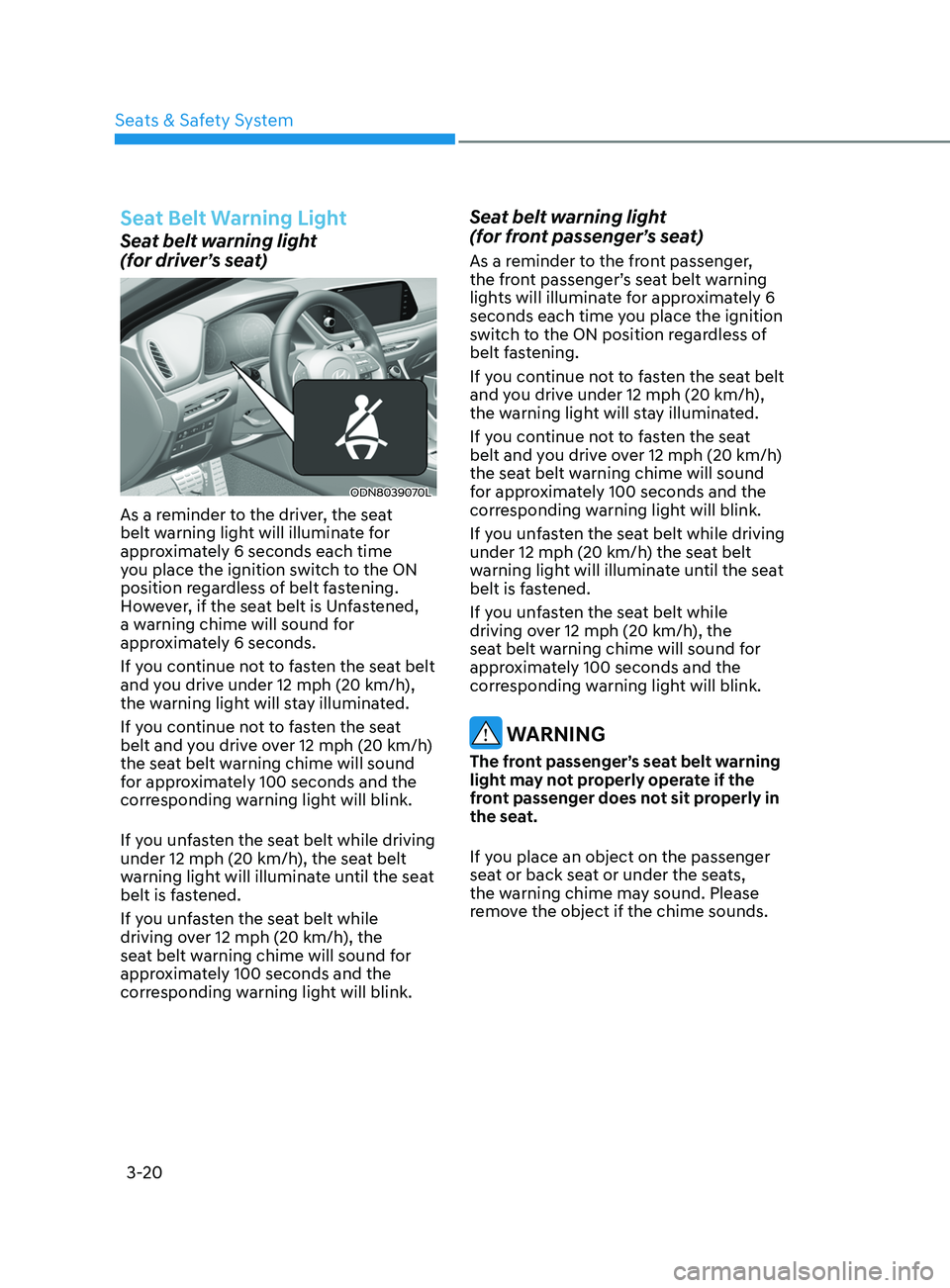
Seat belt warning light
(for driver’s seat)
ODN8039070L
As a reminder to the driver, the seat
belt warning light will illuminate for
approximately 6 seconds each time
you place the ignition switch to the ON
position regardless of belt fastening.
However, if the seat belt is Unfastened,
a warning chime will sound for
approximately 6 seconds.
If you continue not to fasten the seat belt
and you drive under 12 mph (20 km/h),
the warning light will stay illuminated.
If you continue not to fasten the seat
belt and you drive over 12 mph (20 km/h)
the seat belt warning chime will sound
for approximately 100 seconds and the
corresponding warning light will blink.
If you unfasten the seat belt while driving
under 12 mph (20 km/h), the seat belt
warning light will illuminate until the seat
belt is fastened.
If you unfasten the seat belt while
driving over 12 mph (20 km/h), the
seat belt warning chime will sound for
approximately 100 seconds and the
corresponding warning light will blink.
Seat belt warning light
(for front passenger’s seat)
As a reminder to the front passenger,
the front passenger’s seat belt warning
lights will illuminate for approximately 6
seconds each time you place the ignition
switch to the ON position regardless of
belt fastening.
If you continue not to fasten the seat belt
and you drive under 12 mph (20 km/h),
the warning light will stay illuminated.
If you continue not to fasten the seat
belt and you drive over 12 mph (20 km/h)
the seat belt warning chime will sound
for approximately 100 seconds and the
corresponding warning light will blink.
If you unfasten the seat belt while driving
under 12 mph (20 km/h) the seat belt
warning light will illuminate until the seat
belt is fastened.
If you unfasten the seat belt while
driving over 12 mph (20 km/h), the
seat belt warning chime will sound for
approximately 100 seconds and the
corresponding warning light will blink.
WARNING
The front passenger’s seat belt warning
light may not properly operate if the
front passenger does not sit properly in
the seat.
If you place an object on the passenger
seat or back seat or under the seats,
the warning chime may sound. Please
remove the object if the chime sounds.
Seats & Safety System
Page 53 of 546
03
3-25
OHI038175L
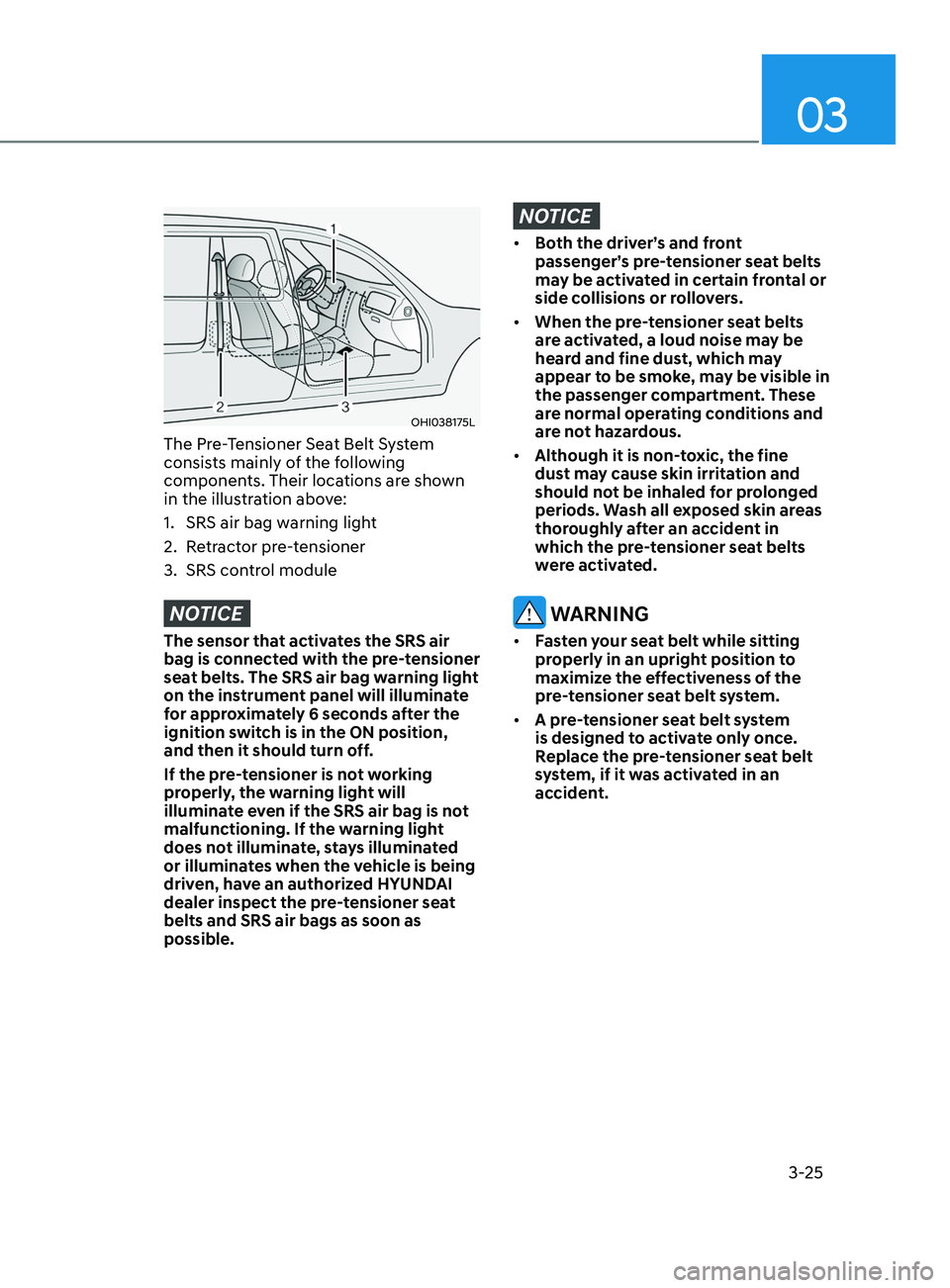
The Pre-Tensioner Seat Belt System
consists mainly of the following
components. Their locations are shown
in the illustration above:
1.
SRS air bag w
arning light
2.
R
etractor pre-tensioner
3.
SRS con
trol module
NOTICE
The sensor that activates the SRS air
bag is connected with the pre-tensioner
seat belts. The SRS air bag warning light
on the instrument panel will illuminate
for approximately 6 seconds after the
ignition switch is in the ON position,
and then it should turn off.
If the pre-tensioner is not working
properly, the warning light will
illuminate even if the SRS air bag is not
malfunctioning. If the warning light
does not illuminate, stays illuminated
or illuminates when the vehicle is being
driven, have an authorized HYUNDAI
dealer inspect the pre-tensioner seat
belts and SRS air bags as soon as
possible.
NOTICE
• Both the driver’s and front
passenger’s pre-tensioner seat belts
may be activated in certain frontal or
side collisions or rollovers.
• When the pre-tensioner seat belts
are activated, a loud noise may be
heard and fine dust, which may
appear to be smoke, may be visible in
the passenger compartment. These
are normal operating conditions and
are not hazardous.
• Although it is non-toxic, the fine
dust may cause skin irritation and
should not be inhaled for prolonged
periods. Wash all exposed skin areas
thoroughly after an accident in
which the pre-tensioner seat belts
were activated.
WARNING
• Fasten your seat belt while sitting
properly in an upright position to
maximize the effectiveness of the
pre-tensioner seat belt system.
• A pre-tensioner seat belt system
is designed to activate only once.
Replace the pre-tensioner seat belt
system, if it was activated in an
accident.
Page 55 of 546

03
3-27
Larger children
Children under age 13 and who are too
large for a booster seat must always
occupy the rear seat and use the
available lap/shoulder belts. A seat belt
should lie across the upper thighs and
be snug across the shoulder and chest
to restrain the child safely. Check belt fit
periodically. Children are afforded the
most safety in the event of an accident
when they are restrained by a proper
restraint system and/or seat belts in the
rear seat. Always have the LATCH system
inspected by your authorized HYUNDAI
dealer after an accident. An accident can
damage the LATCH system and may not
properly secure the child restraint.
If a larger child over age 13 must be
seated in the front seat, the child must
be securely restrained by the available
lap/shoulder belt and the seat should be
placed in the rearmost position.
If the shoulder belt portion slightly
touches the child’s neck or face, try
placing the child closer to the center
of the vehicle. If the shoulder belt still
touches their face or neck, they need to
be returned to an appropriate booster
seat in the rear seat.
WARNING
• Always make sure children are
wearing their seat belts and that they
are properly adjusted before driving.
• NEVER allow the shoulder belt to
contact the child’s neck or face.
• Do not allow more than one child to
use a single seat belt.
Transporting an injured person
A seat belt should be used when an
injured person is being transported.
Consult a physician for specific
recommendations.
One person per belt
Two people (including children) should
never attempt to use a single seat belt.
This could increase the severity of
injuries in case of an accident.
Do not lie down
Sitting in a reclined position when the
vehicle is in motion can be dangerous.
Even when buckled up, the protections
of your restraint system (seat belts and
air bags) is greatly reduced by reclining
your seatback.
To reduce the chance of injuries in the
event of an accident and to achieve the
maximum effectiveness of the restraint
system, all passengers should be sitting
up and the front and rear seats should
be in an upright position when the car is
moving.
A seat belt cannot provide proper
protection if the person is lying down in
the rear seat or if the front or rear seats
are in a reclined position.
WARNING
• NEVER ride with a reclined seatback
when the vehicle is moving.
• Riding with a reclined seatback
increases your chance of serious
or fatal injuries in the event of a
collision or sudden stop.
• Drivers and passengers should
always sit well back in their seats,
properly belted, and with the
seatbacks upright.
Page 70 of 546
3-42
WARNING
To reduce the risk of serious injury or
death from an inflating curtain air bag,
take the following precautions:
• All seat occupants must wear
seat belts at all times to help keep
occupants positioned properly.
• Properly secure child restraints as far
away from the door as possible.
• Do not place any objects over the air
bag. Also, do not attach any objects
around the area the air bag inflates
such as the door, side door glass,
front and rear pillar, roof side rail.
• Do not hang other objects except
clothes, especially hard or breakable
objects. In an accident, it may cause
vehicle damage or personal injury.
• Do not allow passengers to lean their
heads or bodies onto doors, put their
arms on the doors, stretch their arms
out of the window, or place objects
between the doors and seats.
• Do not open or repair the side curtain
air bags.
How Does the Air Bag System
Operate?
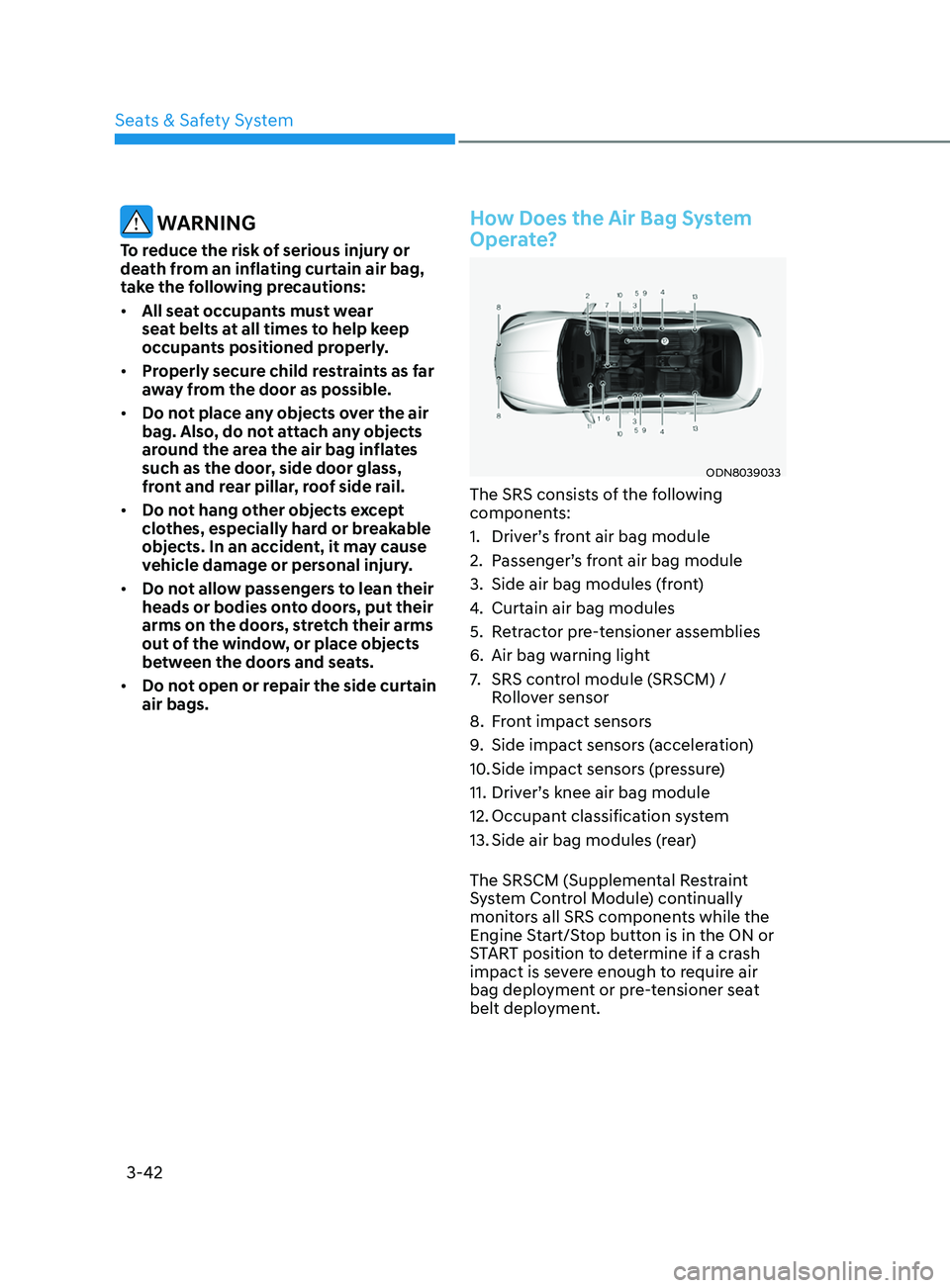
ODN8039033
The SRS consists of the following
components:
1.
Driv
er’s front air bag module
2.
P
assenger’s front air bag module
3.
Side air bag modules (
front)
4.
Curtain air bag modules
5.
R
etractor pre-tensioner assemblies
6.
Air bag w
arning light
7.
SRS con
trol module (SRSCM) /
Rollover sensor
8.
F
ront impact sensors
9.
Side impact sensor
s (acceleration)
10.
Side impact sensor
s (pressure)
11.
Driv
er’s knee air bag module
12.
Occupan
t classification system
13.
Side air bag modules (
rear)
The SRSCM (Supplemental Restraint
System Control Module) continually
monitors all SRS components while the
Engine Start/Stop button is in the ON or
START position to determine if a crash
impact is severe enough to require air
bag deployment or pre-tensioner seat
belt deployment.
Seats & Safety System
Page 71 of 546
03
3-43
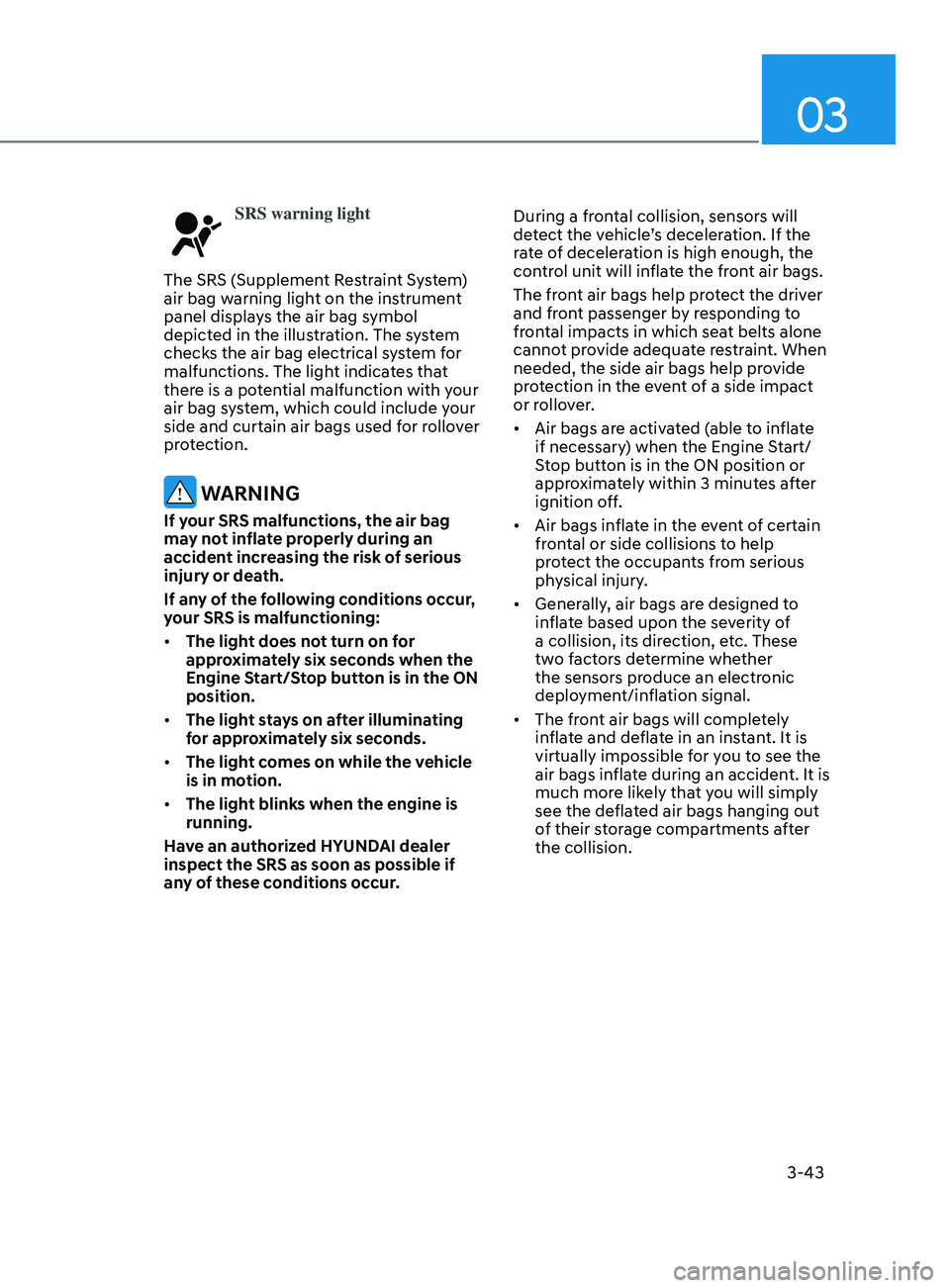
SRS warning light
The SRS (Supplement Restraint System)
air bag warning light on the instrument
panel displays the air bag symbol
depicted in the illustration. The system
checks the air bag electrical system for
malfunctions. The light indicates that
there is a potential malfunction with your
air bag system, which could include your
side and curtain air bags used for rollover
protection.
WARNING
If your SRS malfunctions, the air bag
may not inflate properly during an
accident increasing the risk of serious
injury or death.
If any of the following conditions occur,
your SRS is malfunctioning:
• The light does not turn on for
approximately six seconds when the
Engine Start/Stop button is in the ON
position.
• The light stays on after illuminating
for approximately six seconds.
• The light comes on while the vehicle
is in motion.
• The light blinks when the engine is
running.
Have an authorized HYUNDAI dealer
inspect the SRS as soon as possible if
any of these conditions occur. During a frontal collision, sensors will
detect the vehicle’s deceleration. If the
rate of deceleration is high enough, the
control unit will inflate the front air bags.
The front air bags help protect the driver
and front passenger by responding to
frontal impacts in which seat belts alone
cannot provide adequate restraint. When
needed, the side air bags help provide
protection in the event of a side impact
or rollover.
•
Air bags are activated (able to inflate
if necessary) when the Engine Start/
Stop button is in the ON position or
approximately within 3 minutes after
ignition off.
• Air bags inflate in the event of certain
frontal or side collisions to help
protect the occupants from serious
physical injury.
• Generally, air bags are designed to
inflate based upon the severity of
a collision, its direction, etc. These
two factors determine whether
the sensors produce an electronic
deployment/inflation signal.
• The front air bags will completely
inflate and deflate in an instant. It is
virtually impossible for you to see the
air bags inflate during an accident. It is
much more likely that you will simply
see the deflated air bags hanging out
of their storage compartments after
the collision.
Page 75 of 546
03
3-47
Occupant Classification System
(OCS)
ODN8A039038
Your vehicle is equipped with an
Occupant Classification System (OCS) in
the front passenger’s seat.
Main components of the Occupant
Classification System
• A detection device located within the
front passenger seat cushion.
• Electronic system to determine
whether the passenger air bag
systems should be activated or
deactivated.
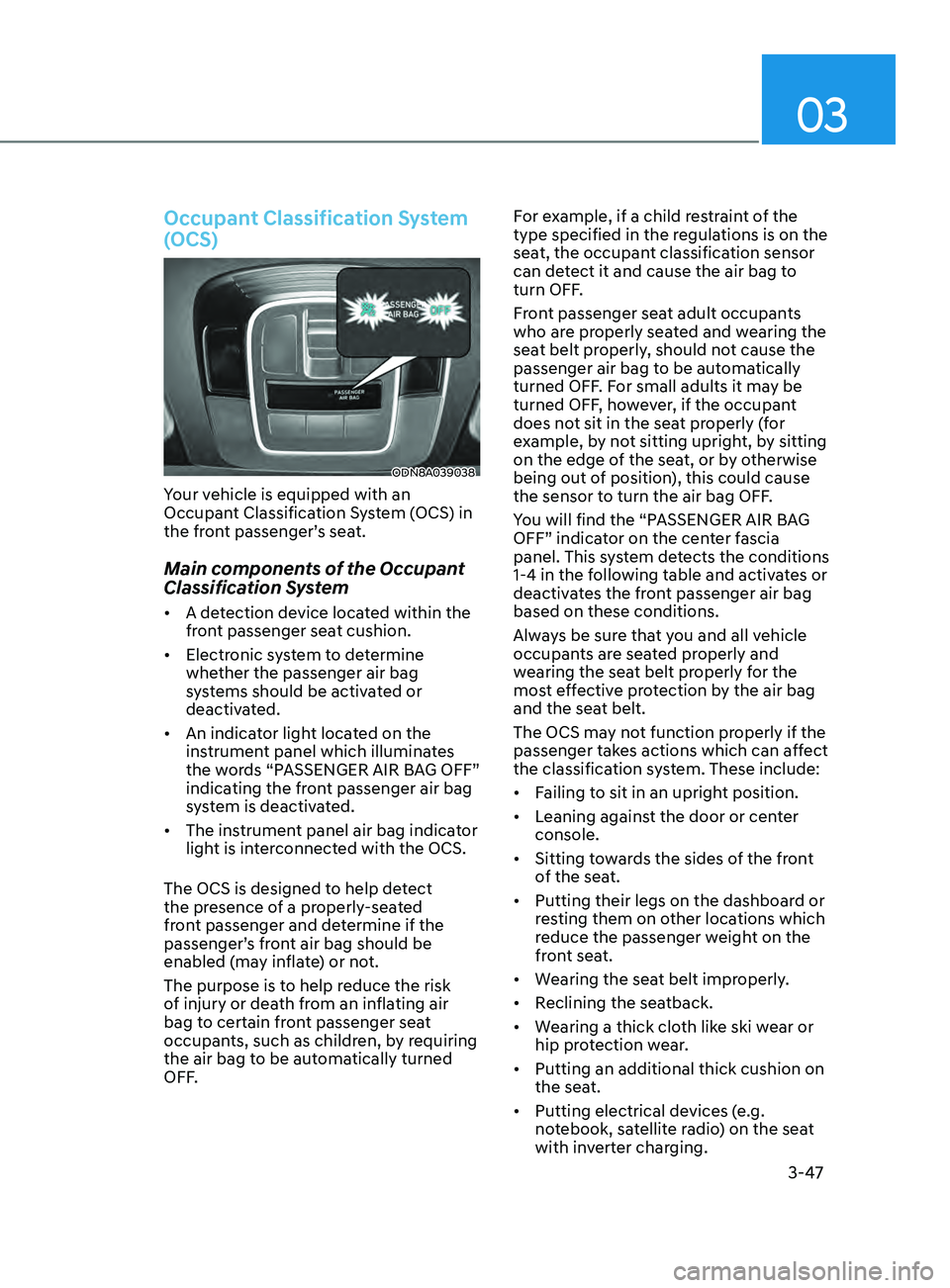
• An indicator light located on the
instrument panel which illuminates
the words “PASSENGER AIR BAG OFF”
indicating the front passenger air bag
system is deactivated.
• The instrument panel air bag indicator
light is interconnected with the OCS.
The OCS is designed to help detect
the presence of a properly-seated
front passenger and determine if the
passenger’s front air bag should be
enabled (may inflate) or not.
The purpose is to help reduce the risk
of injury or death from an inflating air
bag to certain front passenger seat
occupants, such as children, by requiring
the air bag to be automatically turned
OFF. For example, if a child restraint of the
type specified in the regulations is on the
seat, the occupant classification sensor
can detect it and cause the air bag to
turn OFF.
Front passenger seat adult occupants
who are properly seated and wearing the
seat belt properly, should not cause the
passenger air bag to be automatically
turned OFF. For small adults it may be
turned OFF, however, if the occupant
does not sit in the seat properly (for
example, by not sitting upright, by sitting
on the edge of the seat, or by otherwise
being out of position), this could cause
the sensor to turn the air bag OFF.
You will find the “PASSENGER AIR BAG
OFF” indicator on the center fascia
panel. This system detects the conditions
1-4 in the following table and activates or
deactivates the front passenger air bag
based on these conditions.
Always be sure that you and all vehicle
occupants are seated properly and
wearing the seat belt properly for the
most effective protection by the air bag
and the seat belt.
The OCS may not function properly if the
passenger takes actions which can affect
the classification system. These include:
•
Failing to sit in an upright position.
• Leaning against the door or center
console.
• Sitting towards the sides of the front
of the seat.
• Putting their legs on the dashboard or
resting them on other locations which
reduce the passenger weight on the
front seat.
• Wearing the seat belt improperly.
• Reclining the seatback.
• Wearing a thick cloth like ski wear or
hip protection wear.
• Putting an additional thick cushion on
the seat.
• Putting electrical devices (e.g.
notebook, satellite radio) on the seat
with inverter charging.