2021 HYUNDAI SONATA check auto
[x] Cancel search: check autoPage 463 of 546

08
8-9
Normal Maintenanc e Schedule (Smartstream G1.6 T-GDi) (CONT)
MAINTENANCE INTERVALS
MAINTENANCE
ITEM Months 12 24 36 48 60 72 84 96 108 120 132 144 156
Miles×1,000 8 16 24 32 40 48 56 64 72 80 88 96 104 Km×1,000 13 26 39 52 65 78 91 104 117 130 143 156 169
Battery condition I I I I I I I I I I I I I
Brake lines, hoses and connections I I I I I I I I I I I I I
Disc brakes and pads I I I I I I I I I I I I I
Driveshaft and boots I I I I I I I I I I I I I
Suspension mounting bolts I I I I I I I I I I I I I
Air conditioner refrigerant I I I I I I I I I I I I I
Air conditioner compressor I I I I I I I I I I I I I
Exhaust pipe and muffler I I I I I I I I I I I I I
Automatic transmission fluid No check, No service requiredR: Replace or change.
I : Inspect and if necessary, adjust, correct, clean or replace.
Page 467 of 546
08
8-13
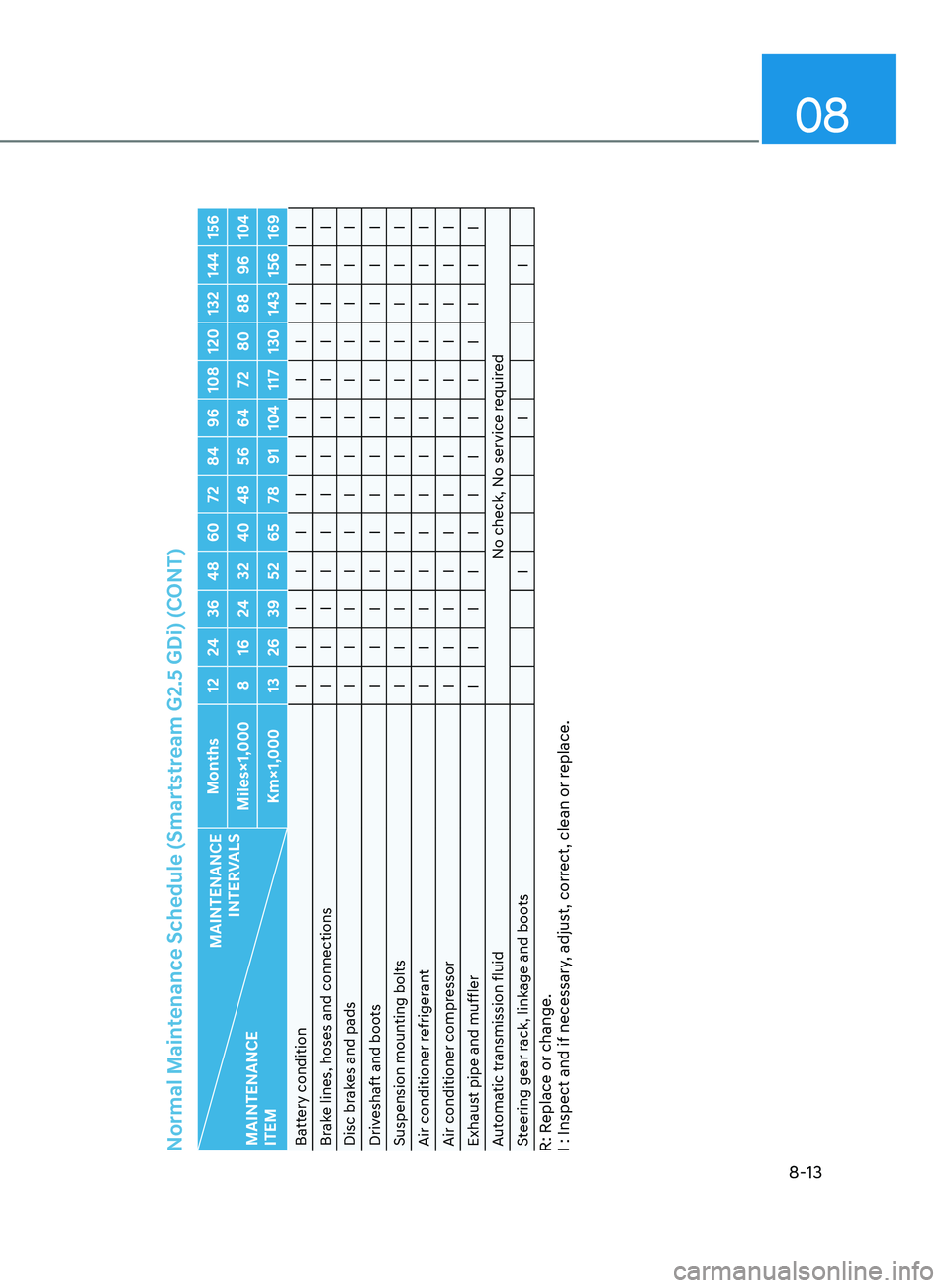
Normal Maintenance Schedule (Smartstream G2.5 GDi) (CONT)
MAINTENANCE INTERVALS
MAINTENANCE
ITEM Months 12 24 36 48 60 72 84 96 108 120 132 144 156
Miles×1,000 8 16 24 32 40 48 56 64 72 80 88 96 104 Km×1,000 13 26 39 52 65 78 91 104 117 130 143 156 169
Battery condition I I I I I I I I I I I I I
Brake lines, hoses and connections I I I I I I I I I I I I I
Disc brakes and pads I I I I I I I I I I I I I
Driveshaft and boots I I I I I I I I I I I I I
Suspension mounting bolts I I I I I I I I I I I I I
Air conditioner refrigerant I I I I I I I I I I I I I
Air conditioner compressor I I I I I I I I I I I I I
Exhaust pipe and muffler I I I I I I I I I I I I I
Automatic transmission fluid No check, No service required
Steering gear rack, linkage and boots IIIR: Replace or change.
I : Inspect and if necessary, adjust, correct, clean or replace.
Page 471 of 546
08
8-17
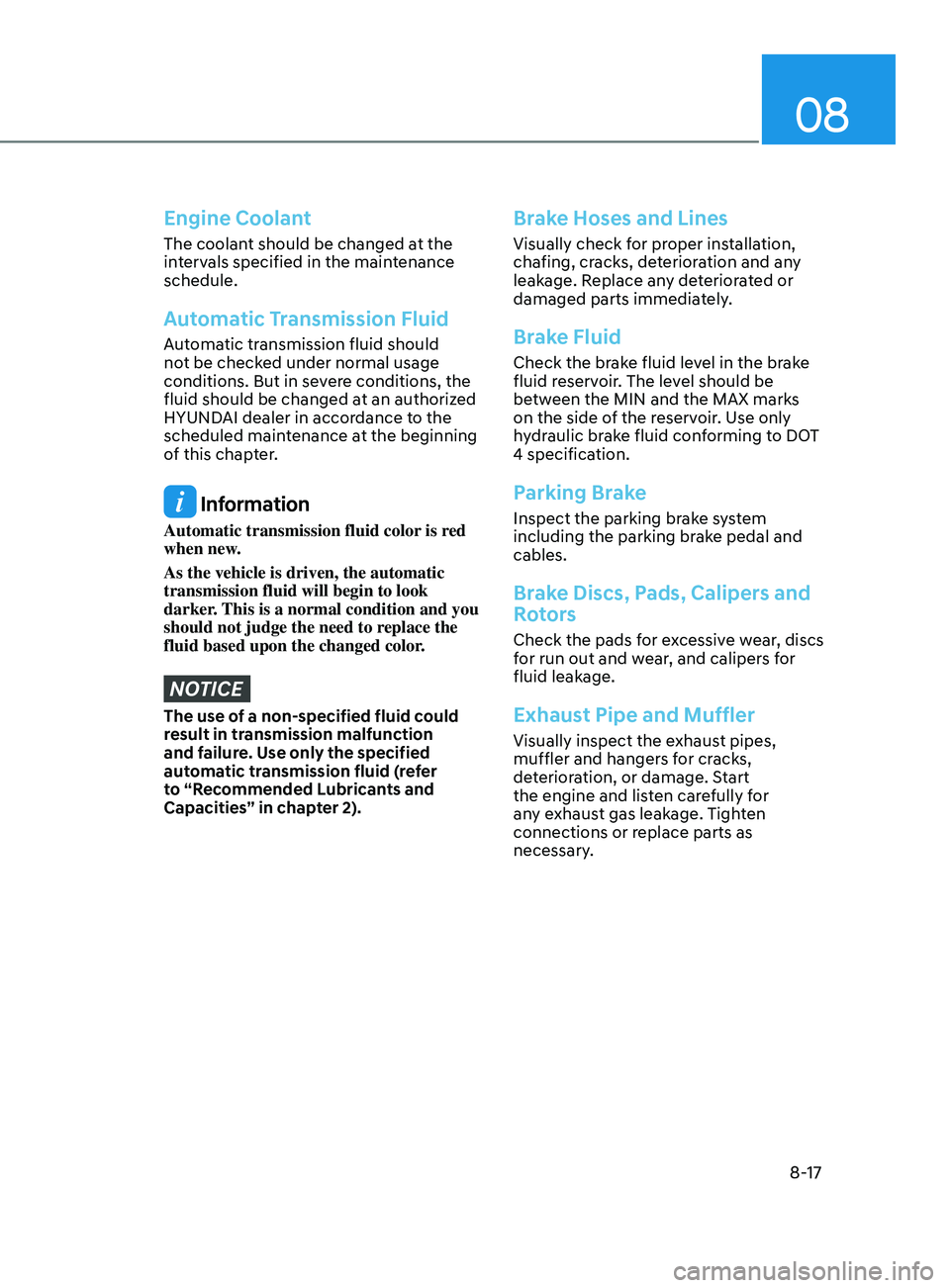
Engine Coolant
The coolant should be changed at the
intervals specified in the maintenance
schedule.
Automatic Transmission Fluid
Automatic transmission fluid should
not be checked under normal usage
conditions. But in severe conditions, the
fluid should be changed at an authorized
HYUNDAI dealer in accordance to the
scheduled maintenance at the beginning
of this chapter.
Information
Automatic transmission fluid color is red
when new.
As the vehicle is driven, the automatic
transmission fluid will begin to look
darker. This is a normal condition and you
should not judge the need to replace the
fluid based upon the changed color.
NOTICE
The use of a non-specified fluid could
result in transmission malfunction
and failure. Use only the specified
automatic transmission fluid (refer
to “Recommended Lubricants and
Capacities” in chapter 2).
Brake Hoses and Lines
Visually check for proper installation,
chafing, cracks, deterioration and any
leakage. Replace any deteriorated or
damaged parts immediately.
Brake Fluid
Check the brake fluid level in the brake
fluid reservoir. The level should be
between the MIN and the MAX marks
on the side of the reservoir. Use only
hydraulic brake fluid conforming to DOT
4 specification.
Parking Brake
Inspect the parking brake system
including the parking brake pedal and
cables.
Brake Discs, Pads, Calipers and
Rotors
Check the pads for excessive wear, discs
for run out and wear, and calipers for
fluid leakage.
Exhaust Pipe and Muffler
Visually inspect the exhaust pipes,
muffler and hangers for cracks,
deterioration, or damage. Start
the engine and listen carefully for
any exhaust gas leakage. Tighten
connections or replace parts as
necessary.
Page 524 of 546
Maintenance
8-70
1. Crankcase Emission Control System
The positive crankcase ventilation system
is employed to prevent air pollution
caused by blow-by gases being emitted
from the crankcase. This system supplies
fresh filtered air to the crankcase through
the air intake hose. Inside the crankcase,
the fresh air mixes with blow-by gases,
which then pass through the PCV valve
into the induction system.
2. Evaporative Emission Control System Including Onboard
Refueling Vapor Recovery
(ORVR)
The Evaporative Emission Control System
is designed to prevent fuel vapors from
escaping into the atmosphere. The
ORVR system is designed to allow the
vapors from the fuel tank to be loaded
into a canister while refueling at the gas
station, preventing the escape of fuel
vapors into the atmosphere.
Canister
Fuel vapors generated inside the fuel
tank are absorbed and stored in the
onboard canister. When the engine is
running, the fuel vapors absorbed in the
canister are drawn into the surge tank
through the purge control solenoid valve.
Purge Control Solenoid Valve (PCSV)
The purge control solenoid valve
is controlled by the Engine Control
Module (ECM); when the engine coolant
temperature is low during idling, the
PCSV closes so that evaporated fuel
is not taken into the engine. After the
engine warms-up during ordinary
driving, the PCSV opens to introduce
evaporated fuel to the engine.
3. Exhaust Emission Control System
The Exhaust Emission Control System is
a highly effective system which controls
exhaust emissions while maintaining
good vehicle performance.
When the engine starts or fails to start,
excessive attempts to restart the engine
may cause damage to the emission
system.
Engine exhaust (carbon monoxide)
precautions
• Carbon monoxide can be present
with other exhaust fumes. If you smell
exhaust fumes of any kind in your
vehicle, drive with all the windows
fully open. Have your vehicle checked
and repaired immediately.
WARNING
Engine exhaust gases contain carbon
monoxide (CO). Though colorless and
odorless, it is dangerous and could be
lethal if inhaled. Follow the instructions
on this page to avoid CO poisoning.
WARNING
CALIFORNIA PROPOSITION 65
WARNING
Engine exhaust and a wide variety of
automobile components and parts,
including components found in the
interior furnishings in a vehicle, contain
or emit chemicals known to the State
of California to cause cancer and
birth defects and reproductive harm.
In addition, certain fluids contained
in vehicles and certain products of
component wear contain or emit
chemicals known to the State of
California to cause cancer and birth
defects or other reproductive harm.
Page 544 of 546

IndexI-16
Tires and wheels ........................................................................\
.................. 2-9, 8-34
Tire care
........................................................................\
................................... 8-34
Recommended cold tire inflation pressures
....................................................8-34
Check tire inflation pressure
........................................................................\
... 8-35
Tire rotation
........................................................................\
............................. 8-36
Wheel alignment and tire balance
................................................................... 8-37
Tire replacement
........................................................................\
...................... 8-38
Wheel replacement
........................................................................\
.................. 8-39
Tire maintenance
........................................................................\
..................... 8-39
Tire traction
........................................................................\
............................. 8-39
Tire sidewall labeling
........................................................................\
.............. 8-39
Tire terminology and definitions
..................................................................... 8-43
All
Season Tires ........................................................................\
...................... 8-46
Summer Tires
........................................................................\
.......................... 8-46
Snow Tires
........................................................................\
............................... 8-46
Radial-Ply Tires
........................................................................\
....................... 8-46
Low Aspect Ratio Tires
........................................................................\
........... 8-47
Towing
........................................................................\
......................................... 7-18
Trailer towing
........................................................................\
............................ 6-151
Trip computer
........................................................................\
.............................. 4-31
Average fuel economy
........................................................................\
............. 4-31
Instant fuel economy
........................................................................\
............... 4-31
Accumulated Info display
........................................................................\
....... 4-32
Driving Info display
........................................................................\
................ 4-32
Digital speedometer
........................................................................\
................ 4-33
Auto Stop accumulated time
........................................................................\
... 4-33
Smart shift
........................................................................\
............................... 4-33
Trunk
........................................................................\
............................................ 5-65
Turn signals........................................................................\
.................................. 5-79
U
USB charger
........................................................................\
............................... 5-147