Page 347 of 636
06
6-59
Towing
4WD vehicles must be towed with
a wheel lift and dollies or flatbed
equipment with all the wheels off the
ground. For more details, refer to
"Towing" section in chapter 8.
Vehicle inspection
• If the vehicle needs to be operated on
a vehicle lift do not attempt to stop
any of the four wheels from turning.
This could damage the 4WD system.
• Never engage the parking brake while
running the engine on a car lift. This
may damage the 4WD system.
Dynamometer testing
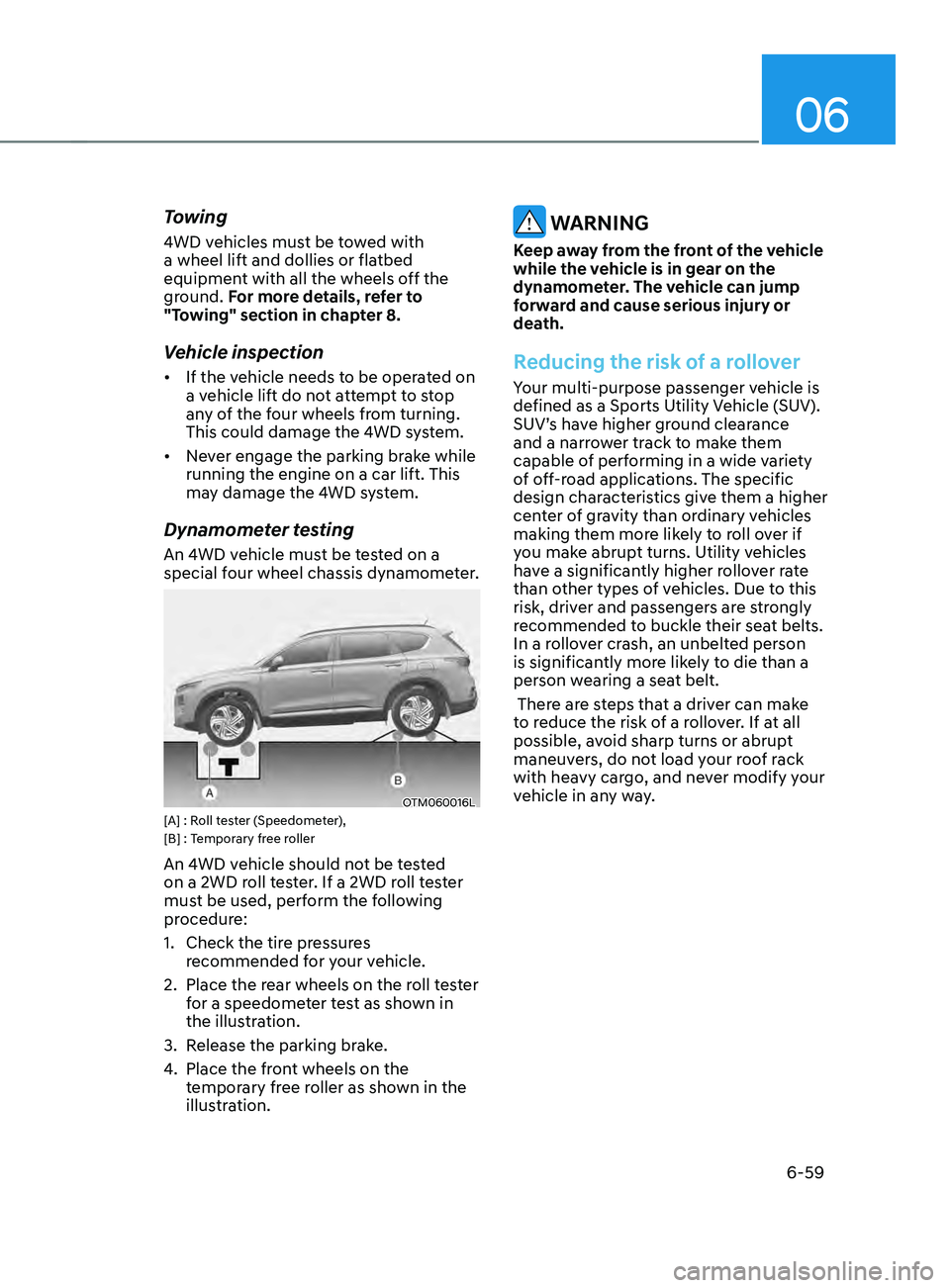
An 4WD vehicle must be tested on a
special four wheel chassis dynamometer.
OTM060016L[A] : Roll tester (Speedometer),
[B] : Temporary free roller
An 4WD vehicle should not be tested
on a 2WD roll tester. If a 2WD roll tester
must be used, perform the following
procedure:
1.
Check the tire pr
essures
recommended for your vehicle.
2.
Place the rear wheels on the r
oll tester
for a speedometer test as shown in
the illustration.
3.
Release the parking br
ake.
4.
Place the fron
t wheels on the
temporary free roller as shown in the
illustration.
WARNING
Keep away from the front of the vehicle
while the vehicle is in gear on the
dynamometer. The vehicle can jump
forward and cause serious injury or
death.
Reducing the risk of a rollover
Your multi-purpose passenger vehicle is
defined as a Sports Utility Vehicle (SUV).
SUV’s have higher ground clearance
and a narrower track to make them
capable of performing in a wide variety
of off-road applications. The specific
design characteristics give them a higher
center of gravity than ordinary vehicles
making them more likely to roll over if
you make abrupt turns. Utility vehicles
have a significantly higher rollover rate
than other types of vehicles. Due to this
risk, driver and passengers are strongly
recommended to buckle their seat belts.
In a rollover crash, an unbelted person
is significantly more likely to die than a
person wearing a seat belt.
There are steps that a driver can make
to reduce the risk of a rollover. If at all
possible, avoid sharp turns or abrupt
maneuvers, do not load your roof rack
with heavy cargo, and never modify your
vehicle in any way.
Page 548 of 636

Emergency situations
8-30
TOWING
Towing service
OTM080011L[A] : Dollies
If emergency towing is necessary,
we recommend having it done by
an authorized HYUNDAI dealer or a
commercial tow-truck service.
Proper lifting and towing procedures
are necessary to prevent damage to
the vehicle. The use of wheel dollies or
flatbed is recommended.
For 2WD vehicles, it is acceptable to tow
the vehicle with the front wheels on the
ground (without dollies) and the rear
wheels off the ground.
If any of the loaded wheels or suspension
components are damaged or the vehicle
is being towed with the rear wheels on
the ground, use a towing dolly under the
rear wheels.
When being towed by a commercial tow
truck and wheel dollies are not used,
the rear of the vehicle should always be
lifted, not the front.
For 4WD vehicles, it must be towed
with a wheel lift and dollies or flatbed
equipment with all the wheels off the
ground.
NOTICE
Do not lift the vehicle by the tow fitting
or body and chassis parts. Otherwise
the vehicle may be damaged.
CAUTION
• Do not tow the vehicle with the rear
wheels on the ground as this may
cause damage to the vehicle.
OTM080013
• Do not tow with sling-type
equipment. Use wheel lift or flatbed
equipment.
OTM080014
Page 549 of 636
08
8-31
When towing your vehicle in an
emergency without wheel dollies:
• Vehicle without EPB
1.
Place the ignition swit
ch in the ACC
position.
2.
Place the shift lev
er/button in N
(Neutral).
3.
Release the parking br
ake.
• Vehicle with EPB
1.
Release EPB be
fore turning off the
engine.
2.
Place the ignition swit
ch to the OFF
position.
3.
Change the gear to N (N
eutral) while
pressing the brake pedal.
4.
Place the ignition swit
ch to the ACC
position.
CAUTION
Failure to shift the gear to N (Neutral)
may cause internal damage to the
transmission.
