2021 HYUNDAI SANTA FE fuel type
[x] Cancel search: fuel typePage 362 of 636
Driving your vehicle
6 -74
Driving in flooded areas
Avoid driving through flooded areas
unless you are sure the water is no
higher than the bottom of the wheel hub.
Drive through any water slowly. Allow
adequate stopping distance because
brake performance may be reduced.
After driving through water, dry the
brakes by gently applying them several
times while the vehicle is moving slowly.
Highway driving
Tires
Adjust the tire inflation, as specified.
Under-inflation may overheat or damage
the tires.
Do not install worn-out or damaged tires,
which may reduce traction or fail the
braking operation.
Information
Never over-inflate your tires above the
maximum inflation pressure, as specified
on your tires.
Fuel, engine coolant and engine oil
Driving at higher speeds on the highway
consumes more fuel and is less efficient
than driving at a slower, more moderate
speed. Maintain a moderate speed in
order to conserve fuel when driving on
the highway.
Be sure to check both the engine coolant
level and the engine oil before driving.
Drive belt
A loose or damaged drive belt may
overheat the engine.
Reducing the risk of a rollover
Your multi-purpose passenger vehicle is
defined as a Sports Utility Vehicle (SUV).
SUV’s have higher ground clearance
and a narrower track to make them
capable of performing in a wide variety
of off-road applications. The specific
design characteristics give them a higher
center of gravity than ordinary vehicles
making them more likely to roll over if
you make abrupt turns. Utility vehicles
have a significantly higher rollover rate
than other types of vehicles. Due to this
risk, driver and passengers are strongly
recommended to buckle their seat belts.
In a rollover crash, an unbelted person
is significantly more likely to die than a
person wearing a seat belt.
There are steps that a driver can make
to reduce the risk of a rollover. If at all
possible, avoid sharp turns or abrupt
maneuvers, do not load your vehicle
with heavy cargo on the roof, and never
modify your vehicle in any way.
WARNING
Utility vehicles have a significantly
higher rollover rate than other types of
vehicles. To prevent rollovers or loss of
control:
• Take corners at slower speeds than
you would with a passenger vehicle.
• Avoid sharp turns and abrupt
maneuvers.
• Do not modify your vehicle in any
way that you would raise the center
of gravity.
• Keep tires properly inflated.
• Do not carry heavy cargo on the roof.
WARNING
In a rollover crash, an unbelted person
is significantly more likely to die than a
person wearing a seat belt. Make sure
all passengers are wearing their seat
belts.
Page 367 of 636
06
6-79
If you are considering to tow with
your vehicle, you should first know
your country’s legal requirements. As
laws vary the requirements for towing
trailers, cars, or other types of vehicles
or apparatus may differ. When you are
not sure about a type of winter weight
oil, we recommend that you consult an
authorized HYUNDAI dealer.
Remember that trailering is different
than just driving your vehicle by
itself. Trailering means changes in
handling, durability, and fuel economy.
Successful, safe trailering requires
correct equipment, and it has to be used
properly. Damage to your vehicle caused
by improper trailer towing is not covered
by your vehicle manufacturer’s warranty.
This section contains time-tested,
important trailering tips and safety
rules. Many of these are important for
your safety and that of your passengers.
Please read this section carefully before
you pull a trailer. WARNING
Take the following precautions:
• If you don’t use the correct
equipment and/or drive improperly,
you can lose control of the vehicle
when you are pulling a trailer. For
example, if the trailer is too heavy,
the braking performance may be
reduced. You and your passengers
could be seriously or fatally injured.
Pull a trailer only if you have followed
all the steps in this section.
• Before towing, make sure the
total trailer weight, GCW (Gross
Combination Weight), GVW (Gross
Vehicle Weight), GAW (Gross Axle
Weight) and trailer tongue load are
all within the limits.
• When you tow a trailer, make sure to
turn off the Idle Stop and Go system.
TRAILER TOWING
Page 582 of 636
Maintenance
9-32
WARNING
Tire failure may cause loss of vehicle
control resulting in an accident. To
reduce risk of SERIOUS INJURY or
DEATH, take the following precautions:
• Inspect your tires monthly for proper
inflation as well as wear and damage.
• The recommended cold tire pressure
for your vehicle can be found in this
manual and on the tire label located
on the driver’s side center pillar.
Always use a tire pressure gauge to
measure tire pressure. Tires with
too much or too little pressure wear
unevenly causing poor handling.
• Check the pressure of the spare
every time you check the pressure of
the other tires on your vehicle.
• Replace tires that are worn, show
uneven wear, or are damaged.
Worn tires can cause loss of braking
effectiveness, steering control, or
traction.
• ALWAYS replace tires with the
same size, type, construction and
tread pattern as each tire that was
originally supplied with this vehicle.
Using tires and wheels other than
the recommended sizes could cause
unusual handling characteristics,
poor vehicle control, or negatively
affect your vehicle’s Anti-Lock Brake
System (ABS) resulting in a serious
accident.
Tire care
For proper maintenance, safety, and
maximum fuel economy, you must
always maintain recommended tire
inflation pressures and stay within the
load limits and weight distribution
recommended for your vehicle.
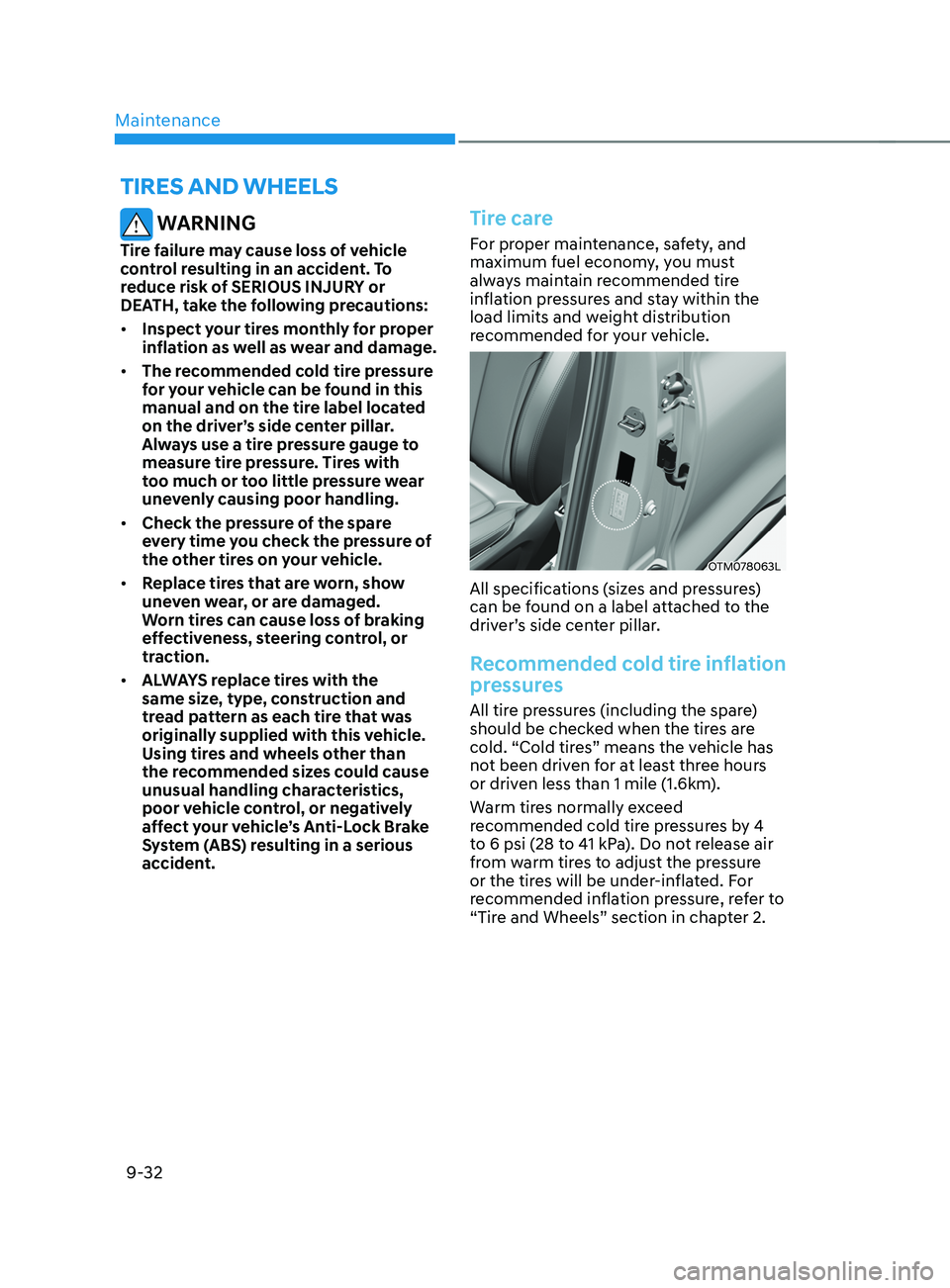
OTM078063L
All specifications (sizes and pressures)
can be found on a label attached to the
driver’s side center pillar.
Recommended cold tire inflation
pressures
All tire pressures (including the spare)
should be checked when the tires are
cold. “Cold tires” means the vehicle has
not been driven for at least three hours
or driven less than 1 mile (1.6km).
Warm tires normally exceed
recommended cold tire pressures by 4
to 6 psi (28 to 41 kPa). Do not release air
from warm tires to adjust the pressure
or the tires will be under-inflated. For
recommended inflation pressure, refer to
“Tire and Wheels” section in chapter 2.
TIRES AND WHEELS
Page 599 of 636
09
9-49
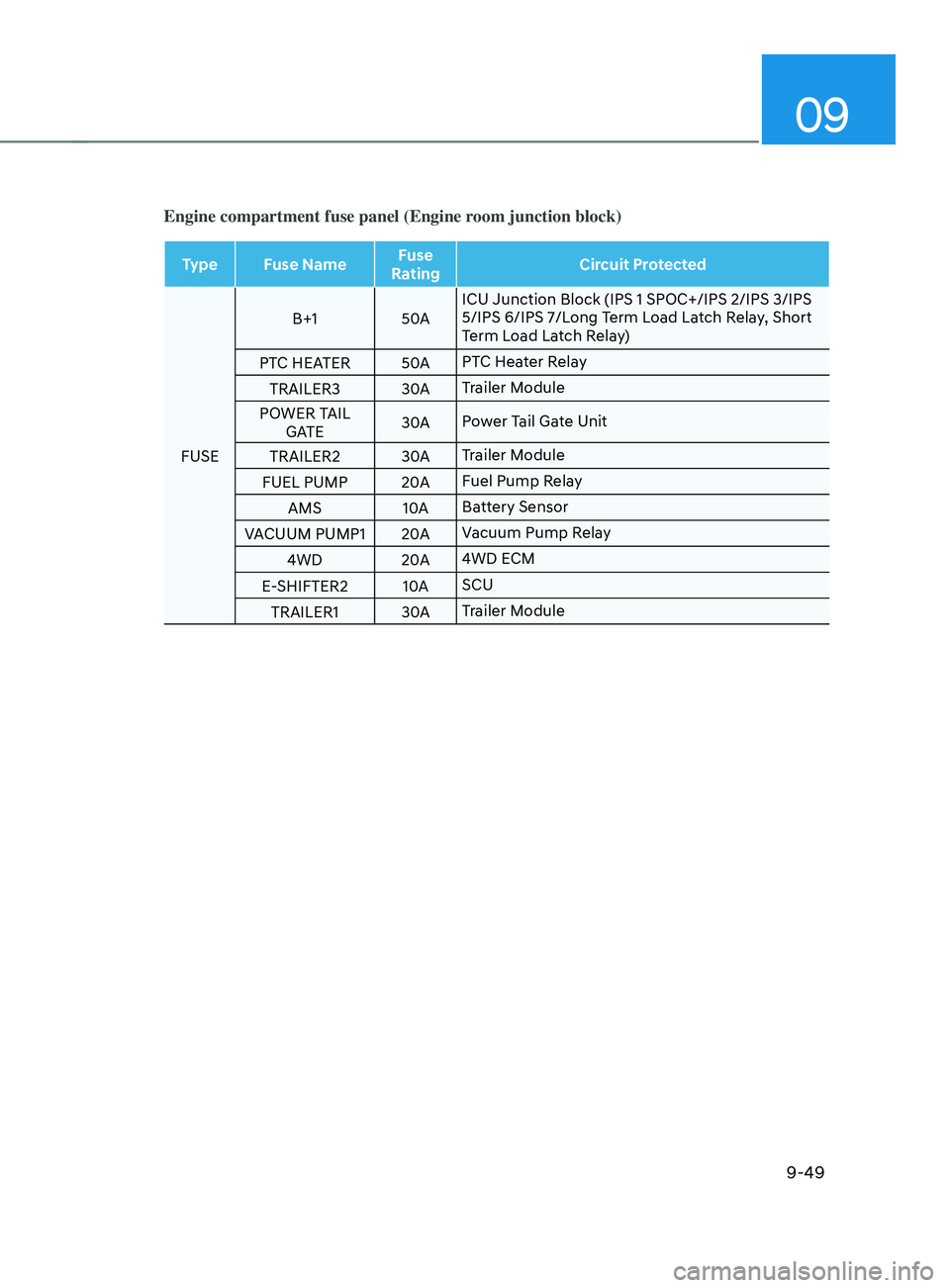
Engine compartment fuse panel (Engine room junction block)
Type Fuse NameFuse
Rating Circuit Protected
FUSE B+1
50AICU Junction Block (IPS 1 SPOC+/IPS 2/IPS 3/IPS
5/IPS 6/IPS 7/Long Term Load Latch Relay, Short
Term Load Latch Relay)
PTC HEATER 50APTC Heater Relay
TRAILER3 30ATrailer Module
POWER TAIL GATE 30A
Power Tail Gate Unit
TRAILER2 30ATrailer Module
FUEL PUMP 20AFuel Pump Relay
AMS 10ABattery Sensor
VACUUM PUMP1 20AVacuum Pump Relay
4WD 20A4WD ECM
E-SHIFTER2 10ASCU
TRAILER1 30ATrailer Module
Page 627 of 636

I
I-5
Dual clutch transmission........................................................................\
.............. 6-23
Dual clutch transmission operation ..................................................................6-23
Good driving practices ........................................................................\
............ 6-33
LCD display message (button type) .................................................................6-30
Paddle shifter (Manual shifter mode) ...............................................................6-32
Parking ........................................................................\
..................................... 6-30
E
Emer
gency commodity
........................................................................\
................ 8-32
Fire extinguisher ........................................................................\
....................... 8-32
First aid kit ........................................................................\
............................... 8-32
Tire pressure gauge ........................................................................\
..................8-32
Triangle reflector ........................................................................\
...................... 8-32
Emission control system
........................................................................\
.............. 9-69
Gasoline Particulate Filter (GPF) .....................................................................9-72
Engine
........................................................................\
............................................ 2-8
Engine compartment
........................................................................\
...................... 2-7
Engine compartment
........................................................................\
...................... 9-3
Engine coolant /liquid-cooled intercooler coolant
............................................... 9-18
Changing coolant ........................................................................\
...................... 9-20
Checking the coolant level ........................................................................\
.......9-18
Engine number
........................................................................\
............................. 2-16
Engine oil
........................................................................\
..................................... 9-16
Checking the engine oil and filter ....................................................................9-17
Checking the engine oil level ........................................................................\
... 9-16
Engine Start/Stop button
........................................................................\
................ 6-9
Engine Stop/Start button positions ...................................................................6-10
Remote start ........................................................................\
.............................. 6-13
Starting the engine ........................................................................\
....................6-1
1
Turning of
f the engine
........................................................................\
.............. 6-12
Explanation of scheduled maintenance items
...................................................... 9-14
Fuel filter (for gasoline engine) ........................................................................\
9-14
Parking brake ........................................................................\
............................ 9-15
Exterior features
........................................................................\
........................... 5-67
Fuel filler door ........................................................................\
.......................... 5-77
Hood ........................................................................\
......................................... 5-67
Liftgate ........................................................................\
.....................................5-68
Power liftgate ........................................................................\
...........................5-70
Smart liftgate ........................................................................\
............................ 5-75