2021 HYUNDAI SANTA FE HYBRID oil change
[x] Cancel search: oil changePage 41 of 598
02
2-13
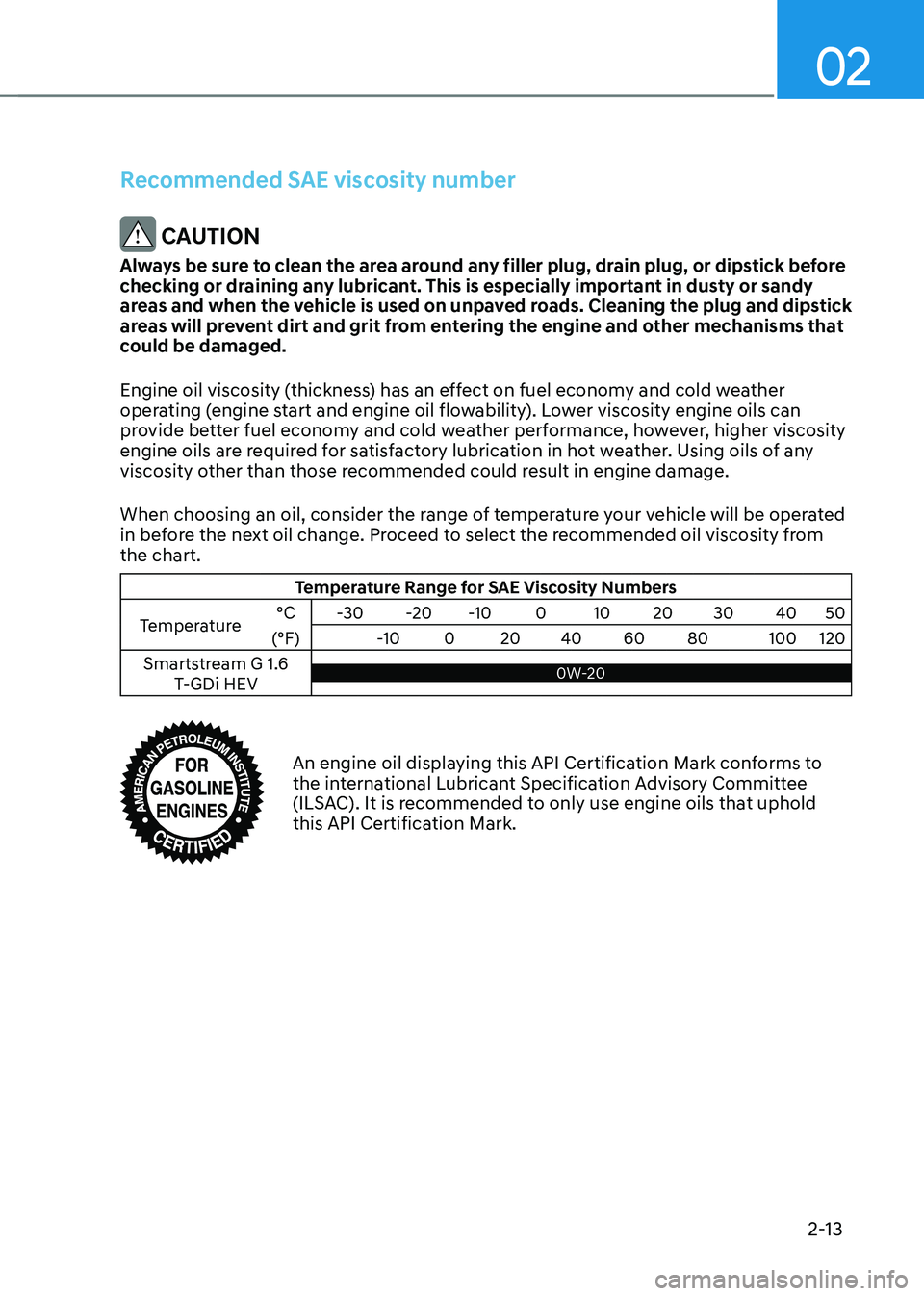
Recommended SAE viscosity number
CAUTION
Always be sure to clean the area around any filler plug, drain plug, or dipstick before
checking or draining any lubricant. This is especially important in dusty or sandy
areas and when the vehicle is used on unpaved roads. Cleaning the plug and dipstick
areas will prevent dirt and grit from entering the engine and other mechanisms that
could be damaged.
Engine oil viscosity (thickness) has an effect on fuel economy and cold weather
operating (engine start and engine oil flowability). Lower viscosity engine oils can
provide better fuel economy and cold weather performance, however, higher viscosity
engine oils are required for satisfactory lubrication in hot weather. Using oils of any
viscosity other than those recommended could result in engine damage.
When choosing an oil, consider the range of temperature your vehicle will be operated
in before the next oil change. Proceed to select the recommended oil viscosity from
the chart.
Temperature Range for SAE Viscosity Numbers
Temperature °C
-30 -20-10 010 20 30 4050
(°F) -10020 40 60 80 100120
Smartstream G 1.6 T-GDi HEV
0W-20 0W-20
An engine oil displaying this API Certification Mark conforms to the international Lubricant Specification Advisory Committee
(ILSAC). It is recommended to only use engine oils that uphold
this API Certification Mark.
Page 287 of 598
06
6-3
WARNING
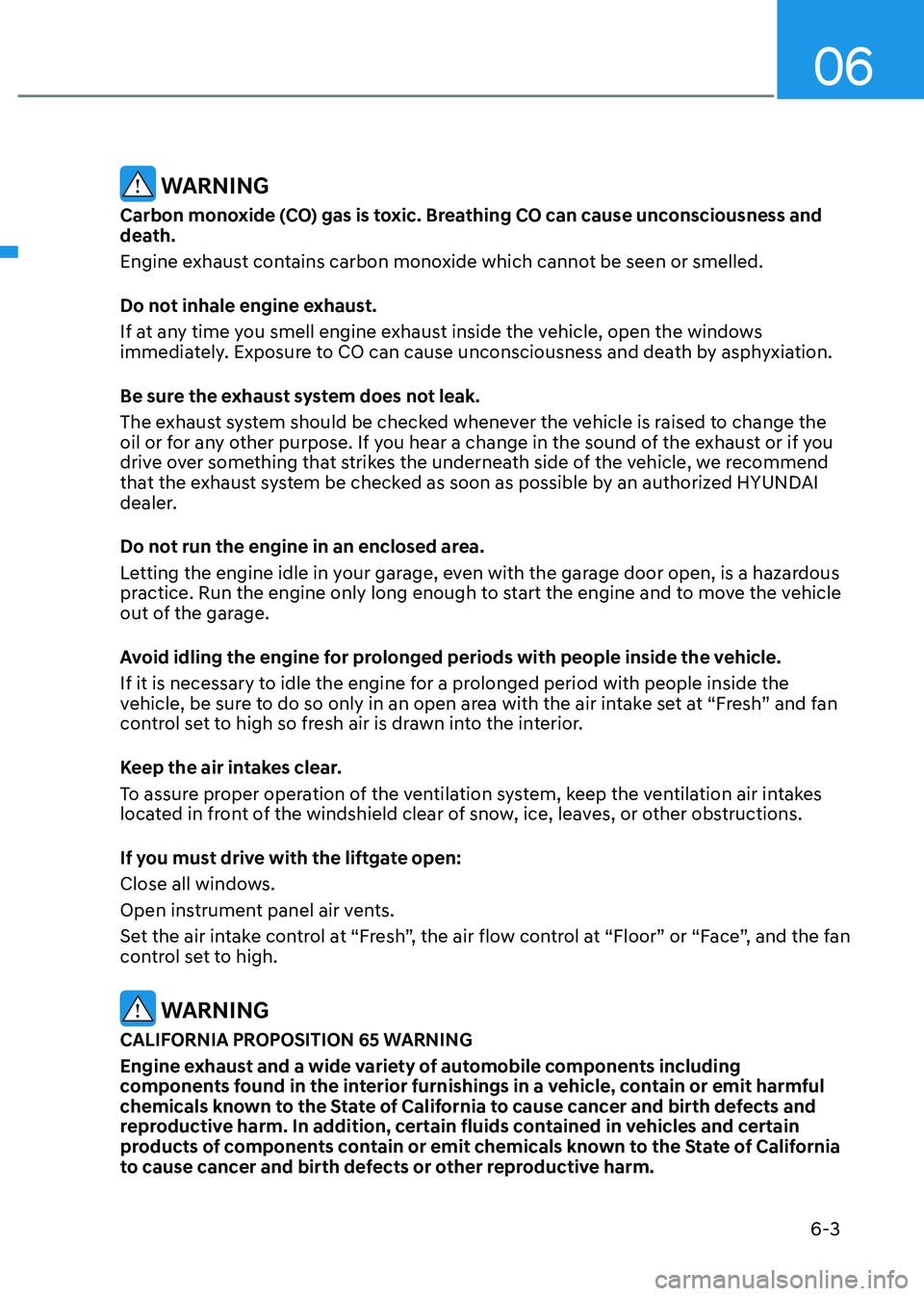
Carbon monoxide (CO) gas is toxic. Breathing CO can cause unconsciousness and
death.
Engine exhaust contains carbon monoxide which cannot be seen or smelled.
Do not inhale engine exhaust.
If at any time you smell engine exhaust inside the vehicle, open the windows
immediately. Exposure to CO can cause unconsciousness and death by asphyxiation.
Be sure the exhaust system does not leak.
The exhaust system should be checked whenever the vehicle is raised to change the
oil or for any other purpose. If you hear a change in the sound of the exhaust or if you
drive over something that strikes the underneath side of the vehicle, we recommend
that the exhaust system be checked as soon as possible by an authorized HYUNDAI
dealer.
Do not run the engine in an enclosed area.
Letting the engine idle in your garage, even with the garage door open, is a hazardous
practice. Run the engine only long enough to start the engine and to move the vehicle
out of the garage.
Avoid idling the engine for prolonged periods with people inside the vehicle.
If it is necessary to idle the engine for a prolonged period with people inside the
vehicle, be sure to do so only in an open area with the air intake set at “Fresh” and fan
control set to high so fresh air is drawn into the interior.
Keep the air intakes clear.
To assure proper operation of the ventilation system, keep the ventilation air intakes
located in front of the windshield clear of snow, ice, leaves, or other obstructions.
If you must drive with the liftgate open:
Close all windows.
Open instrument panel air vents.
Set the air intake control at “Fresh”, the air flow control at “Floor” or “Face”, and the fan
control set to high.
WARNING
CALIFORNIA PROPOSITION 65 WARNING
Engine exhaust and a wide variety of automobile components including
components found in the interior furnishings in a vehicle, contain or emit harmful
chemicals known to the State of California to cause cancer and birth defects and
reproductive harm. In addition, certain fluids contained in vehicles and certain
products of components contain or emit chemicals known to the State of California
to cause cancer and birth defects or other reproductive harm.
Page 338 of 598
Driving your vehicle
6-54
Chain Installation
When installing tire chains, follow the
manufacturer’s instructions and mount
them as tightly possible. Drive slowly
(less than 20 mph (30 km/h)) with
chains installed. If you hear the chains
contacting the body or chassis, stop and
tighten them. If they still make contact,
slow down until the noise stops. Remove
the tire chains as soon as you begin
driving on cleared roads.
When mounting snow chains, park the
vehicle on level ground away from traffic.
Turn on the vehicle Hazard Warning
Flasher and place a triangular emergency
warning device behind the vehicle (if
available). Always place the vehicle in P
(Park), apply the parking brake and turn
off the engine before installing snow
chains.
NOTICE
When using tire chains:
• Wrong size chains or improperly
installed chains can damage your
vehicle’s brake lines, suspension,
body and wheels.
• Use SAE “S” class or wire chains.
• If you hear noise caused by chains
contacting the body, retighten the
chain to prevent contact with the
vehicle body.
• To prevent body damage, retighten
the chains after driving 0.3~0.6 miles
(0.5~1.0 km).
• Do not use tire chains on vehicles
equipped with aluminum wheels. If
unavoidable, use a wire type chain.
• Use wire chains less than 0.47 in.
(12 mm) thick or fabric-type chain
to prevent damage to the chain’s
connection.
• Fabric-type chains must be used on
vehicles equipped with 19/20” tires.
Winter precautions
Use high quality ethylene glycol coolant
Your vehicle is delivered with high
quality ethylene glycol coolant in the
cooling system. It is the only type of
coolant that should be used because it
helps prevent corrosion in the cooling
system, lubricates the water pump and
prevents freezing. Be sure to replace or
replenish your coolant in accordance
with the maintenance schedule in
chapter 9. Before winter, have your
coolant tested to assure that its freezing
point is sufficient for the temperatures
anticipated during the winter.
Check battery and cables
Winter temperatures affect battery
performance. Inspect the battery and
cables, as specified in chapter 9. The
battery charging level can be checked
by an authorized HYUNDAI dealer or in a
service station.
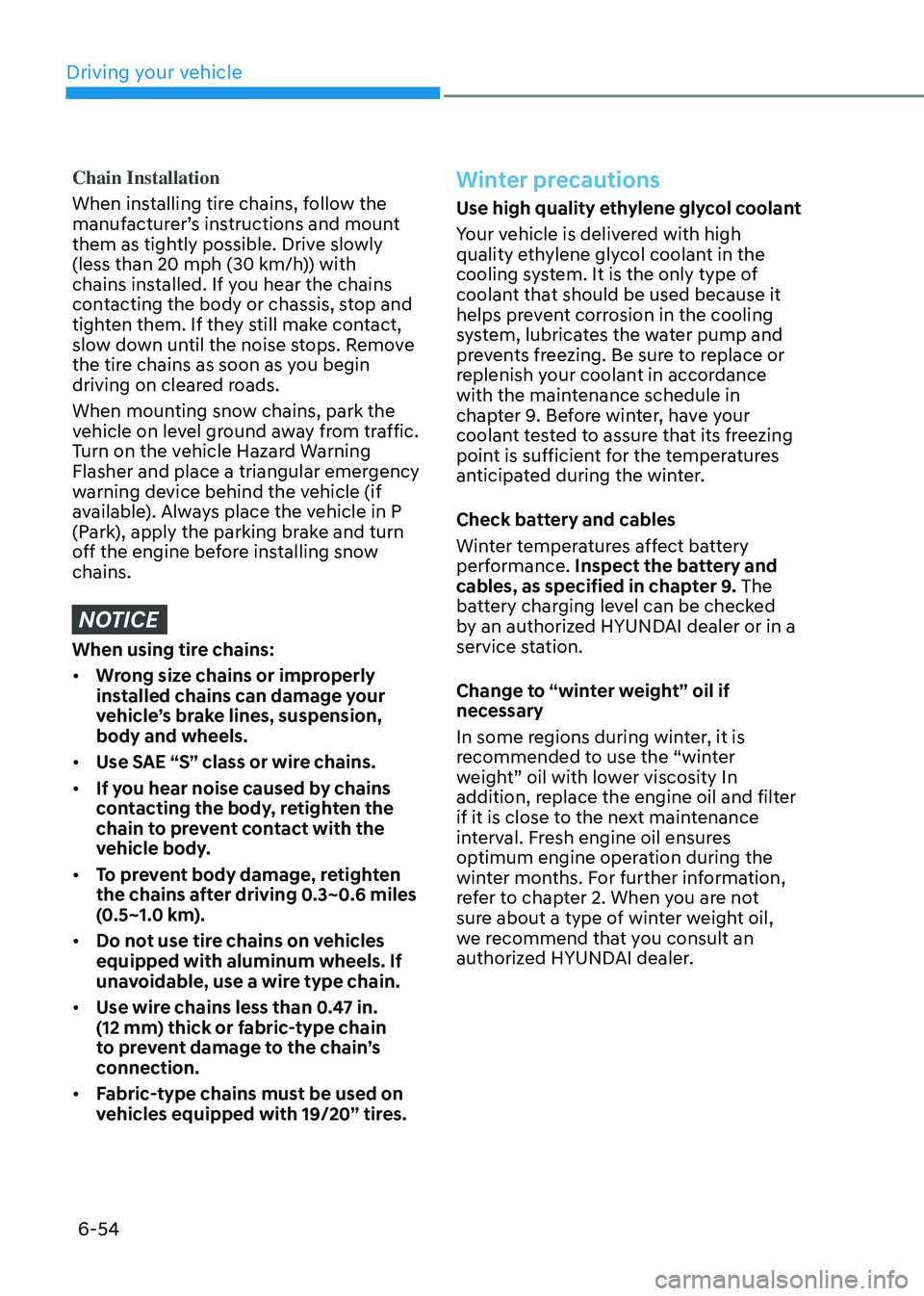
Change to “winter weight” oil if
necessary
In some regions during winter, it is
recommended to use the “winter
weight” oil with lower viscosity In
addition, replace the engine oil and filter
if it is close to the next maintenance
interval. Fresh engine oil ensures
optimum engine operation during the
winter months. For further information,
refer to chapter 2. When you are not
sure about a type of winter weight oil,
we recommend that you consult an
authorized HYUNDAI dealer.
Page 523 of 598
Maintenance
9-8
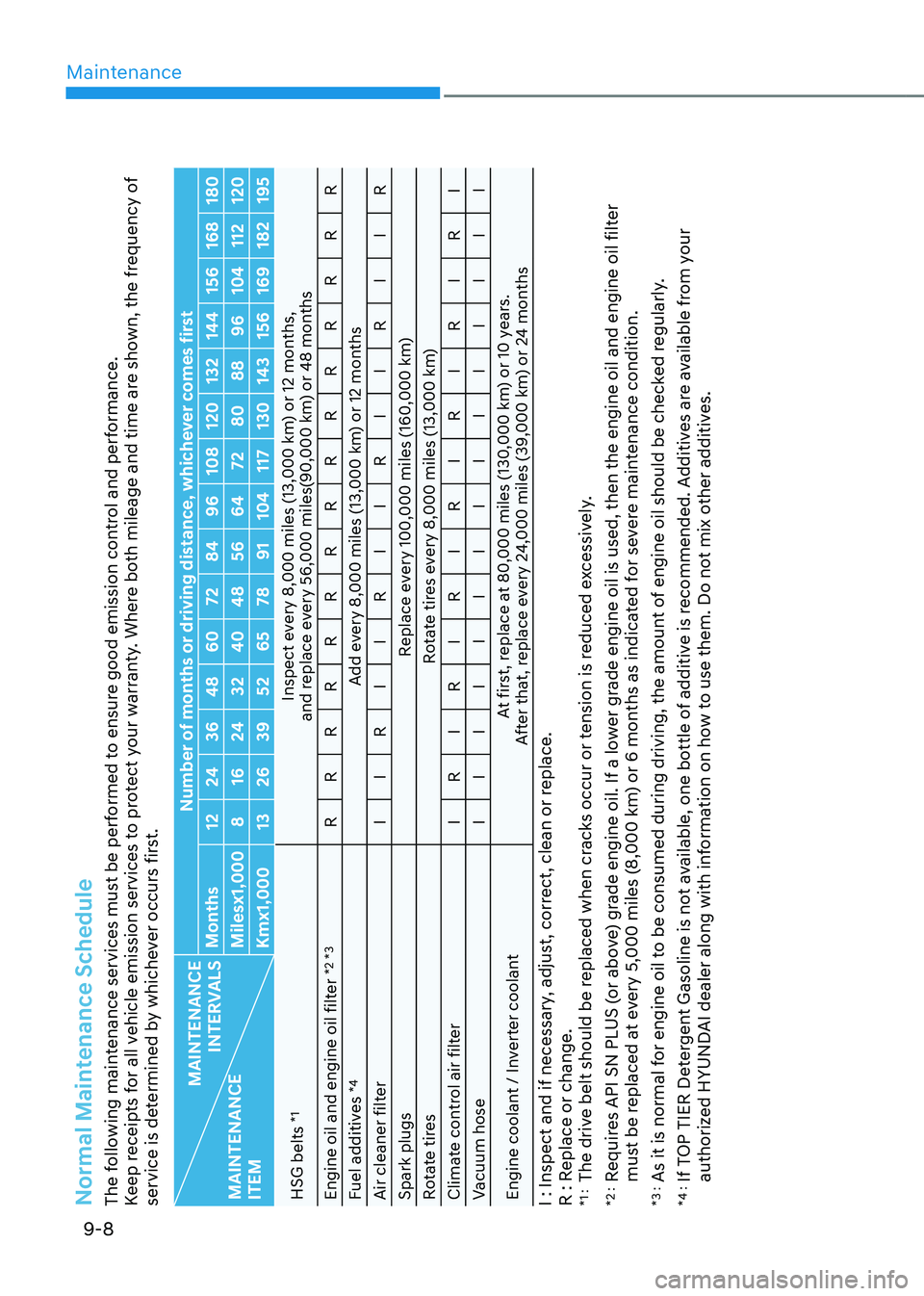
The following maintenance services must be performed to ensure good emission control and performance.
Keep receipts for all vehicle emission services to protect your warranty. Where both mileage and time are shown, the frequency of
service is determined by whichever occurs first.
MAINTENANCE
INTERVALS
MAINTENANCE
ITEM Number of months or driving distance, whichever comes first
Months 1224 3648 60 7284 96108 120 132144 156168 180
Milesx1,000 816 24 3240 48 5664 7280 8896104 112120
Kmx1,000 1326 39 5265 78 91104 117130 143156169 182195
HSG belts
*1
Inspect every 8,000 miles (13,000 km) or 12 months,
and replace every 56,000 miles(90,000 km) or 48 months
Engine oil and engine oil filter
*2 *3
R RRRRRRRRRRRRRR
Fuel additives
*4
Add every 8,000 miles (13,000 km) or 12 months
Air cleaner filter IIR IIR IIR IIR IIR
Spark plugs
Replace every 100,000 miles (160,000 km)
Rotate tires Rotate tires every 8,000 miles (13,000 km)
Climate control air filter IR IR IR IR IR IR IR I
Vacuum hose IIIIIIIIIIIIIII
Engine coolant / Inverter coolant At first, replace at 80,000 miles (130,000 km) or 10 years.
After that, replace every 24,000 miles (39,000 km) or 24 monthsI : Inspect and if necessary, adjust, correct, clean or replace.R : Replace or change.*1 : The drive belt should be replaced when cracks occur or tension is reduced excessively.
*2 : Requires API SN PLUS (or above) grade engine oil. If a lower grade engine oil is used, then the engine oil and engine oil filter
must be replaced at every 5,000 miles (8,000 km) or 6 months as indicated for severe maintenance condition.
*3 : As it is normal for engine oil to be consumed during driving, the amount of engine oil should be checked regularly.
*4 : If TOP TIER Detergent Gasoline is not available, one bottle of additive is recommended. Additives are available from your
authorized HYUNDAI dealer along with information on how to use them. Do not mix other additives.
Normal Maintenance Schedule
Page 525 of 598
Maintenance
9-10
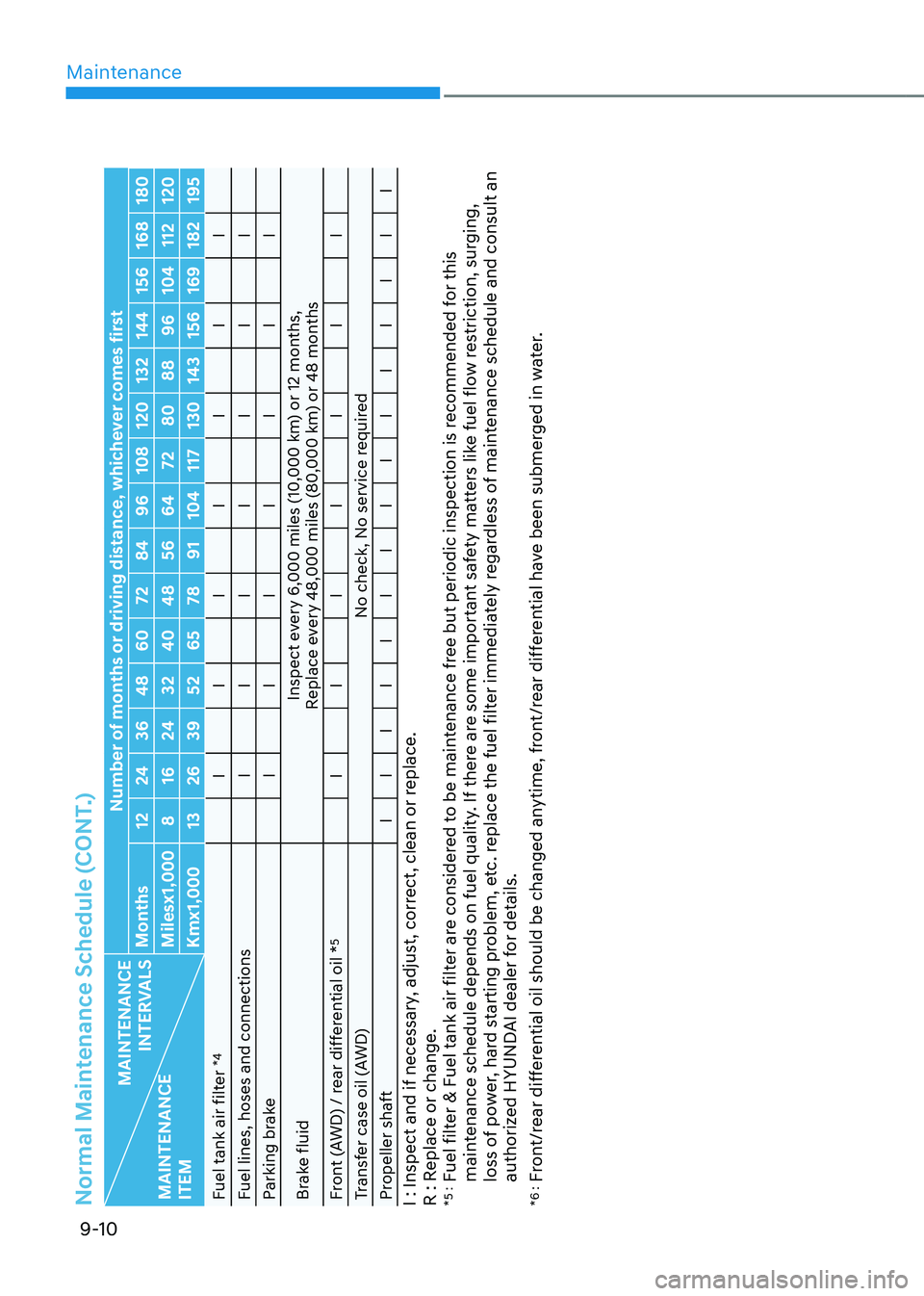
MAINTENANCE
INTERVALS
MAINTENANCE
ITEM Number of months or driving distance, whichever comes first
Months 1224 3648 60 7284 96108 120 132144 156168 180
Milesx1,000 816 24 3240 48 5664 7280 8896104 112120
Kmx1,000 1326 39 5265 78 91104 117130 143156169 182195
Fuel tank air filter
*4
I IIIIII
Fuel lines, hoses and connections IIIIIII
Parking brake IIIIIII
Brake fluid Inspect every 6,000 miles (10,000 km) or 12 months,
Replace every 48,000 miles (80,000 km) or 48 months
Front (AWD) / rear differential oil *
5
I IIIIII
Transfer case oil (AWD) No check, No service required
Propeller shaft IIIIIIIIIIIIIII
I : Inspect and if necessary, adjust, correct, clean or replace.
R : Replace or change.*5 : Fuel filter & Fuel tank air filter are considered to be maintenance free but periodic inspection is recommended for this
maintenance schedule depends on fuel quality. If there are some important safety matters like fuel flow restriction, surging,
loss of power, hard starting problem, etc. replace the fuel filter immediately regardless of maintenance schedule and consult an
authorized HYUNDAI dealer for details.
*6 : Front/rear differential oil should be changed anytime, front/rear differential have been submerged in water.
Normal Maintenance Schedule (CONT.)
Page 528 of 598
09
9-13
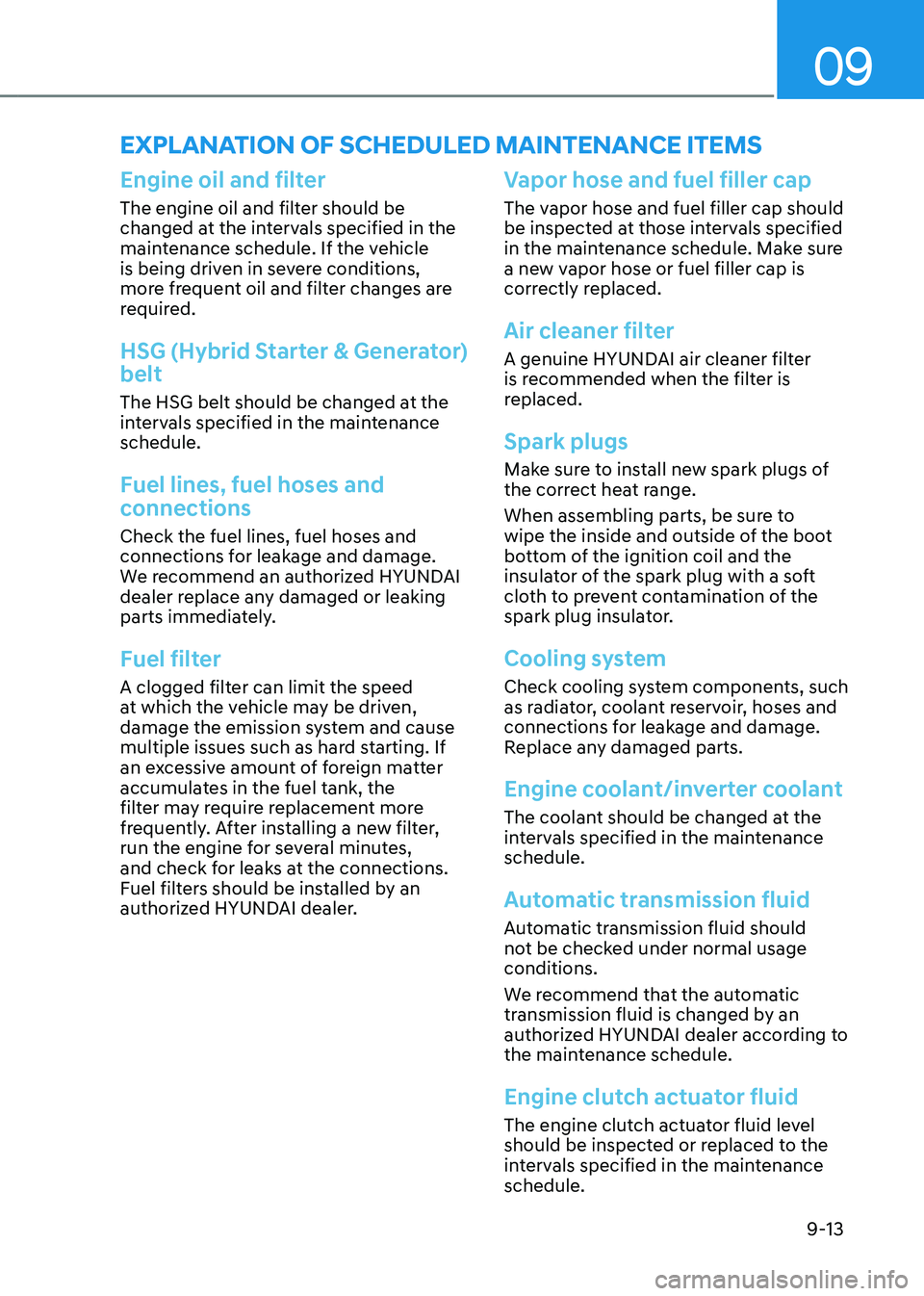
Engine oil and filter
The engine oil and filter should be
changed at the intervals specified in the
maintenance schedule. If the vehicle
is being driven in severe conditions,
more frequent oil and filter changes are
required.
HSG (Hybrid Starter & Generator)
belt
The HSG belt should be changed at the
intervals specified in the maintenance
schedule.
Fuel lines, fuel hoses and
connections
Check the fuel lines, fuel hoses and
connections for leakage and damage.
We recommend an authorized HYUNDAI
dealer replace any damaged or leaking
parts immediately.
Fuel filter
A clogged filter can limit the speed
at which the vehicle may be driven,
damage the emission system and cause
multiple issues such as hard starting. If
an excessive amount of foreign matter
accumulates in the fuel tank, the
filter may require replacement more
frequently. After installing a new filter,
run the engine for several minutes,
and check for leaks at the connections.
Fuel filters should be installed by an
authorized HYUNDAI dealer.
Vapor hose and fuel filler cap
The vapor hose and fuel filler cap should
be inspected at those intervals specified
in the maintenance schedule. Make sure
a new vapor hose or fuel filler cap is
correctly replaced.
Air cleaner filter
A genuine HYUNDAI air cleaner filter
is recommended when the filter is
replaced.
Spark plugs
Make sure to install new spark plugs of
the correct heat range.
When assembling parts, be sure to
wipe the inside and outside of the boot
bottom of the ignition coil and the
insulator of the spark plug with a soft
cloth to prevent contamination of the
spark plug insulator.
Cooling system
Check cooling system components, such
as radiator, coolant reservoir, hoses and
connections for leakage and damage.
Replace any damaged parts.
Engine coolant/inverter coolant
The coolant should be changed at the
intervals specified in the maintenance
schedule.
Automatic transmission fluid
Automatic transmission fluid should
not be checked under normal usage
conditions.
We recommend that the automatic
transmission fluid is changed by an
authorized HYUNDAI dealer according to
the maintenance schedule.
Engine clutch actuator fluid
The engine clutch actuator fluid level
should be inspected or replaced to the
intervals specified in the maintenance
schedule.
EXPLANATION OF SCHEDULED MAINTENANCE ITEMS
Page 530 of 598
09
9-15
Checking the engine oil level
Engine oil is used for lubrication and
cooling, so it is gradually consumed
during driving the vehicle.
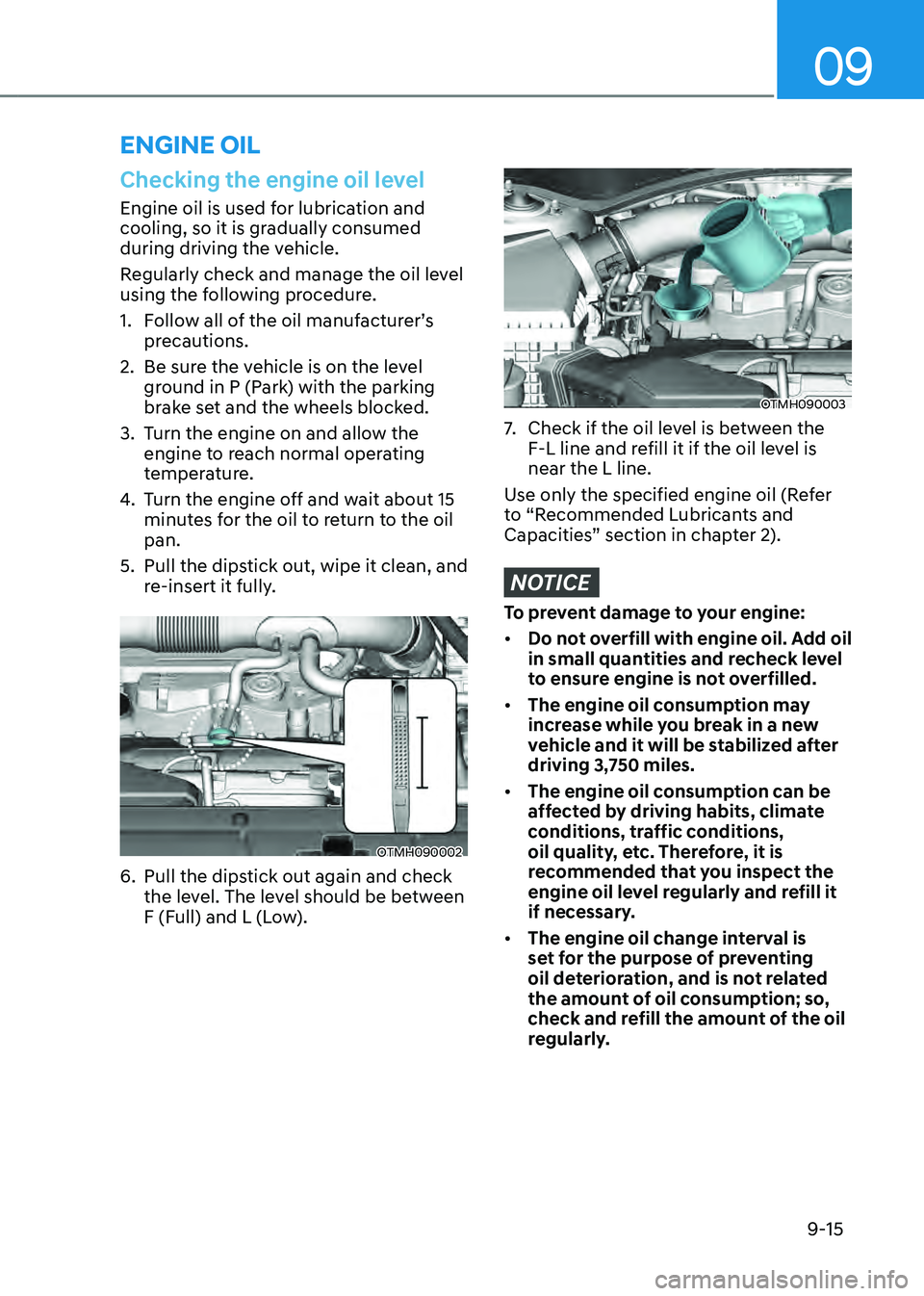
Regularly check and manage the oil level
using the following procedure.
1. Follow all of the oil manufacturer’s
precautions.
2. Be sure the vehicle is on the level
ground in P (Park) with the parking
brake set and the wheels blocked.
3. Turn the engine on and allow the
engine to reach normal operating
temperature.
4. Turn the engine off and wait about 15
minutes for the oil to return to the oil
pan.
5. Pull the dipstick out, wipe it clean, and
re-insert it fully.
OTMH090002
6. Pull the dipstick out again and check
the level. The level should be between
F (Full) and L (Low).
OTMH090003
7. Check if the oil level is between the
F-L line and refill it if the oil level is
near the L line.
Use only the specified engine oil (Refer
to “Recommended Lubricants and
Capacities” section in chapter 2).
NOTICE
To prevent damage to your engine:
• Do not overfill with engine oil. Add oil
in small quantities and recheck level
to ensure engine is not overfilled.
• The engine oil consumption may
increase while you break in a new
vehicle and it will be stabilized after
driving 3,750 miles.
• The engine oil consumption can be
affected by driving habits, climate
conditions, traffic conditions,
oil quality, etc. Therefore, it is
recommended that you inspect the
engine oil level regularly and refill it
if necessary.
• The engine oil change interval is
set for the purpose of preventing
oil deterioration, and is not related
the amount of oil consumption; so,
check and refill the amount of the oil
regularly.
ENGINE OIL
Page 531 of 598
Maintenance
9-16
Checking the engine oil and
filter
We recommend that the engine oil and filter be changed by an authorized
HYUNDAI dealer according to the
Maintenance Schedule at the beginning
of this chapter.
WARNING
CALIFORNIA PROPOSITION 65
WARNING
Engine oil contains chemicals known to
the State of California to cause cancer,
birth defects and reproductive harm.
Used engine oil may cause irritation or
cancer of the skin if left in contact with
the skin for prolonged periods of time.
Always protect your skin by washing
your hands thoroughly with soap and
warm water as soon as possible after
handling used oil.