Page 20 of 570
2-5
02
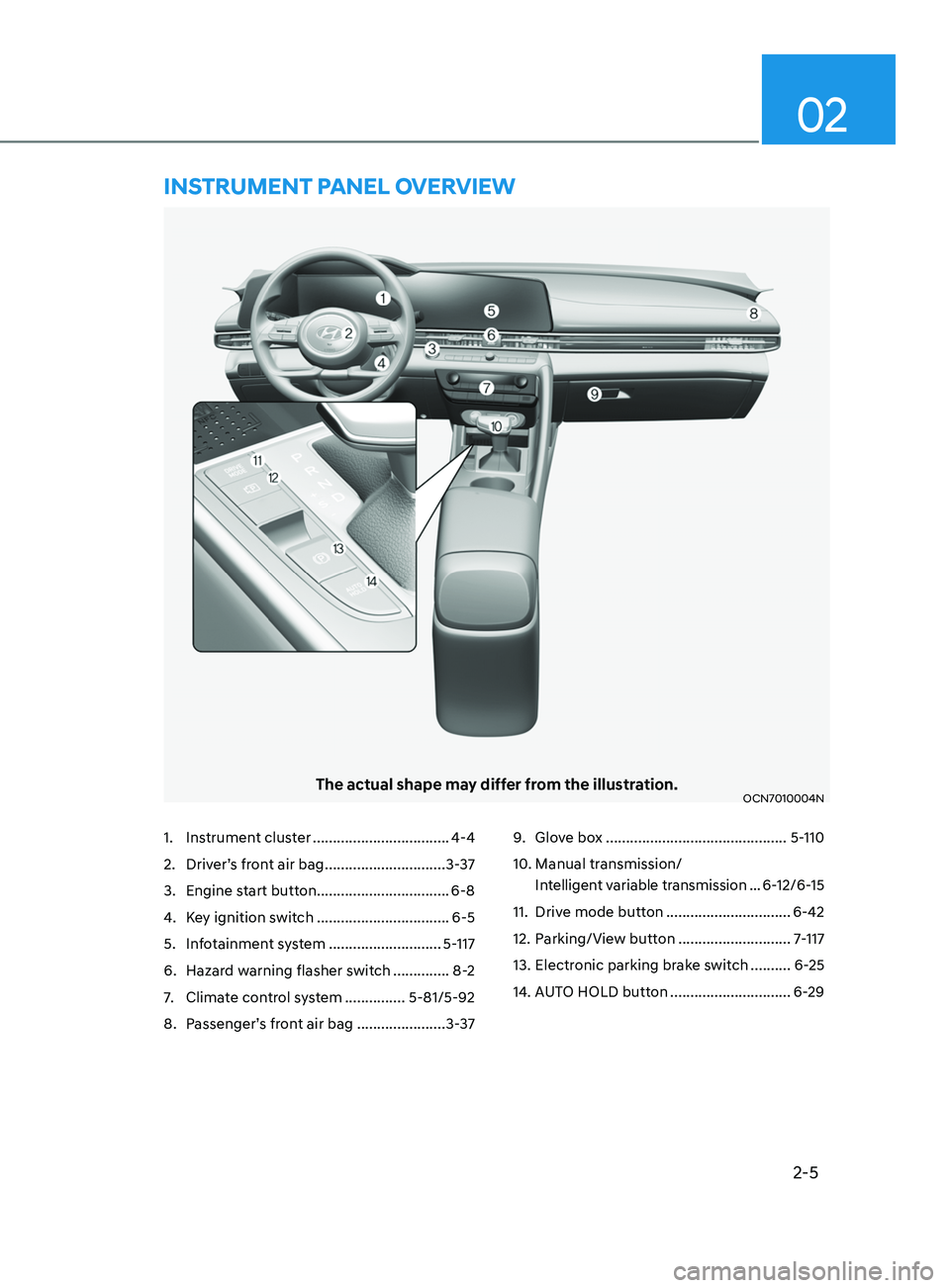
The actual shape may differ from the illustration.OCN7010004N
instrumEnt PanEl ovErviEw
1.Instrument cluster ..................................4-4
2.
Driver’s fr
ont air bag
.............................. 3-37
3.
Engine start butt
on................................. 6-8
4.
Key ignition s
witch
................................. 6-5
5.
Info
tainment system
............................ 5-117
6.
Hazard warning flasher s
witch
..............8-2
7.
Climate con
trol system
...............5-81/5-92
8.
Passenger’s fr
ont air bag
......................3-
379.Glove bo
x .............................................
5-110
10 .
Manual transmission/
Int
elligent variable transmission
...6-12/6-
15
11.
Drive mode button ............................... 6-42
12.
Parking/View butt
on
............................7-
117
13.
Electronic parking brak
e switch
..........6-25
14
.
AUTO HOLD butt
on
..............................6-29
Page 21 of 570
2-6
Vehicle Information
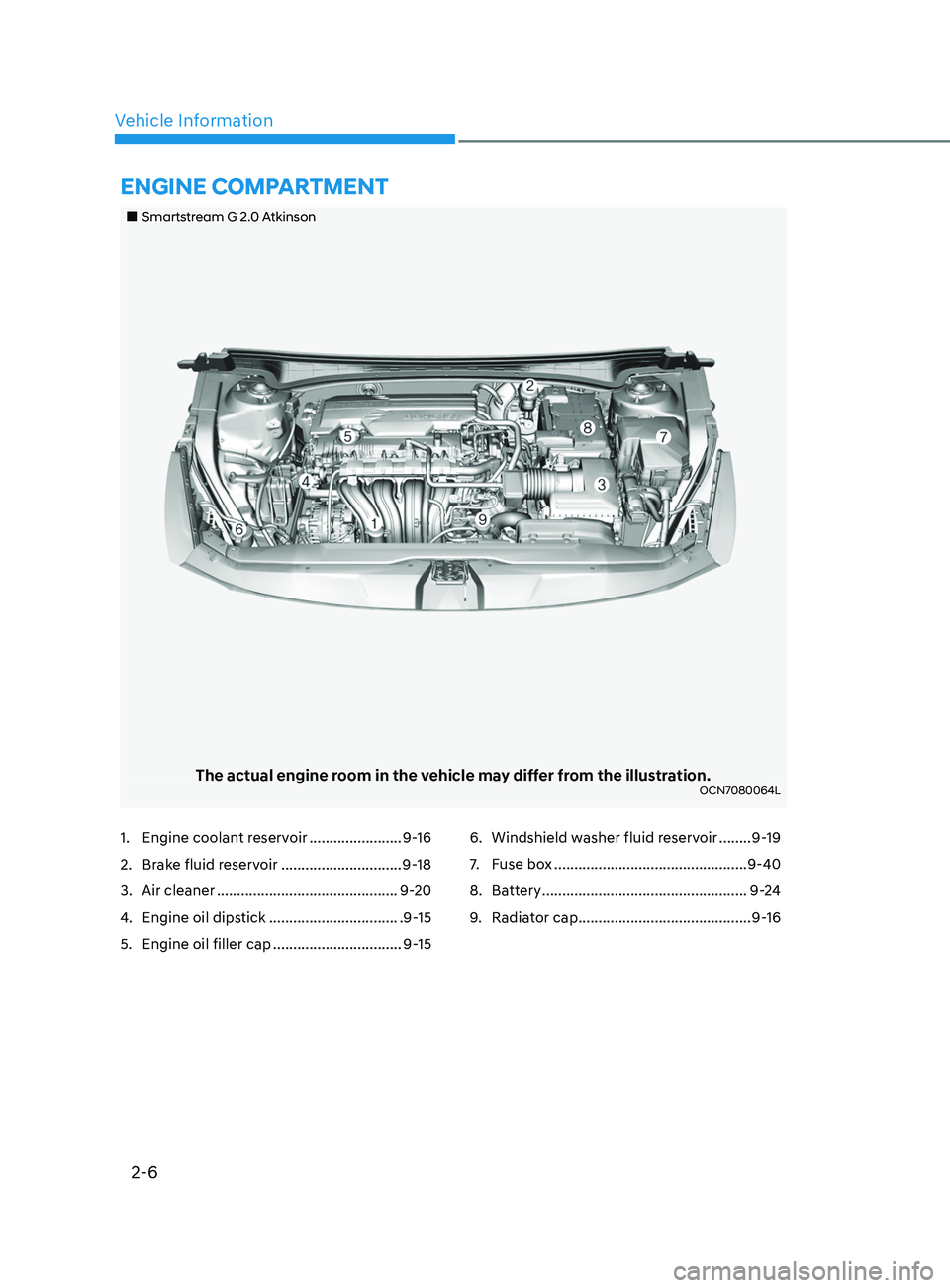
„„Smartstream G 2.0 Atkinson
The actual engine room in the vehicle may differ from the illustration.OCN7080064L
EnginE ComPartmEnt
1. Engine coolant reservoir .......................9- 16
2.
Brak
e fluid reservoir
.............................. 9-
18
3.
Air cleaner ............................................. 9-
20
4.
Engine oil dips
tick
................................ .9-
15
5.
Engine oil filler cap ................................ 9-
156. Windshield washer fluid r
eservoir ........
9- 19
7.
Fuse bo
x
................................................9-40
8.
Batt
ery
...................................................9-2
4
9.
Radiat
or cap
...........................................9-
16
Page 22 of 570
02
2-7
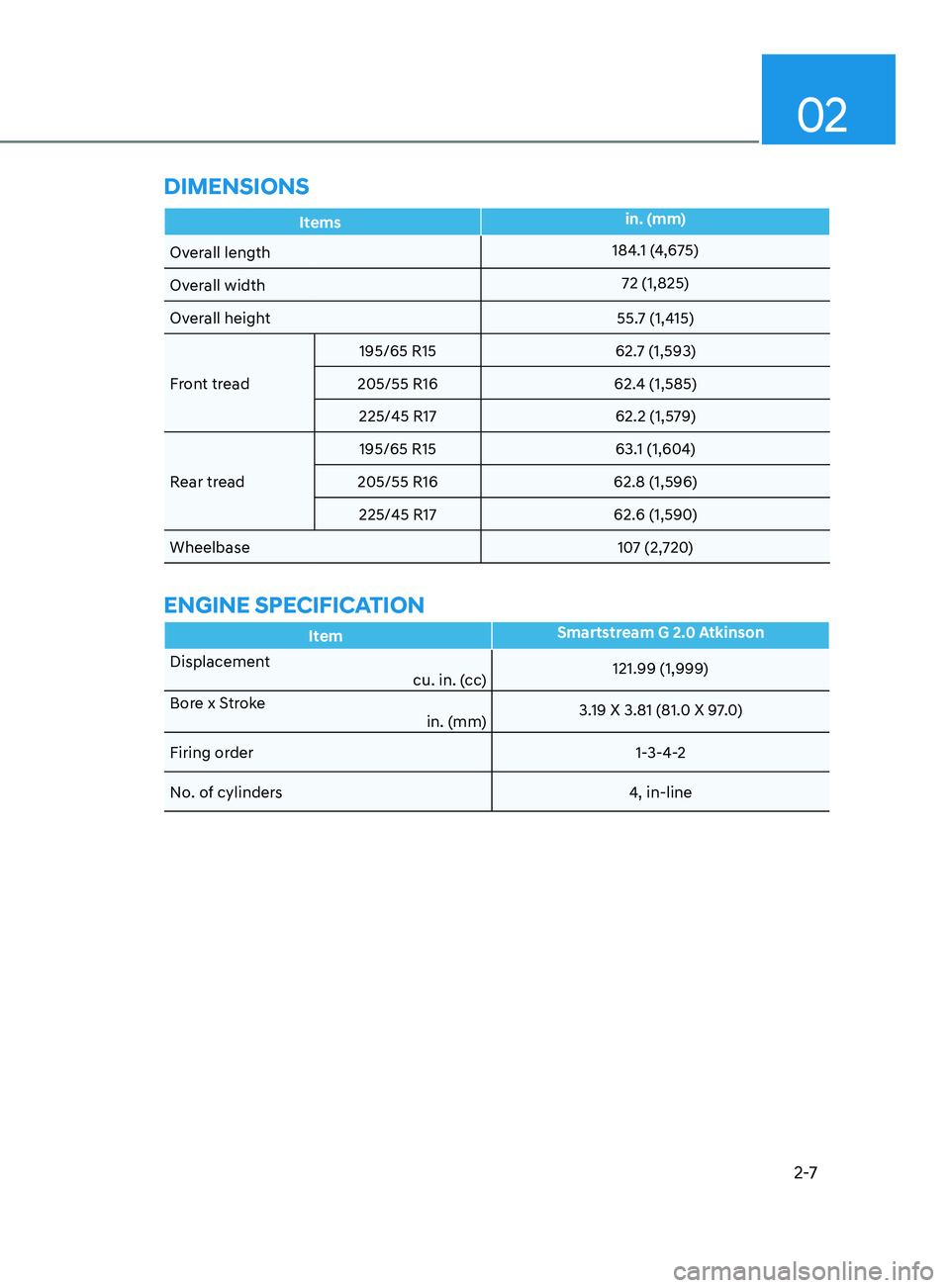
DimEnsions
Itemsin. (mm)
Overall length 184.1 (4,675)
Overall width 72 (1,825)
Overall height 55.7 (1,415)
Front tread 195/65 R15
62.7 (1,593)
205/55 R16 62.4 (1,585)
225/45 R17 62.2 (1,579)
Rear tread 195/65 R15
63.1 (1,604)
205/55 R16 62.8 (1,596)
225/45 R17 62.6 (1,590)
Wheelbase 107 (2,720)
EnginE sPECifiCation
ItemSmartstream G 2.0 Atkinson
Displacement cu. in. (cc) 121.99 (1,999)
Bore x Stroke in. (mm)3.19 X 3.81 (81.0 X 97.0)
Firing order 1-3-4-2
No. of cylinders 4, in-line
Page 26 of 570
02
2-11
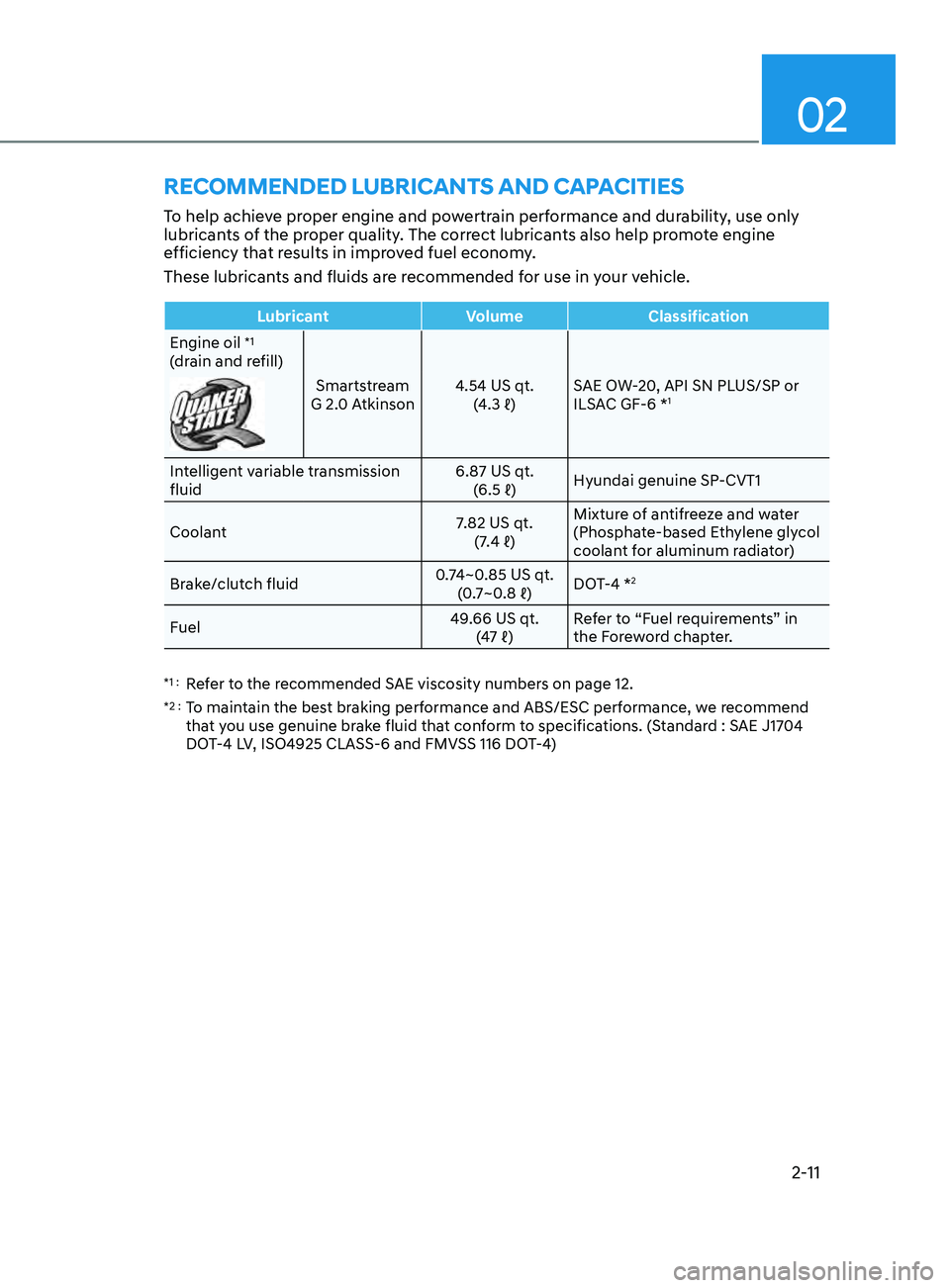
rECommEnDED luBriCants anD CaPaCitiEs
To help achieve proper engine and powertrain performance and durability, use only
lubricants of the proper quality. The correct lubricants also help promote engine
efficiency that results in improved fuel economy.
These lubricants and fluids are recommended for use in your vehicle.
LubricantVolumeClassification
Engine oil
*1
(drain and refill)
Smartstream
G 2.0 Atkinson 4.54 US qt.
(4.3
ℓ) SAE O
W-20, API SN PLUS/SP or
ILSAC GF-6 *
1
Intelligent variable transmission
fluid 6.87 US qt.
(6.5 ℓ) Hyundai genuine SP-CVT1
Coolan
t 7.82 US qt.
(7.4
ℓ)
Mixture o
f antifreeze and water
(Phosphate-based Ethylene glycol
coolant for aluminum radiator)
Brake/clutch fluid
0.
74~0.85 US qt.(0.7~0.8
ℓ) DOT
-4 *
2
Fuel 49.66 US qt.
(47
ℓ) R
efer to “Fuel requirements” in
the Foreword chapter.
*1 : Refer to the recommended SAE viscosity numbers on page 12.
*2 : To maintain the best braking performance and ABS/ESC performance, we recommend
that you use genuine brake fluid that conform to specifications. (Standard : SAE J1704
DOT-4 LV, ISO4925 CLASS-6 and FMVSS 116 DOT-4)
Page 27 of 570
Vehicle Information
2-12
Recommended SAE Viscosity
Number
CAUTION
Always be sure to clean the area around
any filler plug, drain plug, or dipstick
before checking or draining any
lubricant. This is especially important
in dusty or sandy areas and when the
vehicle is used on unpaved roads.
Cleaning the plug and dipstick areas
will prevent dirt and grit from entering
the engine and other mechanisms that
could be damaged.Engine oil viscosity (thickness) has an
effect on fuel economy and cold weather
operating (engine start and engine oil
flowability). Lower viscosity engine oils
can provide better fuel economy and
cold weather performance, however,
higher viscosity engine oils are required
for satisfactory lubrication in hot
weather.
Using oils of any viscosity other than
those recommended could result in
engine damage.
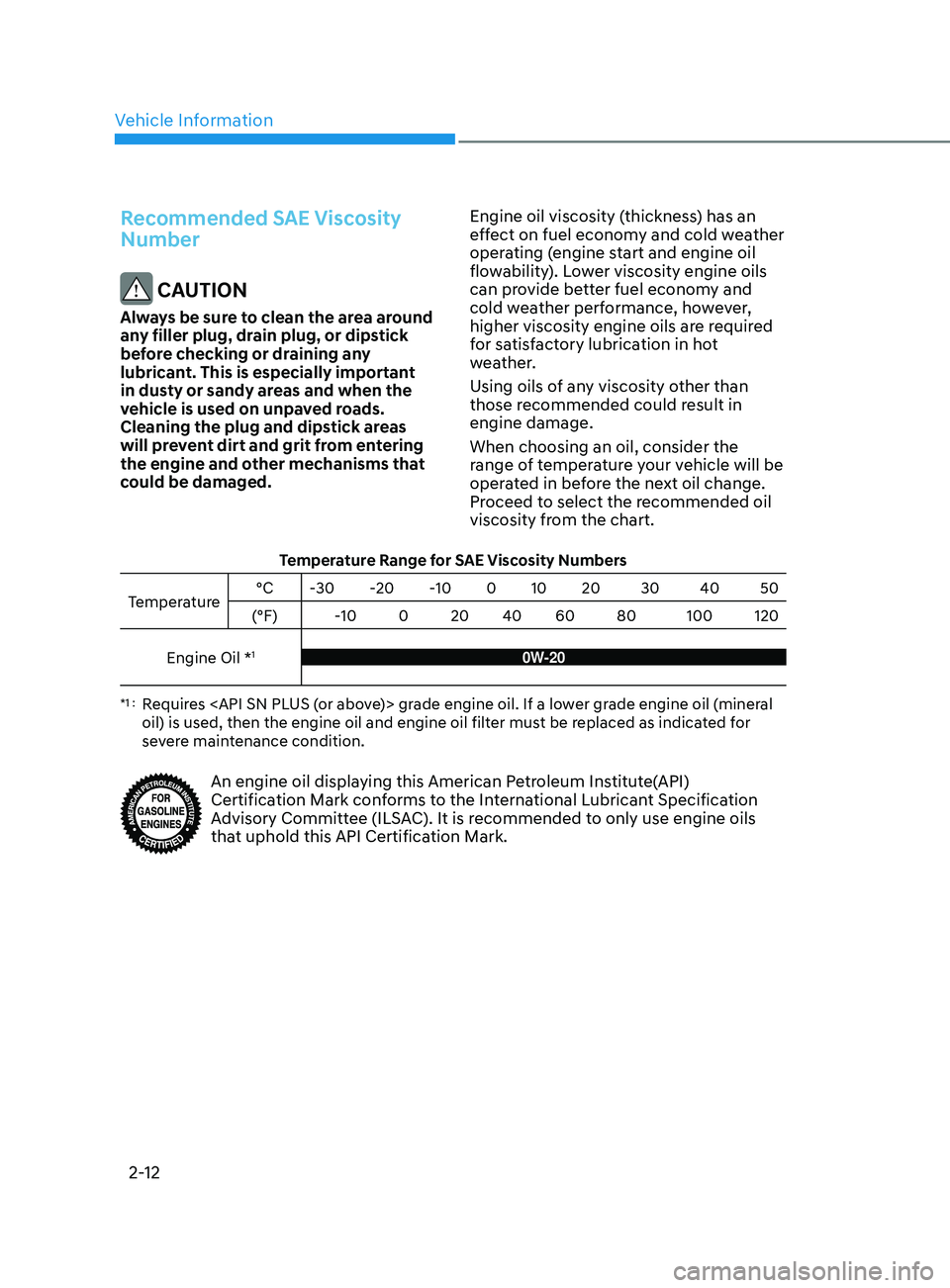
When choosing an oil, consider the
range of temperature your vehicle will be
operated in before the next oil change.
Proceed to select the recommended oil
viscosity from the chart.
Temperature Range for SAE Viscosity Numbers
Temperature °C
-30 -20 -10 0 10 20 30 40 50
(°F) -10 0 20 40 60 80 100 120
Engine Oil *
10W-20
*1 : Requires grade engine oil. If a lower grade engine oil (mineral
oil) is used, then the engine oil and engine oil filter must be replaced as indicated for
severe maintenance condition.
An engine oil displaying this American Petroleum Institute(API)
Certification Mark conforms to the International Lubricant Specification
Advisory Committee (ILSAC). It is recommended to only use engine oils
that uphold this API Certification Mark.
Page 29 of 570
Vehicle Information2-14
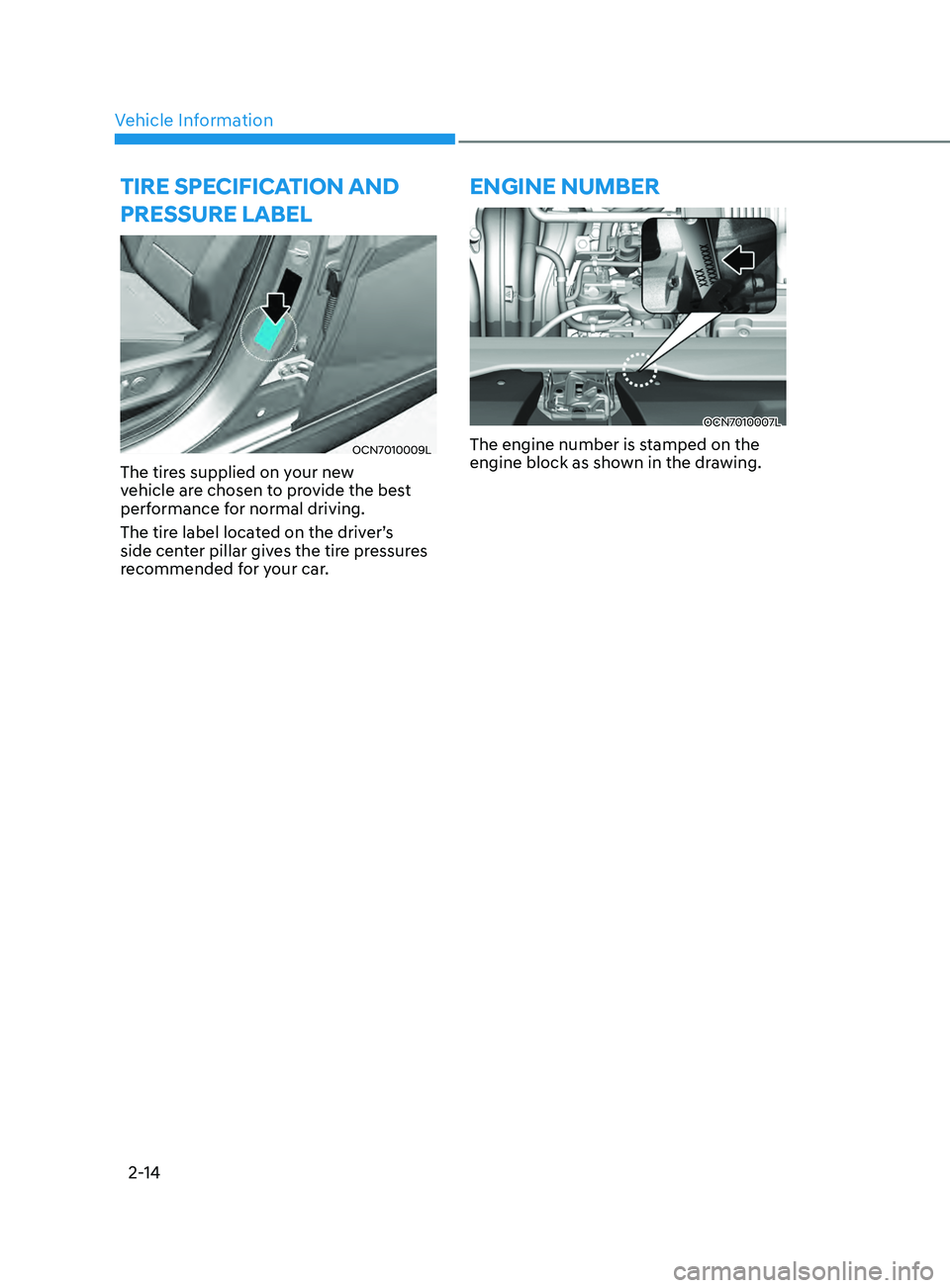
tirE sPECifiCation anD
Pr
EssurE laBEl
OCN7010009L
The tires supplied on your new
vehicle are chosen to provide the best
performance for normal driving.
The tire label located on the driver’s
side center pillar gives the tire pressures
recommended for your car.
EnginE numBEr
OCN7010007L
The engine number is stamped on the
engine block as shown in the drawing.
Page 47 of 570
3-16
OCN7030024
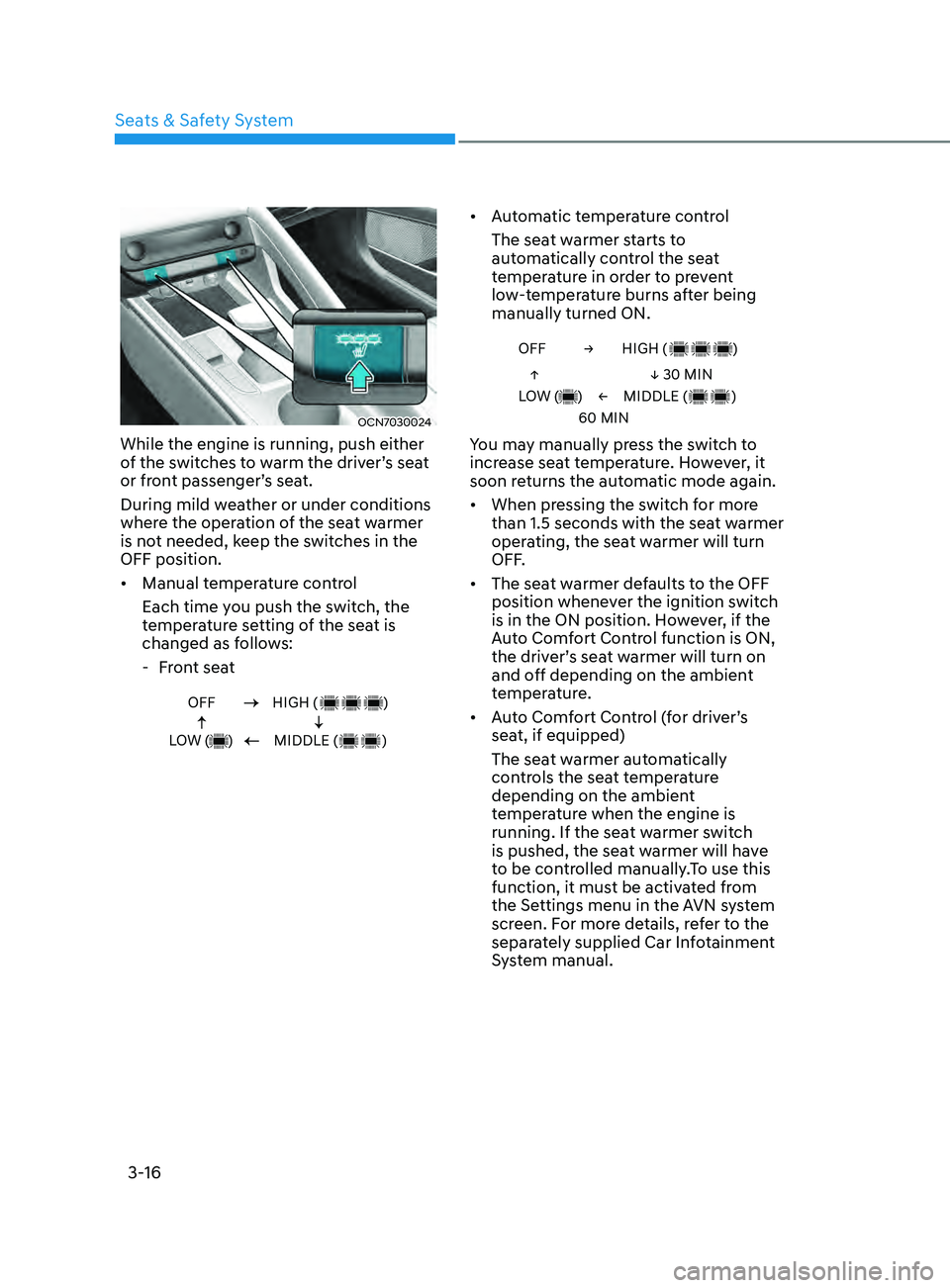
While the engine is running, push either
of the switches to warm the driver’s seat
or front passenger’s seat.
During mild weather or under conditions
where the operation of the seat warmer
is not needed, keep the switches in the
OFF position.
• Manual temperature control
Each time you push the switch, the
temperature setting of the seat is
changed as follows:
- Fr
ont seat
OFF
LOW ( )HIGH ( )
MIDDLE ( )
• Automatic temperature control
The seat warmer starts to
automatically control the seat
temperature in order to prevent
low-temperature burns after being
manually turned ON.
OFF →
←
↑
↓ 30 MIN
60 MIN
LOW ( )
HIGH ( )
MIDDLE ( )
You may manually press the switch to
increase seat temperature. However, it
soon returns the automatic mode again.
• When pressing the switch for more
than 1.5 seconds with the seat warmer
operating, the seat warmer will turn
OFF.
• The seat warmer defaults to the OFF
position whenever the ignition switch
is in the ON position. However, if the
Auto Comfort Control function is ON,
the driver’s seat warmer will turn on
and off depending on the ambient
temperature.
• Auto Comfort Control (for driver’s
seat, if equipped)
The seat warmer automatically
controls the seat temperature
depending on the ambient
temperature when the engine is
running. If the seat warmer switch
is pushed, the seat warmer will have
to be controlled manually.To use this
function, it must be activated from
the Settings menu in the AVN system
screen. For more details, refer to the
separately supplied Car Infotainment
System manual.
Seats & Safety System
Page 49 of 570
3-18
Seat belt warning light
Seat belt warning
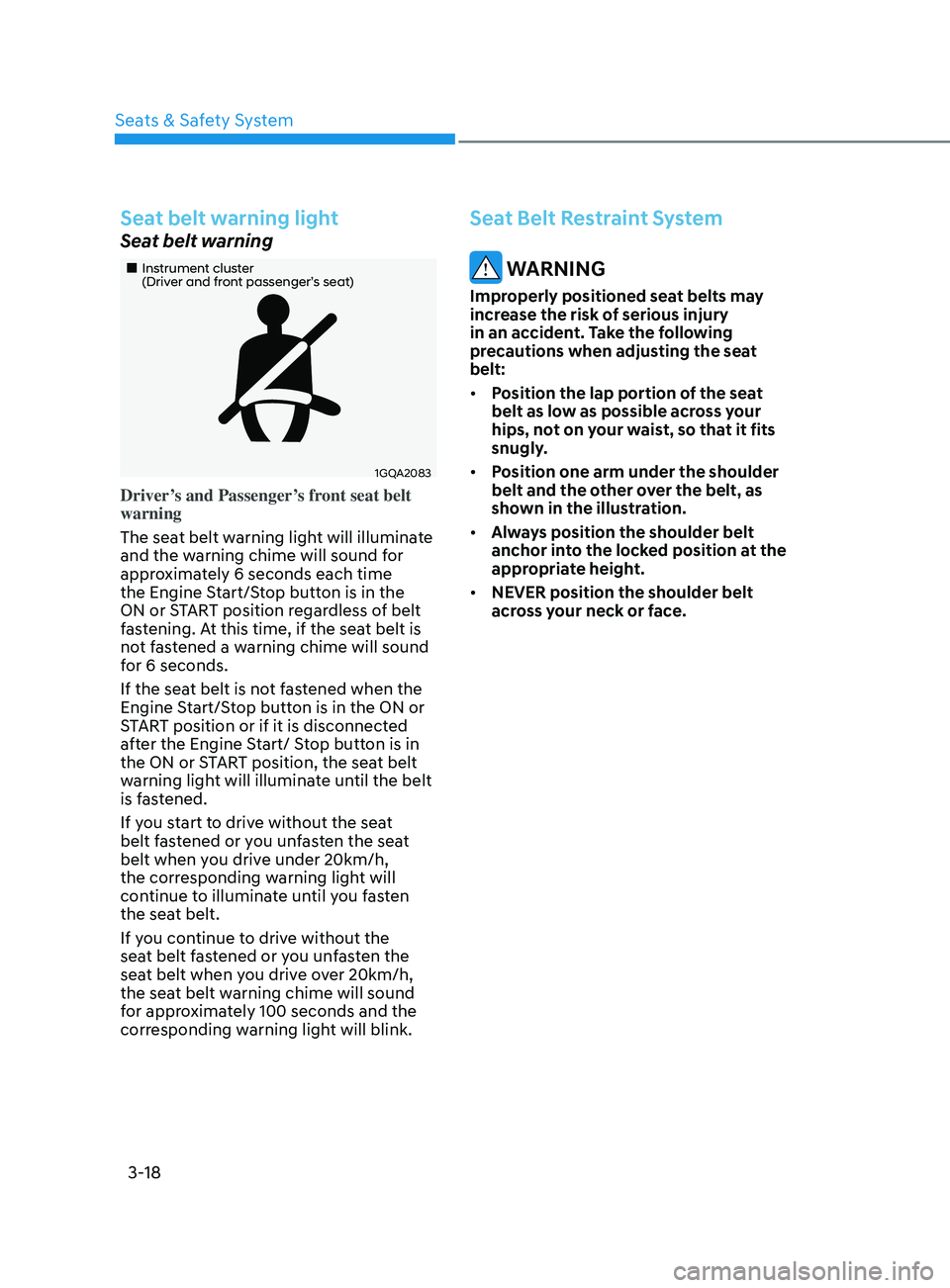
„„Instrument cluster (Driver and front passenger’s seat)
1GQA2083
Driver’s and Passenger’s front seat belt
warning
The seat belt warning light will illuminate
and the warning chime will sound for
approximately 6 seconds each time
the Engine Start/Stop button is in the
ON or START position regardless of belt
fastening. At this time, if the seat belt is
not fastened a warning chime will sound
for 6 seconds.
If the seat belt is not fastened when the
Engine Start/Stop button is in the ON or
START position or if it is disconnected
after the Engine Start/ Stop button is in
the ON or START position, the seat belt
warning light will illuminate until the belt
is fastened.
If you start to drive without the seat
belt fastened or you unfasten the seat
belt when you drive under 20km/h,
the corresponding warning light will
continue to illuminate until you fasten
the seat belt.
If you continue to drive without the
seat belt fastened or you unfasten the
seat belt when you drive over 20km/h,
the seat belt warning chime will sound
for approximately 100 seconds and the
corresponding warning light will blink.
Seat Belt Restraint System
WARNING
Improperly positioned seat belts may
increase the risk of serious injury
in an accident. Take the following
precautions when adjusting the seat
belt:
• Position the lap portion of the seat
belt as low as possible across your
hips, not on your waist, so that it fits
snugly.
• Position one arm under the shoulder
belt and the other over the belt, as
shown in the illustration.
• Always position the shoulder belt
anchor into the locked position at the
appropriate height.
• NEVER position the shoulder belt
across your neck or face.
Seats & Safety System