2021 FORD GT steering
[x] Cancel search: steeringPage 122 of 321
STEERING
To help prevent damage to the power
steering system:
•
Never hold the steering wheel at its
furthest turning points (until it stops)
for more than three to five seconds
when the engine is running.
• Do not operate the vehicle with a low
hydraulic fluid level. See Power
Steering Fluid Check (page 163).
• Some noise is normal during operation.
If excessive, check for low hydraulic
fluid level before seeking service by
your dealer.
• Heavy or uneven efforts may be caused
by low hydraulic fluid. Check for low
hydraulic fluid level before seeking
service by your dealer.
• Do not over fill the hydraulic fluid as
this may result in leaks from the
reservoir. See
Power Steering Fluid
Check (page 163).
If the power steering system breaks down
(or if the engine is off), you can manually
steer the vehicle, but it takes more effort.
If the steering wanders or pulls, check for:
• An improperly inflated tire.
• Uneven tire wear.
• Loose or worn suspension
components.
• Loose or worn steering components.
• Improper vehicle alignment.
A high crown in the road or high crosswinds
may also make the steering seem to
wander or pull. DRIVE MODE CONTROL
Drive Mode Selection
Your vehicle has five selectable drive
modes that deliver an enhanced driving
experience through a suite of sophisticated
electronic vehicle systems. In response to
vehicle use and driving conditions, the
selection of the drive mode optimizes
handling and powertrain response. This
provides a single location to control
multiple systems performance settings.
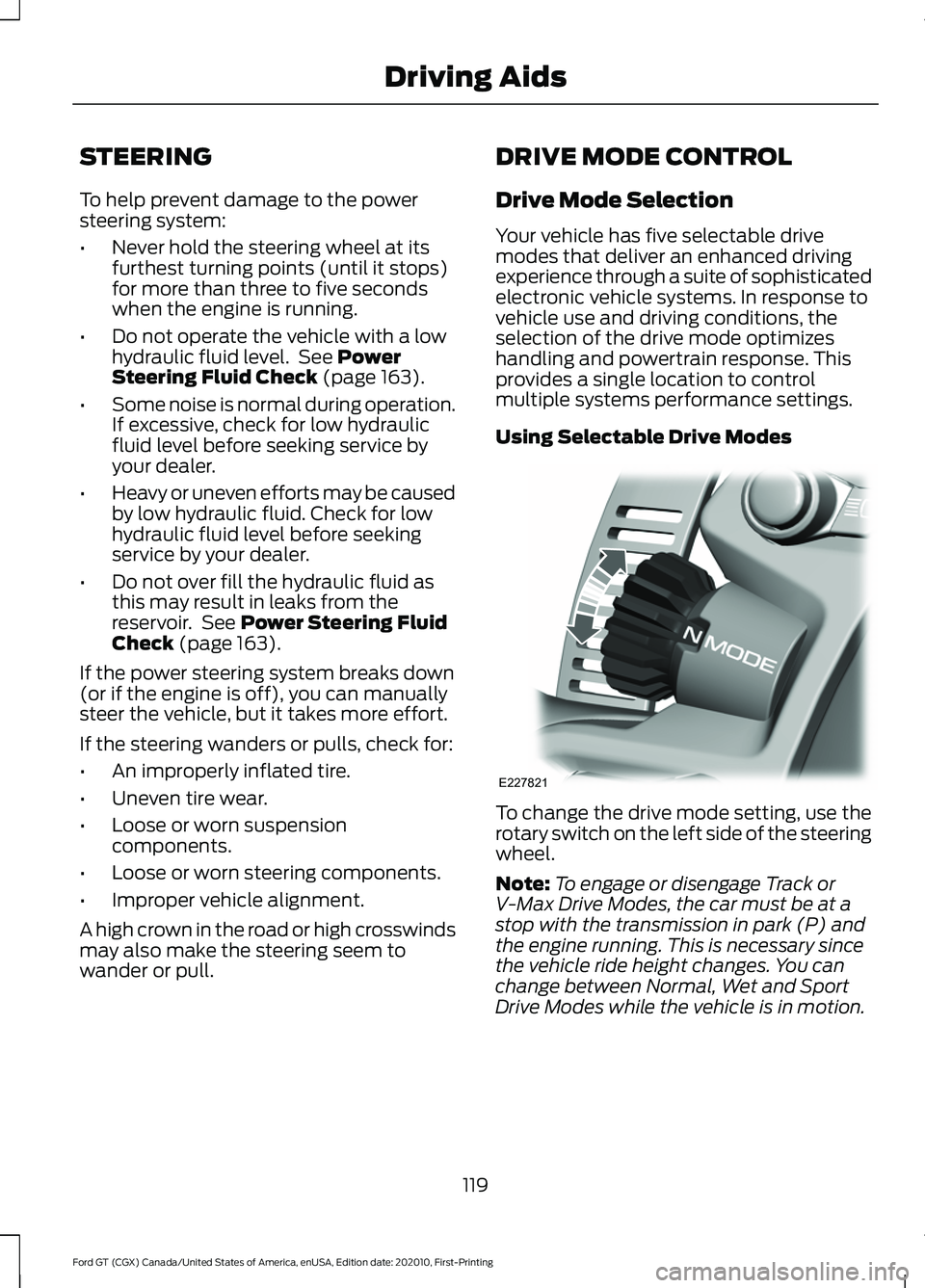
Using Selectable Drive Modes
To change the drive mode setting, use the
rotary switch on the left side of the steering
wheel.
Note:
To engage or disengage Track or
V-Max Drive Modes, the car must be at a
stop with the transmission in park (P) and
the engine running. This is necessary since
the vehicle ride height changes. You can
change between Normal, Wet and Sport
Drive Modes while the vehicle is in motion.
119
Ford GT (CGX) Canada/United States of America, enUSA, Edition date: 202010, First-Printing Driving AidsE227821
Page 133 of 321

TOWING A TRAILER
Note:
Your Ford GT is not designed
for trailer towing. Never tow a
trailer with your Ford GT.
TOWING THE VEHICLE ON
FOUR WHEELS
Emergency Towing
You can release the steering wheel lock by
starting the engine or by pressing the
START/STOP button with your foot off
the brake.
If your Ford GT must be transported,
whenever possible, use an enclosed trailer,
an open car trailer, or a roll back car carrier.
If you must move the car on its wheels,
install the recovery hook provided in the
rear hatch storage. This recovery hook
should be screwed into the receptacle
located in the right corner of the front grille.
Once installed, use the recovery hook to
pull the car. 130
Ford GT (CGX) Canada/United States of America, enUSA, Edition date: 202010, First-Printing TowingE233260
Page 135 of 321

•
Check that the exterior lights work.
• Turn the steering wheel to check that
the steering power assist works.
FLOOR MATS WARNING: Use a floor mat
designed to fit the footwell of your
vehicle that does not obstruct the pedal
area. Failure to follow this instruction
could result in the loss of control of your
vehicle, personal injury or death. WARNING:
Pedals that cannot
move freely can cause loss of vehicle
control and increase the risk of serious
personal injury. WARNING:
Secure the floor mat
to both retention devices so that it
cannot slip out of position and interfere
with the pedals. Failure to follow this
instruction could result in the loss of
control of your vehicle, personal injury or
death. WARNING: Do not place additional
floor mats or any other covering on top
of the original floor mats. This could
result in the floor mat interfering with the
operation of the pedals. Failure to follow
this instruction could result in the loss of
control of your vehicle, personal injury or
death. WARNING:
Always make sure that
objects cannot fall into the driver foot
well while your vehicle is moving. Objects
that are loose can become trapped
under the pedals causing a loss of
vehicle control. To install the floor mats, position the floor
mat eyelet over the retention post and
press down to lock in position. Make sure
the hook and loop fastener is properly
attached to the floor at the front edge of
the driver side floor mat.
To remove the floor mat, reverse the
installation procedure.
Note:
Regularly check the floor mats to
make sure they are secure.
132
Ford GT (CGX) Canada/United States of America, enUSA, Edition date: 202010, First-Printing Driving HintsE142666
Page 153 of 321

Protected Components
Fuse
Rating
Fuse or
Relay
Number
Not used (spare).
20 A 1
5
Not used (spare).
10 A 2
6
Not used (spare).
10 A 2
7
Not used (spare).
10 A 2
8
Brake on-off switch.
10 A 2
9
Push button start switch.
5 A 2
10
Right-hand and left-hand exterior door locks and handles.
5 A 2
11
RF transceiver module.
7.5 A 2
12
Steering column control module logic.
7.5 A 2
13
Smart datalink connector logic.
Instrument cluster.
Extended power mode module.
10 A 2
14
Smart datalink connector power.
10 A 2
15
Decklid release relay.
15 A 1
16
Combined sensor module.
5 A 2
17
Telematics control unit - modem.
5 A 2
18
Not used (spare).
7.5 A 2
19
Front damper controllers.
7.5 A 2
20
Shift indicator module head up display.
5 A 2
21
Interior temperature sensor.
Extended power mode module.
5 A 2
22
Right-hand window switch illumination.
10 A 1
23
Right-hand door lock switch illumination.
150
Ford GT (CGX) Canada/United States of America, enUSA, Edition date: 202010, First-Printing Fuses
Page 154 of 321

Protected Components
Fuse
Rating
Fuse or
Relay
Number
Left-hand door lock switch illumination.
Power mirror/window switch (motor).
Right-hand smart window motor (logic).
Left-hand smart window motor (logic).
Central lock relay.
20 A 1
24
Central unlock relay.
Left-hand smart window motor.
30 A 1
25
Right-hand smart window motor.
30 A 1
26
Not used (spare).
30 A 1
27
Electronic steering column lock (relay supply).
20 A 1
28
Not used (spare).
30 A 1
29
Not used (spare).
30 A 1
30
Not used (spare).
15 A 1
31
SYNC.
10 A 1
32
Audio on/off switch.
Gear shift module.
Heating ventilation and air conditioning electronic control unit
power.
Audio control module.
20 A 1
33
Run-start relay (R12).
30 A 1
34
Steering angle sensor module.
5 A 1
35
Auxiliary power point.
15 A 1
36
Heating ventilation and air conditioning electronic control unit
ignition.
20 A 1
37
Front power distribution box ignition (F1, F3, F20, F22).
151
Ford GT (CGX) Canada/United States of America, enUSA, Edition date: 202010, First-Printing Fuses
Page 159 of 321

UNDER HOOD OVERVIEW
Negative jump start post. See Jump Starting the Vehicle (page 134).
A.
Brake fluid reservoir.
See Brake Fluid Check (page 162).
B.
Cabin air filter access door. See
Cabin Air Filter (page 85).
C.
Washer fluid reservoir. See
Windshield Washers (page 61).
D.
Front hood sensor. See
Warning Lamps and Indicators (page 69).
E.
Hydraulic fluid reservoir for power steering, active aero and active suspension.
See
Power Steering Fluid Check (page 163).
F.
Positive jump start post. See
Jump Starting the Vehicle (page 134).
G.
Front power distribution box. See
Fuse Specification Chart (page 143).
H.
Engine coolant reservoir.
See Engine Coolant Check (page 158).
I.
Rear power distribution box 2. See
Fuse Specification Chart (page 143).
J.
Rear power distribution box 1. See
Fuse Specification Chart (page 143).
K.
Oil cap, reservoir and dipstick. See
Engine Oil Dipstick (page 157).
L.
156
Ford GT (CGX) Canada/United States of America, enUSA, Edition date: 202010, First-Printing MaintenanceE270336
Page 164 of 321

If the engine reaches a preset
over-temperature condition, the engine
automatically switches to alternating
cylinder operation. Each disabled cylinder
acts as an air pump and cools the engine.
When this occurs, your vehicle still
operates, however:
•
Engine power is limited.
• The air conditioning system turns off.
Continued operation increases the engine
temperature, causing the engine to
completely shut down. Your steering and
braking effort increases in this situation.
When the engine temperature cools, you
can re-start the engine. Have your vehicle
checked as soon as possible to minimize
engine damage.
When Fail-Safe Mode Is Activated WARNING: Fail-safe mode is for
use during emergencies only. Operate
your vehicle in fail-safe mode only as
long as necessary to bring your vehicle
to rest in a safe location and seek
immediate repairs. When in fail-safe
mode, your vehicle will have limited
power, will not be able to maintain
high-speed operation, and may
completely shut down without warning,
potentially losing engine power, power
steering assist, and power brake assist,
which may increase the possibility of a
crash resulting in serious injury. WARNING:
Do not remove the
coolant reservoir cap when the engine is
on or the cooling system is hot. Wait 10
minutes for the cooling system to cool
down. Cover the coolant reservoir cap
with a thick cloth to prevent the
possibility of scalding and slowly remove
the cap. Failure to follow this instruction
could result in personal injury. Your vehicle has limited engine power
when in the fail-safe mode, drive your
vehicle with caution. Your vehicle does not
maintain high-speed operation and the
engine may operate poorly.
Remember that the engine is capable of
automatically shutting down to prevent
engine damage. In this situation:
1. Pull off the road as soon as safely
possible and switch the engine off.
2. Contact the Ford GT Concierge to obtain assistance.
See About This
Manual (page 5).
3. If this is not possible, wait a short period for the engine to cool.
4. Check the coolant level. If the coolant level is at or below the minimum mark,
add prediluted coolant immediately.
5. When the engine temperature cools, you can re-start the engine. Have your
vehicle checked as soon as possible to
minimize engine damage.
Note: Driving your vehicle without repair
increases the chance of engine damage.
Engine Coolant Temperature
Management WARNING:
To reduce the risk of
crash and injury, be prepared that the
vehicle speed may reduce and the
vehicle may not be able to accelerate
with full power until the coolant
temperature reduces.
At this time, you may notice the coolant
temperature gauge moves toward the red
zone and a message may appear in the
information display.
161
Ford GT (CGX) Canada/United States of America, enUSA, Edition date: 202010, First-Printing Maintenance
Page 166 of 321

WARNING: Do not allow the fluid
to touch your skin or eyes. If this
happens, rinse the affected areas
immediately with plenty of water and
contact your physician. WARNING:
A fluid level between
the MAX and MIN lines is within the
normal operating range and there is no
need to add fluid. A fluid level not in the
normal operating range could
compromise the performance of the
system. Have your vehicle checked
immediately. To avoid fluid contamination, the reservoir
cap must remain in place and fully tight,
unless you are adding fluid.
Only use fluid that meets Ford
specifications. See
Capacities and
Specifications (page 205). POWER STEERING FLUID
CHECK
The hydraulic fluid reservoir is under the
hood. The fluid is used for power steering,
active aerodynamics and the active
hydraulic suspension. Keep the fluid level
between MIN and MAX marks as shown
on the reservoir.
Note:
This procedure must be followed to
prevent over filling of the reservoir.
1. Start the engine and make sure that the steering wheel is at the straight
ahead position. Do not move the
steering wheel after this time.
2. Allow the engine to idle in Park for 2 minutes then shut the engine off.
3. After the engine has been off for 5 minutes, check the hydraulic fluid level
in the reservoir.
4. The MIN / MAX marks are on the front face of the reservoir. If the level is
above the MIN line on the reservoir DO
NOT add fluid.
5. If the level is below the MIN line, add only enough fluid to bring the level to
a point between the MIN and MAX
lines.
6. DO NOT add fluid past the MAX line.
163
Ford GT (CGX) Canada/United States of America, enUSA, Edition date: 202010, First-Printing MaintenanceE244129 E248557