Page 95 of 191
•
Check that the exterior lights work.
• Turn the steering wheel to check that
the steering power assist works.
92
2021 Motorhome (TY3) Canada/United States of America, enUSA, Edition date: 202010, Second-Printing Driving Hints
Page 112 of 191
Passenger Compartment Fuse Box
WARNING: Always disconnect the
battery before servicing high current
fuses.
Note: If your vehicle has dual batteries,
disconnecting the primary under-hood
battery does not remove power from all
circuits. This fuse panel is below and to the
left-hand side of the steering wheel near
the brake pedal. Remove the panel cover
to access the fuses.
To remove a fuse, use the fuse panel
cover's fuse puller tool.
Replace fuses with the same type and
rating. See
Changing a Fuse (page 111). Protected Component
Fuse
Rating
Fuse
Number
Not used.
—
1
Run/accessory radio feed to body builder.
10 A
2
Not used.
—
3
B+ feed to body builder connector.
20 A
4
Not used.
—
5
Not used.
10 A
6
Smart datalink connector.
10 A
7
109
2021 Motorhome (TY3) Canada/United States of America, enUSA, Edition date: 202010, Second-Printing FusesE145984
Page 117 of 191
UNDER HOOD OVERVIEW - COMMERCIAL CHASSIS
Automatic transmission fluid dipstick. See Automatic Transmission Fluid
Check (page 122).
A
Engine oil dipstick. See
Engine Oil Check (page 116).
B
Brake fluid reservoir. See
Brake Fluid Check (page 124).
C
Power steering fluid reservoir. See
Power Steering Fluid Check (page 126).
D
Air filter assembly. See
Changing the Engine Air Filter (page 117).
E
Engine oil filler cap. See
Engine Oil Check (page 116).
F
Engine compartment fuse box. See
Fuses (page 104).
G
Engine coolant reservoir. See
Engine Coolant Check (page 118).
H
114
2021 Motorhome (TY3) Canada/United States of America, enUSA, Edition date: 202010, Second-Printing MaintenanceE324269
Page 118 of 191
UNDER HOOD OVERVIEW - MOTORHOME CHASSIS
Engine coolant reservoir. See Engine Coolant Check (page 118).
A
Automatic transmission fluid dipstick. See
Automatic Transmission Fluid
Check (page 122).
B
Engine oil dipstick. See
Engine Oil Check (page 116).
C
Engine compartment fuse box. See
Fuses (page 104).
D
Engine oil filler cap. See
Engine Oil Check (page 116).
E
Brake fluid reservoir. See
Brake Fluid Check (page 124).
F
Power steering fluid reservoir. See
Power Steering Fluid Check (page 126).
G
Air filter assembly. See
Changing the Engine Air Filter (page 117).
H
115
2021 Motorhome (TY3) Canada/United States of America, enUSA, Edition date: 202010, Second-Printing MaintenanceE324268
Page 124 of 191

Fail-Safe Cooling
Fail-safe cooling allows you to temporarily
drive your vehicle before any incremental
component damage occurs. The fail-safe
distance depends on ambient
temperature, vehicle load and terrain.
How Fail-Safe Cooling Works
If the engine begins to overheat,
the coolant temperature gauge
moves toward the red zone:
A warning lamp illuminates and
a message may appear in the
information display.
If the engine reaches a preset
over-temperature condition, the engine
automatically switches to alternating
cylinder operation. Each disabled cylinder
acts as an air pump and cools the engine.
When this occurs, your vehicle still
operates, however:
• Engine power is limited.
• The air conditioning system turns off.
Continued operation increases the engine
temperature, causing the engine to
completely shut down. Your steering and
braking effort increases in this situation.
When the engine temperature cools, you
can re-start the engine. Have your vehicle
checked as soon as possible to minimize
engine damage.
When Fail-Safe Mode Is Activated WARNING: Fail-safe mode is for
use during emergencies only. Operate
your vehicle in fail-safe mode only as
long as necessary to bring your vehicle
to rest in a safe location and seek
immediate repairs. When in fail-safe
mode, your vehicle will have limited
power, will not be able to maintain high-speed operation, and may
completely shut down without warning,
potentially losing engine power, power
steering assist, and power brake assist,
which may increase the possibility of a
crash resulting in serious injury.
WARNING:
Do not remove the
coolant reservoir cap when the engine is
on or the cooling system is hot. Wait 10
minutes for the cooling system to cool
down. Cover the coolant reservoir cap
with a thick cloth to prevent the
possibility of scalding and slowly remove
the cap. Failure to follow this instruction
could result in personal injury.
Your vehicle has limited engine power
when in the fail-safe mode, drive your
vehicle with caution. Your vehicle does not
maintain high-speed operation and the
engine may operate poorly.
Remember that the engine is capable of
automatically shutting down to prevent
engine damage. In this situation:
1. Pull off the road as soon as safely possible and switch the engine off.
2. If you are a member of a roadside assistance program, we recommend
that you contact your roadside
assistance service provider.
3. If this is not possible, wait a short period for the engine to cool.
4. Check the coolant level. If the coolant level is at or below the minimum mark,
add prediluted coolant immediately.
5. When the engine temperature cools, you can re-start the engine. Have your
vehicle checked as soon as possible to
minimize engine damage.
Note: Driving your vehicle without repair
increases the chance of engine damage.
121
2021 Motorhome (TY3) Canada/United States of America, enUSA, Edition date: 202010, Second-Printing Maintenance
Page 129 of 191

POWER STEERING FLUID
CHECK Note:
The power steering cap has both a
cold and hot indicator on the dipstick.
1. Start the engine and let it run until it reaches normal operating temperature
(the engine coolant temperature gauge
indicator will be near the center of the
normal area between H and C).
2. While the engine idles, turn the steering
wheel left and right several times.
3. Turn the engine off.
4. Check the fluid level on the dipstick. It should be between the arrows in the
FULL range on the side of the dipstick
with the words MAX. HOT at the top.
Do not add fluid if the level is within
this range.
5. If the fluid is low, add fluid in small amounts, continuously checking the
level until it reaches the FULL range.
Be sure to put the dipstick back in the
reservoir.
Steering linkage lubrication points
There are nine lubrication points on the
steering linkage: See Capacities and
Specifications (page 156).
126
2021 Motorhome (TY3) Canada/United States of America, enUSA, Edition date: 202010, Second-Printing MaintenanceE161557
Page 153 of 191

USING SNOW CHAINS
WARNING: Wheels and tires must
be the same size, load index and speed
rating as those originally fitted on the
vehicle. Use of any other tire or wheel
can affect the safety and performance
of your vehicle. Additionally, the use of
non-recommended tires and wheels can
cause steering, suspension, axle, transfer
case or power transfer unit failure.
Follow the recommended tire inflation
pressures found on the Safety
Compliance Certification label, or the
Tire Label on the B-Pillar or the edge of
the driver door. Failure to follow this
instruction could result in loss of vehicle
control, vehicle rollover, or personal injury
or death.
The tires on your vehicle have all-weather
treads to provide traction in rain and snow.
However, in some climates, you may need
to use snow tires and cables. If you need
to use cables, it is recommended that steel
wheels (of the same size and
specifications) be used, as cables may chip
aluminum wheels. Note:
The suspension insulation and
bumpers help prevent vehicle damage. Do
not remove these components from your
vehicle when using snow tires and chains.
Follow these guidelines when using snow
tires and chains:
• If possible, avoid fully loading your
vehicle.
• Install chains securely, verifying that
the chains do not touch any wiring,
brake lines or fuel lines.
• Drive cautiously. If you hear the chains
rub or bang against your vehicle, stop
and retighten the chains. If this does
not work, remove the chains to prevent
damage to your vehicle.
• Remove the tire chains when they are
no longer needed. Do not use tire
chains on dry roads.
Please contact your coach builder for
approved snow chain types/sizes and
other recommendations for snow chain
use.
150
2021 Motorhome (TY3) Canada/United States of America, enUSA, Edition date: 202010, Second-Printing Wheels and Tires
Page 164 of 191
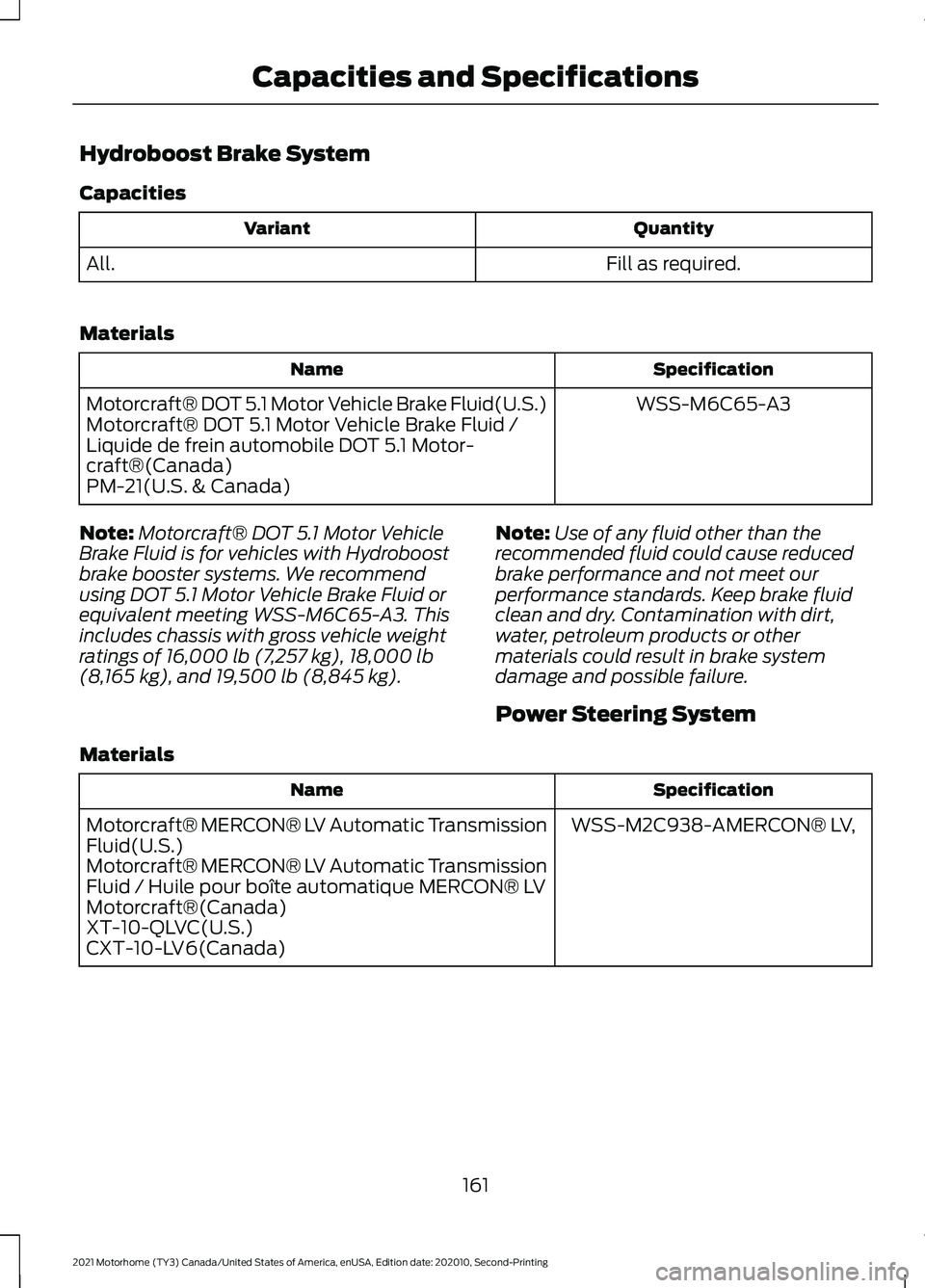
Hydroboost Brake System
Capacities
Quantity
Variant
Fill as required.
All.
Materials Specification
Name
WSS-M6C65-A3
Motorcraft® DOT 5.1 Motor Vehicle Brake Fluid(U.S.)
Motorcraft® DOT 5.1 Motor Vehicle Brake Fluid /
Liquide de frein automobile DOT 5.1 Motor-
craft®(Canada)
PM-21(U.S. & Canada)
Note: Motorcraft® DOT 5.1 Motor Vehicle
Brake Fluid is for vehicles with Hydroboost
brake booster systems. We recommend
using DOT 5.1 Motor Vehicle Brake Fluid or
equivalent meeting WSS-M6C65-A3. This
includes chassis with gross vehicle weight
ratings of 16,000 lb (7,257 kg), 18,000 lb
(8,165 kg), and 19,500 lb (8,845 kg). Note:
Use of any fluid other than the
recommended fluid could cause reduced
brake performance and not meet our
performance standards. Keep brake fluid
clean and dry. Contamination with dirt,
water, petroleum products or other
materials could result in brake system
damage and possible failure.
Power Steering System
Materials Specification
Name
WSS-M2C938-AMERCON® LV,
Motorcraft® MERCON® LV Automatic Transmission
Fluid(U.S.)
Motorcraft® MERCON® LV Automatic Transmission
Fluid / Huile pour boîte automatique MERCON® LV
Motorcraft®(Canada)
XT-10-QLVC(U.S.)
CXT-10-LV6(Canada)
161
2021 Motorhome (TY3) Canada/United States of America, enUSA, Edition date: 202010, Second-Printing Capacities and Specifications


