2021 FORD F-53 weight
[x] Cancel search: weightPage 128 of 191

Hydromax
Chassis with gross vehicle weight ratings
of 20500 pounds (9299 kilograms),
22000 pounds (9979 kilograms), 24000
pounds (10886 kilograms) and 26000
pounds (11793 kilograms) come with
Hydromax Brake Booster Systems. Use
Motorcraft DOT 5.1 Motor Vehicle Brake
Fluid or equivalent meeting Specification
WSS-M6C65-A3. See Capacities and
Specifications (page 156).
Add fluid up to the bottom of the rings at
the top of the reservoir. Do not fill above
this line. •
Use only DOT 5.1 brake fluid certified
to meet our specifications.
• A clear gel-like substance in the
hydraulic brake master cylinder
reservoir could appear on some
vehicles. This substance is a silicone
base lubricant used during assembly
of the master cylinder. It floats on top
of the brake hydraulic fluid in the
master cylinder. This condition is
normal and in no way affects the
operation of the brake system. It does
not require any service.
• Replace brake system fluid on a regular
basis to maintain optimum braking
performance, especially under
heavy-duty driving conditions such as
frequent steep slopes or heavy towing
loads. See
Scheduled Maintenance
(page 168).
Hydroboost
Chassis with gross vehicle weight ratings
of 16000 pounds (7257 kilograms), 18000
pounds (8165 kilograms) and 19500
pounds (8845 kilograms) come with
Hydroboost Brake Booster Systems. Use
Motorcraft DOT 5.1 Motor Vehicle Brake
Fluid or equivalent meeting Specification
WSS-M6C65-A3. See
Capacities and
Specifications (page 156).
Add brake fluid from a clean, unopened
container until the level reaches MAX. Do
not fill above this line. Use only DOT 5.1
brake fluid that is certified to meet our
specifications.
Replace brake system fluid on a regular
basis to maintain optimum braking
performance, especially under heavy-duty
driving conditions such as frequent steep
slopes or heavy towing loads. See
Scheduled Maintenance
(page 168).
125
2021 Motorhome (TY3) Canada/United States of America, enUSA, Edition date: 202010, Second-Printing MaintenanceE161555
Page 138 of 191
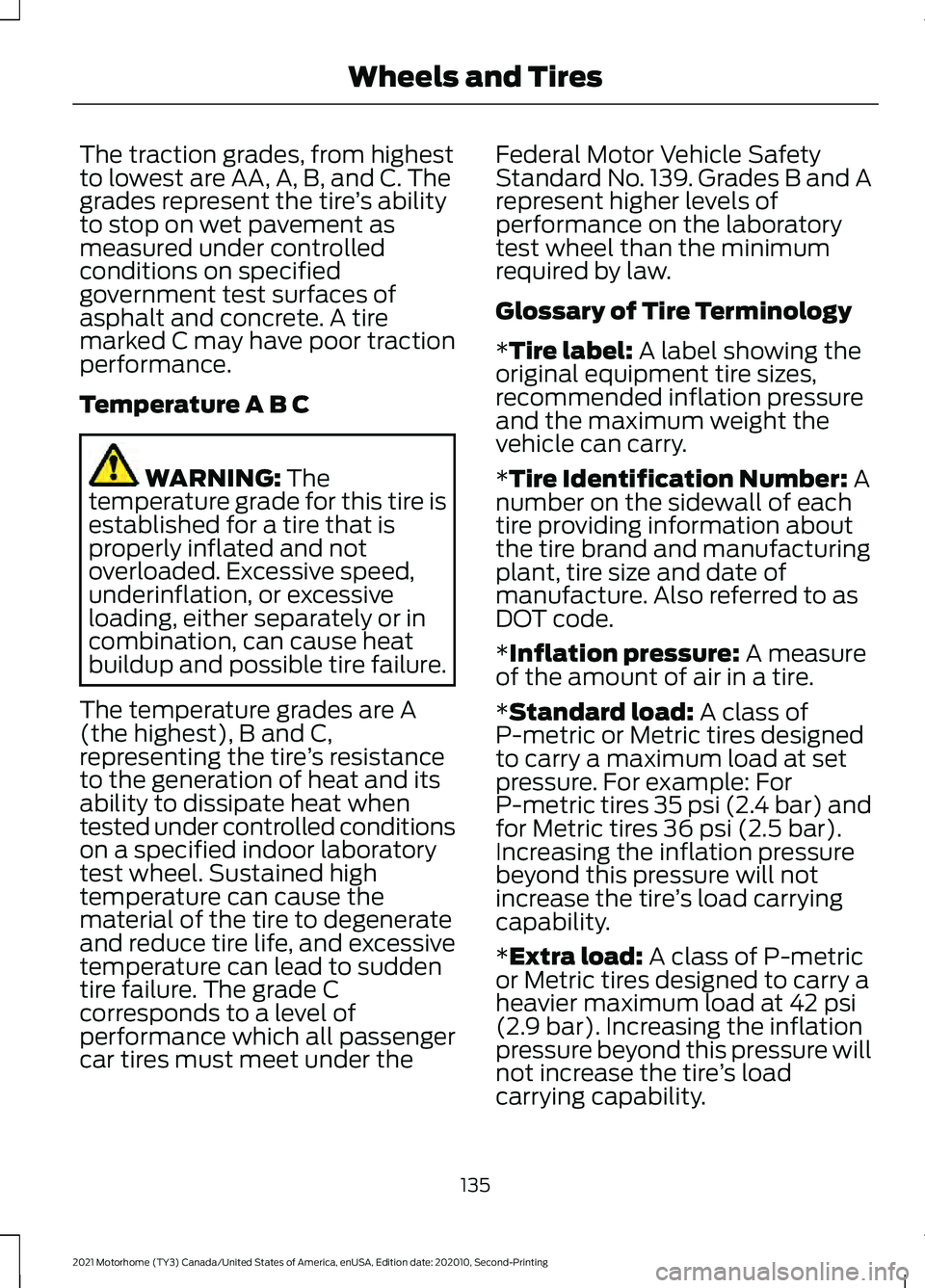
The traction grades, from highest
to lowest are AA, A, B, and C. The
grades represent the tire
’s ability
to stop on wet pavement as
measured under controlled
conditions on specified
government test surfaces of
asphalt and concrete. A tire
marked C may have poor traction
performance.
Temperature A B C WARNING: The
temperature grade for this tire is
established for a tire that is
properly inflated and not
overloaded. Excessive speed,
underinflation, or excessive
loading, either separately or in
combination, can cause heat
buildup and possible tire failure.
The temperature grades are A
(the highest), B and C,
representing the tire ’s resistance
to the generation of heat and its
ability to dissipate heat when
tested under controlled conditions
on a specified indoor laboratory
test wheel. Sustained high
temperature can cause the
material of the tire to degenerate
and reduce tire life, and excessive
temperature can lead to sudden
tire failure. The grade C
corresponds to a level of
performance which all passenger
car tires must meet under the Federal Motor Vehicle Safety
Standard No. 139. Grades B and A
represent higher levels of
performance on the laboratory
test wheel than the minimum
required by law.
Glossary of Tire Terminology
*
Tire label: A label showing the
original equipment tire sizes,
recommended inflation pressure
and the maximum weight the
vehicle can carry.
*
Tire Identification Number: A
number on the sidewall of each
tire providing information about
the tire brand and manufacturing
plant, tire size and date of
manufacture. Also referred to as
DOT code.
*
Inflation pressure: A measure
of the amount of air in a tire.
*
Standard load: A class of
P-metric or Metric tires designed
to carry a maximum load at set
pressure. For example: For
P-metric tires 35 psi (2.4 bar) and
for Metric tires 36 psi (2.5 bar).
Increasing the inflation pressure
beyond this pressure will not
increase the tire ’s load carrying
capability.
*
Extra load: A class of P-metric
or Metric tires designed to carry a
heavier maximum load at 42 psi
(2.9 bar). Increasing the inflation
pressure beyond this pressure will
not increase the tire ’s load
carrying capability.
135
2021 Motorhome (TY3) Canada/United States of America, enUSA, Edition date: 202010, Second-Printing Wheels and Tires
Page 140 of 191

A.
P: Indicates a tire, designated
by the Tire and Rim Association,
that may be used for service on
cars, sport utility vehicles,
minivans and light trucks. Note:
If
your tire size does not begin with
a letter this may mean it is
designated by either the European
Tire and Rim Technical
Organization or the Japan Tire
Manufacturing Association.
B. 215:
Indicates the nominal
width of the tire in millimeters
from sidewall edge to sidewall
edge. In general, the larger the
number, the wider the tire.
C. 65:
Indicates the aspect ratio
which gives the tire's ratio of
height to width.
D. R:
Indicates a radial type tire.
E. 15:
Indicates the wheel or rim
diameter in inches. If you change
your wheel size, you will have to
purchase new tires to match the
new wheel diameter.
F. 95:
Indicates the tire's load
index. It is an index that relates to
how much weight a tire can carry.
You may find this information in
your owner ’s manual. If not,
contact a local tire dealer.
Note: You may not find this
information on all tires because it
is not required by federal law. G.
H:
Indicates the tire's speed
rating. The speed rating denotes
the speed at which a tire is
designed to be driven for extended
periods of time under a standard
condition of load and inflation
pressure. The tires on your vehicle
may operate at different
conditions for load and inflation
pressure. These speed ratings may
need to be adjusted for the
difference in conditions. The
ratings range from 81 mph (130
km/h) to 186 mph (299 km/h).
These ratings are listed in the
following chart.
Note: You may not find this
information on all tires because it
is not required by federal law. Speed rating - mph
(km/h)
Letter
rating
81 (130)
M
87 (140)
N
99 (159)
Q
106 (171)
R
112 (180)
S
118 (190)
T
124 (200)
U
130 (210)
H
149 (240)
V
137
2021 Motorhome (TY3) Canada/United States of America, enUSA, Edition date: 202010, Second-Printing Wheels and Tires
Page 157 of 191

VEHICLE IDENTIFICATION
NUMBER
The Vehicle Identification Number (VIN)
is on the back of the steering member at
one of the following locations.
Note:
The body builder includes an
additional VIN tag that could be on the
driver side of the dash, the A pillar, or near
the driver door.
Motorhome Chassis Commercial Chassis
If you ever find it necessary to
communicate with us about your vehicle,
always include the VIN in your
communication. The VIN contains the
following information:
World manufacturer identifier.
A
Brake system, gross vehicle
weight rating, restraint devices
and their locations.
B
Make, vehicle line, series, body
type.
C
Engine type.
D
Check digit.
E
154
2021 Motorhome (TY3) Canada/United States of America, enUSA, Edition date: 202010, Second-Printing Capacities and SpecificationsE251918 E310570 E142477
Page 163 of 191
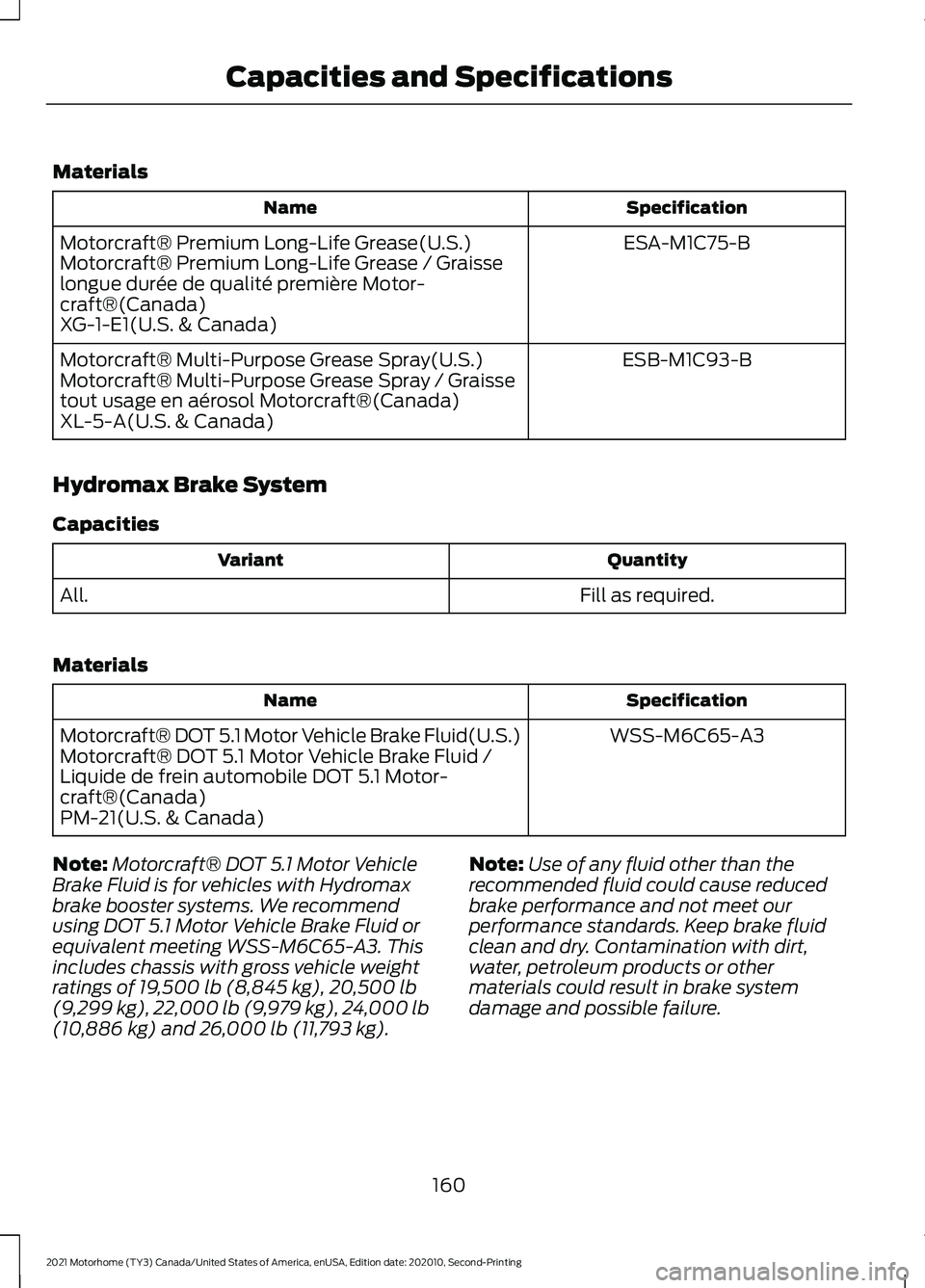
Materials
Specification
Name
ESA-M1C75-B
Motorcraft® Premium Long-Life Grease(U.S.)
Motorcraft® Premium Long-Life Grease / Graisse
longue durée de qualité première Motor-
craft®(Canada)
XG-1-E1(U.S. & Canada)
ESB-M1C93-B
Motorcraft® Multi-Purpose Grease Spray(U.S.)
Motorcraft® Multi-Purpose Grease Spray / Graisse
tout usage en aérosol Motorcraft®(Canada)
XL-5-A(U.S. & Canada)
Hydromax Brake System
Capacities Quantity
Variant
Fill as required.
All.
Materials Specification
Name
WSS-M6C65-A3
Motorcraft® DOT 5.1 Motor Vehicle Brake Fluid(U.S.)
Motorcraft® DOT 5.1 Motor Vehicle Brake Fluid /
Liquide de frein automobile DOT 5.1 Motor-
craft®(Canada)
PM-21(U.S. & Canada)
Note: Motorcraft® DOT 5.1 Motor Vehicle
Brake Fluid is for vehicles with Hydromax
brake booster systems. We recommend
using DOT 5.1 Motor Vehicle Brake Fluid or
equivalent meeting WSS-M6C65-A3. This
includes chassis with gross vehicle weight
ratings of 19,500 lb (8,845 kg), 20,500 lb
(9,299 kg), 22,000 lb (9,979 kg), 24,000 lb
(10,886 kg)
and 26,000 lb (11,793 kg). Note:
Use of any fluid other than the
recommended fluid could cause reduced
brake performance and not meet our
performance standards. Keep brake fluid
clean and dry. Contamination with dirt,
water, petroleum products or other
materials could result in brake system
damage and possible failure.
160
2021 Motorhome (TY3) Canada/United States of America, enUSA, Edition date: 202010, Second-Printing Capacities and Specifications
Page 164 of 191
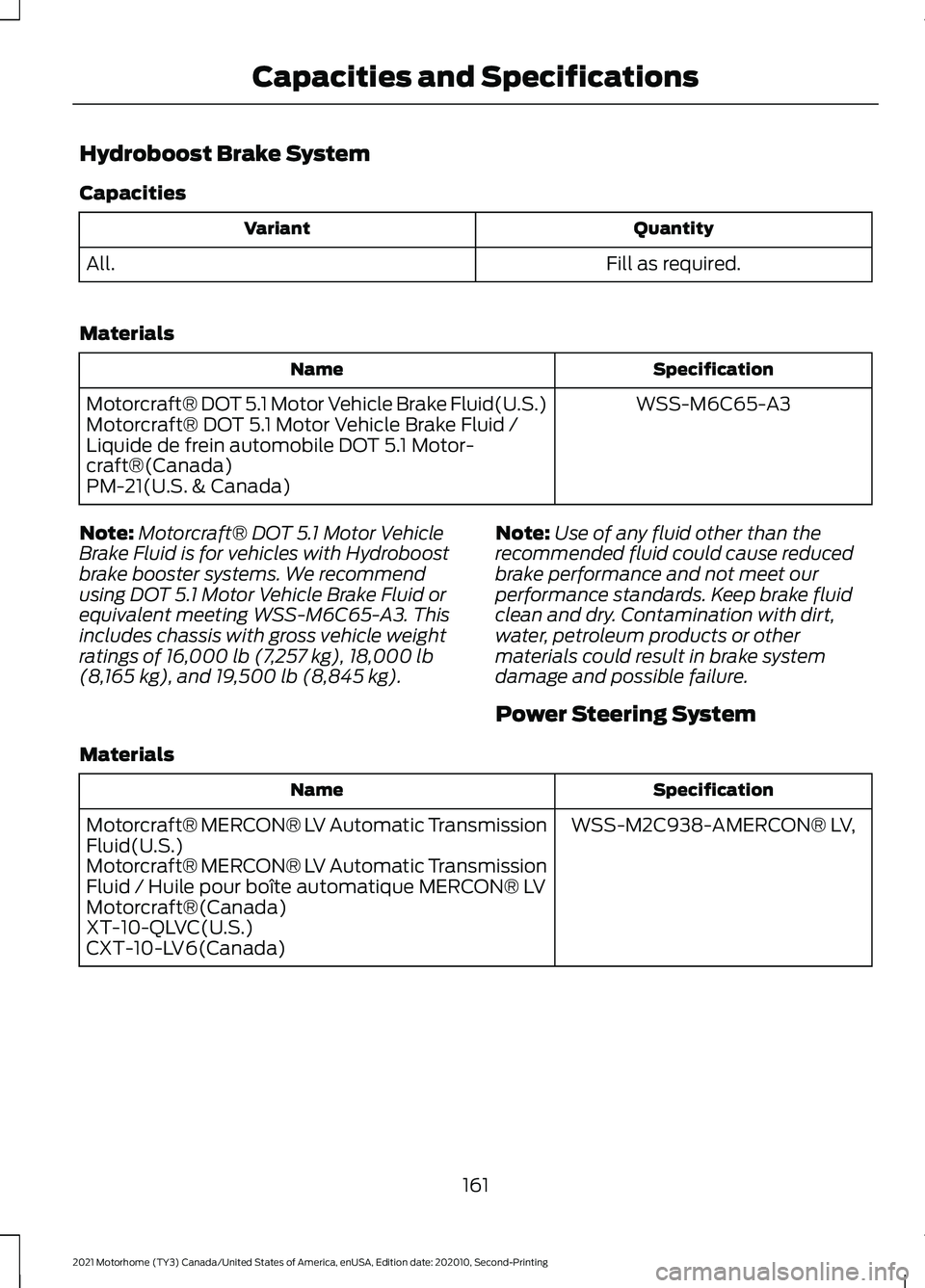
Hydroboost Brake System
Capacities
Quantity
Variant
Fill as required.
All.
Materials Specification
Name
WSS-M6C65-A3
Motorcraft® DOT 5.1 Motor Vehicle Brake Fluid(U.S.)
Motorcraft® DOT 5.1 Motor Vehicle Brake Fluid /
Liquide de frein automobile DOT 5.1 Motor-
craft®(Canada)
PM-21(U.S. & Canada)
Note: Motorcraft® DOT 5.1 Motor Vehicle
Brake Fluid is for vehicles with Hydroboost
brake booster systems. We recommend
using DOT 5.1 Motor Vehicle Brake Fluid or
equivalent meeting WSS-M6C65-A3. This
includes chassis with gross vehicle weight
ratings of 16,000 lb (7,257 kg), 18,000 lb
(8,165 kg), and 19,500 lb (8,845 kg). Note:
Use of any fluid other than the
recommended fluid could cause reduced
brake performance and not meet our
performance standards. Keep brake fluid
clean and dry. Contamination with dirt,
water, petroleum products or other
materials could result in brake system
damage and possible failure.
Power Steering System
Materials Specification
Name
WSS-M2C938-AMERCON® LV,
Motorcraft® MERCON® LV Automatic Transmission
Fluid(U.S.)
Motorcraft® MERCON® LV Automatic Transmission
Fluid / Huile pour boîte automatique MERCON® LV
Motorcraft®(Canada)
XT-10-QLVC(U.S.)
CXT-10-LV6(Canada)
161
2021 Motorhome (TY3) Canada/United States of America, enUSA, Edition date: 202010, Second-Printing Capacities and Specifications
Page 190 of 191

P
Parking Brake...................................................55
Perchlorate.........................................................11
Power Steering Fluid Check......................126
Pre-Collision Assist........................................74
Protecting the Environment........................15
R
Radio Frequency Certification Labels.............................................................176
Cruise Control Module...................................... 176
Recommended Towing Weights..............84
Reduced Engine Performance..................90
Refueling...........................................................43
Replacement Parts Recommendation........................................12
Reporting Safety Defects (Canada Only)...............................................................103
Reporting Safety Defects (U.S. Only)...............................................................102
Resuming the Set Speed.............................61
Roadside Assistance....................................93
Roadside Emergencies
................................93
Running-In See: Breaking-In.................................................... 91
Running Out of Fuel......................................42
S
Safety Precautions
.........................................41
Scheduled Maintenance...........................168
Setting the Cruise Control Speed............60
Snow Chains See: Using Snow Chains.................................. 150
Special Notices................................................12
Special Operating Conditions Scheduled Maintenance................................................173
Speed Control See: Cruise Control............................................. 60
Stability Control.............................................58 Principle of Operation........................................ 58
Starter Switch See: Ignition Switch............................................. 37
Starting a Gasoline Engine..........................37
Starting and Stopping the Engine............37 General Information............................................ 37Steering..............................................................73
Steering Wheel
................................................16
Switching Automatic High Beam Control On and Off
.....................................................22
Switching Cruise Control On and Off....................................................................60
Symbols Glossary.............................................5
T
Technical Specifications See: Capacities and Specifications.............152
The Better Business Bureau (BBB) Auto Line Program (U.S. Only).......................100
Tire Care
...........................................................134
Tires See: Wheels and Tires...................................... 134
Towing a Trailer...............................................83
Towing the Vehicle on Four Wheels.......89
Towing................................................................83
Traction Control
..............................................57
Principle of Operation......................................... 57
Transmission Code Designation
.............155
Transmission...................................................50
Transporting the Vehicle.............................96
U
Under Hood Overview - Commercial Chassis............................................................114
Under Hood Overview - Motorhome Chassis............................................................115
Using Adaptive Cruise Control...................61
Using Snow Chains......................................150
Using Traction Control..................................57
V
Vehicle Care
....................................................130
General Information.......................................... 130
Vehicle Identification Number
.................154
Vehicle Storage..............................................132
VIN See: Vehicle Identification Number.............154
W
Warning Lamps and Indicators
.................27
187
2021 Motorhome (TY3) Canada/United States of America, enUSA, Edition date: 202010, Second-Printing Index