2021 CHRYSLER VOYAGER open hood
[x] Cancel search: open hoodPage 267 of 348

IN CASE OF EMERGENCY265
(Continued)
Inserting Funnel
3. Ensure funnel is inserted fully to hold flapper doors open.
4. Pour fuel into funnel opening.
5. Remove funnel from filler pipe, clean off prior to putting back in the spare tire storage area.
IF YOUR ENGINE OVERHEATS
If the vehicle is overheating, it will need to be
serviced by an authorized dealer.
In any of the following situations, you can reduce
the potential for overheating by taking the
appropriate action.
On the highway — slow down.
In city traffic — while stopped, place the trans -
mission in NEUTRAL (N), but do not increase
engine idle speed.
NOTE:There are steps that you can take to slow down an
impending overheat condition:
If your Air Conditioner (A/C) is on, turn it off. The
A/C system adds heat to the engine cooling
system and turning the A/C off can help remove
this heat.
You can also turn the temperature control to
maximum heat, the mode control to floor and
the blower control to high. This allows the heater
core to act as a supplement to the radiator and
aids in removing heat from the engine cooling
system.
CAUTION!
To avoid fuel spillage and overfilling, do not “top
off” the fuel tank after filling.
WARNING!
Never have any smoking materials lit in or
near the vehicle when the fuel door is open or
the tank is being filled.
Never add fuel when the engine is running.
This is in violation of most state and federal
fire regulations and may cause the Malfunc -
tion Indicator Light to turn on.
A fire may result if fuel is pumped into a
portable container that is inside of a vehicle.
You could be burned. Always place fuel
containers on the ground while filling.
WARNING!
WARNING!
You or others can be badly burned by hot engine
coolant (antifreeze) or steam from your radiator.
If you see or hear steam coming from under the
hood, do not open the hood until the radiator
has had time to cool. Never try to open a cooling
system pressure cap when the radiator or
coolant bottle is hot.
CAUTION!
Driving with a hot cooling system could damage
your vehicle. If temperature gauge reads “H”,
pull over and stop the vehicle. Idle the vehicle
with the air conditioner turned off until the
pointer drops back into the normal range. If the
pointer remains on the “H”, turn the engine off
immediately, and call for service.
7
21_RUV_OM_EN_USC_t.book Page 265
Page 288 of 348

286SERVICING AND MAINTENANCE
Under normal operating conditions, the catalytic
converter will not require maintenance. However, it
is important to keep the engine properly tuned to
ensure proper catalyst operation and prevent
possible catalyst damage.
NOTE:Intentional tampering with emissions control
systems can result in civil penalties being
assessed against you.
In unusual situations involving grossly
malfunctioning engine operation, a scorching odor
may suggest severe and abnormal catalyst
overheating. If this occurs, stop the vehicle, turn off
the engine and allow it to cool. Service, including a
tune-up to the manufacturer specifications, should
be obtained immediately.
To minimize the possibility of catalytic converter
damage:
Do not interrupt the ignition when the transmis -
sion is in gear and the vehicle is in motion.
Do not try to start the vehicle by pushing or
towing the vehicle.
Do not idle the engine with any ignition compo -
nents disconnected or removed, such as when
diagnostic testing, or for prolonged periods
during very rough idle or malfunctioning oper -
ating conditions.
COOLING SYSTEM
Engine Coolant Checks
Check the engine coolant (antifreeze) protection
every 12 months (before the onset of freezing
weather, where applicable). If the engine coolant is
dirty, the system should be drained, flushed, and
refilled with fresh Organic Additive Technology
(OAT) coolant (conforming to MS.90032) by an authorized dealer. Check the front of the A/C
condenser for any accumulation of bugs, leaves,
etc. If dirty, clean by gently spraying water from a
garden hose vertically down the face of the
condenser.
Check the engine cooling system hoses for brittle
rubber, cracking, tears, cuts, and tightness of the
connection at the coolant recovery bottle and
radiator. Inspect the entire system for leaks. DO
NOT REMOVE THE COOLANT PRESSURE CAP
WHEN THE COOLING SYSTEM IS HOT.
Cooling System — Drain, Flush And Refill
NOTE:Some vehicles require special tools to add coolant
properly. Failure to fill these systems properly
could lead to severe internal engine damage. If any
coolant is needed to be added to the system
please contact an authorized dealer.
If the engine coolant (antifreeze) is dirty
or contains visible sediment, have an authorized
dealer clean and flush with Organic Additive
Technology (OAT) coolant (conforming to
MS.90032).
For the proper maintenance intervals
Úpage 272.
WARNING!
You or others can be badly burned by hot
engine coolant (antifreeze) or steam from your
radiator. If you see or hear steam coming from
under the hood, do not open the hood until the
radiator has had time to cool. Never open a
cooling system pressure cap when the radi
-
ator or coolant bottle is hot.
Keep hands, tools, clothing, and jewelry away
from the radiator cooling fan when the hood is
raised. The fan starts automatically and may
start at any time, whether the engine is
running or not.
When working near the radiator cooling fan,
disconnect the fan motor lead or turn the igni -
tion to the OFF mode. The fan is temperature
controlled and can start at any time the igni -
tion is in the ON mode.
21_RUV_OM_EN_USC_t.book Page 286
Page 291 of 348

SERVICING AND MAINTENANCE289
(Continued)
Make sure that the coolant expansion bottle
overflow hoses are not kinked or obstructed.
Keep the front of the radiator clean. If your
vehicle is equipped with air conditioning, keep
the front of the condenser clean.
Do not change the thermostat for Summer or
Winter operation. If replacement is ever neces -
sary, install ONLY the correct type thermostat.
Other designs may result in unsatisfactory
engine cooling performance, poor gas mileage,
and increased emissions.
BRAKE SYSTEM
In order to ensure brake system performance, all
brake system components should be inspected
periodically. For the proper maintenance intervals
Úpage 272.
Brake Master Cylinder
The fluid in the master cylinder should be checked
when performing under hood services or
immediately if the “Brake Warning Light” is
illuminated.
Be sure to clean the top of the master cylinder area
before removing the cap. If necessary, add fluid to
bring the fluid level up to the requirements
described on the brake fluid reservoir. With disc
brakes, fluid level can be expected to fall as the
brake pads wear. Brake fluid level should be
checked when pads are replaced. However, low
fluid level may be caused by a leak and a checkup
may be needed.
Use only manufacturer recommended brake fluid
Úpage 327.
WARNING!
Riding the brakes can lead to brake failure and
possibly a collision. Driving with your foot resting
or riding on the brake pedal can result in
abnormally high brake temperatures, excessive
lining wear, and possible brake damage. You
would not have your full braking capacity in an
emergency.
WARNING!
Use only manufacturer recommended brake
fluid Úpage 327. Using the wrong type of
brake fluid can severely damage your brake
system and/or impair its performance. The
proper type of brake fluid for your vehicle is
also identified on the original factory installed
hydraulic master cylinder reservoir.
To avoid contamination from foreign matter or
moisture, use only new brake fluid or fluid that
has been in a tightly closed container. Keep
the master cylinder reservoir cap secured at
all times. Brake fluid in a open container
absorbs moisture from the air resulting in a
lower boiling point. This may cause it to boil
unexpectedly during hard or prolonged
braking, resulting in sudden brake failure. This
could result in a collision.
Overfilling the brake fluid reservoir can result
in spilling brake fluid on hot engine parts,
causing the brake fluid to catch fire. Brake
fluid can also damage painted and vinyl
surfaces, care should be taken to avoid its
contact with these surfaces.
Do not allow petroleum-based fluid to contam -
inate the brake fluid. Brake seal components
could be damaged, causing partial or
complete brake failure. This could result in a
collision.
WARNING!
8
21_RUV_OM_EN_USC_t.book Page 289
Page 303 of 348
SERVICING AND MAINTENANCE301
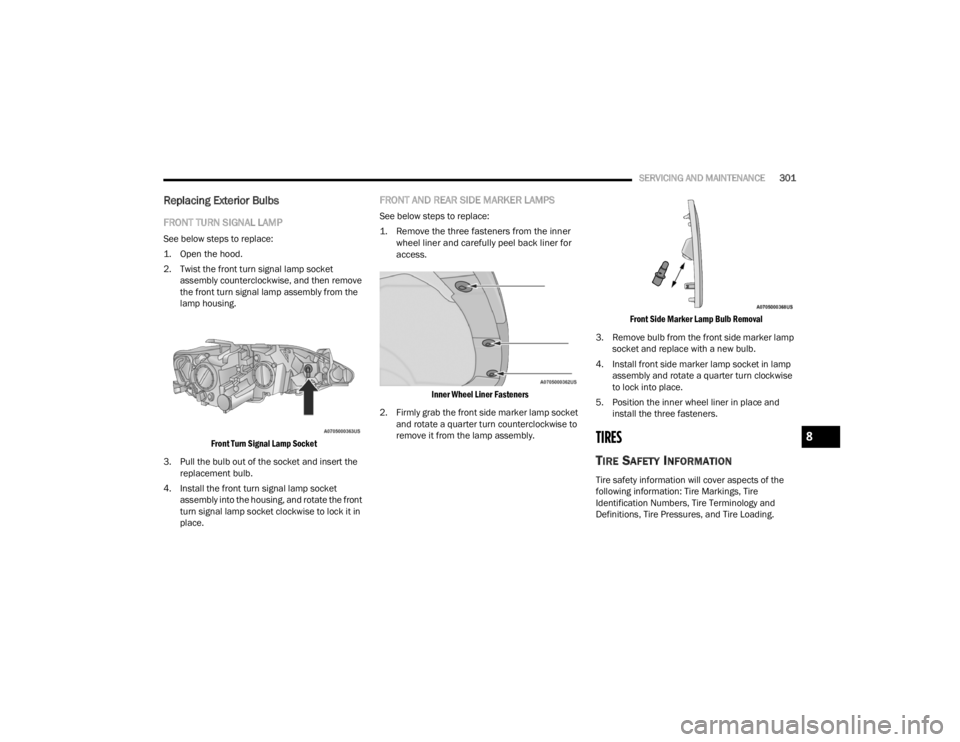
Replacing Exterior Bulbs
FRONT TURN SIGNAL LAMP
See below steps to replace:
1. Open the hood.
2. Twist the front turn signal lamp socket
assembly counterclockwise, and then remove
the front turn signal lamp assembly from the
lamp housing.
Front Turn Signal Lamp Socket
3. Pull the bulb out of the socket and insert the replacement bulb.
4. Install the front turn signal lamp socket assembly into the housing, and rotate the front
turn signal lamp socket clockwise to lock it in
place.
FRONT AND REAR SIDE MARKER LAMPS
See below steps to replace:
1. Remove the three fasteners from the inner wheel liner and carefully peel back liner for
access.
Inner Wheel Liner Fasteners
2. Firmly grab the front side marker lamp socket and rotate a quarter turn counterclockwise to
remove it from the lamp assembly.
Front Side Marker Lamp Bulb Removal
3. Remove bulb from the front side marker lamp socket and replace with a new bulb.
4. Install front side marker lamp socket in lamp assembly and rotate a quarter turn clockwise
to lock into place.
5. Position the inner wheel liner in place and install the three fasteners.
TIRES
TIRE SAFETY INFORMATION
Tire safety information will cover aspects of the
following information: Tire Markings, Tire
Identification Numbers, Tire Terminology and
Definitions, Tire Pressures, and Tire Loading.
8
21_RUV_OM_EN_USC_t.book Page 301
Page 337 of 348

335
Fluid Level Checks Brake
........................................................ 289Engine Oil.................................................. 276Fluid, Brake................................................... 327Fog Lights................................................. 53, 54Fold In Floor (Stow ‘n Go) Seating.................... 37Fold-Flat Seats................................................. 28Forward Collision Warning............................. 196Freeing A Stuck Vehicle................................. 267Front Position Light........................................ 301Fuel............................................................... 323Additives................................................... 325Clean Air.................................................... 324Ethanol...................................................... 324Filler Cap (Gas Cap)................................... 129Gasoline.................................................... 323Materials Added........................................ 325Methanol................................................... 324Octane Rating................................. 323, 326Requirements........................................... 323Specifications............................................ 326Tank Capacity............................................ 326Fuses............................................................. 290
G
Garage Door Opener (HomeLink).................... 50Gas Cap (Fuel Filler Cap)............................... 129Gasoline, (Fuel)............................................. 323Gasoline, Clean Air........................................ 324Gasoline, Reformulated................................. 324
Gear Ranges................................................. 115Glass Cleaning.............................................. 321Gross Axle Weight Rating.............................. 131Gross Vehicle Weight Rating......................... 131GVWR............................................................ 129
H
HazardDriving Through Flowing, Rising,Or Shallow Standing Water
.................. 140Hazard Warning Flashers.............................. 245Head Restraints............................................... 43Headlights....................................................... 53Cleaning................................................... 319High Beam/Low Beam Select Switch.......... 53Lights On Reminder.............................. 53, 54Passing................................................. 53, 54Switch.......................................................... 53Time Delay................................................... 53Heated Mirrors................................................. 48Heated Seats................................................... 43Heater, Engine Block.................................... 110Hill Start Assist.............................................. 190HitchesTrailer Towing........................................... 132HomeLink (Garage Door Opener)..................... 50Hood Prop........................................................ 80Hood Release.................................................. 80Hook, Coat....................................................... 74
I
Ignition.............................................................15Switch..........................................................15Inside Rearview Mirror........................... 48, 245Instrument Cluster...........................................88Descriptions.............................................. 103Display.........................................................88Display Controls...........................................89KeySense Message.....................................90Menu Items.................................................91Instrument Panel Lens Cleaning................... 321Interior And Instrument Lights.........................55Interior Appearance Care.............................. 320Interior Lights...................................................55Intermittent Wipers (Delay Wipers)..................57Introduction....................................................... 7
J
Jack Location................................................ 250Jack Operation.............................................. 249Jump Starting................................................ 262
K
Key Fob............................................................12Arm The System...........................................19Disarm The Alarm........................................19Programming Additional Key Fobs...............14Key Fob Battery Service
(Remote Keyless Entry)....................................13
11
21_RUV_OM_EN_USC_t.book Page 335
Page 341 of 348

339
Spare Tire Changing
...................................... 249Spare Tire Stowage....................................... 256Spare Tires........................ 250, 313, 314, 315Specifications Oil.............................................................. 326Speed ControlCancel....................................................... 122Resume..................................................... 122Starting................................................... 16, 106Button......................................................... 15Cold Weather............................................ 109Engine Fails To Start................................. 109Remote....................................................... 16Starting And Operating.................................. 106Starting Procedures....................................... 106Steering......................................................... 118Tilt Column.................................................. 27Wheel, Heated............................................. 27Wheel, Tilt................................................... 27Steering Wheel Audio Controls...................... 159Steering Wheel Mounted Sound System.......159Store Radio Presets....................................... 166Stow ‘n Go (Fold In Floor) Seats....................... 37Stuck, Freeing............................................... 267Sunglasses Storage......................................... 71Supplemental Restraint System – Air Bag..... 214Sway Control, Trailer...................................... 191Symbol Glossary................................................ 8Synthetic Engine Oil....................................... 278System, Remote Starting................................. 16
T
Telescoping Steering Column.......................... 27Temperature Control, Automatic (ATC)............. 69Tie Down Hooks, Cargo.................................... 82Tilt Steering Column........................................ 27Time DelayHeadlight..................................................... 53Tire And Loading Information Placard........... 306Tire Markings................................................ 302Tire Safety Information................................. 301Tire Service Kit.............................................. 257Tire Stowage................................................. 256Tires......................... 243, 309, 313, 314, 318Aging (Life Of Tires).................................. 312Air Pressure.............................................. 309Chains...................................................... 316Changing.................................................. 249Compact Spare......................................... 314General Information............... 309, 313, 314High Speed............................................... 310Inflation Pressure..................................... 310Jacking............................................ 249, 251Life Of Tires.............................................. 312Load Capacity........................................... 306Pressure Monitoring System(TPMS)................................. 91, 101, 199Quality Grading......................................... 318Radial....................................................... 310Replacement............................................ 312Rotation.................................................... 317
Safety.............................................. 301, 309Sizes......................................................... 303Snow Tires................................................ 313Spare Tires................... 250, 313, 314, 315Spinning................................................... 311Trailer Towing........................................... 136Tread Wear Indicators.............................. 311Wheel Nut Torque..................................... 322To Open Hood..................................................80Tongue Weight/Trailer Weight...................... 134Towing........................................................... 130Disabled Vehicle....................................... 268Guide........................................................ 132Recreational............................................. 138Weight...................................................... 132Towing Behind A Motorhome........................ 138Traction......................................................... 139Traction Control............................................ 191Trailer Sway Control (TSC)............................. 191Trailer Towing................................................ 130Hitches..................................................... 132Minimum Requirements........................... 135Tips........................................................... 137Trailer And Tongue Weight........................ 134Wiring....................................................... 136Trailer Towing Guide..................................... 132Trailer Weight................................................ 132TransaxleAutomatic................................................. 113Operation.................................................. 113
11
21_RUV_OM_EN_USC_t.book Page 339