2021 CHRYSLER 300 wheel size
[x] Cancel search: wheel sizePage 163 of 268
SAFETY 161
Seat belts are necessary for your protection in all
collisions, and also are needed to help keep you in
position, away from an inflating air bag.
When the Occupant Restraint Controller (ORC)
de
tects a collision requiring the front air bags, it
signals the inflator units. A large quantity of
non-toxic gas is generated to inflate the front air
bags.
The steering wheel hub trim cover and the upper
p a
ssenger side of the instrument panel separate
and fold out of the way as the air bags inflate to
their full size. The front air bags fully inflate in less
time than it takes to blink your eyes. The front air
bags then quickly deflate while helping to restrain
the driver and front passenger.
Knee Impact Bolsters
The Knee Impact Bolsters help protect the knees
of the driver and front passenger, and position the
front occupants for improved interaction with the
front air bags.
Supplemental Driver Knee Air Bag
This vehicle is equipped with a Supplemental
Driver Knee Air Bag mounted in the instrument
panel below the steering column. The
Supplemental Driver Knee Air Bag provides
enhanced protection during a frontal impact by
working together with the seat belts,
pretensioners, and front air bags.
Supplemental Side Air Bags
Supplemental Seat-Mounted Side Air Bags (SABs)
This vehicle is equipped with Supplemental
S e
at-Mounted Side Air Bags (SABs).
Supplemental Seat-Mounted Side Air Bags (SABs)
ar
e located in the outboard side of the front seats.
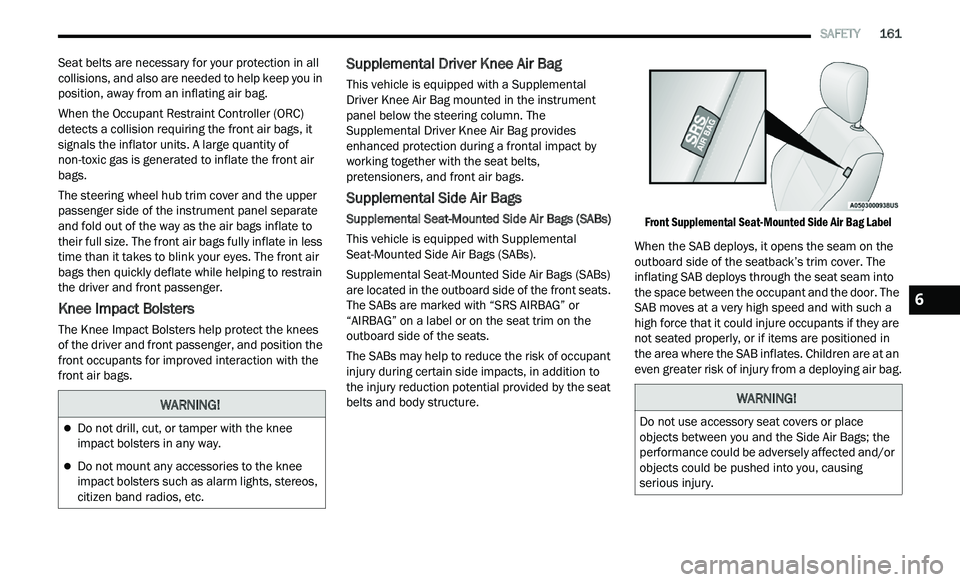
The SABs are marked with “SRS AIRBAG” or
“AIRBAG” on a label or on the seat trim on the
outboard side of the seats.
The SABs may help to reduce the risk of occupant
i n
jury during certain side impacts, in addition to
the injury reduction potential provided by the seat
belts and body structure.
Front Supplemental Seat-Mounted Side Air Bag Label
When the SAB deploys, it opens the seam on the
ou t
board side of the seatback’s trim cover. The
inflating SAB deploys through the seat seam into
the space between the occupant and the door. The
SAB moves at a very high speed and with such a
high force that it could injure occupants if they are
not seated properly, or if items are positioned in
the area where the SAB inflates. Children are at an
even greater risk of injury from a deploying air bag.
WARNING!
Do not drill, cut, or tamper with the knee
impact bolsters in any way.
Do not mount any accessories to the knee
impact bolsters such as alarm lights, stereos,
citizen band radios, etc.
WARNING!
Do not use accessory seat covers or place
objects between you and the Side Air Bags; the
performance could be adversely affected and/or
objects could be pushed into you, causing
serious injury.
6
Page 165 of 268

SAFETY 163
(Continued)
NOTE:
Air bag covers may not be obvious in the interior
t r
im, but they will open during air bag deployment.
Rollover Events
Side Air Bags and seat belt pretensioners are
d e
signed to activate in certain rollover events. The
Occupant Restraint Controller (ORC) determines
whether deployment in a particular rollover event
is appropriate, based on the severity and type of
collision. Vehicle damage by itself is not a good
indicator of whether or not Side Air Bags and seat
belt pretensioners should have deployed.
The Side Air Bags and seat belt pretensioners will
n ot
deploy in all rollover events. The rollover
sensing system determines if a rollover event may
be in progress and whether deployment is
appropriate. In the event the vehicle experiences a
rollover or near rollover event, and deployment is
appropriate, the rollover sensing system will deploy
the Side Air Bags and seat belt pretensioners on
both sides of the vehicle. The SABICs may help reduce the risk of partial or
c
om
plete ejection of vehicle occupants through
side windows in certain rollover or side impact
events.
Air Bag System Components
NOTE:
The Occupant Restraint Controller (ORC) monitors
t h
e internal circuits and interconnecting wiring
associated with electrical Air Bag System Compo -
nents listed below:
Occupant Restraint Controller (ORC)
Air Bag Warning Light
Steering Wheel and Column
Instrument Panel
Knee Impact Bolsters
Driver and Front Passenger Air Bags
Seat Belt Buckle Switch
Supplemental Side Air Bags
Supplemental Knee Air Bags
Front and Side Impact Sensors
Seat Belt Pretensioners
Seat Track Position Sensors
WARNING!
Occupants, including children, who are up
against or very close to Side Air Bags can be
seriously injured or killed. Occupants,
including children, should never lean on or
sleep against the door, side windows, or area
where the side air bags inflate, even if they are
in an infant or child restraint.
Seat belts (and child restraints where appro -
priate) are necessary for your protection in all
c ol
lisions. They also help keep you in position,
away from an inflating Side Air Bag. To get the
best protection from the Side Air Bags, occu -
pants must wear their seat belts properly and
s i
t upright with their backs against the seats.
Children must be properly restrained in a child
restraint or booster seat that is appropriate for
the size of the child.
WARNING!
Side Air Bags need room to inflate. Do not lean
against the door or window. Sit upright in the
center of the seat.
Being too close to the Side Air Bags during
deployment could cause you to be severely
injured or killed.
Relying on the Side Air Bags alone could lead
to more severe injuries in a collision. The Side
Air Bags work with your seat belt to restrain
you properly. In some collisions, Side Air Bags
won’t deploy at all. Always wear your seat belt
even though you have Side Air Bags.
WARNING!
6
Page 237 of 268

SERVICING AND MAINTENANCE 235
NOTE:
Wheel valve stem must be replaced as well when
i n
stalling new tires due to wear and tear in existing
tires.
Keep dismounted tires in a cool, dry place with as
l i
ttle exposure to light as possible. Protect tires
from contact with oil, grease, and gasoline.
Replacement Tires
The tires on your new vehicle provide a balance of
many characteristics. They should be inspected
regularly for wear and correct cold tire inflation
pressures. The manufacturer strongly
recommends that you use tires equivalent to the
originals in size, quality and performance when
replacement is needed
Ú page 234. Refer to the
Tire and Loading Information placard or the
V e
hicle Certification Label for the size designation
of your tire. The Load Index and Speed Symbol for
your tire will be found on the original equipment
tire sidewall.
See the Tire Sizing Chart example found in the “Tire
S a
fety Information” section of this manual for
more information relating to the Load Index and
Speed Symbol of a tire
Ú page 225.
It is recommended to replace the two front tires or
t w
o rear tires as a pair. Replacing just one tire can
seriously affect your vehicle’s handling. If you ever
replace a wheel, make sure that the wheel’s
specifications match those of the original wheels. It is recommended you contact an authorized tire
d
e
aler or original equipment dealer with any
questions you may have on tire specifications or
capability. Failure to use equivalent replacement
tires may adversely affect the safety, handling, and
ride of your vehicle.
TIRE TYPES
All Season Tires — If Equipped
All Season tires provide traction for all seasons
(Spring, Summer, Autumn, and Winter). Traction
levels may vary between different all season tires.
All season tires can be identified by the M+S, M&S,
M/S or MS designation on the tire sidewall. Use all
season tires only in sets of four; failure to do so
may adversely affect the safety and handling of
your vehicle.
Summer Or Three Season Tires —
If Equipped
Summer tires provide traction in both wet and dry
conditions, and are not intended to be driven in
snow or on ice. If your vehicle is equipped with
Summer tires, be aware these tires are not
designed for Winter or cold driving conditions.
Install Winter tires on your vehicle when ambient
temperatures are less than 40°F (5°C) or if roads
are covered with ice or snow. For more
information, contact an authorized dealer.
WARNING!
Do not use a tire, wheel size, load rating, or
speed rating other than that specified for your
vehicle. Some combinations of unapproved
tires and wheels may change suspension
dimensions and performance characteristics,
resulting in changes to steering, handling, and
braking of your vehicle. This can cause unpre -
dictable handling and stress to steering and
s u
spension components. You could lose
control and have a collision resulting in
serious injury or death. Use only the tire and
wheel sizes with load ratings approved for
your vehicle.
Never use a tire with a smaller load index or
capacity, other than what was originally
equipped on your vehicle. Using a tire with a
smaller load index could result in tire over -
loading and failure. You could lose control and
h a
ve a collision.
Failure to equip your vehicle with tires having
adequate speed capability can result in
sudden tire failure and loss of vehicle control.
CAUTION!
Replacing original tires with tires of a different
size may result in false speedometer and
odometer readings.
8
Page 238 of 268
236 SERVICING AND MAINTENANCE
Summer tires do not contain the all season
designation or mountain/snowflake symbol on the
tire sidewall. Use Summer tires only in sets of four;
failure to do so may adversely affect the safety and
handling of your vehicle.
Snow Tires
Some areas of the country require the use of snow
tires during the Winter. Snow tires can be identified
by a “mountain/snowflake” symbol on the tire
sidewall.
If you need snow tires, select tires
equivalent in size and type to the original
eq
uipment tires. Use snow tires only in
sets of four; failure to do so may
adversely affect the safety and handling of your
vehicle.
Snow tires generally have lower speed ratings than
w h
at was originally equipped with your vehicle and
should not be operated at sustained speeds over
75 mph (120 km/h). For speeds above 75 mph
( 1
20 km/h) refer to original equipment or an a
u thorized tire dealer for recommended safe
operating speeds, loading and cold tire inflation
pressures.
While studded tires improve performance on ice,
s k
id and traction capability on wet or dry surfaces
may be poorer than that of non-studded tires.
Some states prohibit studded tires; therefore, local
laws should be checked before using these tire
types.
SPARE TIRES — IF EQUIPPED
For restrictions when towing with a spare tire
designated for temporary emergency use
Ú page 117.
Spare Tire Matching Original Equipped Tire
And Wheel — If Equipped
Your vehicle may be equipped with a spare tire and
wheel equivalent in look and function to the
original equipment tire and wheel found on the
front or rear axle of your vehicle. This spare tire
may be used in the tire rotation for your vehicle. If your vehicle has this option, refer to an authorized
tire dealer for the recommended tire rotation
pattern.
Compact Spare Tire — If Equipped
The compact spare is for temporary emergency
use only. You can identify if your vehicle is
equipped with a compact spare by looking at the
spare tire description on the Tire and Loading
Information Placard located on the driver’s side
door opening or on the sidewall of the tire.
Compact spare tire descriptions begin with the
letter “T” or “S” preceding the size designation.
Example: T145/80D18 103M.
T, S = Temporary Spare Tire
Since this tire has limited tread life, the original
e
q
uipment tire should be repaired (or replaced)
and reinstalled on your vehicle at the first
opportunity.
Do not install a wheel cover or attempt to mount a
con
ventional tire on the compact spare wheel,
since the wheel is designed specifically for the
compact spare tire. Do not install more than one
compact spare tire and wheel on the vehicle at any
given time.
WARNING!
Do not use Summer tires in snow/ice conditions.
You could lose vehicle control, resulting in
severe injury or death. Driving too fast for
conditions also creates the possibility of loss of
vehicle control.
CAUTION!
Because of the reduced ground clearance, do
not take your vehicle through an automatic car
wash with a compact or limited use temporary
spare installed. Damage to the vehicle may
result.
Page 239 of 268
SERVICING AND MAINTENANCE 237
Collapsible Spare Tire — If Equipped
The collapsible spare is for temporary emergency
use only. You can identify if your vehicle is
equipped with a collapsible spare by looking at the
spare tire description on the Tire and Loading
Information Placard located on the driver’s side
door opening or on the sidewall of the tire.
Collapsible spare tire description example:
165/80-17 101P.
Since this tire has limited tread life, the original
e
q
uipment tire should be repaired (or replaced)
and reinstalled on your vehicle at the first
opportunity.
Inflate collapsible tire only after the wheel is
pr
operly installed to the vehicle. Inflate the
collapsible tire using the electric air pump before
lowering the vehicle. Do not install a wheel cover or attempt to mount a
c
on
ventional tire on the collapsible spare wheel,
since the wheel is designed specifically for the
collapsible spare tire.
Full Size Spare — If Equipped
The full size spare is for temporary emergency use
only. This tire may look like the originally equipped
tire on the front or rear axle of your vehicle, but it is
not. This spare tire may have limited tread life.
When the tread is worn to the tread wear
indicators, the temporary use full size spare tire
needs to be replaced. Since it is not the same as
your original equipment tire, replace (or repair) the
original equipment tire and reinstall on the vehicle
at the first opportunity.
Limited Use Spare — If Equipped
The limited use spare tire is for temporary
emergency use only. This tire is identified by a label
located on the limited use spare wheel. This label
contains the driving limitations for this spare. This
tire may look like the original equipped tire on the
front or rear axle of your vehicle, but it is not.
Installation of this limited use spare tire affects
vehicle handling. Since it is not the same as your
original equipment tire, replace (or repair) the
original equipment tire and reinstall on the vehicle
at the first opportunity.WARNING!
Compact and collapsible spares are for temporary
emergency use only. With these spares, do not
drive more than 50 mph (80 km/h). Temporary
us
e spares have limited tread life. When the tread
is worn to the tread wear indicators, the
temporary use spare tire needs to be replaced. Be
sure to follow the warnings, which apply to your
spare. Failure to do so could result in spare tire
failure and loss of vehicle control.
WARNING!
Compact and Collapsible spares are for temporary
emergency use only. With these spares, do not
drive more than 50 mph (80 km/h). Temporary
us
e spares have limited tread life. When the tread
is worn to the tread wear indicators, the
temporary use spare tire needs to be replaced. Be
sure to follow the warnings, which apply to your
spare. Failure to do so could result in spare tire
failure and loss of vehicle control.
WARNING!
Limited use spares are for emergency use only.
Installation of this limited use spare tire affects
vehicle handling. With this tire, do not drive
more than the speed listed on the limited use
spare wheel. Keep inflated to the cold tire
inflation pressures listed on your Tire and
Loading Information Placard located on the
driver’s side B-pillar or the rear edge of the
driver’s side door. Replace (or repair) the original
equipment tire at the first opportunity and
reinstall it on your vehicle. Failure to do so could
result in loss of vehicle control.
8
Page 241 of 268
SERVICING AND MAINTENANCE 239
SNOW TRACTION DEVICES
Use of traction devices require sufficient tire-to-body clearance. Due to limited clearance, the following snow traction devices are recommended. Follow these
recommendations to guard against damage.
Snow traction device must be of proper size for the tire, as recommended by the snow traction device manufacturer.
No other tire sizes are recommended for use with the snow traction device.
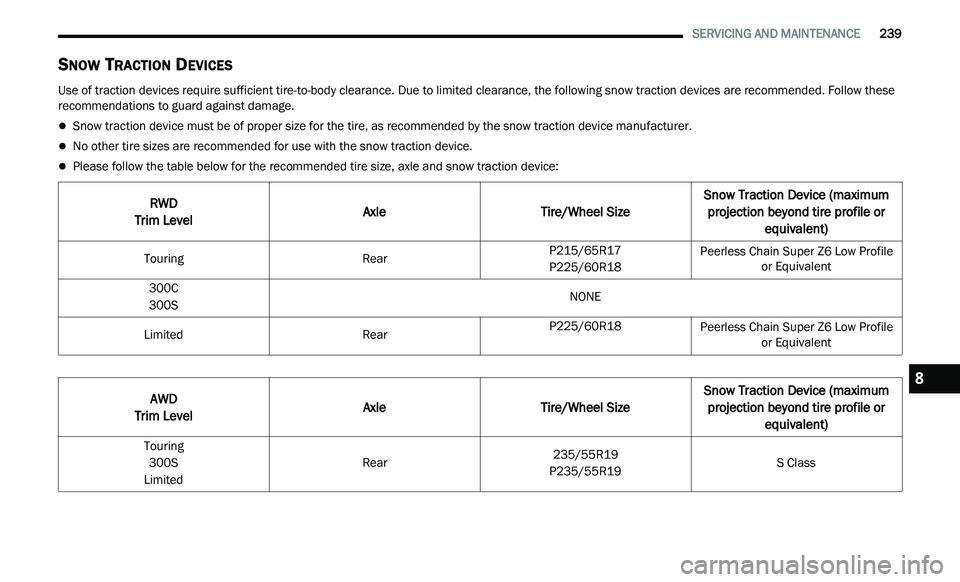
Please follow the table below for the recommended tire size, axle and snow traction device:
RWD
Trim Level Axle
Tire/Wheel SizeSnow Traction Device (maximum
p r
ojection beyond tire profile or equivalent)
Touring RearP215/65R17
P225/60R18Peerless Chain Super Z6 Low Profile
or
Equivalent
300C 300S NONE
Limited RearP225/60R18
Peerless Chain Super Z6 Low Profile
or
Equivalent
AWD
Trim Level Axle
Tire/Wheel SizeSnow Traction Device (maximum
p r
ojection beyond tire profile or equivalent)
Touring
300S
Limited Rear
235/55R19
P235/55R19 S Class
8
Page 247 of 268
245
TECHNICAL SPECIFICATIONS
VEHICLE IDENTIFICATION NUMBER (VIN)
The VIN is on the left front corner of the instrument
panel. The VIN is visible from outside of the vehicle
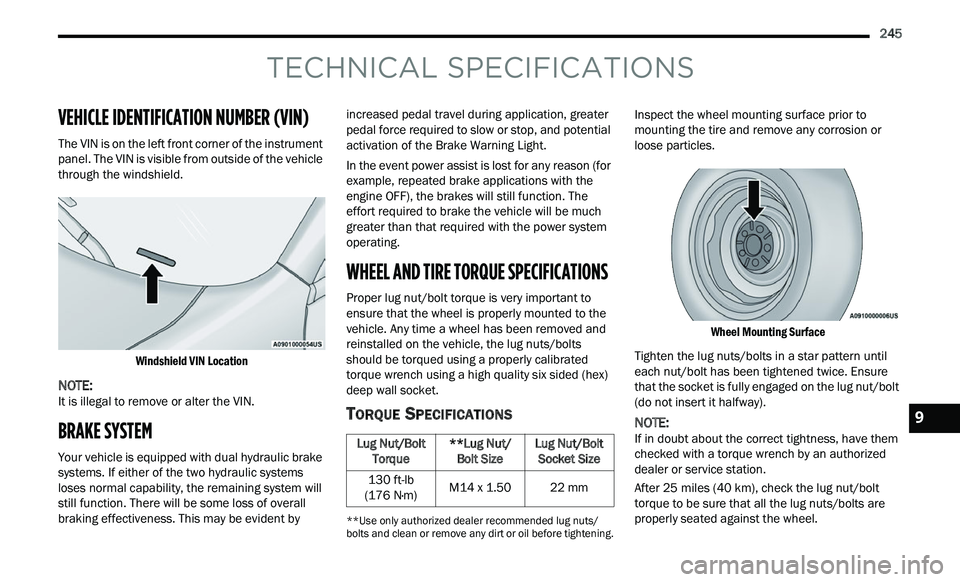
through the windshield.
Windshield VIN Location
NOTE:
It is illegal to remove or alter the VIN.
BRAKE SYSTEM
Your vehicle is equipped with dual hydraulic brake
systems. If either of the two hydraulic systems
loses normal capability, the remaining system will
still function. There will be some loss of overall
braking effectiveness. This may be evident by increased pedal travel during application, greater
pedal force required to slow or stop, and potential
activation of the Brake Warning Light.
In the event power assist is lost for any reason (for
ex
ample, repeated brake applications with the
engine OFF), the brakes will still function. The
effort required to brake the vehicle will be much
greater than that required with the power system
operating.
WHEEL AND TIRE TORQUE SPECIFICATIONS
Proper lug nut/bolt torque is very important to
ensure that the wheel is properly mounted to the
vehicle. Any time a wheel has been removed and
reinstalled on the vehicle, the lug nuts/bolts
should be torqued using a properly calibrated
torque wrench using a high quality six sided (hex)
deep wall socket.
TORQUE SPECIFICATIONS
**Use only authorized dealer recommended lug nuts/
bolts and clean or remove any dirt or oil before tightening.
Inspect the wheel mounting surface prior to
mounting the tire and remove any corrosion or
loose particles.
Wheel Mounting Surface
Tighten the lug nuts/bolts in a star pattern until
ea
ch nut/bolt has been tightened twice. Ensure
that the socket is fully engaged on the lug nut/bolt
(do not insert it halfway).
NOTE:
If in doubt about the correct tightness, have them
c h
ecked with a torque wrench by an authorized
dealer or service station.
After 25 miles (40 km), check the lug nut/bolt
t or
que to be sure that all the lug nuts/bolts are
properly seated against the wheel.
Lug Nut/Bolt Torque**Lug Nut/Bolt Size Lug Nut/Bolt
Soc ket Size
130 ft-lb
( 1
76 N·m) M14 x 1.50
22 mm
9
Page 264 of 268

262
Starting............................................................81Automatic Transmission..............................81Button.........................................................15Cold Weather..............................................83Engine Fails To Start...................................83Starting And Operating....................................81Starting Procedures.........................................81Steering...........................................................23Column Lock...............................................23Power..........................................................92Tilt Column...........................................23, 24Wheel, Heated.............................................24Wheel, Tilt............................................23, 24Storage..........................................................242Storage, Vehicle......................................50, 242Storing Your Vehicle......................................242Stuck, Freeing...............................................192Sun Roof..........................................................58Sunglasses Storage.........................................52Supplemental Restraint System – Air Bag.....159Synthetic Engine Oil.......................................203
T
Telescoping Steering Column...................23, 24Temperature Control, Automatic (ATC)............49Tilt Steering Column.................................23, 24Time Delay
Headlight.....................................................42Tire And Loading Information Placard...........229
Tire Markings................................................225Tire Safety Information.................................225Tires...................................177, 232, 236, 241Aging (Life Of Tires)..................................234Air Pressure..............................................232Chains......................................................239Changing.........................................182, 184Compact Spare.........................................236General Information........................232, 236High Speed...............................................233Inflation Pressure.....................................232Jacking.....................................................184Life Of Tires..............................................234Load Capacity...........................................229Pressure Monitoring System (TPMS)..76, 148Quality Grading.........................................241Radial.......................................................233Replacement............................................235Rotation....................................................240Safety..............................................225, 232Sizes.........................................................226Snow Tires................................................236Spare Tires.............................183, 236, 237Spinning...................................................234Trailer Towing...........................................117Tread Wear Indicators..............................234Wheel Nut Torque.....................................245To Open Hood..................................................59Tongue Weight/Trailer Weight......................116
Towing...........................................................114Behind A Motorhome................................119Disabled Vehicle.......................................193Guide........................................................116Recreational.............................................119Weight......................................................116Towing Behind A Motorhome........................119Traction.........................................................119Traction Control............................................142Trailer Towing................................................114Hitches.....................................................115Minimum Requirements...........................116Tips...........................................................118Trailer And Tongue Weight........................116Wiring.......................................................118Trailer Towing Guide.....................................116Trailer Weight................................................116Transfer CaseFluid.................................................213, 250Maintenance............................................213Transmission....................................................87Automatic..........................................87, 212Fluid..........................................................250Maintenance............................................212Shifting........................................................85Transporting Pets..........................................176Tread Wear Indicators...................................234Trunk Lid (Deck Lid).........................................60Trunk Release Remote Control........................60
Turn Signals..............................................43, 78