2021 CHEVROLET COLORADO heater
[x] Cancel search: heaterPage 14 of 89

Chevrolet/GMC 2.8L Duramax Diesel Engine Supplement (GMNA-Localizing-
U.S./Canada-14465442) - 2021 - CRC - 2/3/20
Driving and Operating 13
Driving and Operating
Starting and Operating
Starting the Diesel Engine . . . . . . . . . . . . . . 13
Winter Cover . . . . . . . . . . . . . . . . . . . . . . . . . . . 16
Engine Heater . . . . . . . . . . . . . . . . . . . . . . . . . . . 17
Fuel Operated Heater (FOH) (VanModels Only) . . . . . . . . . . . . . . . . . . . . . . . . . 19
Parking over Things That Burn . . . . . . . . . . 19
Diesel Particulate Filter
Diesel Particulate Filter . . . . . . . . . . . . . . . . . 19
Diesel Exhaust Fluid
Diesel Exhaust Fluid . . . . . . . . . . . . . . . . . . . . 22
Brakes
Exhaust Brake . . . . . . . . . . . . . . . . . . . . . . . . . . 24
Fuel
Top Tier Fuel . . . . . . . . . . . . . . . . . . . . . . . . . . . 25
Fuel Additives . . . . . . . . . . . . . . . . . . . . . . . . . . 25
Fuel for Diesel Engines . . . . . . . . . . . . . . . . . 25
Biodiesel . . . . . . . . . . . . . . . . . . . . . . . . . . . . . . . 26
Cold Weather Operation . . . . . . . . . . . . . . . . 27
Water in Fuel . . . . . . . . . . . . . . . . . . . . . . . . . . . 27
Running Out of Fuel . . . . . . . . . . . . . . . . . . . . 30
Fuel Filter Replacement . . . . . . . . . . . . . . . . . 30
Filling the Tank . . . . . . . . . . . . . . . . . . . . . . . . . 32
Filling a Portable Fuel Container . . . . . . . . 34
Trailer Towing
Trailer Towing . . . . . . . . . . . . . . . . . . . . . . . . . . 34
Conversions and Add-Ons
Power Take-Off (PTO) . . . . . . . . . . . . . . . . . . . 37
Starting and Operating
Starting the Diesel Engine
The diesel engine starts differently than a
gasoline engine.
Caution
If the steering wheel is turned until it
reaches the end of its travel, and is held
in that position while starting the vehicle,
damage may occur to the power steering
system and there may be loss of power
steering assist.
Move the shift lever to P (Park) or
N (Neutral). To restart the engine when the
vehicle is already moving, use
N (Neutral) only.
Caution
Do not try to shift to P (Park) if the
vehicle is moving. If you do, you could
damage the transmission. Shift to P (Park)
only when the vehicle is stopped.
Starting the Engine
1. Turn the ignition key to ON/RUN.
Page 15 of 89

Chevrolet/GMC 2.8L Duramax Diesel Engine Supplement (GMNA-Localizing-
U.S./Canada-14465442) - 2021 - CRC - 2/3/20
14 Driving and Operating
Observe the wait-to-start light. See
Wait-to-Start Light010. This light may
not come on if the engine is warm.
2. If the wait-to-start light is on, wait until this light goes off. Turn the ignition key
to START, then release the ignition key.
The engine will continue to crank until
the engine starts.
The engine has a fast warm-up glow
plug system. The wait-to-start light will
illuminate for a much shorter time than
most diesel engines, due to the rapid
heating of the glow plug system.
Caution
If the wait-to-start light stays on after
starting the vehicle, the vehicle may not
run properly. Have the vehicle serviced
right away.
3. If the engine does not start after 15 seconds of cranking, turn the ignition
off. Wait one minute for the cranking
motor to cool, then try the same steps
again.
If you are trying to start the engine after
you have run out of fuel, follow the steps in
Running Out of Fuel 030. When the engine is cold, let it run for a few
minutes before driving. This lets oil pressure
build up. The engine will sound louder when
it is cold.
For turbo protection, engine power at
speeds above idle may be limited if the
engine is cold. This protection can last up to
a maximum of 40 seconds at extreme cold
coolant and ambient temperatures.
Cold Weather Starting
Use the recommended engine oil when the
outside temperature drops below freezing.
See
Engine Oil 055. When the outside
temperature drops below –18 °C (0 °F), use
of the engine coolant heater is
recommended.
If you experience longer cranking times,
notice an unusual amount of exhaust smoke,
or are at higher elevations (over 2 135 m or
7,000 ft), you may use the engine coolant
heater. See Engine Heater 017.
See Fuel for Diesel Engines 025 for
information on what fuel to use in cold
weather.
If the Diesel Engine Will Not Start
If the vehicle runs out of fuel, see Running
Out of Fuel 030. If the vehicle is not out of fuel, and the
engine will not start:
Turn the ignition key to ON/RUN. After the
wait-to-start light goes off, turn the ignition
key to START.
If the light does not go off, wait a few
seconds, then try starting the engine again.
See your dealer as soon as possible for a
starting system check.
If the light comes on and then goes off and
you know the batteries are charged, but the
engine still will not start, the vehicle needs
service.
If the light does not come on when the
engine is cold, the vehicle needs service.
If the batteries do not have enough charge
to start the engine, see
“Battery”in the
owner’s manual.
Check that the correct engine oil has been
used and changed at appropriate intervals.
If the wrong oil is used, the engine may be
harder to start.
Be sure you are using the proper fuel for
existing weather conditions. See Fuel for
Diesel Engines 025.
If the engine starts, runs a short time, then
stops, the vehicle needs service.
Page 16 of 89
Chevrolet/GMC 2.8L Duramax Diesel Engine Supplement (GMNA-Localizing-
U.S./Canada-14465442) - 2021 - CRC - 2/3/20
Driving and Operating 15
{Warning
Do not use gasoline or starting aids, such
as ether, in the air intake. They could
damage the engine, which may not be
covered by the vehicle warranty. They
could also cause a fire, which could cause
serious personal injury.
Engine Idle Variations
Under certain conditions the engine idle
speed can vary or be elevated. Change in
idle speed is normal and does not indicate a
problem. Normal conditions that can raise
idle speed are low voltage, DPF
regeneration, air conditioning compressor
loads, and engine warmup. These speeds can
range from approximately 600 to 1000 rpm.
Elevated Idle
The engine has a cold temperature high idle
feature which elevates the engine idle speed
from base idle to 1050 to 1100 rpm for
pickup models or 1200 rpm for van models
when outside temperatures are below 0 °C
(32 °F), and the engine coolant temperature
is below 65 °C (150 °F). This feature enhances
heater performance by raising the engine
coolant temperature faster.To turn this feature on or off on pickup
models, see
Vehicle Personalization (Van
Models) 011 or
Vehicle Personalization (Pickup Models) 011.
On van models, this feature can be turned
on and off using the DIC buttons.
When the engine is started, it will slowly
ramp up to the high idle speed after a delay
of a few seconds up to approximately
two minutes. For this method to work
properly there must be no throttle or brake
pedal faults.
The engine idle speed will return to normal
once the following conditions are met:
.Engine coolant temperature reaches 65 °C
(150 °F).
.Air intake temperature reaches 0 °C
(32 °F).
The high idle speed will be temporarily
interrupted and the engine speed will return
to normal if any of the following conditions
occur:
.The brake pedal is applied.
.The accelerator pedal is pressed.
.The transmission is shifted out of P (Park)
or N (Neutral).
.Vehicle speed is detected. Once these inputs are removed, the engine
idle speed will slowly ramp back up to high
idle after the normal delay, if the conditions
for engine coolant temperature and air
intake temperature are still met.
Fast Idle Control (Vans Only)
The vehicle may have this system which can
be used to increase the engine idle speed.
Fast Idle control will be enabled when the
following conditions are met:
.The parking brake is set.
.The transmission is in P (Park) or
N (Neutral).
.The vehicle speed is about
0 km/h (0 mph).
.The cruise control Set switch is pressed
and released for Preset Fast Idle Speed
(1200 rpm).
Fast Idle control will be disabled when one
or more of the following conditions occur:
.The cruise control Set switch is pressed
and released. See “Cruise Control”in the
owner’s manual.
.The cruise control Cancel switch is
pressed.
.The brake pedal is pressed.
Page 17 of 89
Chevrolet/GMC 2.8L Duramax Diesel Engine Supplement (GMNA-Localizing-
U.S./Canada-14465442) - 2021 - CRC - 2/3/20
16 Driving and Operating
.The transmission is shifted out of P (Park)
or N (Neutral).
.The parking brake is released.
.The vehicle speed is not 0 km/h (0 mph).
On vans, when fast idle is active, a FAST
IDLE ON message will be displayed in
the DIC.
Winter Cover
Pickups
Do not use a winter cover on pickups.
Vans
If equipped, the winter cover can be used to
enhance heater performance in extremely
cold conditions below −18 °C (0 °F). The
winter cover installs over the grille and
restricts airflow to the engine compartment.
For vehicles that did not come with a winter
cover, a GM winter cover can be purchased.
See your dealer for additional information.
When the winter cover is in use, the heater,
ventilation, and air conditioning AUTO mode
may not function properly. Use the manual
settings for comfort.
Usage Guidelines
The winter cover should only be used while
operating the vehicle in extremely cold
temperatures or in heavy snow for extended
periods. In these temperatures, the vehicle
does not need a large amount of air to
properly cool the engine. When more
airflow is required to cool the vehicle, the
winter cover should not be used. The
following usage guidelines will allow
adequate airflow for proper radiator and air
cooler performance:
.Do not use the winter cover if towing a
trailer. The vehicle may overheat if the
radiator is covered while towing.
.Do not modify the cover. The winter
cover does not cover some sections of the
front of the vehicle to provide enough
airflow.
.When the winter cover is used, the
outside air temperature display may not
function properly.
.Keep the underside of the winter cover as
clean as possible. Remove monthly or as
necessary and clean away dust and
debris.
.Use only a mild soap to clean. Do not use
harsh soap, strong detergents, or vinyl
protectant/sealant type products as they
may damage the special finish. Allow the
winter cover to dry completely before
reinstalling.
Installation Instructions
When first trying to fit the cover, it may
appear to be undersized but will stretch
during installation to ensure a tight fit. The
initial installation of the cover is best
performed when the winter cover is warm.
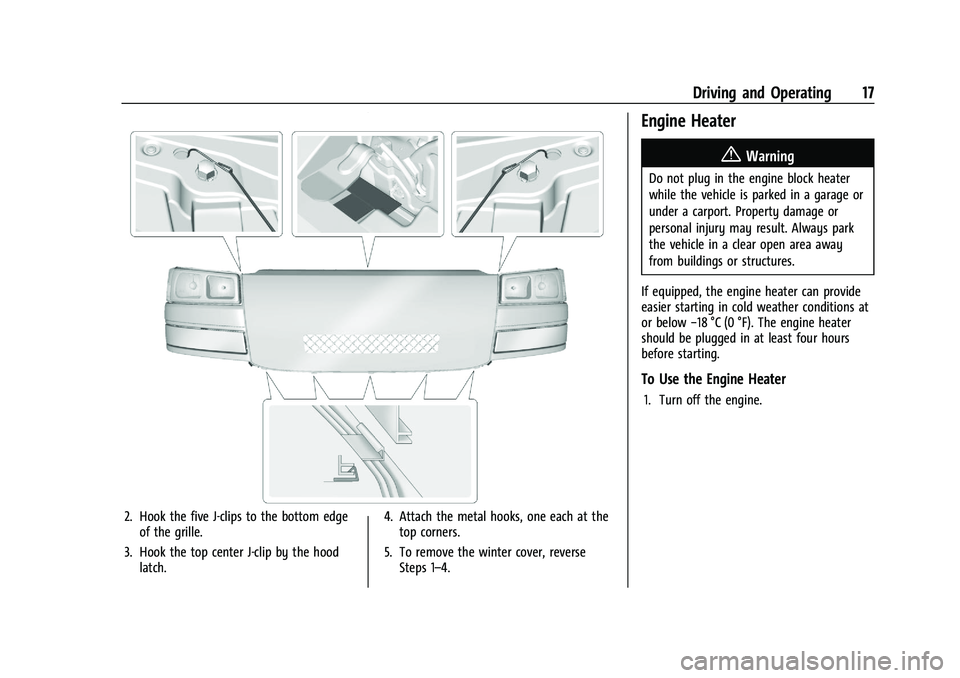
1. Open the hood and secure it with the prop rod.
Page 18 of 89
Chevrolet/GMC 2.8L Duramax Diesel Engine Supplement (GMNA-Localizing-
U.S./Canada-14465442) - 2021 - CRC - 2/3/20
Driving and Operating 17
2. Hook the five J-clips to the bottom edgeof the grille.
3. Hook the top center J-clip by the hood latch. 4. Attach the metal hooks, one each at the
top corners.
5. To remove the winter cover, reverse Steps 1–4.
Engine Heater
{Warning
Do not plug in the engine block heater
while the vehicle is parked in a garage or
under a carport. Property damage or
personal injury may result. Always park
the vehicle in a clear open area away
from buildings or structures.
If equipped, the engine heater can provide
easier starting in cold weather conditions at
or below −18 °C (0 °F). The engine heater
should be plugged in at least four hours
before starting.
To Use the Engine Heater
1. Turn off the engine.
Page 19 of 89

Chevrolet/GMC 2.8L Duramax Diesel Engine Supplement (GMNA-Localizing-
U.S./Canada-14465442) - 2021 - CRC - 2/3/20
18 Driving and Operating
Pickups
Vans2. Open the hood and unwrap the electrical
cord. The cord is in the engine
compartment, on the driver side behind
the battery for pickups, and on the
passenger side for vans.
3. Clean and dry the heater cord and connector ends. Check the heater cord
for damage. If it is damaged, do not use
it. See your dealer for a replacement.
Inspect the cord for damage yearly.
4. Plug it into a normal, grounded 110-volt AC outlet.
{Warning
Improper use of the heater cord or an
extension cord can damage the cord and
may result in overheating and fire.
.Plug the cord into a three-prong
electrical utility receptacle that is
protected by a ground fault detection
function. An ungrounded outlet could
cause an electric shock.
.Use a weatherproof, heavy-duty,
15 amp-rated extension cord if needed.
Failure to use the recommended
extension cord in good operating
condition, or using a damaged heater
(Continued)
Warning (Continued)
or extension cord, could make it
overheat and cause a fire, property
damage, electric shock, and injury.
.Do not operate the vehicle with the
heater cord permanently attached to
the vehicle. Possible heater cord and
thermostat damage could occur.
.While in use, do not let the heater
cord touch vehicle parts or sharp
edges. Never close the hood on the
heater cord.
.Before starting the vehicle, unplug the
cord, reattach the cover to the plug,
and securely fasten the cord. Keep the
cord away from any moving parts.
5. Before starting the engine, be sure to unplug and store the cord as it was
before to keep it away from moving
engine parts and prevent damage.
The length of time the heater should remain
plugged in depends on the outside
temperature. You may wish to use the
coolant heater to improve ease of starting
at temperatures between −18 °C (0 °F) and
−29 °C (−20 °F). Keep the coolant heater
plugged in for a minimum of four hours. At
Page 20 of 89
Chevrolet/GMC 2.8L Duramax Diesel Engine Supplement (GMNA-Localizing-
U.S./Canada-14465442) - 2021 - CRC - 2/3/20
Driving and Operating 19
temperatures below−29 °C (−20 °F), the
coolant heater should remain plugged in for
at least eight hours. Be sure to store the
cord before starting the engine. See Fuel for
Diesel Engines 025 for information on what
fuel to use in cold weather.
Caution
Do not use the engine heater
continuously. This could damage the
engine heater and may cause a fire.
Always unplug the engine heater
after use.
Fuel Operated Heater (FOH) (Van
Models Only)
If equipped, the FOH will enhance heater
performance and will reduce the amount of
time it takes to warm the inside of the
vehicle in cold conditions below or equal to
4 °C (39 °F).
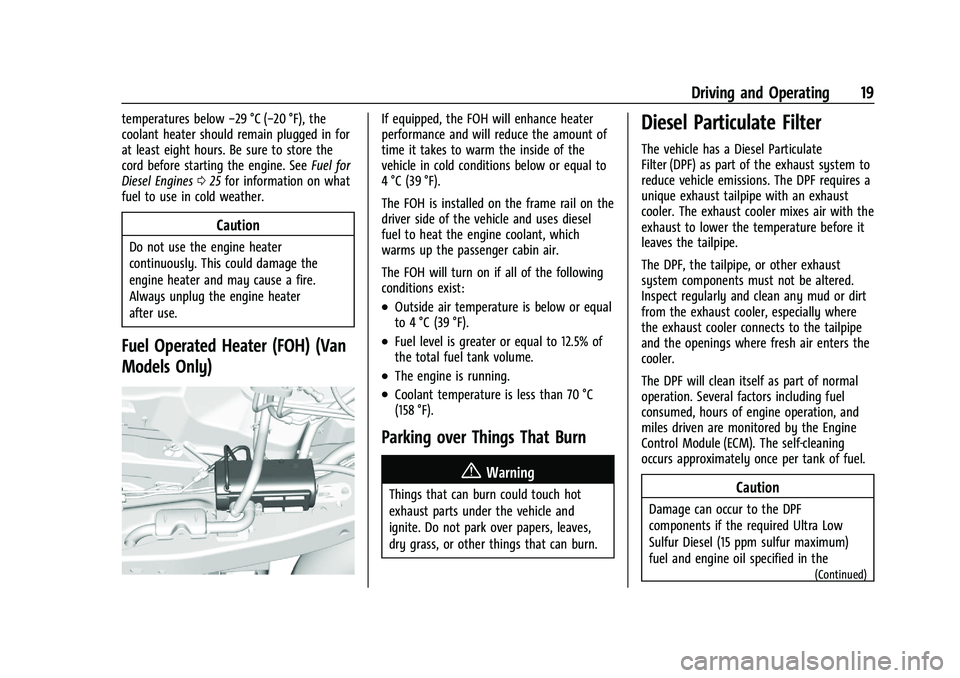
The FOH is installed on the frame rail on the
driver side of the vehicle and uses diesel
fuel to heat the engine coolant, which
warms up the passenger cabin air.
The FOH will turn on if all of the following
conditions exist:
.Outside air temperature is below or equal
to 4 °C (39 °F).
.Fuel level is greater or equal to 12.5% of
the total fuel tank volume.
.The engine is running.
.Coolant temperature is less than 70 °C
(158 °F).
Parking over Things That Burn
{Warning
Things that can burn could touch hot
exhaust parts under the vehicle and
ignite. Do not park over papers, leaves,
dry grass, or other things that can burn.
Diesel Particulate Filter
The vehicle has a Diesel Particulate
Filter (DPF) as part of the exhaust system to
reduce vehicle emissions. The DPF requires a
unique exhaust tailpipe with an exhaust
cooler. The exhaust cooler mixes air with the
exhaust to lower the temperature before it
leaves the tailpipe.
The DPF, the tailpipe, or other exhaust
system components must not be altered.
Inspect regularly and clean any mud or dirt
from the exhaust cooler, especially where
the exhaust cooler connects to the tailpipe
and the openings where fresh air enters the
cooler.
The DPF will clean itself as part of normal
operation. Several factors including fuel
consumed, hours of engine operation, and
miles driven are monitored by the Engine
Control Module (ECM). The self-cleaning
occurs approximately once per tank of fuel.
Caution
Damage can occur to the DPF
components if the required Ultra Low
Sulfur Diesel (15 ppm sulfur maximum)
fuel and engine oil specified in the
(Continued)
Page 28 of 89
Chevrolet/GMC 2.8L Duramax Diesel Engine Supplement (GMNA-Localizing-
U.S./Canada-14465442) - 2021 - CRC - 2/3/20
Driving and Operating 27
Caution
Do not use home-made biodiesel or home
test kits because the quality cannot be
verified by approved scientific methods.
Do not use raw vegetable oil or other
unmodified bio-oils, fats, or blends of
vegetable oil with diesel. They could
damage the fuel system and engine, and
damages would not be covered by the
vehicle warranty.
Biodiesel Blends
Fuels with a biodiesel content up to 20% by
volume may be used (e.g., named B20).
Only use biodiesel blends up to 20% by
volume that comply with your country’s or
region’s fuel standards.
Caution
Do not use blends containing more than
20% biodiesel. Any engine, fuel system,
or exhaust after-treatment system
damage would not be covered by the
vehicle warranty.
As a renewable fuel, biodiesel provides some
environmental benefits. However, biodiesel
has unique properties and needs to be handled differently than diesel fuel. Its use
presents additional risks and may not be
appropriate in all situations. Certain vehicle
operating modes increase these risks and
should be avoided.
Biodiesel fuel quality degrades with time
and exposure to high temperature quicker
than Ultra Low Sulfur Diesel fuel. More
frequent refueling provides the best
opportunity to have a supply of fresh fuel.
Storage at hot ambient temperatures will
accelerate biodiesel degradation.
If the vehicle is not driven often and uses
little fuel, or if it is stored for extended
periods of time, avoid the use of biodiesel
blended fuels above 5% by volume. When
the vehicle is stored for longer than one
month, it should be run out of biodiesel to
below one-quarter tank, refueled with
biodiesel-free fuel, and driven several
kilometers (miles) before storage.
Cold Weather Operation
In cold weather, the fuel filter may become
clogged by wax naturally present in the
fuel. To unclog it, move the vehicle to a
warm garage area and allow the filter to
warm up. The fuel filter may need to be
replaced. See
Fuel Filter Replacement 030. At temperatures below 0 °C (32 °F), it is
recommended to avoid using biodiesel
blends above 5% blend. This blend may
cause fuel filter plugging, system gelling,
and freezing that may affect vehicle
starting. You may need to turn the ignition
on and off a few times before the vehicle
will start. Also, idle the vehicle for a couple
of minutes before accelerating.
It is recommended to use Ultra Low Sulfur
No. 1-D diesel fuel or a blend of No. 1-D and
No. 2-D diesel fuel to enhance vehicle
operation in cold weather at temperatures
below 0 °C (32 °F). Use of No. 1-D diesel fuel
may lower the fuel economy. For additional
information for better cold weather
operation, see
Engine Heater017.
Water in Fuel
Improper fuel tank inspection or cleaning,
or contaminated fuel from suppliers, can
cause water to be pumped into the fuel
tank along with the diesel fuel. If a WATER
IN FUEL SERVICE REQUIRED message displays,
the water must be drained immediately.