2021 CHEVROLET COLORADO display
[x] Cancel search: displayPage 24 of 89

Chevrolet/GMC 2.8L Duramax Diesel Engine Supplement (GMNA-Localizing-
U.S./Canada-14465442) - 2021 - CRC - 2/3/20
Driving and Operating 23
Filling the DEF Tank
DEF Fill–Van Model Shown, 4-Cylinder
Pickups Similar
The blue DEF cap is behind the fuel/DEF
door. Do not remove the fuel and DEF caps
at the same time. Fill diesel fuel and DEF
independently. Turn the DEF cap
counterclockwise to remove.
In cold conditions DEF can freeze in the DEF
fill pipe opening. If this prevents the filling
of the DEF tank, place the vehicle in a warm
garage overnight.
Fill the DEF tank on level ground and with
the vehicle off. When adding DEF, it is
recommended to fully fill the DEF tank. For DEF tank capacity see
Capacities and
Specifications 082. When adding DEF to an
empty or very low tank, always add at least
7.5L (2 gal) of fluid to release the vehicle
from speed limitation.
When fluid reaches the top of the DEF fill
pipe, stop filling. Do not top off the DEF
tank. If using a bottle or jug to refill DEF,
follow the instructions on the container
label and use a dedicated fill aid.
Caution
Do not overfill the DEF tank and do not
allow DEF to contact the finished surfaces
of the vehicle, as it could damage the
vehicle finish. If DEF is spilled during
filling, wipe any affected surface with a
damp cloth.
Make sure the cap is fully installed.
Push the fuel/DEF door closed.
DEF Low
As the DEF level drops, warnings will
automatically be displayed in the Driver
Information Center (DIC). Select Vehicle
Information in the DIC to view DEF level
status. See Driver Information Center (DIC)
0 10. Refill the DEF tank at the first opportunity
after a low warning indication to avoid
vehicle speed limitations.
It may take some time for the vehicle to
detect that DEF has been added. If there
was a vehicle speed limitation, it will be
removed gradually and it may take several
kilometers/miles for the DIC message to
update.
If DEF is added under freezing conditions,
especially if DEF level is low and frozen, up
to several hours of drive time may be
required to remove the speed limitation.
It is recommended to ensure the DEF tank
level is 30% or higher during winter time.
The DEF range DIC message first displays at
approximately 1 600 km (1,000 mi). This
message appears again at approximately
500 km (300 mi) of remaining range before
the exhaust fluid tank becomes empty.
As the fluid level nears empty, these
messages appear every time the vehicle is
started.
If the DEF low warnings are ignored and the
DEF tank becomes empty, the DIC will
display messages that describe the action
needed and distance until vehicle speed is
Page 25 of 89
Chevrolet/GMC 2.8L Duramax Diesel Engine Supplement (GMNA-Localizing-
U.S./Canada-14465442) - 2021 - CRC - 2/3/20
24 Driving and Operating
limited. For the DEF warning light symbol,
seeDiesel Exhaust Fluid (DEF) Warning Light
0 10.
DEF Quality Poor
Use only DEF that is GM approved, or fluid
containing the API certified or ISO 22241
label.
DEF has an expiration date. If the system
detects poor quality, or contaminated or
diluted DEF, the DIC message will display
along with distance until vehicle speed is
limited.
The speed limitation will occur in a series of
steps with the final speed limitation being
8 km/h (5 mph) along with a flashing
warning light and chimes.
Adding fresh DEF to the system may resolve
the problem after several kilometers/miles
of driving, depending on several factors.
If the DIC message persists, see your dealer
or additional DIC messages may display.
Service DEF System
If a problem occurs with the DEF system, a
DIC message displays along with distance
until vehicle speed is limited. The speed limitation will occur in a series of
steps with the final speed limitation being
8 km/h (5 mph) along with a flashing
warning light and chimes.
In some cases, this message will clear itself,
indicating that the DEF system was able to
correct the condition. If the DIC message
persists, see your dealer or additional DIC
messages may display.
Service Emission System
If a problem occurs with the vehicle
emission system, a DIC message displays
along with distance until vehicle speed is
limited. The speed limitation will occur in a
series of steps with the final speed
limitation of 88 km/h (55 mph) and chimes.
In some cases, this message will clear itself,
indicating that the emission system was
able to correct the condition. If the DIC
message persists, see your dealer or
additional DIC messages may display.
Brakes
Exhaust Brake
The exhaust brake can be used to enhance
the vehicle brake system and reduce brake
lining wear.Downshifts may be automatically selected
to increase engine speed, which increases
the effectiveness of the exhaust brake. The
number of downshifts selected is
determined by the length of time the brakes
are applied and the rate the vehicle is
slowing. The system delivers the correct
amount of braking to assist in vehicle
control. The heavier the vehicle load, the
more active the engine exhaust brake will
be. Use of the exhaust brake will help
maintain vehicle speed when used with
cruise control. See
“Cruise Control”in the
owner’s manual.
Automatic downshifts will not occur if the
vehicle is in Range Selection Mode. See
“Manual Mode” in the owner’s manual.
The exhaust brake only activates when the
transmission torque converter is locked. This
can vary based on vehicle speed, gear,
and load.
To activate the system, press the switch on
the center stack.
Page 28 of 89
Chevrolet/GMC 2.8L Duramax Diesel Engine Supplement (GMNA-Localizing-
U.S./Canada-14465442) - 2021 - CRC - 2/3/20
Driving and Operating 27
Caution
Do not use home-made biodiesel or home
test kits because the quality cannot be
verified by approved scientific methods.
Do not use raw vegetable oil or other
unmodified bio-oils, fats, or blends of
vegetable oil with diesel. They could
damage the fuel system and engine, and
damages would not be covered by the
vehicle warranty.
Biodiesel Blends
Fuels with a biodiesel content up to 20% by
volume may be used (e.g., named B20).
Only use biodiesel blends up to 20% by
volume that comply with your country’s or
region’s fuel standards.
Caution
Do not use blends containing more than
20% biodiesel. Any engine, fuel system,
or exhaust after-treatment system
damage would not be covered by the
vehicle warranty.
As a renewable fuel, biodiesel provides some
environmental benefits. However, biodiesel
has unique properties and needs to be handled differently than diesel fuel. Its use
presents additional risks and may not be
appropriate in all situations. Certain vehicle
operating modes increase these risks and
should be avoided.
Biodiesel fuel quality degrades with time
and exposure to high temperature quicker
than Ultra Low Sulfur Diesel fuel. More
frequent refueling provides the best
opportunity to have a supply of fresh fuel.
Storage at hot ambient temperatures will
accelerate biodiesel degradation.
If the vehicle is not driven often and uses
little fuel, or if it is stored for extended
periods of time, avoid the use of biodiesel
blended fuels above 5% by volume. When
the vehicle is stored for longer than one
month, it should be run out of biodiesel to
below one-quarter tank, refueled with
biodiesel-free fuel, and driven several
kilometers (miles) before storage.
Cold Weather Operation
In cold weather, the fuel filter may become
clogged by wax naturally present in the
fuel. To unclog it, move the vehicle to a
warm garage area and allow the filter to
warm up. The fuel filter may need to be
replaced. See
Fuel Filter Replacement 030. At temperatures below 0 °C (32 °F), it is
recommended to avoid using biodiesel
blends above 5% blend. This blend may
cause fuel filter plugging, system gelling,
and freezing that may affect vehicle
starting. You may need to turn the ignition
on and off a few times before the vehicle
will start. Also, idle the vehicle for a couple
of minutes before accelerating.
It is recommended to use Ultra Low Sulfur
No. 1-D diesel fuel or a blend of No. 1-D and
No. 2-D diesel fuel to enhance vehicle
operation in cold weather at temperatures
below 0 °C (32 °F). Use of No. 1-D diesel fuel
may lower the fuel economy. For additional
information for better cold weather
operation, see
Engine Heater017.
Water in Fuel
Improper fuel tank inspection or cleaning,
or contaminated fuel from suppliers, can
cause water to be pumped into the fuel
tank along with the diesel fuel. If a WATER
IN FUEL SERVICE REQUIRED message displays,
the water must be drained immediately.
Page 29 of 89

Chevrolet/GMC 2.8L Duramax Diesel Engine Supplement (GMNA-Localizing-
U.S./Canada-14465442) - 2021 - CRC - 2/3/20
28 Driving and Operating
{Warning
Diesel fuel containing water is still
combustible. You or others could be
burned. If the fuel needs to be drained,
keep sparks, flames, and smoking
materials away from the mixture.
Caution
Water in the diesel fuel can corrode
internal components of the fuel system
and lead to severe damage. It can also
support fungus or bacteria growth, which
can damage the fuel system and Fuel
Operated Heater (FOH), if equipped. Even
with a diesel fuel biocide, the fuel system
may still need to be cleaned. Your dealer
can advise of the appropriate solution.
If the fuel tank needs to be purged to
remove water, see your dealer or a
qualified technician. Improper purging can
damage the fuel system and block
the FOH.
Water in Fuel Troubleshooting
If the WATER IN FUEL SERVICE REQUIRED
message comes on:Problem Recommended
Action
Message displays
but goes off during
the ignition cycle. The fuel filter is
partially filled with
water. Drain the
water as soon as
possible. See
"Removing Water
from the Fuel Filter"
following.
Message displays
and stays on. Drain the fuel filter
immediately. If no
water can be
drained, and the
temperature is
below freezing, then
water may be
frozen in the filter.
Move the vehicle to
a warm location to
thaw the water,
then drain the fuel.
If water still does
not drain, see your
dealer. Problem
Recommended
Action
Immediately after
refueling, message
displays and
stays on. A large amount of
water is in the fuel
tank. Drain the fuel
filter immediately.
If the message stays
on or comes back
on without
refueling, then fuel
tank purging is
required. See your
dealer. If the
message displays
and the engine
stalls or runs rough,
do not drive until
the water
contaminated fuel is
drained.
Caution
Driving with this message on can damage
the fuel injection system and the engine.
If the message comes on right after a
(Continued)
Page 47 of 89
Chevrolet/GMC 2.8L Duramax Diesel Engine Supplement (GMNA-Localizing-
U.S./Canada-14465442) - 2021 - CRC - 2/3/20
46 Driving and Operating
accumulate soot. The engine control system,
depending on the speed and load being
applied by the PTO, may not be able to
generate enough energy or adequate heat
needed to automatically clean or regenerate
the DPF. If manual regeneration is not
initiated, continued operation under
conditions that do not allow effective
regeneration or cleaning will eventually plug
the DPF and result in reduced power. The
ENGINE POWER IS REDUCED Driver
Information Center (DIC) message and
malfunction indicator lamp will be displayed,
and dealer service will be required to return
the vehicle to normal, full power operation.
To prevent this from occurring, frequently
monitor the vehicle during stationary PTO
operation, paying particular attention to any
horn chirps and/or the CLEAN EXHAUST
FILTER SEE OWNER MANUAL NOW DIC
warning messages. If the DIC message is
displayed during PTO operation, seeDiesel
Particulate Filter 019 for information on
how to clean or regenerate the DPF.PTO Operational Speed Control
Variable PTO operational speed control
provides the following functions:
Cruise Control SET− (In-Cab) or Remote PTO
Set 1 Switch
SET : Press and hold the accelerator to
obtain the desired engine speed, then press
and release SET− on the cruise control. The
current engine speed will be maintained.
This action can be repeated as desired to
capture a higher rpm value. The PTO set
speed cannot exceed 2900 rpm.
TAP DOWN : Press and release SET− on the
cruise control to reduce the engine speed by
increments of 100 rpm. The tap down
engine speed increments can be adjusted by
the GM Service Tool. The Service Tool can
enable the option for adjustment of tap
down engine speed increments through the
Radio Customization menu.
COAST : Press and hold SET− on the cruise
control to reduce the rpm at 150 rpm/sec
until the desired engine speed is reached or
until the initial PTO Standby Speed is
reached. In-Cab Cruise Control +RES or Remote PTO
Set 2 Switch
RESUME :
After a PTO set speed has been
met, a Resume Speed message is retained
after an application of the brake pedal.
Engine speed will reduce to basic idle speed.
The PTO indicator light will blink slowly
indicating the previous PTO set speed has
been retained in memory. Press and release
+RES on the cruise control to resume the
previous PTO set speed.
TAP UP : Press and release +RES on the
cruise control to increase the engine speed
by increments of 100 rpm (factory preset
value). The tap up engine speed increments
can be adjusted by the GM Service Tool. The
Service Tool can enable the option for
adjustment of tap up engine speed
increments through the Radio
Customization menu.
ACCEL : Press and hold +RES on the cruise
control to increase the rpm by 150 rpm/sec
until the desired engine speed is reached or
until the maximum allowable PTO set speed
is reached. Alternatively, the engine speed
acceleration can be adjusted through the
Radio Customization menu.
Page 51 of 89
Chevrolet/GMC 2.8L Duramax Diesel Engine Supplement (GMNA-Localizing-
U.S./Canada-14465442) - 2021 - CRC - 2/3/20
50 Driving and Operating
Programmable ParametersFactory SettingMinimum Value Maximum Value
Engine Speed Tap Step Menu (In Stationary Variable and Mobile) DISABLED
DISABLED ENABLED
Remote Set Switch Speed Control DISABLEDDISABLED ENABLED
Remote Throttle Speed Control DISABLEDDISABLED ENABLED
Remote Engine Start DISABLEDDISABLED ENABLED
Remote Engine Shutdown DISABLEDDISABLED ENABLED
Throttle Override ENABLEDDISABLED ENABLED
Throttle Override Timer 10 Minutes10 Minutes 13 Minutes
Driver Door Status Usage ENABLEDDISABLED ENABLED
Remote PTO In Cab Control DISABLEDDISABLED ENABLED
If the PTO factory preset parameters do not
match the settings described above, then
they may have already been altered in order
to satisfy the requirements of the installed
PTO system and body equipment.
The following PTO settings are also offered
via the vehicle customization screens, which
can be enabled by your service technician.
These include the following parameters:
.PTO Standby rpm
.PTO Set 1 Speed
.PTO Set 2 Speed
.Tap Step Speed
.PTO Engine Run Timer
Driver Information Center (DIC) Warning
Messages
If the PTO indicator light does not remain
on, it indicates that not all PTO enabling
conditions have been met. One or more of the following DIC messages may display if
the PTO will not engage and the appropriate
action must be taken.
.PTO: SHIFT TO PARK (P) (Stationary
mode only)
.PTO: SET PARK BRAKE (Stationary
mode only)
.PTO: PRESS & RELEASE BRAKE (Mobile
mode only)
.PTO: RELEASE BRAKE TO ENGAGE PTO
Page 57 of 89
Chevrolet/GMC 2.8L Duramax Diesel Engine Supplement (GMNA-Localizing-
U.S./Canada-14465442) - 2021 - CRC - 2/3/20
56 Vehicle Care
.Use engine oil approved to the proper
specification and of the proper viscosity
grade. See“Selecting the Right Engine
Oil” in this section.
.Check the engine oil level regularly and
maintain the proper oil level. See
“Checking Engine Oil” and“When to Add
Engine Oil” in this section.
.Change the engine oil at the appropriate
time. See“Engine Oil Life System” in the
owner’s manual.
.Always dispose of engine oil properly. See
“What to Do with Used Oil” in this
section.
Checking Engine Oil
Check the engine oil level regularly, every
650 km (400 mi), especially prior to a long
trip. The engine oil dipstick handle is a loop.
See Engine Compartment Overview 053 for
the location.
{Warning
The engine oil dipstick handle may be
hot; it could burn you. Use a towel or
glove to touch the dipstick handle.
If a low oil Driver Information Center (DIC)
message displays, check the oil level. Follow these guidelines:
.To get an accurate reading, park the
vehicle on level ground. Check the engine
oil level after the engine has been off for
at least two hours. Checking the engine
oil level on steep grades or too soon after
engine shutoff can result in incorrect
readings. Accuracy improves when
checking a cold engine prior to starting.
Remove the dipstick and check the level.
.If unable to wait two hours, the engine
must be off for at least 15 minutes if the
engine is warm, or at least 30 minutes if
the engine is not warm. Pull out the
dipstick, wipe it with a clean paper towel
or cloth, then push it back in all the way.
Remove it again, keeping the tip down,
and check the level.
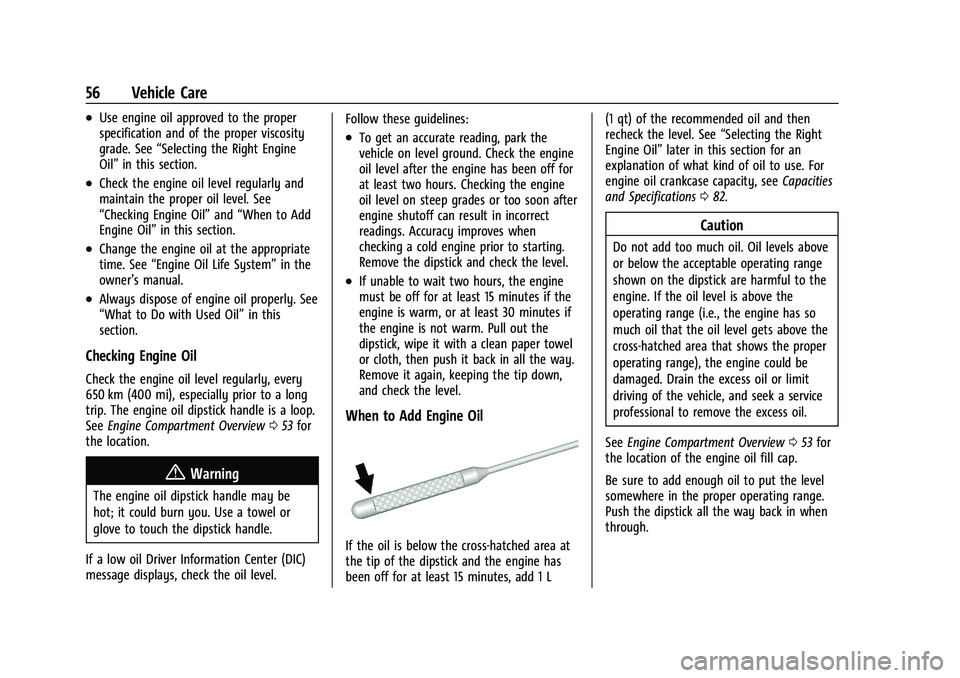
When to Add Engine Oil
If the oil is below the cross-hatched area at
the tip of the dipstick and the engine has
been off for at least 15 minutes, add 1 L(1 qt) of the recommended oil and then
recheck the level. See
“Selecting the Right
Engine Oil” later in this section for an
explanation of what kind of oil to use. For
engine oil crankcase capacity, see Capacities
and Specifications 082.
Caution
Do not add too much oil. Oil levels above
or below the acceptable operating range
shown on the dipstick are harmful to the
engine. If the oil level is above the
operating range (i.e., the engine has so
much oil that the oil level gets above the
cross-hatched area that shows the proper
operating range), the engine could be
damaged. Drain the excess oil or limit
driving of the vehicle, and seek a service
professional to remove the excess oil.
See Engine Compartment Overview 053 for
the location of the engine oil fill cap.
Be sure to add enough oil to put the level
somewhere in the proper operating range.
Push the dipstick all the way back in when
through.
Page 59 of 89

Chevrolet/GMC 2.8L Duramax Diesel Engine Supplement (GMNA-Localizing-
U.S./Canada-14465442) - 2021 - CRC - 2/3/20
58 Vehicle Care
engine at extremely low temperatures.
When selecting an oil of the appropriate
viscosity grade, it is recommended to select
an oil of the correct specification. See
“Specification”earlier in this section.
Engine Oil Additives/Engine Oil Flushes
Do not add anything to the oil. The
recommended oils meeting the dexos2
specification are all that is needed for good
performance and engine protection.
Engine oil system flushes are not
recommended and could cause engine
damage not covered by the vehicle
warranty.
What to Do with Used Oil
Used engine oil contains certain elements
that can be unhealthy for your skin and
could even cause cancer. Do not let used oil
stay on your skin for very long. Clean your
skin and nails with soap and water, or a
good hand cleaner. Wash or properly
dispose of clothing or rags containing used
engine oil. See the manufacturer's warnings
about the use and disposal of oil products.
Used oil can be a threat to the environment.
If you change your own oil, be sure to drain
all the oil from the filter before disposal. Never dispose of oil by putting it in the
trash or pouring it on the ground, into
sewers, or into streams or bodies of water.
Recycle it by taking it to a place that
collects used oil.
Engine Oil Life System
The engine oil life system calculates engine
oil life based on vehicle use and displays the
CHANGE ENGINE OIL SOON message when it
is time to change the engine oil and filter.
The oil life system should be reset to 100%
only following an oil change. See
“Engine Oil
Life System” in the owner’s manual.
Automatic Transmission Fluid
When to Check and Change (2.8L
4-Cylinder Engine Pickup Models)
See“Automatic Transmission Fluid” in the
owner’s manual.
When to Check and Change (2.8L
4-Cylinder Engine Van Models)
It is not necessary to check the transmission
fluid level. A transmission fluid leak is the
only reason for fluid loss. If a leak occurs,
take the vehicle to your dealer and have it
repaired as soon as possible. There is a special procedure for checking and
changing the transmission fluid. Because this
procedure is difficult, this should be done at
your dealer. Contact your dealer for
additional information.
Change the fluid and filter at the intervals
listed in
Maintenance Schedule 073 or
Maintenance Schedule 077, and be sure to
use the fluid listed in Recommended Fluids
and Lubricants 078.
Engine Air Cleaner/Filter
2.8L 4-Cylinder Engine Pickup Models
See “Engine Air Cleaner/Filter” in the
owner’s manual.
2.8L 4-Cylinder Engine Van Models
The air cleaner/filter assembly is on the
front of the engine compartment on the
driver side of the vehicle. See Engine
Compartment Overview 053.
When to Inspect/Replace the Engine Air
Cleaner/Filter
For intervals on changing and inspecting the
engine air filter, see Maintenance Schedule
0 73 or
Maintenance Schedule 077.