2021 ALFA ROMEO GIULIA change wheel
[x] Cancel search: change wheelPage 190 of 284

SAFETY
188
(Continued)
Periodic Safety Checks You Should Make
Outside The Vehicle
Tires
Examine tires for excessive tread wear and
uneven wear patterns. Check for stones, nails,
glass, or other objects lodged in the tread or
sidewall. Inspect the tread for cuts and cracks.
Inspect sidewalls for cuts, cracks, and bulges.
Check the wheel nuts for tightness. Check the
tires (including spare) for proper cold inflation
pressure.
Lights
Have someone observe the operation of brake
lights and exterior lights while you work the
controls. Check turn signal and high beam
indicator lights on the instrument panel.
Door Latches
Check for proper closing, latching, and locking.
Fluid Leaks
Check area under the vehicle after overnight
parking for fuel, coolant, oil, or other fluid
leaks. Also, if gasoline fumes are detected or if
fuel or brake fluid leaks are suspected the
cause should be located and corrected imme-
diately.
ALWAYS REMOVE THE EXISTING FLOOR
MAT FROM THE VEHICLE before
installing any other floor mat. NEVER
install or stack an additional floor mat on
top of an existing floor mat.
ONLY install floor mats designed to fit your
vehicle. NEVER install a floor mat that
cannot be properly attached and secured
to your vehicle. If a floor mat needs to be
replaced, only use a FCA approved floor
mat for the specific make, model, and
year of your vehicle.
ONLY use the driver’s side floor mat on the
driver’s side floor area. To check for inter -
ference, with the vehicle properly parked
with the engine off, fully depress the
accelerator, the brake, and the clutch
pedal (if present) to check for interfer -
ence. If your floor mat interferes with the
operation of any pedal, or is not secure to
the floor, remove the floor mat from the
vehicle and place the floor mat in your
trunk.
ONLY use the passenger’s side floor mat
on the passenger’s side floor area.
WARNING! (Continued)
ALWAYS make sure objects cannot fall or
slide into the driver’s side floor area when
the vehicle is moving. Objects can become
trapped under accelerator, brake, or
clutch pedals and could cause a loss of
vehicle control.
NEVER place any objects under the floor
mat (e.g., towels, keys, etc.). These
objects could change the position of the
floor mat and may cause interference with
the accelerator, brake, or clutch pedals.
If the vehicle carpet has been removed
and re-installed, always properly attach
carpet to the floor and check the floor mat
fasteners are secure to the vehicle carpet.
Fully depress each pedal to check for
interference with the accelerator, brake,
or clutch pedals then re-install the floor
mats.
It is recommended to only use mild soap
and water to clean your floor mats. After
cleaning, always check your floor mat has
been properly installed and is secured to
your vehicle using the floor mat fasteners
by lightly pulling mat.
WARNING! (Continued)
21_GA_OM_EN_USC_t.book Page 188
Page 197 of 284
195
(Continued)
Inflation ProcedureTo use your Tire Service Kit, proceed as
follows:
1. Apply the Electric Park Brake.
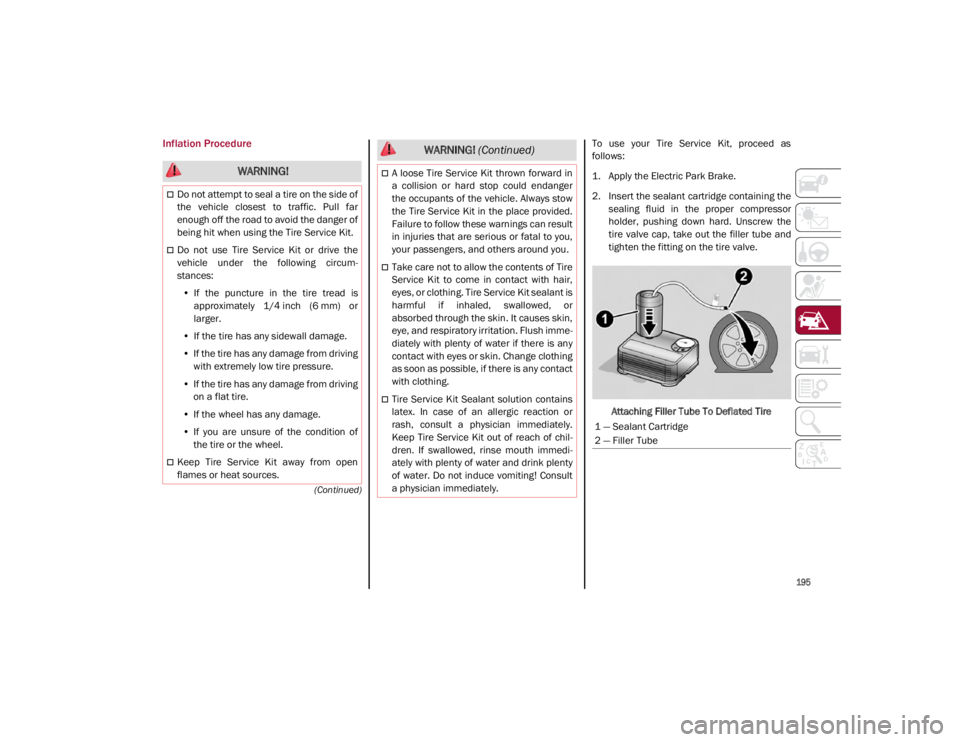
2. Insert the sealant cartridge containing thesealing fluid in the proper compressor
holder, pushing down hard. Unscrew the
tire valve cap, take out the filler tube and
tighten the fitting on the tire valve.
Attaching Filler Tube To Deflated Tire
WARNING!
Do not attempt to seal a tire on the side of
the vehicle closest to traffic. Pull far
enough off the road to avoid the danger of
being hit when using the Tire Service Kit.
Do not use Tire Service Kit or drive the
vehicle under the following circum -
stances:
• If the puncture in the tire tread is
approximately 1/4 inch (6 mm) or
larger.
• If the tire has any sidewall damage.
• If the tire has any damage from driving
with extremely low tire pressure.
• If the tire has any damage from driving
on a flat tire.
• If the wheel has any damage.
• If you are unsure of the condition of
the tire or the wheel.
Keep Tire Service Kit away from open
flames or heat sources.
A loose Tire Service Kit thrown forward in
a collision or hard stop could endanger
the occupants of the vehicle. Always stow
the Tire Service Kit in the place provided.
Failure to follow these warnings can result
in injuries that are serious or fatal to you,
your passengers, and others around you.
Take care not to allow the contents of Tire
Service Kit to come in contact with hair,
eyes, or clothing. Tire Service Kit sealant is
harmful if inhaled, swallowed, or
absorbed through the skin. It causes skin,
eye, and respiratory irritation. Flush imme -
diately with plenty of water if there is any
contact with eyes or skin. Change clothing
as soon as possible, if there is any contact
with clothing.
Tire Service Kit Sealant solution contains
latex. In case of an allergic reaction or
rash, consult a physician immediately.
Keep Tire Service Kit out of reach of chil -
dren. If swallowed, rinse mouth immedi -
ately with plenty of water and drink plenty
of water. Do not induce vomiting! Consult
a physician immediately.
WARNING! (Continued)
1 — Sealant Cartridge
2 — Filler Tube
21_GA_OM_EN_USC_t.book Page 195
Page 246 of 284

SERVICING AND MAINTENANCE
244
Radial Ply Tires
Tire Repair
If your tire becomes damaged, it may be
repaired if it meets the following criteria:
The tire has not been driven on when flat.
The damage is only on the tread section of
your tire (sidewall damage is not repair-
able).
The puncture is no greater than a ¼ of an
inch (6 mm).
Consult an authorized tire dealer for tire
repairs and additional information.
Damaged Run Flat tires, or Run Flat tires that
have experienced a loss of pressure should be
replaced immediately with another Run Flat
tire of identical size and service description
(Load Index and Speed Symbol). Replace the
tire pressure sensor as well as it is not
designed to be reused.
Run Flat Tires — If Equipped
Run Flat tires allow you the capability to drive
50 miles (80 km) at 50 mph (80 km/h) after a
rapid loss of inflation pressure. This rapid loss
of inflation is referred to as the Run Flat mode.
A Run Flat mode occurs when the tire inflation
pressure is of/or below 14 psi (96 kPa). Once
a Run Flat tire reaches the Run Flat mode it
has limited driving capabilities and needs to
be replaced immediately. A Run Flat tire is not
repairable. When a Run Flat tire is changed
after driving with underinflated tire condition,
please replace the TPM sensor as it is not
designed to be reused when driven under Run
Flat mode 14 psi (96 kPa) condition.
NOTE:
TPM Sensor must be replaced after driving the
vehicle on a flat tire condition.
It is not recommended driving a vehicle loaded
at full capacity or to tow a trailer while a tire is
in the Run Flat mode.
See the tire pressure monitoring section for
more information
Ú
page 156.
Tire Spinning
When stuck in mud, sand, snow, or ice condi -
tions, do not spin your vehicle's wheels above
30 mph (48 km/h) or for longer than 30
seconds continuously without stopping.
Tread Wear Indicators
Tread wear indicators are in the original equip -
ment tires to help you in determining when
your tires should be replaced.
Tire Tread
WARNING!
Combining radial ply tires with other types
of tires on your vehicle will cause your
vehicle to handle poorly. The instability
could cause a collision. Always use radial
ply tires in sets of four. Never combine them
with other types of tires.
WARNING!
Fast spinning tires can be dangerous.
Forces generated by excessive wheel
speeds may cause tire damage or failure. A
tire could explode and injure someone. Do
not spin your vehicle's wheels faster than
30 mph (48 km/h) for more than 30
seconds continuously when you are stuck,
and do not let anyone near a spinning
wheel, no matter what the speed.
1 — Worn Tire
2 — New Tire
21_GA_OM_EN_USC_t.book Page 244
Page 247 of 284
245
(Continued)
These indicators are molded into the bottom
of the tread grooves. They will appear as
bands when the tread depth becomes a 1/16
of an inch (1.6 mm). When the tread is worn to
the tread wear indicators, the tire should be
replaced.
For further information
Ú
page 245.
Life Of Tire
The service life of a tire is dependent upon
varying factors including, but not limited to:
Driving style.
Tire pressure - Improper cold tire inflation
pressures can cause uneven wear patterns
to develop across the tire tread. These
abnormal wear patterns will reduce tread
life, resulting in the need for earlier tire
replacement.
Distance driven.
Performance tires, tires with a speed rating
of V or higher, and Summer tires typically
have a reduced tread life. Rotation of these
tires per the vehicle scheduled mainte -
nance is highly recommended.
NOTE:
Wheel valve stem must be replaced as well
when installing new tires due to wear and tear
in existing tires.
Keep dismounted tires in a cool, dry place with
as little exposure to light as possible. Protect
tires from contact with oil, grease, and gaso
-
line.
Replacement Tires
The tires on your new vehicle provide a
balance of many characteristics. They should
be inspected regularly for wear and correct
cold tire inflation pressures. FCA US LLC
strongly recommends that you use tires equiv -
alent to the originals in size, quality and perfor -
mance when replacement is needed
Ú
page 244. Refer to the Tire and Loading
Information placard or the Vehicle Certifica -
tion Label for the size designation of your tire.
The Load Index and Speed Symbol for your tire
will be found on the original equipment tire
sidewall. For more information relating to the Load
Index and Speed Symbol of a tire
Ú
page 234.
It is recommended to replace the two front
tires or two rear tires as a pair. Replacing just
one tire can seriously affect your vehicle’s
handling. If you ever replace a wheel, make
sure that the wheel’s specifications match
those of the original wheels.
It is recommended you contact an authorized
tire dealer or original equipment dealer with
any questions you may have on tire specifica -
tions or capability. Failure to use equivalent
replacement tires may adversely affect the
safety, handling, and ride of your vehicle.
WARNING!
Tires and the spare tire should be replaced
after six years, regardless of the remaining
tread. Failure to follow this warning can
result in sudden tire failure. You could lose
control and have a collision resulting in
serious injury or death.
WARNING!
Do not use a tire, wheel size, load rating,
or speed rating other than that specified
for your vehicle. Some combinations of
unapproved tires and wheels may change
suspension dimensions and performance
characteristics, resulting in changes to
steering, handling, and braking of your
vehicle. This can cause unpredictable
handling and stress to steering and
suspension components. You could lose
control and have a collision resulting in
serious injury or death. Use only the tire
and wheel sizes with load ratings
approved for your vehicle.
21_GA_OM_EN_USC_t.book Page 245
Page 280 of 284

278
INDEX
T
Tie Down Hooks, Cargo ................................ 64
Tire And Loading Information Placard ......237
Tire Markings..............................................234
Tire Safety Information .............................. 234
Tire Service Kit ...........................................194
Tires .................................188, 241, 246, 250Aging (Life Of Tires) ................................ 245Air Pressure ............................................ 241
Flat Changing .........................................194
General Information......................241, 246
High Speed ............................................. 242
Inflation Pressure...................................241Life Of Tires ............................................ 245
Load Capacity................................237, 238Pressure Monitoring System (TPMS) .............................. 75, 76
Quality Grading....................................... 250
Radial......................................................244
Replacement ..........................................245
Safety .............................................234, 241
Sizes .......................................................234
Snow Tires ..............................................247
Spare Tires ............................................. 246
Spinning..................................................244
Tread Wear Indicators ...........................244
Tow Hooks ..................................................202 Towing
Disabled Vehicle .................................... 201
Towing Trailers ........................................... 138
TPMS (Tire Pressure Monitoring
System) ....................................................... 156
Traction Control System (TCS) .................. 144
Transmission .............................................. 258
Transporting Animals................................. 139
Transporting Passengers .......................... 139
Transporting Pets....................................... 187
Tread Wear Indicators ............................... 244
Trunk Lid (Deck Lid) ..................................... 63
Turn Signals ...........................................44, 77
U
Uconnect Settings Customer Programmable Features ........ 24
Passive Entry Programming .................... 24
Uniform Tire Quality Grades ...................... 250
Universal Transmitter .................................. 38
Untwisting Procedure, Seat Belt ............... 162
Use Of The Owner’s Manual........................... 5
V
Vehicle Changes/Alterations ......................... 3
Vehicle Identification Number .................. 255
Vehicle Loading ................................. 136, 238 W
Warning Lights (Instrument Cluster
Descriptions)................................................. 75
Warranty Information ................................ 272
WARRANTY INFORMATION
.................. 272
Washer Fluid For Windshield/
Headlights .................................................. 214
Washers, Windshield.................................... 47
Weights ...................................................... 262
Wheel And Wheel Tire Care ...................... 246
Wheel And Wheel Tire Trim....................... 246
Wheels And Tires ....................................... 234
Wind Buffeting ..............................................59
Windows (Cleaning) ................................... 253
Windshield Defroster ................................ 187
Windshield Washers.....................................47
Windshield Wiper Replacing Blades .................................. 219
Windshield Wipers ........................................46
Wipers, Intermittent .....................................47
Wipers, Rain Sensitive .................................47
21_GA_OM_EN_USC_t.book Page 278