2020 YAMAHA XSR 900 ABS
[x] Cancel search: ABSPage 6 of 102

Table of contentsSafety information........................... 1-1
Description ....................................... 2-1
Left view ......................................... 2-1
Right view ....................................... 2-2
Controls and instruments................ 2-3
Instrument and co ntrol functions... 3-1
Immobilizer system ..... .................... 3-1
Main switch/steering lock................ 3-2
Indicator lights and warning
lights ............................................ 3-3
Multi-function meter unit ................. 3-5
D-mode (drive mode).................... 3-12
Handlebar switches ...................... 3-12
Clutch lever................................... 3-14
Shift pedal..... ............................ .... 3-14
Brake lever ................................... 3-15
Brake pedal .................................. 3-15
ABS .............................................. 3-15
Traction control syst em ................ 3-16
Fuel tank cap ................................ 3-18
Fuel............................................... 3-18
Fuel tank overflow hose................ 3-20
Catalytic converter ........................ 3-21
Seat .............................................. 3-21
Storage compartment ................... 3-22
Adjusting the front fork.................. 3-22
Adjusting the shock absorber assembly ................................... 3-24
Luggage strap holders . ................. 3-25Auxiliary DC connector................. 3-26
Sidestand ..................................... 3-26
Ignition circuit cut-
off system ........ 3-27
For your safety – pre-operation
checks .............................................. 4-1
Operation and important riding
points ................................................ 5-1
Engine break-in .............................. 5-1
Starting the engine ......................... 5-2
Shifting ........................................... 5-3
Tips for reducing fuel consumption ............................... 5-3
Parking ........................................... 5-4
Periodic maintenance and
adjustment ....................................... 6-1
Tool kit............................................ 6-2
Periodic maintenance charts .......... 6-3
Periodic maintenance chart for the emission control system ............. 6-3
General maintenance and
lubrication chart .......................... 6-5
Checking the spark plugs ............... 6-9
Canister ........................................ 6-10
Engine oil ..................................... 6-10
Why Yamalube ............................. 6-13
Coolant ......................................... 6-13
Air filter element ........................... 6-14 Checking the engine idling
speed............ ............................ 6-15
Checking the throttle grip free play ........................................... 6-15
Valve clearance ........................... 6-15
Tires ............................................. 6-16
Cast wheels ................................. 6-18
Adjusting the clutch lever free
play ........................................... 6-18
Checking the brake lever free play ........................................... 6-19
Brake light switches ..................... 6-20
Checking the front and rear brake pads................................ 6-20
Checking the brake fluid level ...... 6-21
Changing the brake fluid .............. 6-22
Drive chain slack.......................... 6-22
Cleaning and lubricating the drive chain ................................ 6-24
Checking and lubricating the
cables ....................................... 6-25
Checking and lubricating the throttle grip and cable ............... 6-25
Checking and lubricating the brake and shift pedals .............. 6-25
Checking and lubricating the brake and clutch levers ............ 6-26
Checking and lubricating the
sidestand .................................. 6-27
Lubricating the swingarm pivots ........................................ 6-27BAE-28199-E1.book 1 ページ 2019年8月23日 金曜日 午後3時56分
Page 18 of 102

Instrument and control functions
3-3
1
23
4
5
6
7
8
9
10
11
12 To unlock the steering
From the “LOCK” position, push the
key in and turn it to “OFF”.
EAU59681
(Parking)
The hazard lights and turn signal lights
can be turned on, but all other electrical
systems are off. The key can be re-
moved.NOTICE
ECA20760
Using the hazard or turn signal
lights for an extended length of timemay cause the battery to discharge.
EAU4939H
Indicator lights and warning
lights
EAU11032
Turn signal indicator lights “ ” and
“”
Each indicator light will flash when its
corresponding turn signal lights are flashing.
EAU11061
Neutral indicator light “ ”
This indicator light comes on when the
transmission is in the neutral position.
EAU11081
High beam indicator light “ ”
This indicator light comes on when the
high beam of the headlight is switched
on.
EAU11259
Oil level warning light “ ”
This warning light comes on when the
engine oil level is low. To prevent en-
gine damage, replenish the engine oil
as soon as possible.
Even if the oil level is sufficient, the
warning light may flicker when riding on
a slope or during sudden acceleration
or deceleration, but this is not a mal-
function. If a problem is detected in the
oil level detection circuit, the oil level
warning light will flash repeatedly. If this
occurs, have a Yamaha dealer check
the vehicle.
1. Push.
2. Turn.12
1. Traction control system indicator light
“”
2. ABS warning light “ ”
3. Engine trouble warning light “ ”
4. Coolant temperature warning light “ ”
5. Oil level warning light “ ”
6. Left turn signal indicator light “ ”
7. Neutral indicator light “ ”
8. High beam indicator light “ ”
9. Right turn signal indicator light “ ”
10.Immobilizer system indicator light “ ”
2
13
4
5
6
7
8
9
10
ABS
BAE-28199-E1.book 3 ページ 2019年8月23日 金曜日 午後3時56分
Page 19 of 102

Instrument and control functions
3-4
1
234
5
6
7
8
9
10
11
12
TIPWhen the vehicle is turned on, the light
will come on for a few seconds and
then go off. If the light does not come
on, or if the light remains on after con-
firming that the oil level is correct (see
page 6-10), have a Yamaha dealercheck the vehicle.
EAU11449
Coolant temperature warning light
“”
This warning light comes on when the
engine is overheating. If this occurs,
stop the engine immediately and allow
the engine to cool. (See page 6-39.)
For vehicles with a radiator fan, the ra-
diator fan(s) automatically switch on or
off according to the coolant tempera-
ture.TIPWhen the vehicle is turned on, the light
will come on for a few seconds, and
then go off. If the light does not come
on, or if the light remains on, have aYamaha dealer check the vehicle.
NOTICE
ECA10022
Do not continue to operate the en-gine if it is overheating.
EAU73172
Engine trouble warning light “ ”
This warning light comes on if a prob-
lem is detected in the engine or other
vehicle control system . If this occurs,
have a Yamaha dealer check the
on-board diagnostic system.TIPWhen the vehicle is turned on, the light
will come on for a few seconds and
then go off. If the light does not come
on, or if the light remains on, have aYamaha dealer check the vehicle.
EAU69895
ABS warning light “ ”
This warning light comes on when the
vehicle is first turned on, and goes off
after starting riding. If the warning light
comes on while riding, the anti-lock
brake system may not work correctly.
WARNING
EWA16043
If the ABS warning light does not turn
off after reaching 10 km/h (6 mi/h), or
if the warning light comes on while
riding:
Use extra caution to avoid pos-
sible wheel lock during emer-
gency braking.
Have a Yamaha dealer check thevehicle as soon as possible.
EAU78591
Traction control system indicator
light “TCS”
This indicator light will flash when trac-
tion control has engaged.
If the traction control system is turned
off, this indicator light will come on.
(See page 3-16.)TIPWhen the vehicle is turned on, the light
should come on for a few seconds and
then go off. If the light does not come
on, or if the light remains on, have aYamaha dealer check vehicle.
ABS
BAE-28199-E1.book 4 ページ 2019年8月23日 金曜日 午後3時56分
Page 30 of 102

Instrument and control functions
3-15
1
23
4
5
6
7
8
9
10
11
12
EAU26827
Brake leverThe brake lever is located on the right
side of the handlebar. To apply the front
brake, pull the lever toward the throttle
grip.
The brake lever is equipped with a
brake lever position adjusting dial. To
adjust the distance between the brake
lever and the throttle grip, push the
brake lever away from the throttle grip
and rotate the adjusting dial. Make sure
the setting number on the adjusting dial
aligns with the match mark on the brake
lever.
EAU12944
Brake pedalThe brake pedal is located on the right
side of the motorcycle. To apply the
rear brake, press down on the brake
pedal.
EAU63040
ABSThe Yamaha ABS (Anti-lock Brake
System) features a dual electronic con-
trol system, which acts on the front and
rear brakes independently.
Operate the brakes with ABS as you
would conventional brakes. If the ABS
is activated, a pulsating sensation may
be felt at the brake lever or brake pedal.
In this situation, continue to apply the
brakes and let the ABS work; do not
“pump” the brakes as this will reduce
braking effectiveness.
WARNING
EWA16051
Always keep a sufficient distance
from the vehicle ahead to match the
riding speed even with ABS.
The ABS performs best with
long braking distances.
On certain surfaces, such as
rough or gravel roads, the brak-
ing distance may be longer withthe ABS than without.
The ABS is monitored by an ECU,
which will revert the system to conven-
tional braking if a malfunction occurs.
1. Brake lever
2. Distance
3. Brake lever position adjusting dial
4. Match mark
1
2
4
3
1. Brake pedal
1
BAE-28199-E1.book 15 ページ 2019年8月23日 金曜日 午後3時56分
Page 31 of 102

Instrument and control functions
3-16
1
234
5
6
7
8
9
10
11
12
TIP
The ABS performs a self-diagno-
sis test each time the vehicle first
starts off after the key is turned to
“ON” and the vehicle has traveled
at a speed of 10 km/h (6 mi/h) or
higher. During this test, a “clicking”
noise can be heard from the hy-
draulic control unit, and if the brake
lever or brake pedal is even slight-
ly applied, a vibration can be felt at
the lever and pedal, but these do
not indicate a malfunction.
This ABS has a test mode which
allows the owner to experience the
pulsation at the brake lever or
brake pedal when the ABS is oper-
ating. However, special tools are
required, so please consult yourYamaha dealer.
NOTICE
ECA20100
Be careful not to damage the wheel
sensor or wheel sensor rotor; other-
wise, improper performance of theABS will result.
EAU74351
Traction control systemThe traction control system (TCS)
helps maintain traction when accelerat-
ing on slippery surfaces, such as un-
paved or wet roads. If sensors detect
that the rear wheel is starting to slip (un-
controlled spinning), the traction control
system assists by regulating engine
power as needed until traction is re-
stored.
WARNING
EWA15433
The traction control system is not a
substitute for riding appropriately
for the conditions. Traction control
cannot prevent loss of traction due
to excessive speed when entering
turns, when accelerating hard at a
sharp lean angle, or while braking,
and cannot prevent front wheel slip-
ping. As with any vehicle, approach
surfaces that may be slippery with
caution and avoid especially slip-pery surfaces.
The “ ” indicator light flashes when
traction control has engaged. You may
notice slight changes in engine and ex-
1. Front wheel sensor
2. Front wheel sensor rotor
1. Rear wheel sensor
2. Rear wheel sensor rotor
1
2
12
BAE-28199-E1.book 16 ページ 2019年8月23日 金曜日 午後3時56分
Page 39 of 102
Instrument and control functions
3-24
1
234
5
6
7
8
9
10
11
12
suspension.
EAU57944
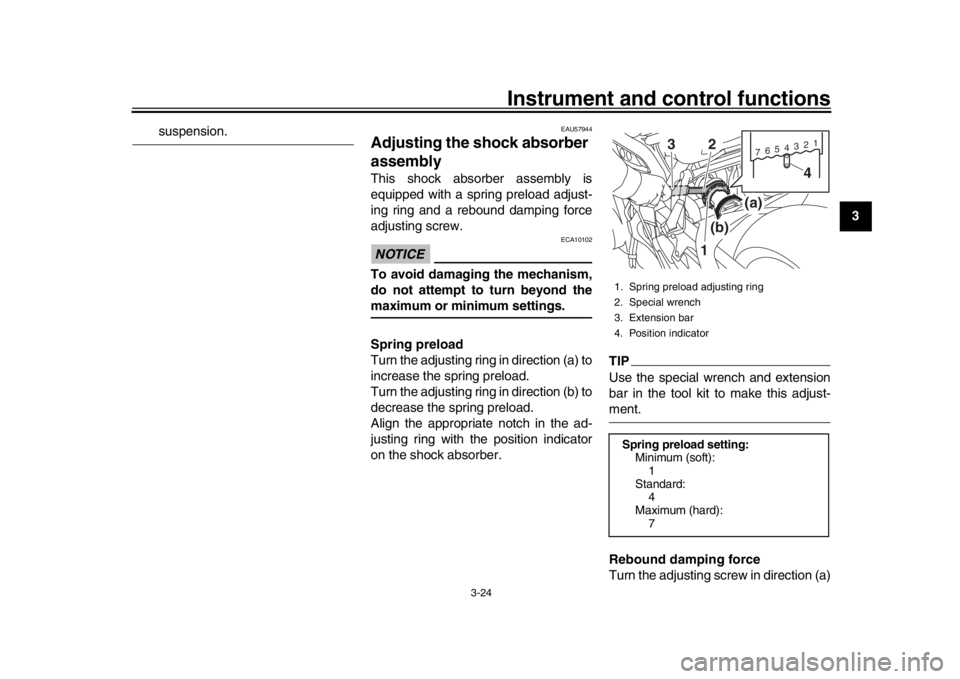
Adjusting the shock absorber
assemblyThis shock absorber assembly is
equipped with a spring preload adjust-
ing ring and a rebound damping force
adjusting screw.NOTICE
ECA10102
To avoid damaging the mechanism,
do not attempt to turn beyond themaximum or minimum settings.
Spring preload
Turn the adjusting ring in direction (a) to
increase the spring preload.
Turn the adjusting ring in direction (b) to
decrease the spring preload.
Align the appropriate notch in the ad-
justing ring with the position indicator
on the shock absorber.
TIPUse the special wrench and extension
bar in the tool kit to make this adjust-ment.
Rebound damping force
Turn the adjusting screw in direction (a)1. Spring preload adjusting ring
2. Special wrench
3. Extension bar
4. Position indicatorSpring preload setting: Minimum (soft):
1
Standard: 4
Maximum (hard): 7
7654321
1(b) (a)
4
2
3
BAE-28199-E1.book 24 ページ 2019年8月23日 金曜日 午後3時56分
Page 40 of 102
Instrument and control functions
3-25
1
23
4
5
6
7
8
9
10
11
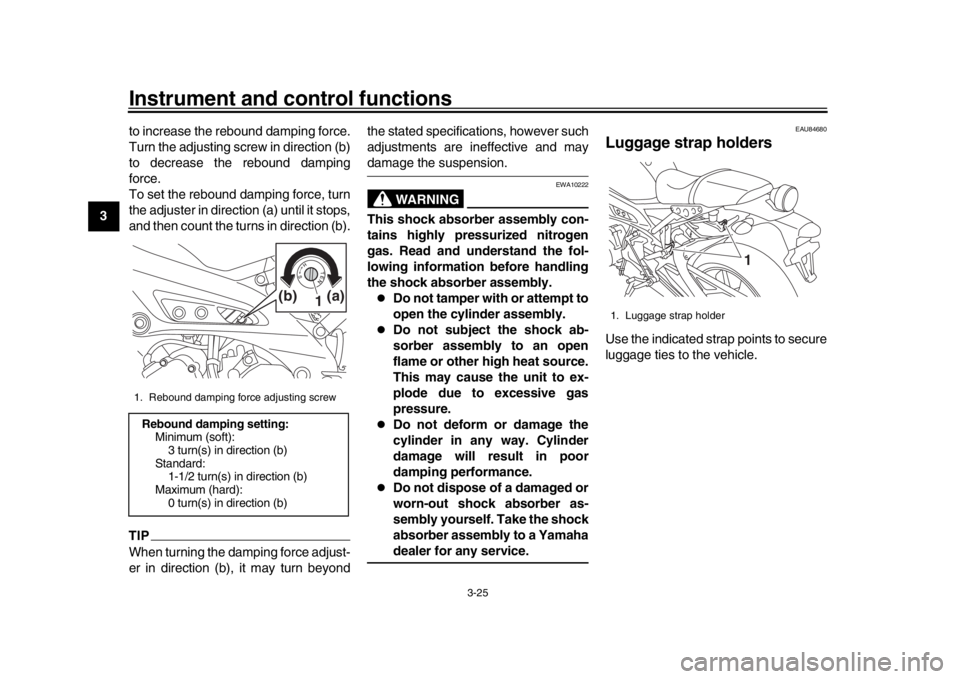
12 to increase the rebound damping force.
Turn the adjusting screw in direction (b)
to decrease the rebound damping
force.
To set the rebound damping force, turn
the adjuster in direction (a) until it stops,
and then count the turns in direction (b).
TIPWhen turning the damping force adjust-
er in direction (b), it may turn beyond the stated specifications, however such
adjustments are ineffective and may
damage the suspension.
WARNING
EWA10222
This shock absorber assembly con-
tains highly pressurized nitrogen
gas. Read and understand the fol-
lowing information before handling
the shock absorber assembly.
Do not tamper with or attempt to
open the cylinder assembly.
Do not subject the shock ab-
sorber assembly to an open
flame or other high heat source.
This may cause the unit to ex-
plode due to excessive gas
pressure.
Do not deform or damage the
cylinder in any way. Cylinder
damage will result in poor
damping performance.
Do not dispose of a damaged or
worn-out shock absorber as-
sembly yourself. Take the shock
absorber assembly to a Yamahadealer for any service.
EAU84680
Luggage strap holdersUse the indicated strap points to secure
luggage ties to the vehicle.
1. Rebound damping force adjusting screwRebound damping setting:
Minimum (soft):
3 turn(s) in direction (b)
Standard: 1-1/2 turn(s) in direction (b)
Maximum (hard): 0 turn(s) in direction (b)
1(a)(b)
1. Luggage strap holder
1
BAE-28199-E1.book 25 ページ 2019年8月23日 金曜日 午後3時56分
Page 48 of 102

Operation and important riding points
5-2
1
2
3
45
6
7
8
9
10
11
12
EAU86590
Starting the engineThe ignition circuit cut-off system will
enable starting when:
the transmission is in the neutral
position or
the transmission is in gear, the sid-
estand is up, and the clutch lever is
pulled.
To start the engine
1. Turn the main switch on and set the engine stop switch to the run
position.
2. Confirm the indicator and warning light(s) come on for a few seconds,
and the go off. (See page 3-3.)TIP
Do not start the engine if the en-
gine trouble warning light or the oil
level warning light remains on.
The ABS warning light should
come on and stay on until the vehi-
cle reaches a speed of 10 km/h (6mi/h).
NOTICE
ECA24110
If a warning or indicator light does not work as described above, have a
Yamaha dealer check the vehicle.
3. Shift the transmission into the neu- tral position.
4. Start the engine by pushing the start switch.
5. Release the start switch when the engine starts, or after 5 seconds.
Wait 10 seconds before pressing
the switch again to allow battery
voltage to restore.NOTICE
ECA11043
For maximum engine life, never ac-
celerate hard when the engine iscold!
EAUM3632
TIPThis model is equipped with:
a lean angle sensor. This sensor
stops the engine in case of a vehi-
cle turnover. If this happens, the
engine trouble warning light will
come on, but this is not a malfunc-
tion. Turn the vehicle power off
and then back on again to cancel
the warning light. Failing to do so
will prevent the engine from start-
ing even though the engine will
crank when pushing the start
switch.
an engine auto-stop system. The
engine stops automatically if left
idling for 20 minutes. If the engine
stops, simply push the start switchto restart the engine.
BAE-28199-E1.book 2 ページ 2019年8月23日 金曜日 午後3時56分