Page 21 of 96

Instrument and control functions
3-7
3 tween the various tripmeter, odometer,
instantaneous fuel consumption, aver-
age fuel consumption, and average
speed modes in the following order:
TRIP F → km/L or L/100 km → AVE_
_._ km/L or AVE_ _._ L/100 km → AVE_
_._ km/h → ODO → TRIP 1 → TRIP 2
→ TRIP F
For the UK:
TRIP F → km/L, L/100 km or MPG →
AVE_ _._ km/L, AVE_ _._ L/100 km or
AVE_ _ _._ MPG→ AVE_ _._ km/h or
AVE_ _._ MPH → ODO → TRIP 1 →
TRIP 2 → TRIP F
To reset a tripmeter, select it by push-
ing the “SELECT” button and then
push and hold the “RESET” button.
If you do not reset the fuel reserve trip-
meter manually, it resets itself auto-
matically and the display returns to the
prior mode after refueling and traveling
5 km (3 mi).
Odometer mode
The odometer shows the total distance
traveled by the vehicle. It will lock at
999999 and cannot be reset.Tripmeters mode
The tripmeters shows the total dis-
tance traveled since they were last re-
set.
To reset a tripmeter, push and hold the
“RESET” button.
TIP
The tripmeters will reset and con-
tinue counting after 9999.9 is
reached. To reset the tripmeters,
while it is being displayed, push
and hold the “RESET” button.
Instantaneous fuel consumption
mode
Shows the current fuel consumption
when the vehicle is traveling at least 10
km/h (6 mi/h).
1. Odometer
ZAUM15751
1. Tripmeter
1. Instantaneous fuel consumption display
ZAUM15761
ZAUM15771
UB6GE0E0.book Page 7 Wednesday, August 28, 2019 11:11 AM
Page 29 of 96

Instrument and control functions
3-15
3
EAU63040
ABS
The Yamaha ABS (Anti-lock Brake
System) features a dual electronic con-
trol system, which acts on the front and
rear brakes independently.
Operate the brakes with ABS as you
would conventional brakes. If the ABS
is activated, a pulsating sensation may
be felt at the brake lever or brake ped-
al. In this situation, continue to apply
the brakes and let the ABS work; do
not “pump” the brakes as this will re-
duce braking effectiveness.
WARNING
EWA16051
Always keep a sufficient distance
from the vehicle ahead to match the
riding speed even with ABS.
The ABS performs best with
long braking distances.
On certain surfaces, such as
rough or gravel roads, the brak-
ing distance may be longer with
the ABS than without.
The ABS is monitored by an ECU,
which will revert the system to conven-
tional braking if a malfunction occurs.
TIP
The ABS performs a self-diagno-
sis test each time the vehicle first
starts off after the key is turned to
“ON” and the vehicle has traveled
at a speed of 10 km/h (6 mi/h) or
higher. During this test, a “click-
ing” noise can be heard from the
hydraulic control unit, and if the
brake lever or brake pedal is even
slightly applied, a vibration can be
felt at the lever and pedal, but
these do not indicate a malfunc-
tion.This ABS has a test mode which
allows the owner to experience
the pulsation at the brake lever or
brake pedal when the ABS is op-
erating. However, special tools are
required, so please consult your
Yamaha dealer.
NOTICE
ECA20100
Be careful not to damage the wheel
sensor or wheel sensor rotor; other-
wise, improper performance of the
ABS will result.
1. Front wheel sensor rotor
2. Front wheel sensor
1. Rear wheel sensor
2. Rear wheel sensor rotor
ZAUM1734
1
2
ZAUM1590
1
2
UB6GE0E0.book Page 15 Wednesday, August 28, 2019 11:11 AM
Page 30 of 96

Instrument and control functions
3-16
3
EAU13076
Fuel tank cap
To open the fuel tank cap
Open the fuel tank cap lock cover, in-
sert the key into the lock, and then turn
it 1/4 turn clockwise. The lock will be
released and the fuel tank cap can be
opened.
To close the fuel tank cap
With the key still inserted in the lock,
push down the fuel tank cap. Turn the
key 1/4 turn counterclockwise, remove
it, and then close the lock cover.
TIP
The fuel tank cap cannot be closed un-
less the key is in the lock. In addition,
the key cannot be removed if the cap is
not properly closed and locked.
WARNING
EWA11092
Make sure that the fuel tank cap is
properly closed after filling fuel.
Leaking fuel is a fire hazard.
EAU13213
Fuel
Make sure there is sufficient gasoline in
the tank.
WARNING
EWA10882
Gasoline and gasoline vapors are
extremely flammable. To avoid fires
and explosions and to reduce the
risk of injury when refueling, follow
these instructions.
1. Before refueling, turn off the en-
gine and be sure that no one is sit-
ting on the vehicle. Never refuel
while smoking, or while in the vi-
cinity of sparks, open flames, or
other sources of ignition such as
the pilot lights of water heaters
and clothes dryers.
2. Do not overfill the fuel tank. Stop
filling when the fuel reaches the
bottom of the filler tube. Because
fuel expands when it heats up,
heat from the engine or the sun
can cause fuel to spill out of the
fuel tank.
3. Wipe up any spilled fuel immedi-
ately. NOTICE: Immediately
wipe off spilled fuel with a clean,1. Fuel tank cap lock cover
2. Unlock.
1
2
1. Fuel tank filler tube
2. Maximum fuel level
1
2
UB6GE0E0.book Page 16 Wednesday, August 28, 2019 11:11 AM
Page 32 of 96

Instrument and control functions
3-18
3
EAU58301
Fuel tank overflow hose
Before operating the vehicle:
Check the fuel tank overflow hose
connection and routing.
Check the fuel tank overflow hose
for cracks or damage, and replace
it if necessary.
Make sure that the fuel tank over-
flow hose is not blocked, and
clean it if necessary.
EAU13435
Catalytic converter
The exhaust system contains catalytic
converter(s) to reduce harmful exhaust
emissions.
WARNING
EWA10863
The exhaust system is hot after op-
eration. To prevent a fire hazard or
burns:
Do not park the vehicle near
possible fire hazards such as
grass or other materials that
easily burn.
Park the vehicle in a place
where pedestrians or children
are not likely to touch the hot
exhaust system.
Make sure that the exhaust sys-
tem has cooled down before
doing any maintenance work.
Do not allow the engine to idle
more than a few minutes. Long
idling can cause a build-up of
heat.
1. Fuel tank overflow hose
1
UB6GE0E0.book Page 18 Wednesday, August 28, 2019 11:11 AM
Page 33 of 96
Instrument and control functions
3-19
3
EAU57992
Seat
To remove the seat
1. Open the seat lock cover, insert
the key into the seat lock, and then
turn the key counterclockwise.
2. While holding the key in that posi-
tion, slide the seat backward and
then lift the rear of the seat up, and
then pull the seat off.
To install the seat
1. Insert the projections into the seat
holders as shown.
2. Push the rear of the seat down to
lock it in place.
3. Remove the key.
TIP
Make sure that the seat is properly se-
cured before riding.
1. Seat lock cover
2. Seat lock
3. Turn.
1
23
UB6GE0E0.book Page 19 Wednesday, August 28, 2019 11:11 AM
Page 58 of 96
Periodic maintenance and adjustment
6-14
6
EAU48434
Adjusting the throttle grip free
play
Measure the throttle grip free play as
shown.
Periodically check the throttle grip free
play and, if necessary, adjust it as fol-
lows.
TIP
The engine idling speed must be cor-
rectly adjusted before checking and
adjusting the throttle grip free play.
1. Slide the rubber cover back.
2. Loosen the locknut.
3. To increase the throttle grip free
play, turn the adjusting nut in di-
rection (a). To decrease the throt-
tle grip free play, turn the adjusting
nut in direction (b).4. Tighten the locknut and then slide
the rubber cover to its original po-
sition.
1. Throttle grip free play
Throttle grip free play:
3.0–5.0 mm (0.12–0.20 in)
1
1. Adjusting nut
2. Locknut
1
2
(a)
(b)
UB6GE0E0.book Page 14 Wednesday, August 28, 2019 11:11 AM
Page 62 of 96

Periodic maintenance and adjustment
6-18
6
EAU21963
Cast wheels
To maximize the performance, durabil-
ity, and safe operation of your vehicle,
note the following points regarding the
specified wheels.
The wheel rims should be
checked for cracks, bends, warp-
age or other damage before each
ride. If any damage is found, have
a Yamaha dealer replace the
wheel. Do not attempt even the
smallest repair to the wheel. A de-
formed or cracked wheel must be
replaced.
The wheel should be balanced
whenever either the tire or wheel
has been changed or replaced. An
unbalanced wheel can result in
poor performance, adverse han-
dling characteristics, and a short-
ened tire life.
EAU22047
Adjusting the clutch lever free
play
Measure the clutch lever free play as
shown.
Periodically check the clutch lever free
play and, if necessary, adjust it as fol-
lows.
1. Slide the rubber cover back at the
clutch lever.
2. Loosen the locknut.
3. To increase the clutch lever free
play, turn the clutch lever free play
adjusting bolt in direction (a). To
decrease the clutch lever free
play, turn the adjusting bolt in di-
rection (b).
TIP
If the specified clutch lever free play
could be obtained as described above,
skip steps 4…7.
4. Fully turn the adjusting bolt at the
clutch lever in direction (a) to loos-
en the clutch cable.
1. Rubber cover
2. Clutch lever free play adjusting bolt
3. Locknut
4. Clutch lever free play
Clutch lever free play:
10.0–15.0 mm (0.39–0.59 in)
4
12 (a) (b)
3
UB6GE0E0.book Page 18 Wednesday, August 28, 2019 11:11 AM
Page 63 of 96
Periodic maintenance and adjustment
6-19
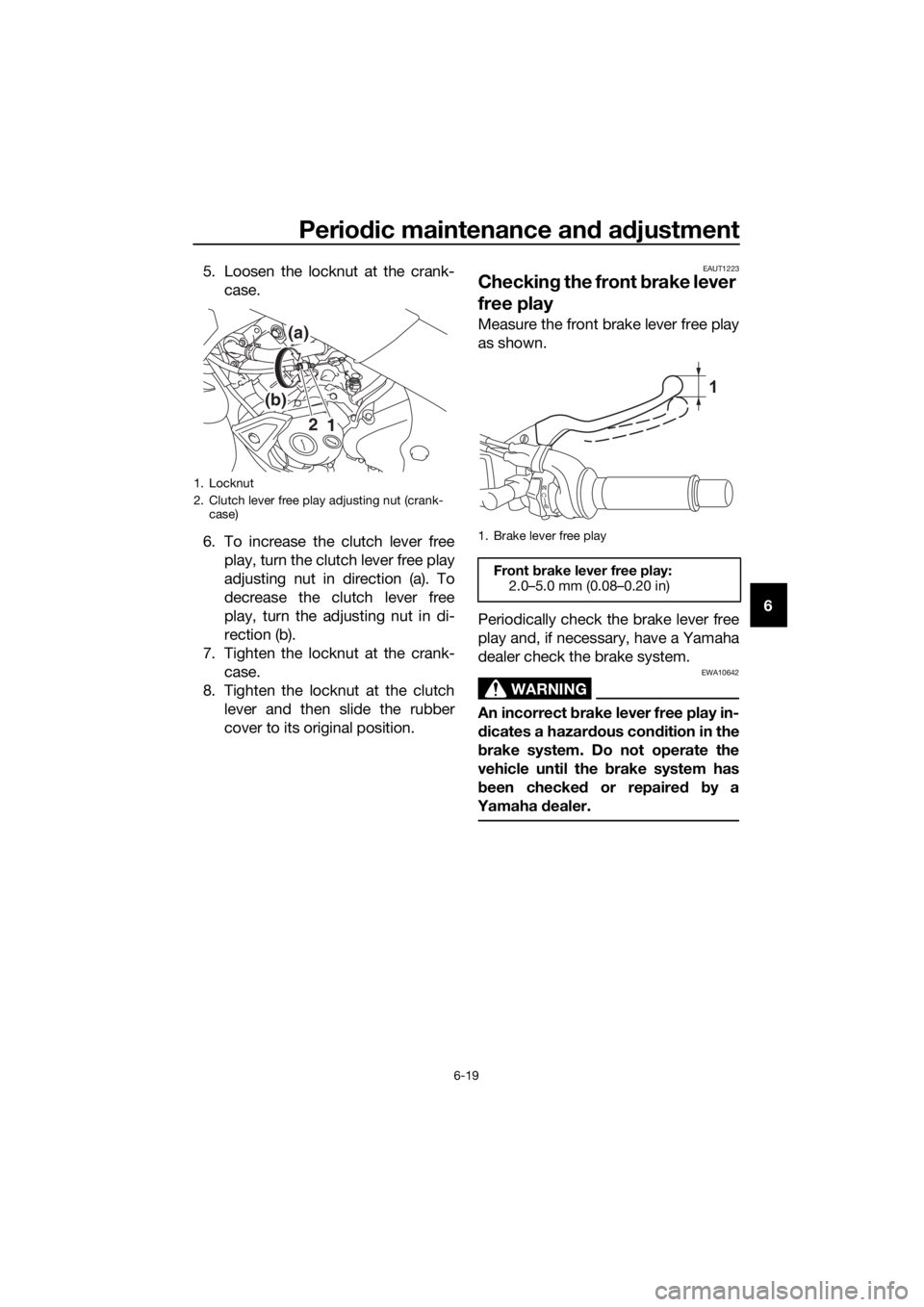
6 5. Loosen the locknut at the crank-
case.
6. To increase the clutch lever free
play, turn the clutch lever free play
adjusting nut in direction (a). To
decrease the clutch lever free
play, turn the adjusting nut in di-
rection (b).
7. Tighten the locknut at the crank-
case.
8. Tighten the locknut at the clutch
lever and then slide the rubber
cover to its original position.
EAUT1223
Checking the front brake lever
free play
Measure the front brake lever free play
as shown.
Periodically check the brake lever free
play and, if necessary, have a Yamaha
dealer check the brake system.
WARNING
EWA10642
An incorrect brake lever free play in-
dicates a hazardous condition in the
brake system. Do not operate the
vehicle until the brake system has
been checked or repaired by a
Yamaha dealer.
1. Locknut
2. Clutch lever free play adjusting nut (crank-
case)
1 2 (a)
(b)
1. Brake lever free play
Front brake lever free play:
2.0–5.0 mm (0.08–0.20 in)
1
UB6GE0E0.book Page 19 Wednesday, August 28, 2019 11:11 AM

