Page 248 of 279
246Vehicle careCaution
Drive slowly. Do not drive jerkily.
Excessive tractive force can
damage the vehicle.
When the engine is not running,
considerably more force is needed to
brake and steer.
To prevent the entry of exhaust gases from the towing vehicle, switch on the
air recirculation and close the
windows.
Vehicles with automatic transmission: The vehicle must be towed facing
forwards, not faster than 50 mph nor further than 60 miles. In all other
cases and when the transmission is
defective, the front axle must be
raised off the ground.
Seek the assistance of a workshop. After towing, unscrew the towing eye.
Insert cap with the flange into the
recess and fix cap by pushing.
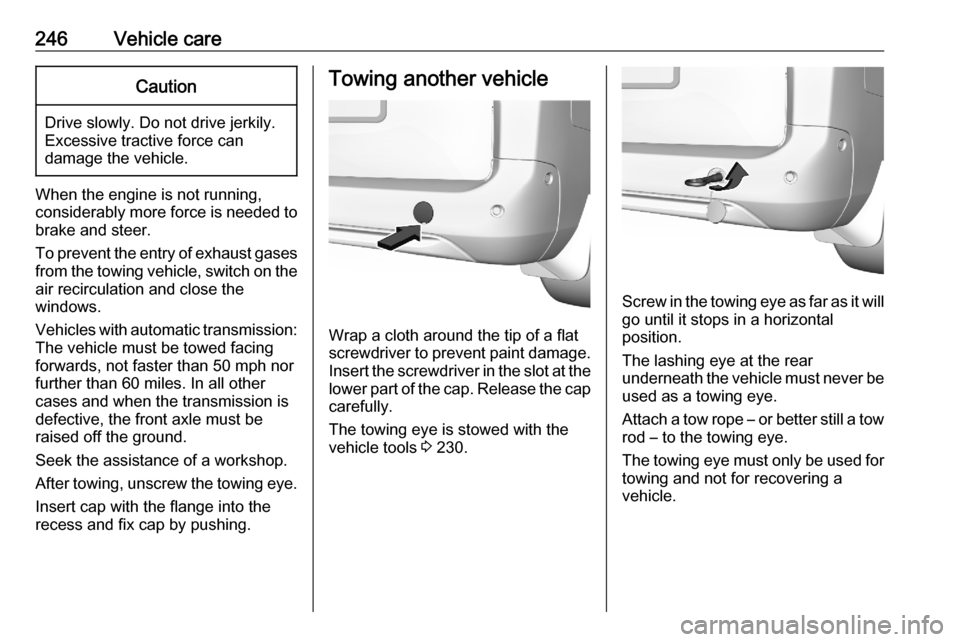
Towing another vehicle
Wrap a cloth around the tip of a flat
screwdriver to prevent paint damage. Insert the screwdriver in the slot at the
lower part of the cap. Release the cap carefully.
The towing eye is stowed with the
vehicle tools 3 230.
Screw in the towing eye as far as it will
go until it stops in a horizontal
position.
The lashing eye at the rear
underneath the vehicle must never be used as a towing eye.
Attach a tow rope – or better still a tow
rod – to the towing eye.
The towing eye must only be used for
towing and not for recovering a
vehicle.
Page 250 of 279

248Vehicle careThoroughly rinse and leather-off the
vehicle. Rinse leather frequently. Use
separate leathers for painted and
glass surfaces: remnants of wax on
the windows will impair vision.
Have the door hinges of all doors
greased by a workshop.
Exterior lights
Headlight and other light covers are
made of plastic. Do not use any
abrasive or caustic agents, do not use
an ice scraper, and do not clean them
dry.
Polishing and waxing
Polishing is necessary only if the paint
has become dull or if solid deposits
have become attached to it.
Plastic body parts must not be treated with wax or polishing agents.
Windows and wiper blades
Switch off wipers before handling in
their areas.
Use a soft lint-free cloth or chamois leather together with window cleaner
and insect remover.When cleaning the rear window from
inside, always wipe in parallel to the
heating element to prevent damage.
For mechanical removal of ice, use a
sharp-edged ice scraper. Press the
scraper firmly against the glass so
that no dirt can get under it and
scratch the glass.
Clean smearing wiper blades with a
soft cloth and window cleaner. Also
make sure to remove any residues
such as wax, insect residues and
similar from the window.
Ice residues, pollution and continuous wiping on dry windows will damage or
even destroy the wiper blades.
Glass panel
Use a soft lint-free cloth or chamois
leather together with window cleaner
to clean the glass panel.
Wheels and tyres
Do not use high-pressure jet
cleaners.
Clean rims with a pH-neutral wheel
cleaner.Rims are painted and can be treated
with the same agents as the body.
Paintwork damageRectify minor paintwork damage witha touch-up pen before rust forms.
Have more extensive damage or rust
areas repaired by a workshop.
Underbody Some areas of the vehicle underbody
have a PVC undercoating while other
critical areas have a durable
protective wax coating.
After the underbody is washed, check the underbody and have it waxed if
necessary.
Bitumen / rubber materials could
damage the PVC coating. Have
underbody work carried out by a
workshop.
Before and after winter, wash the
underbody and have the protective
wax coating checked.
Page 253 of 279

Service and maintenance251Service and
maintenanceGeneral information ...................251
Service information ..................251
Recommended fluids, lubricants and parts .................................... 254
Recommended fluids and lubricants ................................ 254General information
Service information In order to ensure economical and
safe vehicle operation and to
maintain the value of your vehicle, it
is of vital importance that all
maintenance work is carried out at the proper intervals as specified.
The detailed, up-to-date service
schedule for your vehicle is available
at the workshop.
Severe operating conditions exist if one or more of the following
circumstances occur frequently: Cold
starting, stop and go operation, e.g.
for taxis and police vehicles, trailer
operation, mountain driving, driving
on poor and sandy road surfaces,
increased air pollution, presence of
airborne sand and high dust content,
driving at high altitude and large
variations of temperature.
Under these severe operating
conditions, certain service work may
be required more frequently than the
regular service interval indicated inthe service display. Contact a
workshop for customised service
schedules.
Service display 3 99.
Page 255 of 279

Service and maintenance253
Engine code
EB2ADT
EB2ADTS
DV5RC
DV5RD
DV5RE
DV6FE
DV6FD
DV6D
Country group 49,000 miles / 1 year9,000 miles / 1 year9,000 miles / 1 year9,000 miles / 1 yearCountry group 56,000 miles / 1 year6,000 miles / 1 year6,000 miles / 1 year6,000 miles / 1 yearCountry Group 1:
Andorra, Austria, Belgium,Cyprus, Denmark, Finland, France, Germany, Greece, Iceland, Ireland, Italy, Liechtenstein,
Luxembourg, Malta, Monaco, Netherlands, Norway, Portugal, San Marino, Spain, Sweden, Switzerland, United Kingdom.Country Group 2:
Bosnia-Herzegovina, Bulgaria, Croatia, Czech Republic, Estonia, Hungary, Latvia, Lithuania, North Macedonia, Poland,
Romania, Slovakia, Slovenia.Country Group 3:
Albania, Montenegro, Serbia.Country Group 4:
Israel, South Africa, Turkey.Country Group 5:
All other countries which are not listed in the previous country groups.Confirmations
Confirmation of service is recorded in the Service and warranty booklet. The date and mileage is completed with the stamp
and signature of the servicing workshop.
Make sure that the Service and warranty booklet is completed correctly as continuous proof of service is essential if any warranty or goodwill claims are to be met, and is also a benefit when selling the vehicle.
Page 256 of 279

254Service and maintenanceRecommended fluids,lubricants and parts
Recommended fluids and lubricants
Only use products that meet the
recommended specifications.9 Warning
Operating materials are
hazardous and could be
poisonous. Handle with care. Pay
attention to information given on
the containers.
Engine oil
Engine oil is identified by its quality
and its viscosity. Quality is more
important than viscosity when
selecting which engine oil to use. The engine oil quality ensures e.g. engine
cleanliness, wear protection and
engine oil aging control, whereas
viscosity grade gives information on
the oil's thickness over a temperature range.
Select the appropriate engine oil
based on its quality and on the
minimum ambient temperature
3 258.
Topping up engine oilCaution
In case of any spilled oil, wipe it up and dispose it properly.
Engine oils of different manufacturersand brands can be mixed as long as
they comply with the required engine
oil quality and viscosity.
Select the appropriate engine oil
based on its quality and on the
minimum ambient temperature
3 258.
Additional engine oil additives
The use of additional engine oil
additives could cause damage and
invalidate the warranty.
Engine oil viscosity grades
The SAE viscosity grade gives
information of the thickness of the oil.
Multigrade oil is indicated by two
figures, e.g. SAE 5W-30. The first figure, followed by a W, indicates the
low temperature viscosity and the
second figure the high temperature
viscosity.
Select the appropriate viscosity grade depending on the minimum ambient
temperature 3 258.
All of the recommended viscosity
grades are suitable for high ambient
temperatures.
Coolant and antifreeze
Use only organic acid type-long life
coolant (LLC) antifreeze approved for
the vehicle. Consult a workshop.
The system is factory filled with
coolant designed for excellent
corrosion protection and frost
protection down to approx. -37 °C.
This concentration should be
maintained all year round. The use of additional coolant additives that
intend to give additional corrosion
protection or seal against minor leaks
can cause function problems. Liability
Page 258 of 279
256Technical dataTechnical dataVehicle identification..................256
Vehicle identification number ..256
Identification plate ...................256
Engine identification ................257
Vehicle data ............................... 258
Recommended fluids and lubricants ................................ 258
Engine data ............................. 260
Vehicle dimensions .................262
Capacities ................................ 263
Tyre pressures ........................ 264Vehicle identification
Vehicle identificationnumber
The Vehicle Identification Number
may be embossed on the instrument
panel, visible through the windscreen.
Identification plate
The identification plate is located on
the front left or right door frame.
Page 260 of 279
258Technical dataVehicle dataRecommended fluids and lubricantsRequired engine oil quality Country groups 3 251
Countries included in country groups 1 to 3EB2FA
EB2ADT
EB2ADTS
EP6FADTXD
DV5RC
DV5RD
DV5REEP6FDTM
EB2DT
EC5F
DW10FC
DV6D
DV6FD
DV6FEVauxhall Original engine oilB71 2010 / B71 2312B71 2312
Engine EC5F: B71 2290, B71 2296 or B71 300 may also be used.
Countries included in country group 4
all enginesVauxhall Original engine oilB71 2302 / B71 2297
Engine EC5F: B71 2296 or B71 300 may also be used.
Page 262 of 279
260Technical dataEngine dataEngine identifier code
D12XHL
F12XHLF12XHTZ16XUD15DTLD15DTSales designation1.2 Turbo1.21.61.5 Turbo1.5 TurboEngineering codeEB2ADTEB2ADTSEC5FDV5REDV5RDPiston displacement [cm 3
]11991199158714991499Engine power [kW]8196855675at rpm55005500575035003500Torque [Nm]205230150230250at rpm17501750400017501750Fuel typePetrolPetrolPetrolDieselDieselOctane rating RON 1)2)recommended959595--possible98----1)
A country specific label at the fuel filler flap can supersede the engine specific requirement.
2) In certain countries, the use of a particular fuel, e.g. a specific octane rating, may be required to ensure proper engine operation.


