2020 TOYOTA PROACE VERSO Interior sensor
[x] Cancel search: Interior sensorPage 3 of 418

.
.
Driving recommendations 192Starting-switching off the engine, manual key, remote control 195Starting and switching off the engine, 198"Smart Entry & Start System" 198Parking brake 201Hill start assist control (HAC) 2025 -speed manual gearbox 2036 -speed manual gearbox 203Gear shift indicator 204Automatic gearbox 205Electronic gearbox 210Stop & Start 214Head-up display 218Adjustable Speed Limiter (ASL) 220Road Sign Assist 221Speed limiter 225Cruise control 228Adaptive cruise control 232Forward collision warning and Autonomous emergency braking system with Pedestrian Detection 239Lane Departure Alert 245Driver Attention Alert 247Blind spot monitoring system 249Parking sensors 252Reversing camera, interior mirror 254180° rear vision 255Tyre Pressure Warning System (TPWS) 258
Fuel tank 261Diesel misfuel prevention 262Snow chains 264Towing a trailer 265Energy economy mode 266Accessories 267Roof bars / Roof rack 268Changing a wiper blade 269B o nn et 271Diesel engine 272Checking levels 273Checks 276AdBlue® and SCR system (Diesel) 278
Warning triangle (stowing) 282Tool box 282Temporary puncture repair kit 285Changing a wheel 291Changing a bulb 298Changing a fuse 31112 V battery 316To w i n g 3 2 0Running out of fuel (Diesel) 322
Dimensions 323Engines 324Weights 324Identification markings 327
DrivingPractical information
In the event of a breakdown
Technical data
Emergency or assistance 328Toyota Pro Touch with navigation system 331To y o t a P r o To u c h 367Toyota Radio Bluetooth 387
Audio and telematics
Alphabetical index
Contents
Page 134 of 418

134
In order for these systems to be fully effective, follow the operation and maintenance guidelines below:F To obtain an even air distribution, take care not to obstruct the exterior air intake grilles located at the base of the windscreen, the nozzles, the vents and the air outlets, as well as the air extractor located at the rear.F Do not cover the sunshine sensor, located at the top of the windscreen; this is used for regulation of the air conditioning system.F Operate the air conditioning system for at least 5 to 10 minutes, once or twice a month
to keep it in per fect working order.F Ensure that the passenger compartment filter is in good condition and have the filter elements replaced regularly. We recommend the use of a combined passenger compartment filter. Thanks to its special active additive, it contributes to the purification of the air breathed by the occupants and the cleanliness of the passenger compartment (reduction of allergic symptoms, bad odours and greasy deposits).F To ensure correct operation of the air conditioning system, you are also advised to have it checked regularly as recommended in the maintenance and warranty guide.F If the system does not produce cold air, switch it off and contact an authorized Toyota dealer or repairer, or another duly qualified and equipped professional.
Recommendations for heating, ventilation and air conditioning
If after an extended stop in sunshine, the interior temperature is very high, first ventilate the passenger compartment for a few moments.Put the air flow control at a setting high enough to quickly change the air in the passenger compartment.The air conditioning system does not contain chlorine and does not present any danger to the ozone layer.
The condensation created by the air conditioning results in a discharge of water under the vehicle which is per fectly normal.
When towing the maximum load on a steep gradient in high temperatures, switching off the air conditioning increases the available engine power and so improves the towing ability.
Stop & Start
The heating and air conditioning systems only work when the engine is running.To maintain a comfortable temperature in the passenger compartment, you can temporarily deactivate the Stop & Start system.For more information on Stop & Star t, refer to the corresponding section.
Air vents
To close a vent, move the control towards the outside of the vehicle. Slight resistance may be felt.
Ease of use and comfort
Page 143 of 418

143
Rear view mirror
Equipped with an anti-dazzle system, which darkens the mirror glass and reduces the nuisance to the driver caused by the sun, headlamps from other vehicles...
Manual model
AdjustmentF Adjust the mirror so that the glass is directed correctly in the "day" position.
In order to ensure optimum visibility during your manoeuvres, the mirror lightens automatically when reverse gear is engaged.
Day / night positionF Pull the lever to change to the "night" anti-dazzle position.F Push the lever to change to the normal "day" position.
Automatic "Electrochromatic rear-view mirror" model
This system automatically and progressively changes between the day and night uses by means of a sensor, which measures the light from the rear of the vehicle.
Conversation mirror
This mirror, placed on top of the central mirror, enables the driver or front passenger to obser ve all the rear seats.Fitted on its own ball joint, its manual adjustment is simple and provides a view of the rear interior of the vehicle.It can also be adjusted for improved visibility during manoeuvres or when overtaking.
4
Lighting and visibility
Page 249 of 418

249
Blind spot monitoring system
A warning lamp appears in the door mirror on the side in question:- immediately, when being overtaken,- after a delay of about one second, when overtaking a vehicle slowly.
This driving assistance system warns the driver of the presence of another vehicle in the blind spot angle of their vehicle (areas masked from the driver's field of vision), as soon as this presents a potential danger.
The alert is given by a warning lamp which comes on in the door mirror on the side in question as soon as a vehicle - car, lorry, bicycle - is detected and the following conditions are fulfilled:- all the vehicles must be moving in the same direction and on adjacent lanes,- the speed of your vehicle is between 7 and 87 mph (12 and 140 km/h),- when you overtake a vehicle with a speed difference of less than 6 mph (10 km/h),- when a vehicle overtakes you with a speed difference of less than 15 mph (25 km/h),- the traffic must be flowing normally,- in the case of an overtaking manoeuvre, if this is prolonged and the vehicle being overtaken returns to the blind spot,- you are driving on a straight or slightly curved road,- your vehicle is not pulling a trailer, a caravan...
This system is designed to improve safety when driving and is in no circumstances a substitute for the use of the interior rear view mirror and door mirrors. It is the driver's responsibility to constantly check the traffic, to assess the distances and relative speeds of other vehicles and to predict their movements before deciding whether to change lane.The blind spot sensor system does not replace the need for vigilance on the part of the driver.
6
Driving
Page 254 of 418

254
Reversing camera with display in the interior mirror
The visual aid reversing camera is activated automatically when reverse gear is engaged.
The function may be completed with parking sensors.
Opening the rear tailgate or rear door (depending on equipment) can inter fere with the display.If a side door is open, allow for the space it occupies.Some deformation of the image is normal.
The reversing camera cannot in any circumstances be a substitute for vigilance on the part of the driver.
Check the cleanliness of the camera lens regularly.Clean the reversing camera regularly using a soft, dry cloth.
The image is displayed in the interior mirror.
High pressure jet washing (if muddy, for example)When washing your vehicle, do not
place the tip of the lance within 30 cm of the camera as there is a risk of damaging it.The blue lines represent the width of your vehicle including the mirrors.The red line represents a distance of 30 cm from the rear bumper and the thin blue lines respectively 1 m (A) and 2 m (B).
Driving
Page 313 of 418

313
FuseN°Rating(A)Functions
F110Electric power steering, clutch switch
F415Horn.
F520Front/rear screenwash pump.
F620Front/rear screenwash pump.
F710Rear 12 V accessory socket.
F820Single or double rear wipers.
F10/F1130Front and rear, exterior, interior locks.
F1310Front air conditioning controls, radio controls, gear lever, head-up display.
F145Alarm, ER A-GLONASS emergency call system.
F175Instrument panel.
F193Steering mounted controls.
F213Smart Entry & Start System or ignition switch.
F223Rain and sunshine sensor, multifunction detection camera.
F235Seat belt unfastened or not fastened display screen.
F245Touch screen, reversing camera and parking sensors.
F255Airbags.
F2920Audio system, touch screen, CD player, navigation.
F3115Audio system (battery +).
F3215Front 12 V accessory socket.
F345Blind spot monitoring system, door mirror electric controls.
F355Heated washer jets, headlamp beam height control.
F365Rear courtesy lamp.
Version 1 (Eco)
The fuses described hereafter vary according to the equipment in your vehicle.
8
In the event of a breakdown
Page 314 of 418
314
FuseN°Rating(A)Functions
F13Smart Entry & Start System or ignition switch.
F55Touch screen, reversing camera and parking sensors.
F710Rear air conditioning controls, Hi-Fi amplifier.
F820Single or double rear wiper.
F10/F1130Front and rear, exterior, interior locks.
F123Alarm.
F1710Rear 12 V accessory socket.
F185ER A-GLONASS emergency call system.
F213Rear courtesy lamp.
F223Glove box lamp, rear courtesy lamps.
F235Blind spot monitoring system, door mirror electric controls.
F245Steering mounted controls.
F255Headlamp beam height control.
F263Seat belt unfastened or not fastened display screen.
F273Rain and sunshine sensor, multifunction detection camera.
F2810Front air conditioning controls, radio controls, gear lever, head-up display.
F30A or B15Audio system (battery +).
F315Airbags.
F3315Front 12 V accessory socket.
F355Instrument panel.
F3620Audio system, touch screen, CD player, navigation.
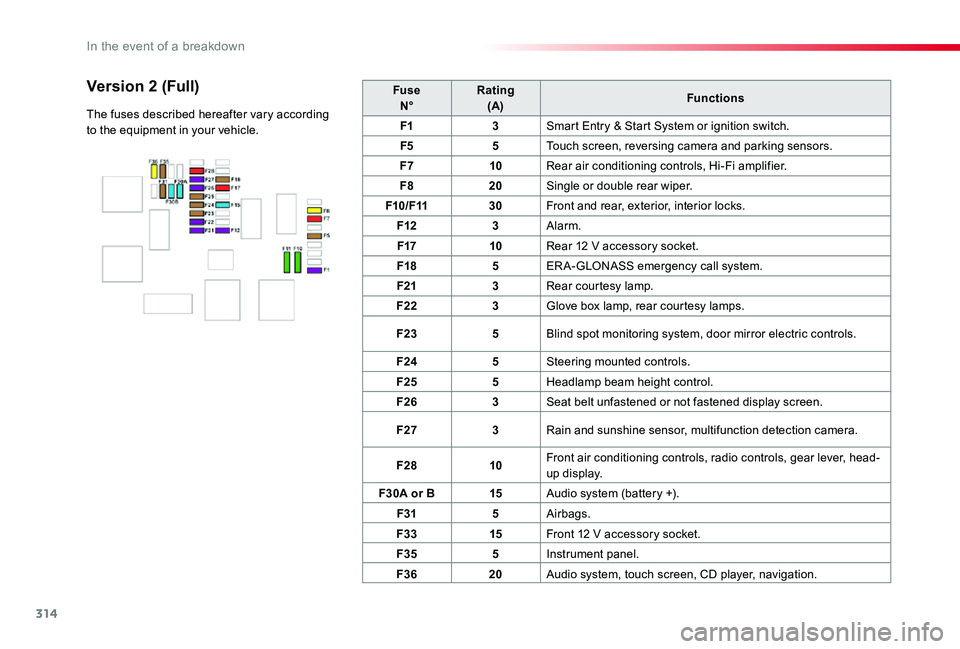
Version 2 (Full)
The fuses described hereafter vary according to the equipment in your vehicle.
In the event of a breakdown
Page 414 of 418

414
Roof bars .......................................................268Roof rack .......................................................268Running out of fuel (Diesel) ..........................322
Safety, children ................................167, 170, 173 -191Saturation of the Diesel Particle Filter (DPF) ..........................................................276Screen, instrument panel ..........................38, 39Screenwash ..................................................15 6Screenwash, rear ..........................................15 5SCR (Selective Catalytic Reduction) ............278Seat and bench seat, rear, fixed .............98, 109Seat and bench seat, rear, on rails .......................................101, 109Seat belts ...............................16 4-167, 179, 18 0Seat belts, rear ..............................................165Seat, bench front, 2-seat ........................93, 165Seats, electric .................................................90Seats, front ................................................87, 90Seats, front bench ...........................................94Seats, heated ............................................91, 94Seat(s), captain, rear, on rails ................................................105, 166Seats, rear .........................................95, 98, 101
S
Pads, brake ...................................................277Paint colour code ..........................................327Parcel shelf, rear ...........................................11 8Parking brake ..................................16, 201, 277Parking sensors, audible and visual ....................................................253Plates, identification......................................327Pressures, tyres ........................... 290, 297, 327Pre-tensioning seat belts ..............................16 4Priming the fuel system ................................322Protecting children ..................167, 170, 173 -191Puncture ........................................................285
PR
Range ..............................................................40Range, AdBlue ................................................33Rear screen, demisting .................................13 3Rear screen, opening .....................................82Recharging the battery .................................318Recirculation, air ...................................125, 13 0Reduction of electrical load .............................................................266Regeneration of the Diesel Particle Filter (DPF) ..................276Reinitialisation of the Tyre Pressure Warning System (TPWS) ...........................259Reinitialising the remote control .....................................................51, 62Reminder, key in ignition ...............................197Reminder, lighting on ....................................14 6Remote control .....................................................45-65Removing a wheel ........................................294Removing the mat .........................................11 0Replacing bulbs ...........................................................298Replacing fuses ............................................311Replacing the air filter ...................................276Replacing the oil filter ...................................276Replacing the passenger compartment filter ......................................276Reser voir, headlamp wash ...........................275Reservoir, screenwash .................................275Resetting the service indicator ........................................................31Resetting the trip recorder ........................................................36Rev counter ...............................................13, 14Reversing camera .........................................255Reversing camera (on interior mirror) .......................................254Reversing lamp ....................................305, 308Road Sign Assist ...........................................221
Alphabetical index