2020 TOYOTA PRIUS PRIME Gasoline
[x] Cancel search: GasolinePage 86 of 792
86
PRIUS PRIME_OM_OM47C77U_(U)
2-1. Plug-in hybrid system
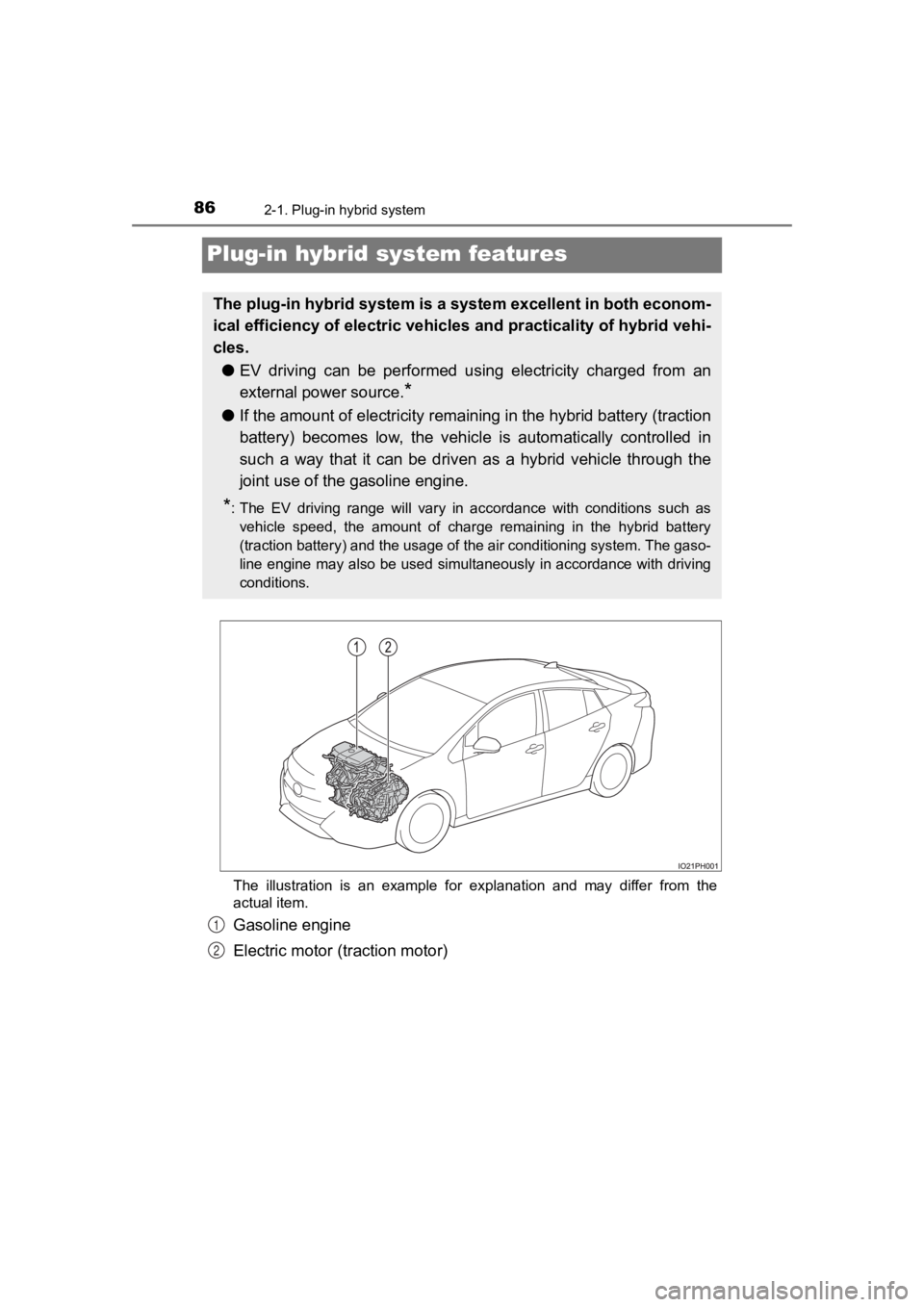
Plug-in hybrid system features
The illustration is an example for explanation and may differ from the
actual item.
Gasoline engine
Electric motor (traction motor)
The plug-in hybrid system is a system excellent in both econom-
ical efficiency of electric vehicles and practicality of hybrid vehi-
cles.
● EV driving can be performed using electricity charged from an
external power source.
*
●If the amount of electricity remaining in the hybrid battery (t raction
battery) becomes low, the vehicle is automatically controlled i n
such a way that it can be driven as a hybrid vehicle through the
joint use of the gasoline engine.
*: The EV driving range will vary in accordance with conditions s uch as
vehicle speed, the amount of charge remaining in the hybrid bat tery
(traction battery) and the usage of the air conditioning system. The gaso-
line engine may also be used simultaneously in accordance with driving
conditions.
1
2
Page 88 of 792

88
PRIUS PRIME_OM_OM47C77U_(U)
2-1. Plug-in hybrid system
EV auto mode (P. 9 0 )
When a sufficient amount of elect ricity for EV driving is remaining in
the hybrid battery (traction battery) after charging
*, the operation
mode can be switched to EV auto mode.
Switching to EV auto mode make powerful driving possible by usi ng
both the gasoline engine and elec tric motor in a driving condition
that requires large driving force, such as when passing a vehicle on
a highway or driving on a steep slope.
When in EV auto mode, the EV auto mode indicator illuminates.
*: The amount of remaining charge can be checked on the multi-informa- tion display etc. ( P. 229)
HV mode
When in HV mode, the vehicle is driven using both the gasoline
engine and electric motor. ( P. 92)
● If electricity needed for EV driving in EV mode or EV auto mode
is not remaining, the operation mode will be automatically
switched to HV mode.
● The operation mode can be switched to HV mode at any timing
by operating the switch to keep electricity for EV driving etc.
*
( P. 90). Switching to HV mode when driving on a highway or
when driving uphill is recommended in order to conserve battery
power.
When in HV mode, the EV drive mode indicator and EV auto mode i ndi-
cator turn off.
*: The EV driving range may reduce even after switching to HV mode.
2
3
Page 89 of 792

PRIUS PRIME_OM_OM47C77U_(U)
892-1. Plug-in hybrid system
2
Plug-in hybrid system
Hybrid battery (traction battery) charge mode ( P. 91)
Electricity generated in the gas oline engine can be charged in the
hybrid battery (traction battery) by switching to the hybrid battery
(traction battery) charge mode wh en electricity needed for EV driv-
ing is not remaining.
*
● The system may not be able to switch to the hybrid battery (tra c-
tion battery) charge mode due to the state of the plug-in hybri d
system. ( P. 9 1 )
● Charging time differs depending on the driving state of the vehi-
cle when driving in hybrid batte ry (traction battery) charge mode.
When in the hybrid battery (traction battery) charge mode, the hybrid
battery charge mode indicator illuminates.
*: When in the hybrid battery (traction battery) charge mode, the hybrid
battery can be charged while driving. However, the gasoline eng ine runs
to charge the battery and fuel consumption becomes higher compa red
with driving in HV mode.
4
Page 91 of 792

PRIUS PRIME_OM_OM47C77U_(U)
912-1. Plug-in hybrid system
2
Plug-in hybrid system
■Switching to the hybrid battery (traction battery) charge mode
Press and hold the switch.
Take your hand off the switch
once the hybrid battery charge
mode indicator starts to blink.
The hybrid battery charge mode
indicator illuminates when the
switch to hybrid battery (traction
battery) charge mode is com-
plete.
When the hybrid battery (traction battery) is fully charged
*, the hybrid
battery (traction battery) charge mode is automatically cancele d and the
operation mode will be switched to HV mode.
The hybrid battery (traction battery) charge mode will be cance led by
pressing EV/HV mode selection switch or EV auto mode switch.
*: The maximum charge amount in the hybrid battery (traction batt ery)
charge mode is approximately 80% of the fully charged capacity for the
charging from an external power source.
■ If the plug-in hybrid system ope ration mode cannot be changed
In the following situations, the plug-in hybrid system operation mode cannot
be changed even if the EV/HV mode selection switch or EV auto mode switch
is pressed. (In this case, the warning message is displayed on the multi-infor-
mation display when the switch is pressed.)
● When electricity needed for EV driving is not remaining (when in EV/EV
auto mode)
● When the traction battery is almost completely charged (hybrid battery [trac-
tion battery] charge mode)
■ When switching from EV mode to another mode using the switch
When the power switch is turned of f, operation mode switching is canceled
and the system returns to EV mode the next time the vehicle is started.
■ Hybrid battery (traction battery) charge mode
●The following may occur to protect the system, etc.
• Cannot switch to hybrid battery (traction battery) charge mode or cannot
cancel it
• Gasoline engine does not start or stops even after switching to hybrid bat- tery (traction battery) charge mode
● If a load to the system is large, such as when the power consumption of the
air conditioning system is large or when the temperature of the engine cool-
ant is high, it may take longer time than usual to charge using the hybrid bat-
tery (traction battery) charge mode, or charging to the hybrid battery
(traction battery) may not be performed.
Page 92 of 792

92
PRIUS PRIME_OM_OM47C77U_(U)
2-1. Plug-in hybrid system
■When in EV/EV auto mode
In EV/EV auto mode, EV driving (driving using only the electric
motor)
* is possible. However, depending on the situation, EV driv-
ing may be canceled and both gaso line engine and electric motor
are used ( P. 95). Also, if a little electricity is remaining in the
hybrid battery (traction battery), HV mode is automatically sel ected.
To drive in EV/EV auto mode l ong, observe the followings.
● Avoid sudden acceleration and sudden deceleration, and be sure
to drive smoothly.
If you repeatedly accelerate, the hybrid battery (traction batt ery)
charge will deplete quickly. Also , EV driving may be canceled by
rapid acceleration or vehicle speed.
● Restrain your speed as much as possible. The distance that can
be driven in EV/EV auto mode will reduce considerably at high
speeds.
*: The EV driving range can be checked using the multi-informatio n dis-
play etc. ( P. 212, 228, 235, 252)
■
When in HV mode
The vehicle can be used in the same way as a standard hybrid
vehicle.
In HV mode, controls are primarily carried out as follows in ac cor-
dance with the dr iving conditions.
● The gasoline engine stops
* when the vehicle is stopped.
● During start off, the electric motor (traction motor) drives the vehi-
cle.
● During normal driving, the gasoline engine and electric motor
(traction motor) are controlled effectively, and the vehicle is
driven with optimum fuel efficiency. Also, when necessary, the
electric motor (traction motor) operates as an electrical gener ator
to charge the hybrid battery (traction battery).
● When the accelerator pedal is depressed heavily, drive force
from both the gasoline engine and the electric motor (traction
motor) is used to accelerate.
*: When the hybrid battery (traction battery) requires charging or the
engine is warming up, etc., the gasoline engine will not automa tically
stop. ( P. 95)
Control when driving in each mode
Page 94 of 792

94
PRIUS PRIME_OM_OM47C77U_(U)
2-1. Plug-in hybrid system
■Regenerative braking
In the following situations, kinetic energy is converted to electric energy and
deceleration force can be obtained in conjunction with the rech arging of the
hybrid battery (traction battery).
● The accelerator pedal is released while driving with the shift position in D or
B.
● The brake pedal is depressed while driving with the shift posit ion in D or B.
■ EV driving range
●The EV driving range is displayed on the multi-information disp lay etc.
( P. 212, 228, 235, 252)
● The EV driving range changes in accordance with the charge status of the
hybrid battery (traction battery), the speed of the vehicle, et c.
● Even if there is enough charge remaining in the hybrid battery (traction bat-
tery), EV driving may be canceled and both gasoline engine and electric
motor are used depending on the situation. ( P. 95)
■ After EV mode has switched to HV mode due to low hybrid battery (trac-
tion battery) charge
If the hybrid battery (traction battery) is regenerated by driving continuously
down a long slope, the EV driving range etc. will be displayed on the multi-
information display and EV mode will be automatically switched to.
If EV mode is not switched to even though EV driving range is b eing dis-
played, EV mode can be switched to by pressing the EV/HV mode selection
switch.
■ Refilling fuel
Plug-in hybrid vehicles can be driven using electricity charged from an exter-
nal power source. However, as the gasoline engine is used depending on the
situation even if in EV mode, and the gasoline engine is provided on board as
a power source for driving in HV mode, it is needed to refuelin g the vehicle.
Check the fuel amount and refill immediately when the fuel level becomes
low. ( P. 368)
Page 95 of 792

PRIUS PRIME_OM_OM47C77U_(U)
952-1. Plug-in hybrid system
2
Plug-in hybrid system
■Gasoline engine operation in EV/EV auto mode
Even if there is a sufficient amount of electricity remaining in the hybrid bat-
tery (traction battery) and EV driving range ( P. 212, 228, 235, 252) is being
displayed on the multi-information display etc., EV driving (dr iving using only
the electric motor) may be canceled and both gasoline engine an d electric
motor are used depending on the situation (EV driving will be returned to
automatically after EV driving becomes possible again).
EV driving may be canceled automatically in the following circu mstances:
● When vehicle speed is more than approximately 84 mph (135 km/h) .
● When power is needed temporarily, for example when the accelera tor pedal
is depressed firmly or when accelerating suddenly.
*
● When the temperature of the hybrid system is high.
The vehicle has been left in the sun, driven on a hill, driven at high speeds,
etc.
● When the temperature of the hybrid system is low.
● When the heater is switched on when the outside temperature is below
about 14°F (-10°C).
● When the windshield defogger switch is pressed. ( P. 504, 514)
● When the system determines that the gasoline engine needs to be started.
The gasoline engine may also operate in circumstances other tha n those
listed above, depending on conditions.
*: When traveling in the EV auto mode only
■ Conditions in which the gasoline engine may not stop
The gasoline engine starts and stops automatically. However, it may not stop
automatically in the following conditions
*:
● During gasoline engine warm-up
● During hybrid battery (traction battery) charging
● When the temperature of the hybrid battery (traction battery) is high or low
● When the windshield defogger switch is pressed. ( P. 504, 514)
*: Depending on the circumstances, the gasoline engine may also not stop
automatically in situations other than those above.
Page 96 of 792

96
PRIUS PRIME_OM_OM47C77U_(U)
2-1. Plug-in hybrid system
■If the vehicle is not used for a long time
●The 12-volt battery may discharge. In this event, charge the 12 -volt battery.
( P. 595)
In order to prevent the hybrid battery (traction battery) from becoming
extremely low in charge, charge the hybrid battery (traction ba ttery) from
external power source or start the hybrid system at least once every 2 or 3
months, and turn the power switch off after the gasoline engine has
stopped automatically. (If the gasoline engine does not start up even after
approximately 10 seconds have pass ed since the “READY” indicator came
on, the power switch can be turned to off without any further action.)
● When the vehicle is left with the charging cable connected, the electricity
consumption amount of the 12-volt battery increases due to cont rols, such
as the system checking, operating. When the charging cable is n ot needed,
immediately remove it from the vehicle.
■ Sounds and vibrations sp ecific to a hybrid vehicle
There may be no engine sound or vibration even though the vehic le is able to
move with the “READY” indicator is illuminated. For safety, app ly the parking
brake and make sure to shift the shift position to P when parke d.
The following sounds or vibrations may occur when the hybrid sy stem is
operating and are not a malfunction.
● Motor sounds may be heard from the engine compartment.
● Sounds may be heard from the hybrid battery (traction battery) when the
hybrid system starts or stops.
● Relay operating sounds such as a snap or soft clank will be emi tted from the
hybrid battery (traction battery), behind the rear seats, when the hybrid sys-
tem is started or stopped.
● Sounds from the hybrid system may be heard when the back door is open.
● Sounds may be heard from the transmission when the gasoline engine
starts or stops, when driving at low speeds, or during idling.
● Engine sounds may be heard when accelerating sharply.
● Sounds may be heard due to regenerative braking when the brake pedal is
depressed or as the accelerator pedal is released.
● Vibration may be felt when the gasoline engine starts or stops.
● Cooling fan sounds may be heard from the air intake vent. ( P. 99)
■ Vehicle proximity notification system
In the following cases, the vehicle proximity notification syst em may be diffi-
cult for surrounding people to hear.
● In very noisy areas
● In the wind or the rain
Also, as the vehicle proximity notification system is installed on the front of
the vehicle, it may be more difficult to hear from the rear of the vehicle com-
pared to the front.