2020 TOYOTA 86 warning
[x] Cancel search: warningPage 135 of 532
135
1-7. Safety information
1
Before driving
WARNING
■
Front passenger occupant classification system precautions
Observe the following precautions regarding front passenger occ upant clas-
sification system.
Failure to do so may cause the occupant classification system t o not function
correctly, resulting in death or serious injury.
● Wear the seat belt properly.
● Do not apply excessive force to the seat.
● Do not put sharp object(s) on the seat or pierce the seat uphol stery.
● Do not put objects under the front passenger seat.
● Do not use a seat accessory, such as a cushion or seat cover, t hat covers
the seat cushion surface.
● Do not spill liquid on the front passenger seat. If liquid is spilled, wipe it off
immediately and dry the seat. If the airbag warning light illum inates, dry
the seat until the warning light turns off. If the airbag warni ng light stays on
even when the seat has dried, do not allow anyone to sit on the front pas-
senger seat and have the system checked by your Toyota dealer. If the air-
bag warning light does not illuminate, check that the airbag ON /OFF
indicator light works properly. If the indicator light does not work properly,
do not allow anyone to sit in the front passenger’s seat and ha ve the sys-
tem inspected by your Toyota dealer.
● Do not remove or disassemble the front passenger seat. Also, do not
replace or modify the seat upholstery or foam inside the seat.
● Do not install any accessory (such as an audio amplifier) other than a gen-
uine Toyota accessory under the front passenger’s seat.
● Do not place a magnetized items near the seat belt buckle.
Page 136 of 532

136 1-7. Safety information
WARNING
■Front passenger occupant classification system precautions
●Never install a rearward facing child seat in the front passeng er’s seat
even if the front passenger’s SRS frontal airbag is deactivated . Be sure to
install it in the rear seat in a correct manner. Also, it is strongly recom-
mended that any forward facing child seat or booster seat be in stalled in
the rear seat, and that even children who have outgrown a child restraint
system be also seated in the rear seat. This is because childre n sitting in
the front passenger’s seat may be killed or severely injured should the
front passenger’s SRS frontal airbag deploy. Toyota believes th at the rear
seats are the safest place for children
● If luggage or electronic devices are placed on the front passen ger seat,
the OFF indicator may turn off and the ON indicator may illumin ate. If this
occurs, the front passenger’s airbag may deploy during a collision. If this is
not desirable, remove the luggage or electronic devices from th e front pas-
senger seat.
● Modifications for persons with disabilities that may affect the front passen-
ger occupant classification system. (U.S. only) Removing, repla cing or
modifying any parts of the front seats, seat belts, front bumpe r, front side
frame, instrument panel, combination meter, steering wheel, ste ering col-
umn, tires, suspension or floor panel can affect the operation of the Toyota
front passenger occupant classification system.
Page 139 of 532
139
1-7. Safety information
1
Before driving
WARNING
■
Child restraint precautions
●For effective protection in automobile accidents and sudden stops, a child
must be properly restrained, using a seat belt or child restrai nt system
depending on the age and size of the child. Holding a child in your arms is
not a substitute for a child restraint system. In an accident, the child can be
crushed against the windshield, or between you and the vehicle' s interior.
● Toyota strongly urges the use of a proper child restraint syste m that con-
forms to the size of the child, installed on the rear seat. According to acci-
dent statistics, the child is safer when properly restrained in the rear seat
than in the front seat.
● Never install a rear-facing child restraint system on the front passenger
seat even if the “AIR BAG OFF” indicator light is illuminated. In the event
of an accident, the force of the rapid inflation of the front p assenger airbag
can cause death or serious injury to the child if the rear-facing child
restraint system is installed on the front passenger seat.
● A forward-facing child restraint system may be installed on the front pas-
senger seat only when it is unavoidable. A child restraint syst em that
requires a top tether strap should not be used in the front passenger seat
since there is no top tether strap anchor for the front passenger seat.
Adjust the seatback as upright as possible and always move the seat as
far back as possible even if the “AIR BAG OFF” indicator light is illumi-
nated, because the front passenger airbag could inflate with co nsiderable
speed and force. Otherwise, the child may be killed or seriousl y injured.
Page 140 of 532

140 1-7. Safety information
WARNING
■Child restraint precautions
●Do not allow the child to lean his/her head or any part of his/ her body
against the door or the area of the seat, front and rear pillar s or roof side
rails from which the SRS side airbags or SRS curtain shield air bags deploy
even if the child is seated in the child restraint system. It i s dangerous if
the SRS side airbags and curtain shield airbags inflate, and the impact
could cause death or serious injury to the child.
● Make sure you have complied with all installation instructions provided by
the child restraint manufacturer and that the system is properly secured. If
it is not secured properly, it may cause death or serious injur y to the child
in the event of a sudden stop, sudden swerve or an accident.
■ When children are in the vehicle
Do not allow children to play with the seat belt. If the seat b elt becomes
twisted around a child’s neck, it may lead to choking or other serious injuries
that could result in death.
If this occurs and the buckle cannot be unfastened, scissors sh ould be used
to cut the belt.
■ When the child restrai nt system is not in use
● Keep the child restraint system properly secured on the seat ev en if it is
not in use. Do not store the restraint unsecured in the passeng er compart-
ment.
● If it is necessary to detach the child restraint system, remove it from the
vehicle or store it securely in the trunk. This will prevent it from injuring
passengers in the event of a sudden stop, sudden swerve or acci dent.
Page 149 of 532
149
1-7. Safety information
1
Before driving
WARNING
■
When installing a booster seat
To prevent the belt from going into ALR lock mode, do not fully extend the
shoulder belt. ALR mode causes the belt to tighten only. This c ould cause
injury or discomfort to the child. ( P. 62)
■ When installing a child restraint system
Follow the directions given in the child restraint system insta llation manual
and fix the child restraint system securely in place.
If the child restraint system is not correctly fixed in place, the child or other
passengers may be injured or even killed in the event of sudden braking,
sudden swerving or an accident.
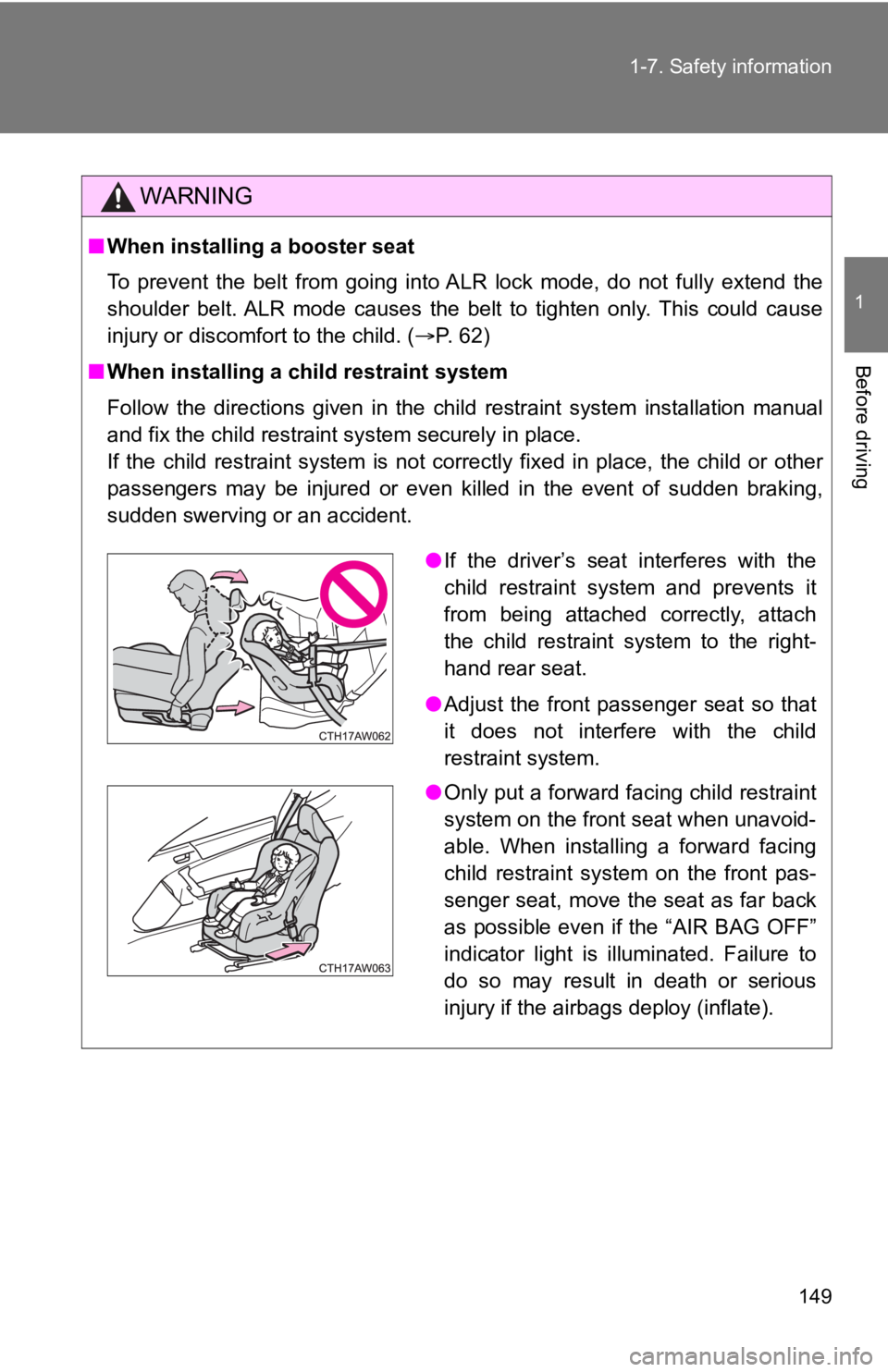
● If the driver’s seat interferes with the
child restraint system and prevents it
from being attached correctly, attach
the child restraint system to the right-
hand rear seat.
● Adjust the front passenger seat so that
it does not interfere with the child
restraint system.
● Only put a forward facing child restraint
system on the front seat when unavoid-
able. When installing a forward facing
child restraint system on the front pas-
senger seat, move the seat as far back
as possible even if the “AIR BAG OFF”
indicator light is illuminated. Failure to
do so may result in death or serious
injury if the airbags deploy (inflate).
Page 150 of 532
150 1-7. Safety information
WARNING
■When installing a ch ild restraint system
● When a booster seat is installed, always ensure that the shoulder belt is
positioned across the center of the child's shoulder. The belt should be
kept away from the child's neck, but not so that it could fall off the child's
shoulder. Failure to do so may result in death or serious injury in the event
of sudden braking, sudden swerving or an accident.
● Ensure that the belt and plate are securely locked and the seat belt is not
twisted.
● Shake the child restraint system left and right, and forward an d backward
to ensure that it has been securely installed.
● After securing a child restraint system, never adjust the seat.
● Follow all installation instructions provided by the child rest raint system
manufacturer.
■ To correctly attach a child rest raint system to the anchors
When using the LATCH anchors, be sure that there are no foreign objects
around the anchors and that the seat belt is not caught behind the child
restraint. Make sure the child restraint system is securely att ached, or it may
cause death or serious injury to the child or other passengers in the event of
sudden braking, sudden swerve or an accident.
Page 151 of 532

When driving2
151
2-1. Driving proceduresDriving the vehicle............ 152
Engine (ignition) switch (vehicles with a smart
key system).................... 166
Engine (ignition) switch (vehicles without a
smart key system).......... 175
Automatic transmission .... 178
Manual Transmission ....... 185
Turn signal lever .............. 188
Parking brake ................... 189
Horn ................................. 190
2-2. Instrument cluster Gauges and meters ......... 191
Indicators and warning lights .............................. 194
Multi-information display (monochrome display) ... 200
Multi-information display (color display) ................ 207 2-3. Operating the lights and
windshield wipers
Headlight switch ............... 222
Fog light switch ................ 228
Windshield wipers and washer ........................... 229
2-4. Using other driving systems
Cruise control ................... 232
Rear view monitor system ........................... 237
Driving assist systems ..... 245
Hill-start assist control ...... 252
2-5. Driving information Cargo and luggage .......... 256
Vehicle load limits ............ 260
Winter driving tips ............ 261
Trailer towing ................... 265
Dinghy towing .................. 266
Page 156 of 532
156 2-1. Driving procedures
■After the engine starts
In order to secure a rich exhaust sound when starting the vehicle and envi-
ronmental performance, air intake and exhaust sounds become lou d and
vibrations may increase for a little while after the engine starts. This is not a
malfunction.
■ Operating your vehicle in a foreign country
Comply with the relevant vehicle registration laws and confirm the availability
of the correct fuel. ( P. 461)
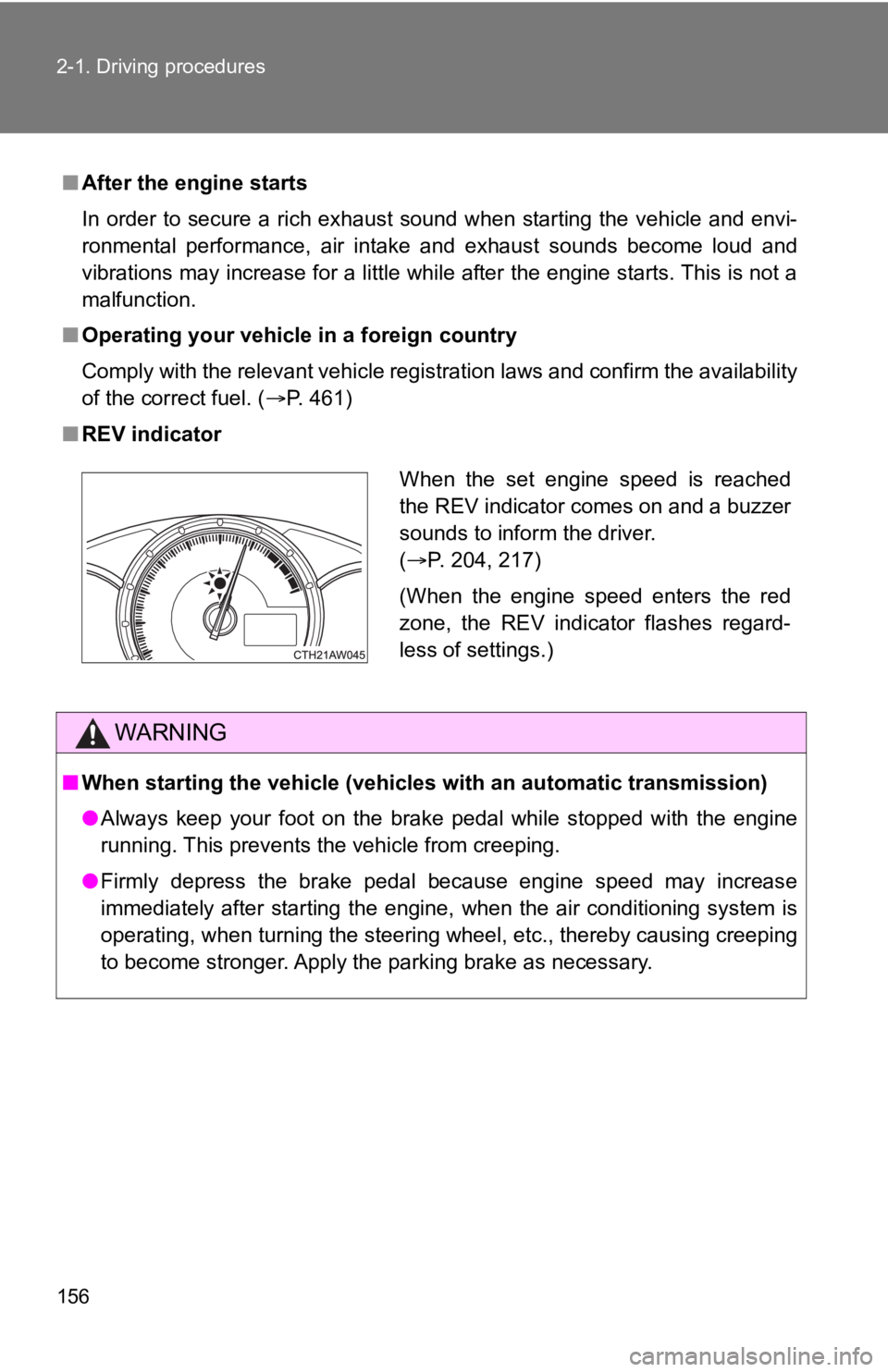
■ REV indicator
WARNING
■When starting the vehicle (vehicl es with an automatic transmission)
● Always keep your foot on the brake pedal while stopped with the engine
running. This prevents the vehicle from creeping.
● Firmly depress the brake pedal because engine speed may increas e
immediately after starting the engine, when the air conditioning system is
operating, when turning the steering wheel, etc., thereby causi ng creeping
to become stronger. Apply the parking brake as necessary.
When the set engine speed is reached
the REV indicator comes on and a buzzer
sounds to inform the driver.
( P. 204, 217)
(When the engine speed enters the red
zone, the REV indicator flashes regard-
less of settings.)