Page 338 of 532
338 4-3. Do-it-yourself maintenance
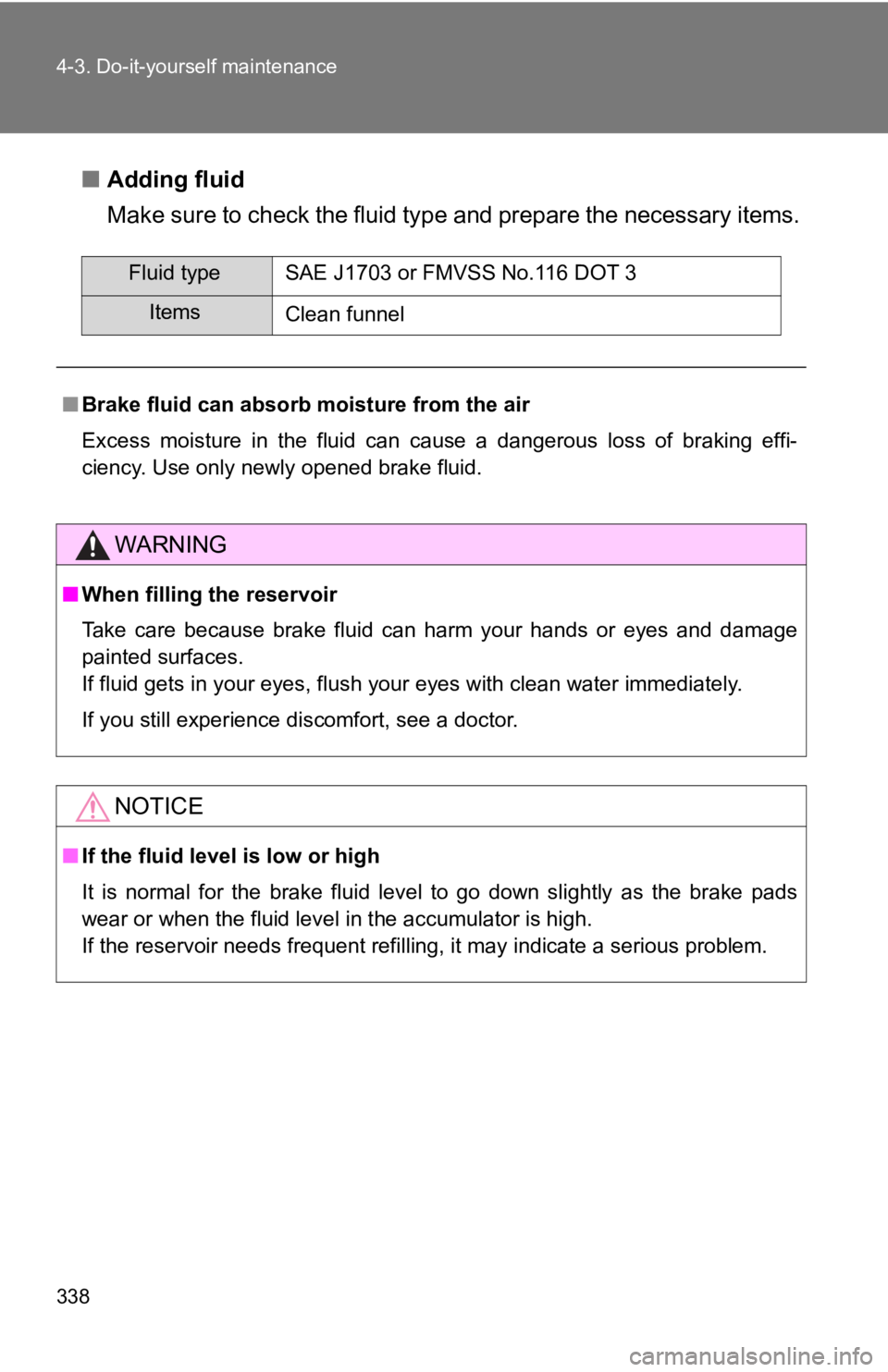
■Adding fluid
Make sure to check the fluid ty pe and prepare the necessary ite ms.
Fluid type SAE J1703 or FMVSS No.116 DOT 3
Items
Clean funnel
■ Brake fluid can absorb moisture from the air
Excess moisture in the fluid can cause a dangerous loss of braking effi-
ciency. Use only newly opened brake fluid.
WARNING
■When filling the reservoir
Take care because brake fluid can harm your hands or eyes and d amage
painted surfaces.
If fluid gets in your eyes, flush your eyes with clean water im mediately.
If you still experience discomfort, see a doctor.
NOTICE
■ If the fluid level is low or high
It is normal for the brake fluid level to go down slightly as t he brake pads
wear or when the fluid level in the accumulator is high.
If the reservoir needs frequent refilling, it may indicate a serious problem.
Page 394 of 532

394
5-1. Essential information
If you think something is wrong
If you notice any of the following symptoms, your vehicle proba bly
needs adjustment or repair. Cont act your Toyota dealer as soon as
possible.
■ Visible symptoms
●Fluid leaks under the vehicle
(Water dripping from t he air conditioning after use is normal.)
● Flat-looking tires or uneven tire wear
● Vehicles with a monochrome multi-information display: The
engine coolant temperature gauge needle continually points
higher than normal
● Vehicles with a color multi-information display: The high
engine coolant temperature wa rning light flashes or illumi-
nates
■ Audible symptoms
●Changes in exhaust sound
● Excessive tire squeal when cornering
● Strange noises related to the suspension system
● Pinging or other noises related to the engine
■ Operational symptoms
●Engine missing, stumbling or running rough
● Appreciable loss of power
● Vehicle pulls heavily to one side when braking
● Vehicle pulls heavily to one side when driving on a level road
● Loss of brake effectiveness, s pongy feeling, pedal almost
touches the floor
Page 396 of 532
396
5-2. Steps to take in an emergency
If a warning light tur ns on or a war ning buzzer sounds...
Stop the vehicle immediately. Continuing to drive the vehicle
may be dangerous.
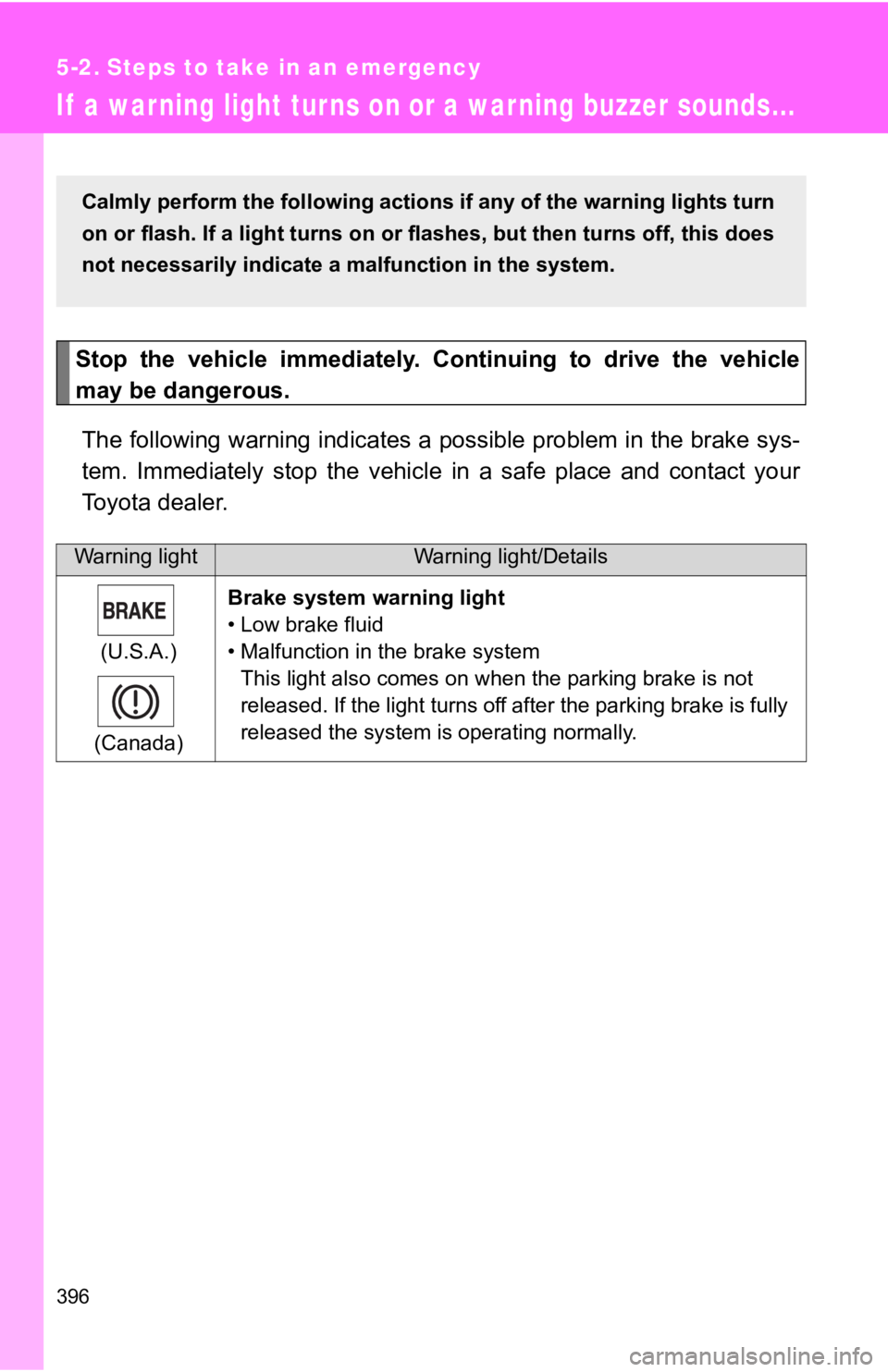
The following warning indicates a possible problem in the brake sys-
tem. Immediately stop the vehicl e in a safe place and contact your
Toyota dealer.
Warning lightWarning light/Details
(U.S.A.)
(Canada) Brake system warning light
• Low brake fluid
• Malfunction in the brake system
This light also comes on when the parking brake is not
released. If the light turns off after the parking brake is ful ly
released the system is operating normally.
Calmly perform the following actions if any of the warning ligh ts turn
on or flash. If a light turns on or flashes, but then turns off , this does
not necessarily indicate a malfunction in the system.
Page 398 of 532
398 5-2. Steps to take in an emergency
Have the vehicle inspected immediately.
Failing to investigate the cause of the following warnings may lead to
the system operating abnormally and possibly cause an accident.
Have the vehicle ins pected by your Toyota dealer immediately.
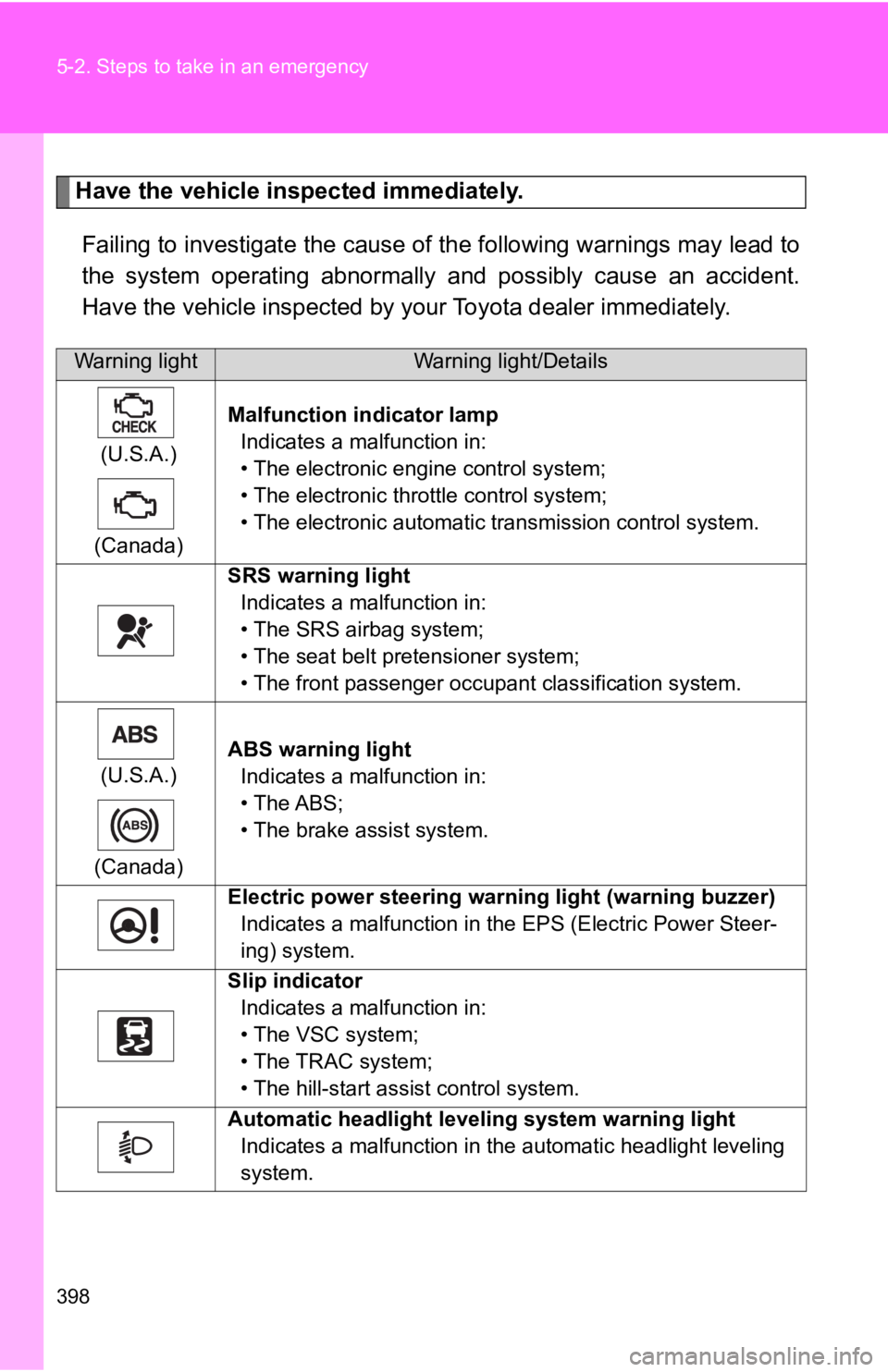
Warning lightWarning light/Details
(U.S.A.)
(Canada) Malfunction indicator lamp
Indicates a malfunction in:
• The electronic engine control system;
• The electronic throttle control system;
• The electronic automatic transmission control system.
SRS warning light Indicates a malfunction in:
• The SRS airbag system;
• The seat belt pretensioner system;
• The front passenger occupant classification system.
(U.S.A.)
(Canada) ABS warning light
Indicates a malfunction in:
• The ABS;
• The brake assist system.
Electric power steering warn ing light (warning buzzer)
Indicates a malfunction in the EPS (Electric Power Steer-
ing) system.
Slip indicator Indicates a malfunction in:
• The VSC system;
• The TRAC system;
• The hill-start assist control system.
Automatic headlight leveling system warning light Indicates a malfunction in the automatic headlight leveling
system.
Page 405 of 532
5
When trouble arises
405
5-2. Steps to take in an emergency
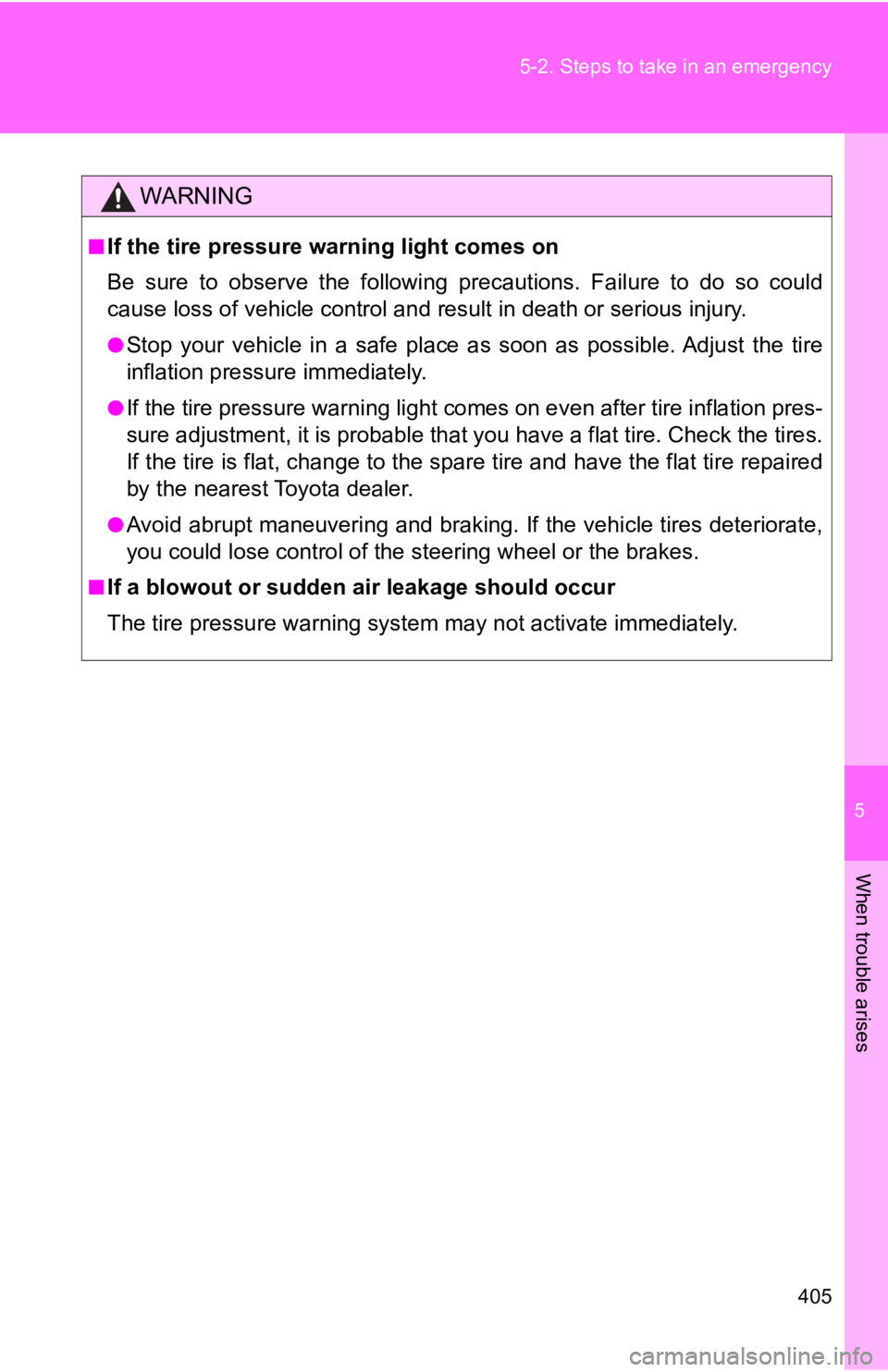
WARNING
■If the tire pressure warning light comes on
Be sure to observe the following precautions. Failure to do so
could
cause loss of vehicle control and result in death or serious injury.
●Stop your vehicle in a safe plac e as soon as possible. Adjust the tire
inflation pressure immediately.
●If the tire pressure warning light comes on even after tire inf lation pres-
sure adjustment, it is probable that you have a flat tire. Check the tires.
If the tire is flat, change to the spare tire and have the flat tire repaired
by the nearest Toyota dealer.
●Avoid abrupt maneuvering and braking. If the vehicle tires dete riorate,
you could lose control of the steering wheel or the brakes.
■If a blowout or sudden air leakage should occur
The tire pressure warning system may not activate immediately.
Page 408 of 532
408
5-2. Steps to take in an emergency
If a warning message is displayed (vehicles with a color multi-information display)
Stop the vehicle immediately. Continuing to drive the vehicle
may be dangerous.
The following warning indicates a possible problem in the brake sys-
tem. Immediately stop the vehicl e in a safe place and contact your
Toyota dealer.
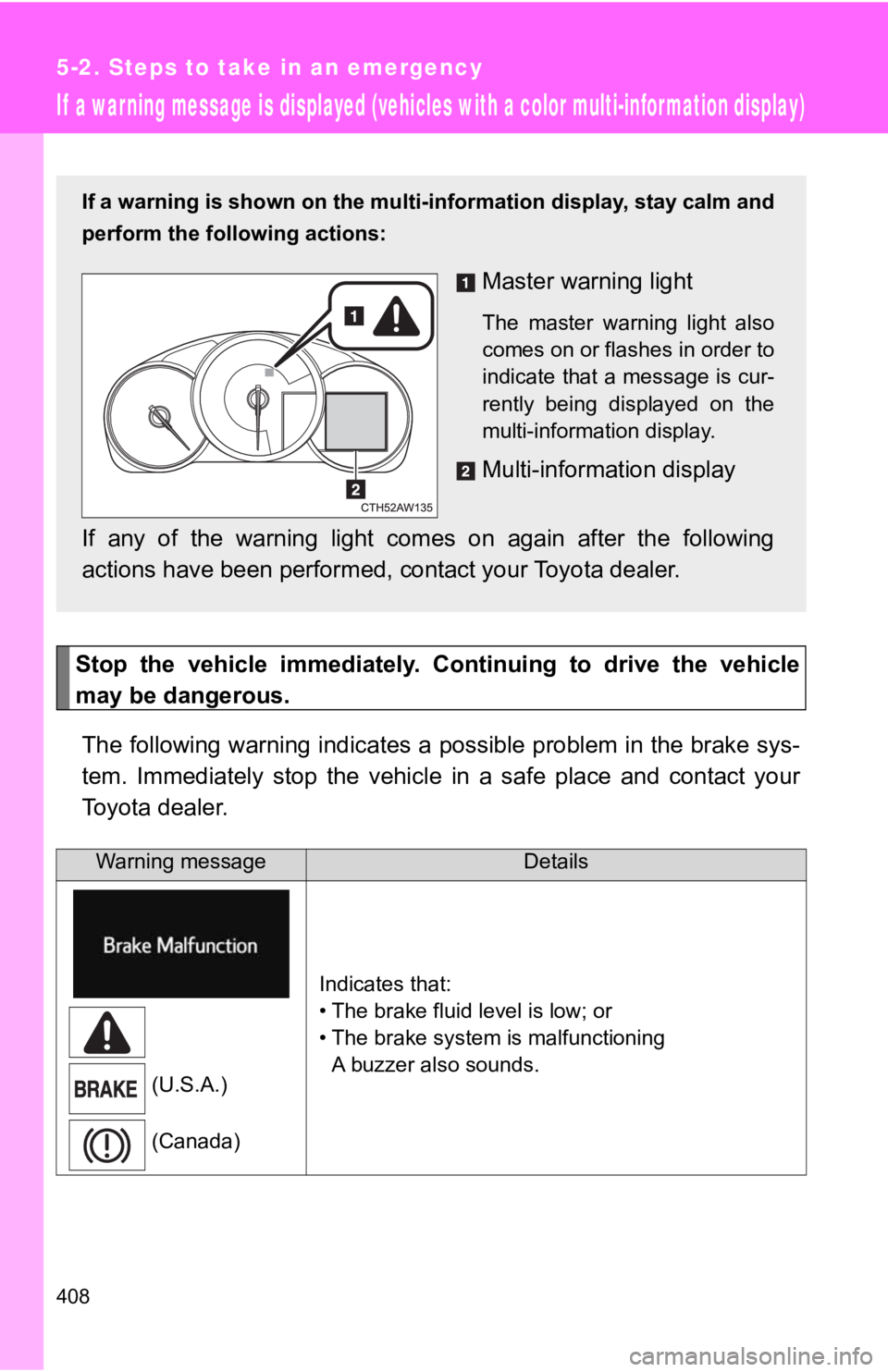
Warning messageDetails
(U.S.A.)
(Canada) Indicates that:
• The brake fluid level is low; or
• The brake system is malfunctioning
A buzzer also sounds.
If a warning is shown on the mult i-information display, stay calm and
perform the following actions:
Master warning light
The master warning light also
comes on or flashes in order to
indicate that a message is cur-
rently being displayed on the
multi-information display.
Multi-information display
If any of the warning light comes on again after the following
actions have been performed, contact yo ur Toyota dealer.
Page 437 of 532
5
When trouble arises
437
5-2. Steps to take in an emergency
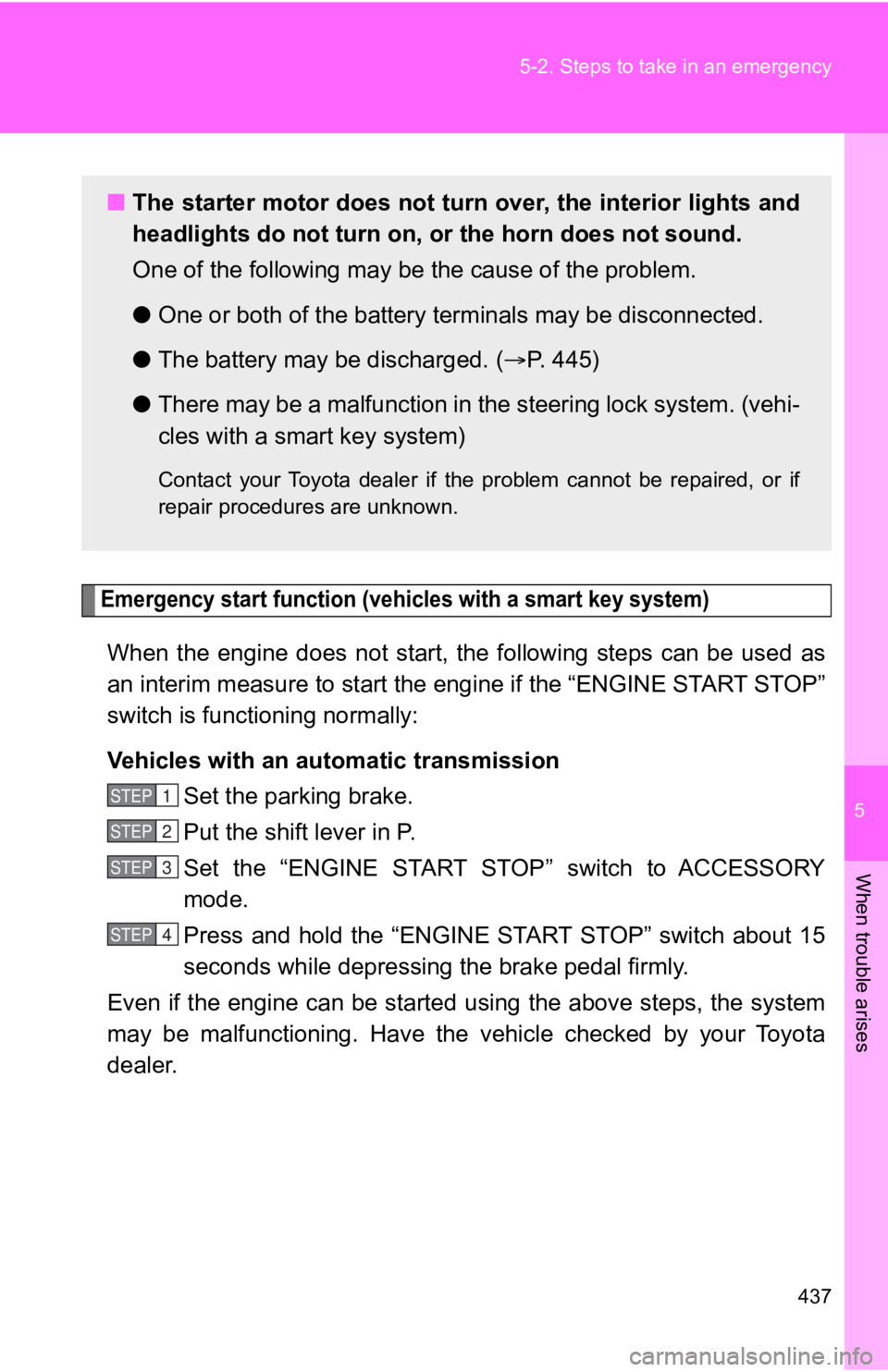
Emergency start function (vehicles with a smart key system)
When the engine does not start, the following steps can be used
as
an interim measure to start the engine if the “ENGINE START STO P”
switch is functioning normally:
Vehicles with an automatic transmission
Set the parking brake.
Put the shift lever in P.
Set the “ENGINE START STOP” switch to ACCESSORY
mode.
Press and hold the “ENGINE START STOP” switch about 15
seconds while depressing the brake pedal firmly.
Even if the engine can be started using the above steps, the sy stem
may be malfunctioning. Have the vehicle checked by your Toyota
dealer.
■ The starter motor does not turn over, the interior lights and
headlights do not turn on, or the horn does not sound.
One of the following may be the cause of the problem.
● One or both of the battery ter minals may be disconnected.
● The battery may be discharged. ( P. 445)
● There may be a malfunction in the steering lock system. (vehi-
cles with a smart key system)
Contact your Toyota dealer if the problem cannot be repaired, o r if
repair procedures are unknown.
STEP 1
STEP 2
STEP 3
STEP 4
Page 442 of 532
442 5-2. Steps to take in an emergency
Starting the engineVehicles with an automatic transmission Ensure that the shift lever is in P and firmly depress the brake
pedal.
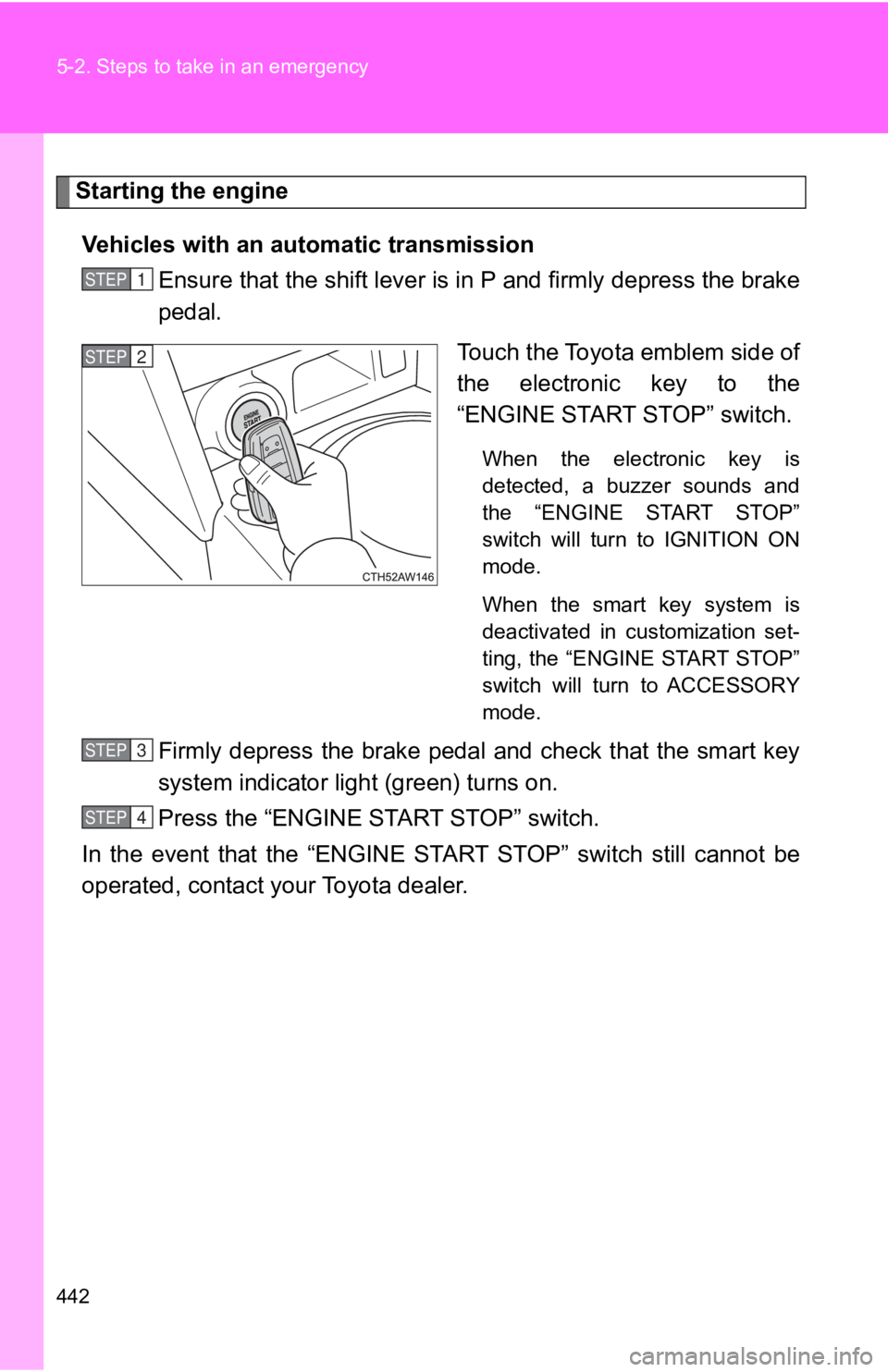
Touch the Toyota emblem side of
the electronic key to the
“ENGINE START STOP” switch.
When the electronic key is
detected, a buzzer sounds and
the “ENGINE START STOP”
switch will turn to IGNITION ON
mode.
When the smart key system is
deactivated in customization set-
ting, the “ENGINE START STOP”
switch will turn to ACCESSORY
mode.
Firmly depress the brake pedal and check that the smart key
system indicator light (green) turns on.
Press the “ENGINE START STOP” switch.
In the event that the “ENGINE START STOP” switch still cannot b e
operated, contact your Toyota dealer.
STEP 1
STEP 2
STEP 3
STEP 4