Page 358 of 408

Practical tips
current they are using. This limits the amount
of po w
er consumed and helps t o ensur
e r
eli-
able starting even after a long period. Some
convenience functions, such as remote vehi-
cle opening, may not be available under cer-
tain circumstances. These functions will be
restored when you switch on the ignition and
start the engine.
With the engine switched off
For example, if you listen to the sound system
with the engine switched off the battery will
run down.
If the energy consumption means there is a
risk that the engine will not start, a text will
appear in vehicles with a driver information
system*.
This driver indicator tells you that you must
start the engine so that the battery can re-
charge.
When the engine is running
Although the alternator generates electrical
power, the battery can still become dis-
charged while the vehicle is being driven. This
can occur when a lot of power is being con-
sumed but only a small amount supplied, es-
pecially if the battery is not fully charged ini-
tially.
To restore the necessary energy balance, the
system will then temporarily shut off the elec-
trical devices that are using a lot of power, or reduce the current they are consuming. Heat-
ing systems in particular use a large amount
of el
ectrical power. If you notice, for instance,
that the seat heating* or the rear window
heater is not working, they may have been
temporarily switched off or regulated to a
lower heat output. These systems will be
available again as soon as sufficient electri-
cal power is available.
You may also notice that the engine runs at a
slightly faster idling speed when necessary.
This is quite normal, and no cause for con-
cern. The increased idling speed allows the
alternator to meet the greater power require-
ment and charge the battery at the same
time. Wheels
Wheel s and t
yres
Gener al not
es
Page 359 of 408
Wheels
Low profile tyres
L o
w pr ofil
e t
yres have a wider tread, a larger
wheel diameter and a lower sidewall height.
Therefore, its driving behaviour is more agile.
Low profile tyres may deteriorate more quick-
ly than standard tyres, for instance due to
strong knocks, potholes, manhole covers and
kerbs. Correct tyre pressure is very important
Page 360 of 408
Practical tips
New wheels and tyres It is best to have all wheels and tyres serviced
by a specialised workshop. There they hav
e
the r
equired knowledge, the special tools and
the corresponding spare parts.
�
Page 361 of 408
Wheels
the combinations allowed between the
front axle (axle 1) and the r
ear axl
e (axle 2).
�
Page 362 of 408
Practical tips
should check wheel alignment at a SEAT Of-
ficial Service . WARNING
Unsuitable handling of the wheels and
tyres may lead t o sudden t
yre pressure los-
ses, to tread separation or even to a blow-
out.
�
Page 363 of 408
Wheels
WARNING
The tyres must be replaced at the latest
when the tread is worn down t o the tr
ead
wear indicators. Failure to follow this in-
struction could result in an accident.
�
Page 365 of 408
Page 367 of 408
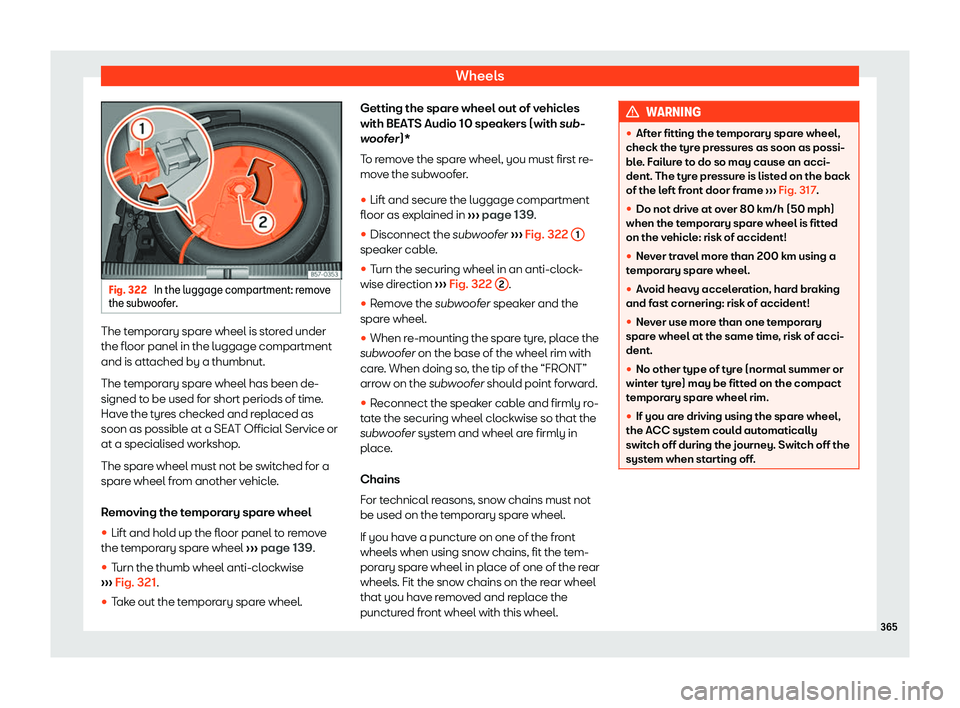
Wheels
Fig. 322
In the luggage compartment: remove
the sub woof
er. The temporary spare wheel is stored under
the fl
oor panel in the luggage compartment
and is att ached by a thumbnut.
The t empor
ary spar
e wheel has been de-
signed to be used for short periods of time.
Have the tyres checked and replaced as
soon as possible at a SEAT Official Service or
at a specialised workshop.
The spare wheel must not be switched for a
spare wheel from another vehicle.
Removing the temporary spare wheel
�