Page 21 of 492
CAUTION
When adjusting the seat positions, be
sure not to contact any moving parts to
avoid possible injuries and/or damage.
FRONT MANUAL SEAT
ADJUSTMENT
Your vehicle seats can be adjusted manu-
ally. For additional information about ad-
justing the seats, refer to the steps outlined
in this section.
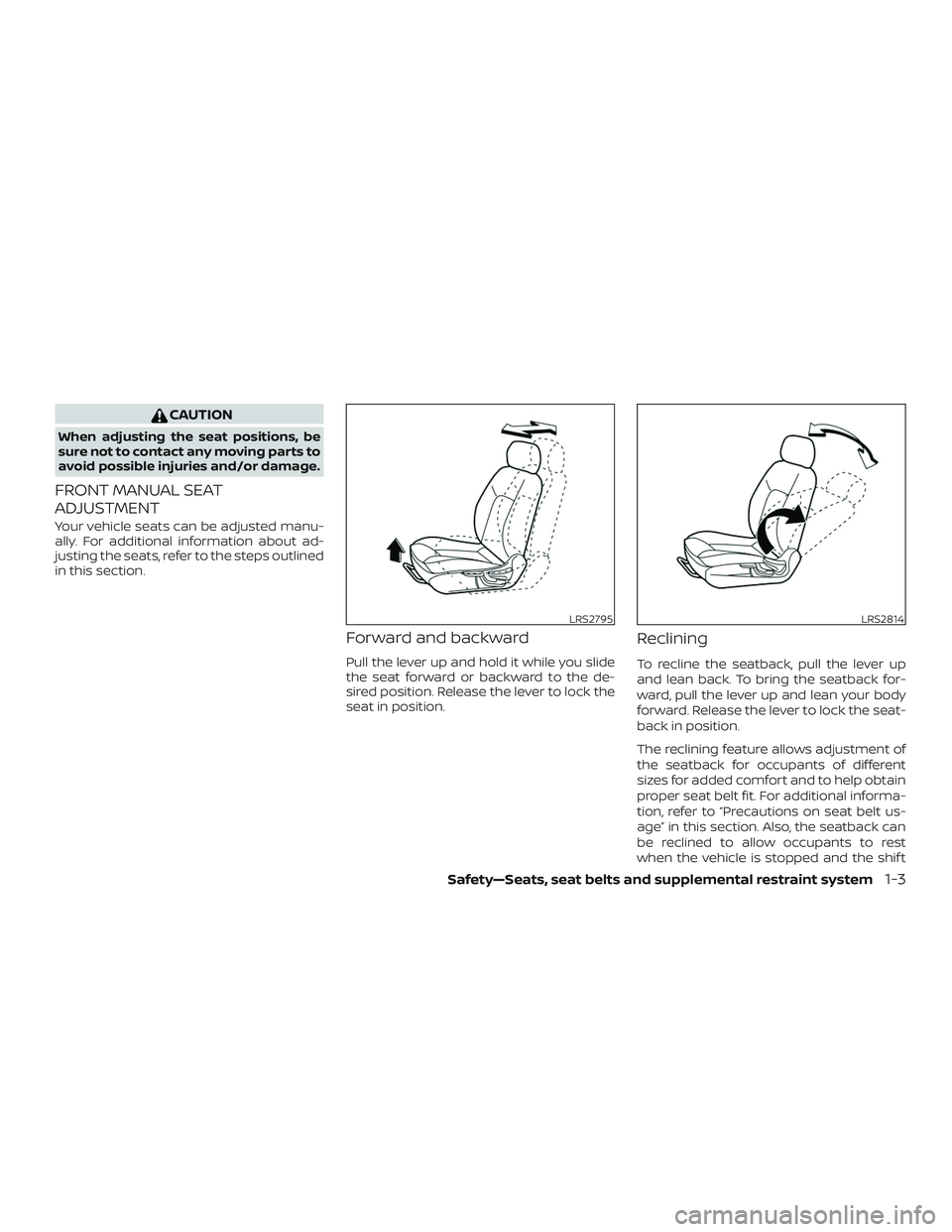
Forward and backward
Pull the lever up and hold it while you slide
the seat forward or backward to the de-
sired position. Release the lever to lock the
seat in position.
Reclining
To recline the seatback, pull the lever up
and lean back. To bring the seatback for-
ward, pull the lever up and lean your body
forward. Release the lever to lock the seat-
back in position.
The reclining feature allows adjustment of
the seatback for occupants of different
sizes for added comfort and to help obtain
proper seat belt fit. For additional informa-
tion, refer to “Precautions on seat belt us-
age” in this section. Also, the seatback can
be reclined to allow occupants to rest
when the vehicle is stopped and the shif t
LRS2795LRS2814
Safety—Seats, seat belts and supplemental restraint system1-3
Page 22 of 492
lever is in P (Park) or N (Neutral) position
with the parking brake fully applied.
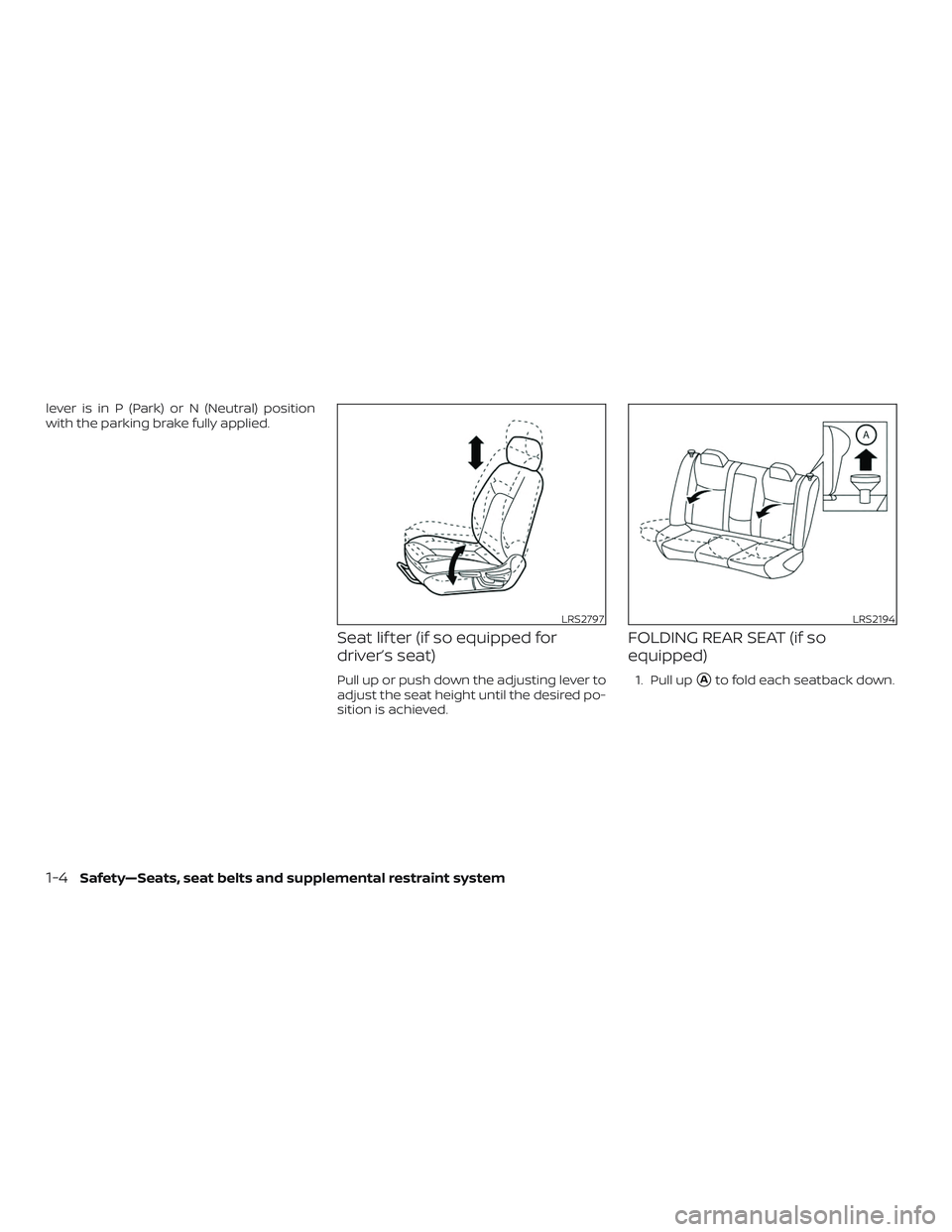
Seat lif ter (if so equipped for
driver’s seat)
Pull up or push down the adjusting lever to
adjust the seat height until the desired po-
sition is achieved.
FOLDING REAR SEAT (if so
equipped)
1. Pull up�Ato fold each seatback down.
LRS2797LRS2194
1-4Safety—Seats, seat belts and supplemental restraint system
Page 23 of 492

2. To return the rear seat to a seating po-sition, lif t up on the seatback and push
it up to an upright position. Firmly press
zones
�Aand�Bto lock the seatback in
place.
WARNING
∙ Never allow anyone to ride in the cargo area or on the rear seat when it
is in the fold-down position. Use of
these areas by passengers without
proper restraints could result in seri-
ous injury or death in an accident or
sudden stop. ∙ Properly secure all cargo with ropes or
straps to help prevent it from sliding
or shif ting. Do not place cargo higher
than the seatbacks. In a sudden stop
or collision, unsecured cargo could
cause personal injury.
∙ When returning the seatbacks to the upright position, be certain they are
completely secured in the latched po-
sition. If they are not completely se-
cured, passengers may be injured in
an accident or sudden stop.
∙ Closely supervise children when they are around cars to prevent them from
playing and becoming locked in the
hatch where they could be seriously
injured. Keep the car locked, with the
rear seatback and hatch securely
latched when not in use, and prevent
children’s access to car keys.
ARMREST (if so equipped for
driver’s side only)
To use the armrest, pull it down to the rest-
ing position.
�AStowed position
�BResting position
LRS2432LRS2454
Safety—Seats, seat belts and supplemental restraint system1-5
Page 24 of 492

WARNING
Head restraints/headrests supplement
the other vehicle safety systems. They
may provide additional protection
against injury in certain rear end colli-
sions. Adjustable head restraints/
headrests must be adjusted properly,
as specified in this section. Check the
adjustment af ter someone else uses
the seat. Do not attach anything to the
head restraint/headrest stalks or re-
move the head restraint/headrest. Do
not use the seat if the head
restraint/headrest has been removed.
If the head restraint/headrest was re-
moved, reinstall and properly adjust the
head restraint/headrest before an oc-
cupant uses the seating position. Fail-
ure to follow these instructions can re-
duce the effectiveness of the head
restraints/headrests. This may in-
crease the risk of serious injury or death
in a collision.The illustration shows the seating posi-
tions equipped with head restraints/
headrests.
�
Indicates the seating position is
equipped with a head restraint.
� Indicates the seating position is equipped
with a headrest.
+ Indicates the seating position is not
equipped with a head restraint or headrest
(if applicable).
∙ Your vehicle is equipped with a head restraint/headrest that may be inte-
grated, adjustable or non-adjustable. ∙ Adjustable head restraints/headrests
have multiple notches along the stalk(s)
to lock them in a desired adjustment
position.
∙ The non-adjustable head restraints/ headrests have a single locking notch
to secure them to the seat frame.
∙ Proper Adjustment: – For the adjustable type, align thehead restraint/headrest so the cen-
ter of your ear is approximately level
with the center of the head
restraint/headrest.
– If your ear position is still higher than the recommended alignment, place
the head restraint/headrest at the
highest position.
∙ If the head restraint/headrest has been removed, ensure that it is reinstalled
and locked in place before riding in that
designated seating position.
LRS2695
HEAD RESTRAINTS/HEADRESTS
1-6Safety—Seats, seat belts and supplemental restraint system
Page 25 of 492
ADJUSTABLE HEAD RESTRAINT/
HEADREST COMPONENTS
1. Removable head restraint/headrest
2. Multiple notches
3. Lock knob
4. Stalks
NON-ADJUSTABLE HEAD
RESTRAINT/HEADREST
COMPONENTS
1. Removable head restraint/headrest
2. Single notch
3. Lock knob
4. Stalks
REMOVE
Use the following procedure to remove the
head restraint/headrest:1. Pull the head restraint/headrest up to the highest position.
2. Push and hold the lock knob.
3. Remove the head restraint/headrest from the seat.
4. Store the head restraint/headrest properly in a secure place so it is not
loose in the vehicle.
LRS2300LRS2299LRS2302
Safety—Seats, seat belts and supplemental restraint system1-7
Page 26 of 492
5. Reinstall and properly adjust the headrestraint/headrest before an occupant
uses the seating position.
INSTALL
1. Align the head restraint/headreststalks with the holes in the seat. Make
sure that the head restraint/headrest is
facing the correct direction. The stalk
with the notch (notches)
�1must be
installed in the hole with the lock knob
�2.
2. Push and hold the lock knob and push the head restraint/headrest down.
3. Properly adjust the head restraint/ headrest before an occupant uses the
seating position.
ADJUST
For adjustable head restraint/headrest
Adjust the head restraint/headrest so the
center is level with the center of your ears. If
your ear position is still higher than the
recommended alignment, place the head
restraint/headrest at the highest position.
LRS2303WRS0134
1-8Safety—Seats, seat belts and supplemental restraint system
Page 27 of 492
For non-adjustable head restraint/
headrest
Make sure the head restraint/headrest is
positioned so the lock knob is engaged in
the notch before riding in that designated
seating position.Raise
To raise the head restraint/headrest, pull it
up.
Make sure the head restraint/headrest is
positioned so the lock knob is engaged in
the notch before riding in that designated
seating position.
Lower
To lower, push and hold the lock knob and
push the head restraint/headrest down.
Make sure the head restraint/headrest is
positioned so the lock knob is engaged in
the notch before riding in that designated
seating position.
LRS2351LRS2305LRS2306
Safety—Seats, seat belts and supplemental restraint system1-9
Page 28 of 492
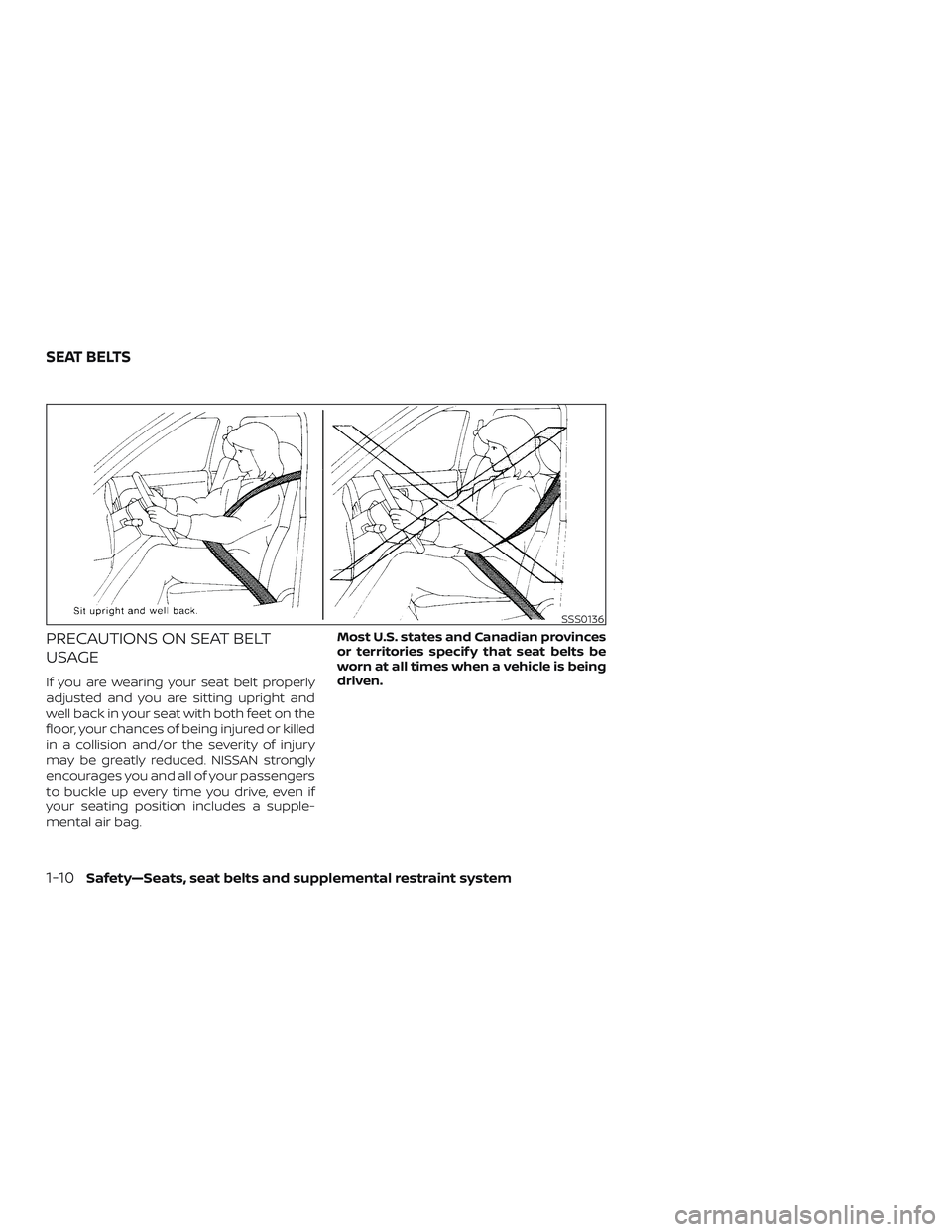
PRECAUTIONS ON SEAT BELT
USAGE
If you are wearing your seat belt properly
adjusted and you are sitting upright and
well back in your seat with both feet on the
floor, your chances of being injured or killed
in a collision and/or the severity of injury
may be greatly reduced. NISSAN strongly
encourages you and all of your passengers
to buckle up every time you drive, even if
your seating position includes a supple-
mental air bag.Most U.S. states and Canadian provinces
or territories specif y that seat belts be
worn at all times when a vehicle is being
driven.
SSS0136
SEAT BELTS
1-10Safety—Seats, seat belts and supplemental restraint system