Page 235 of 346

∙ Use the correct jack-up points. Neveruse any other part of the vehicle for
jack support.
∙ Never jack up the vehicle more than necessary.
∙ Never use blocks on or under the jack.
∙ Do not start or run the engine while vehicle is on the jack. It may cause the
vehicle to move. This is especially true
for vehicles with limited slip
differentials.
∙ Do not allow passengers to stay in the vehicle while it is on the jack.
∙ Never run the engine with a wheel(s) off the ground. It may cause the ve-
hicle to move. Always refer to the proper illustrations for
the correct placement and jack-up points
for your specific vehicle model and jack
type.
Carefully read the caution label attached
to the jack body and the following in-
structions.
1. Loosen each wheel nut 1 or 2 turns by turning counterclockwise with the
wheel nut wrench. Do not remove the
wheel nuts until the tire is off the
ground. 2. Place the jack directly under the
jack-up point as illustrated so the top
of the jack contacts the vehicle at the
jack-up point. Align the jack head be-
tween the 2 notches in the front or the
rear. Also fit the groove of the jack head
between the notches.
The jack should be used on firm and
level ground.
3. To lif t the vehicle, securely hold the jack lever and rod with both hands. Carefully
raise the vehicle until the tire clears the
ground. Remove the wheel nuts, and
then remove the tire.
Page 236 of 346
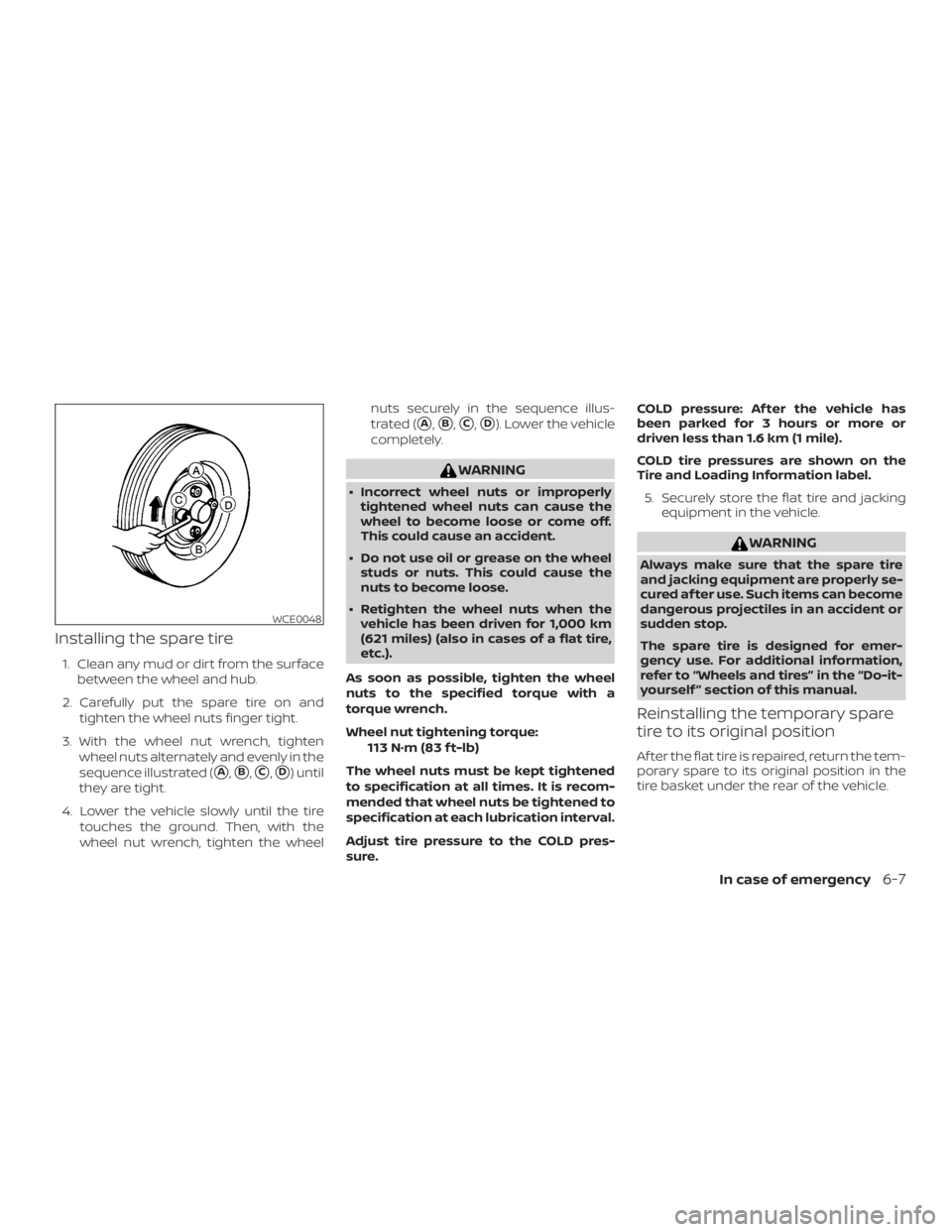
Installing the spare tire
1. Clean any mud or dirt from the surfacebetween the wheel and hub.
2. Carefully put the spare tire on and tighten the wheel nuts finger tight.
3. With the wheel nut wrench, tighten wheel nuts alternately and evenly in the
sequence illustrated (
�A,�B,�C,�D) until
they are tight.
4. Lower the vehicle slowly until the tire touches the ground. Then, with the
wheel nut wrench, tighten the wheel nuts securely in the sequence illus-
trated (
�A,�B,�C,�D). Lower the vehicle
completely.
Page 238 of 346
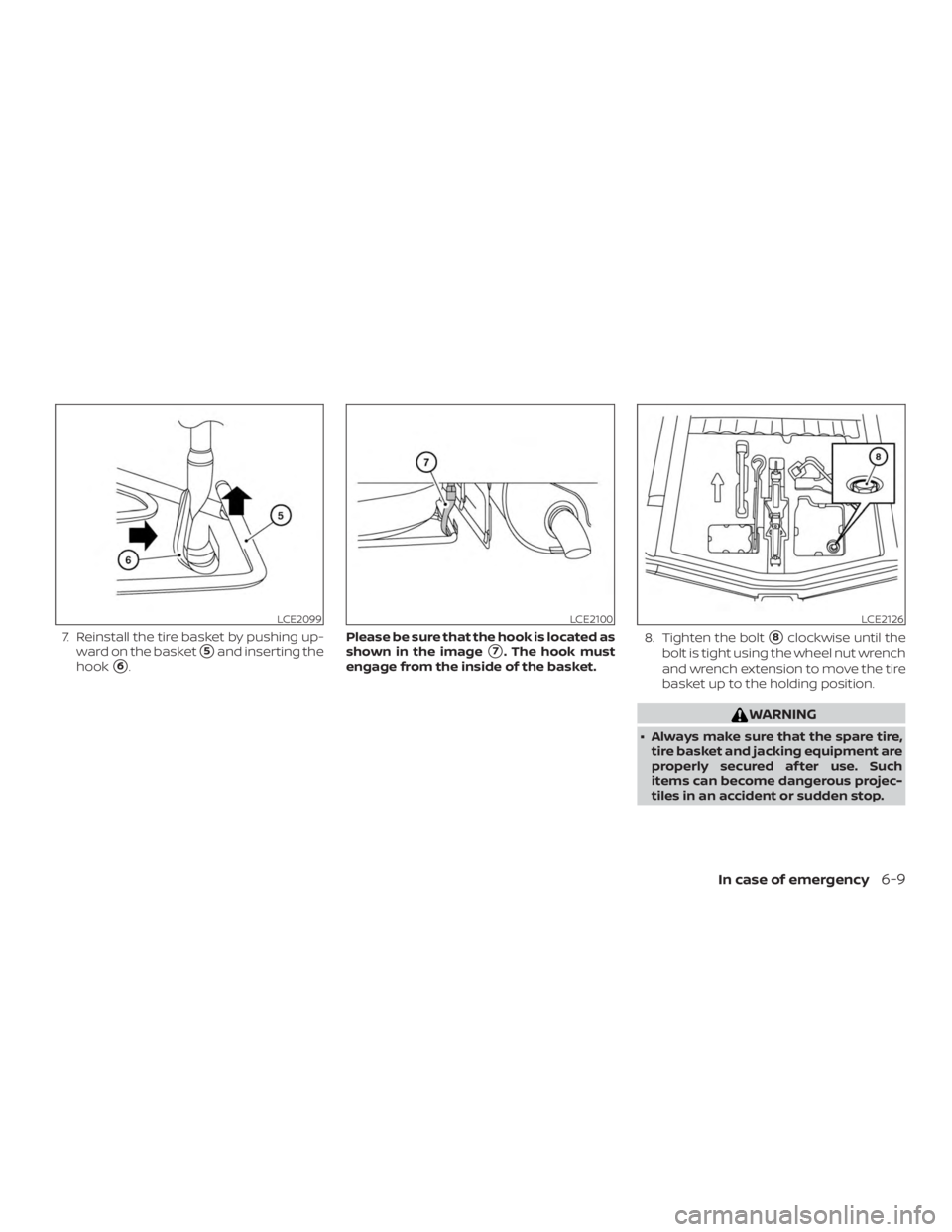
7. Reinstall the tire basket by pushing up-ward on the basket
�5and inserting the
hook
�6. Please be sure that the hook is located as
shown in the image�7. The hook must
engage from the inside of the basket. 8. Tighten the bolt�8clockwise until the
bolt is tight using the wheel nut wrench
and wrench extension to move the tire
basket up to the holding position.
Page 239 of 346
∙ The spare tire is designed for emer-gency use. For additional information
refer to “Wheels and tires” in the “Do-
it-yourself ” section of this manual.
∙ When reinstalling the spare tire bas- ket under the vehicle af ter use, be
sure that the hook engages the bas-
ket from the inside. If the spare tire
basket hook is not engaged properly,
there is an increased risk of the spare
tire separating from the vehicle in a
crash and causing injury.
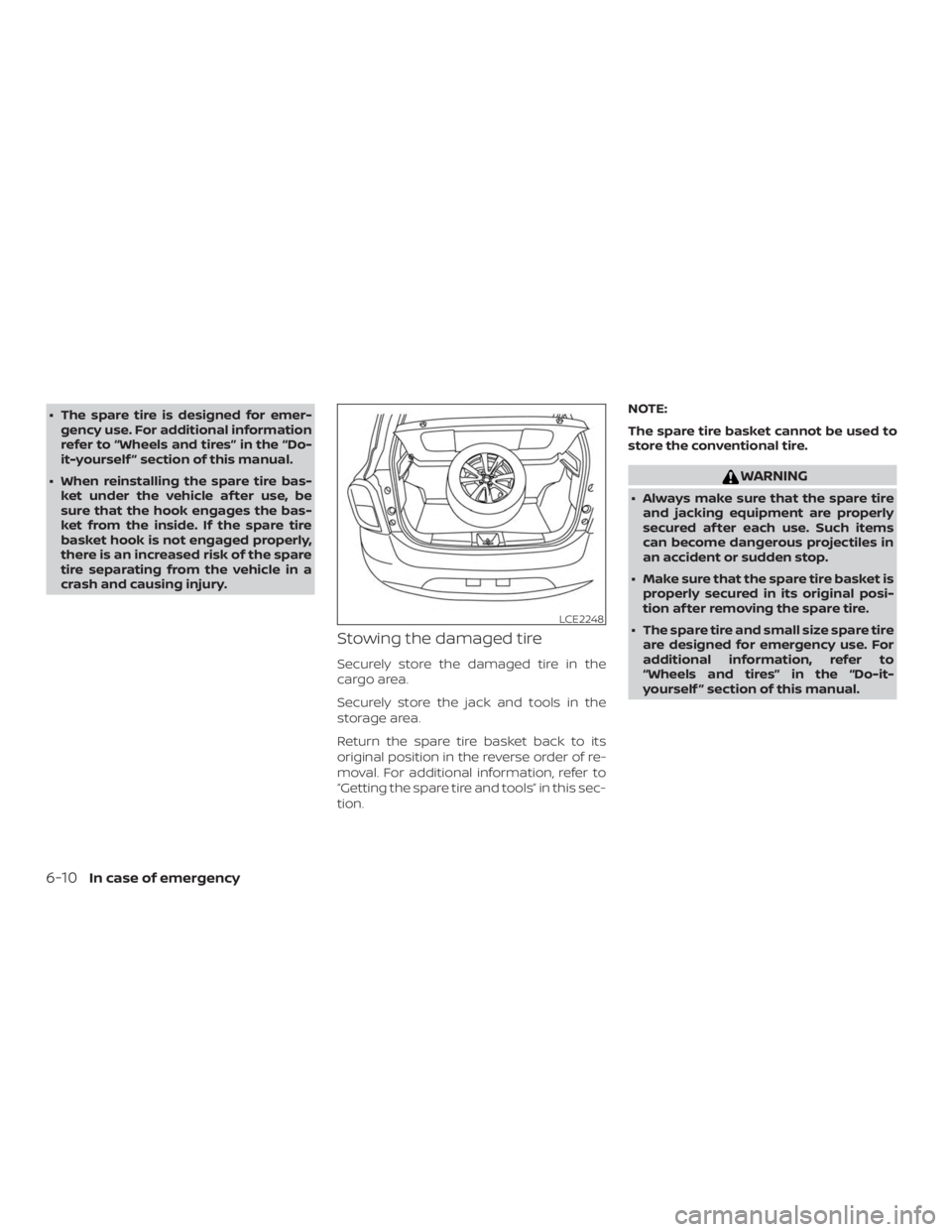
Stowing the damaged tire
Securely store the damaged tire in the
cargo area.
Securely store the jack and tools in the
storage area.
Return the spare tire basket back to its
original position in the reverse order of re-
moval. For additional information, refer to
“Getting the spare tire and tools” in this sec-
tion. NOTE:
The spare tire basket cannot be used to
store the conventional tire.
Page 244 of 346
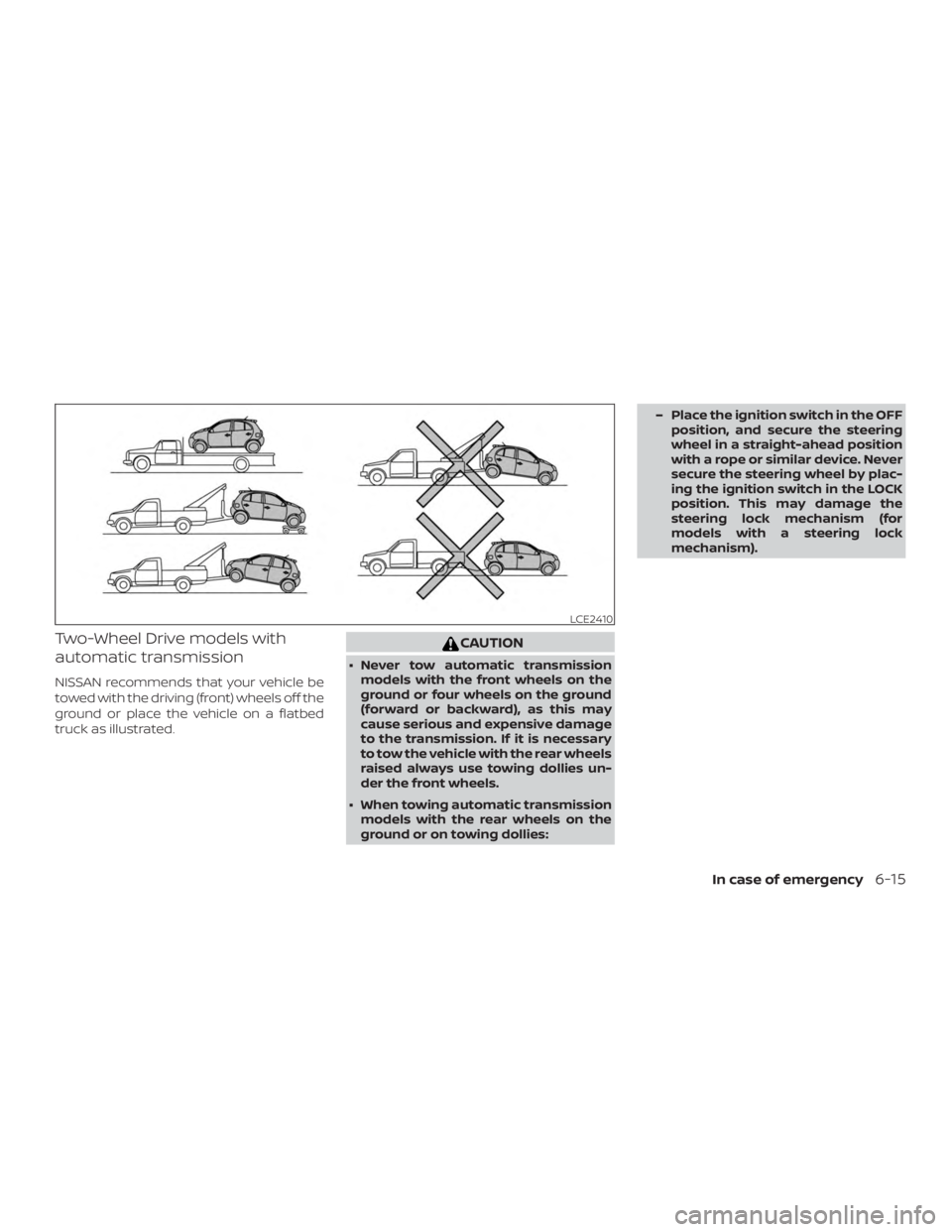
Two-Wheel Drive models with
automatic transmission
NISSAN recommends that your vehicle be
towed with the driving (front) wheels off the
ground or place the vehicle on a flatbed
truck as illustrated.
Page 245 of 346
Two-Wheel Drive models with
manual transmission
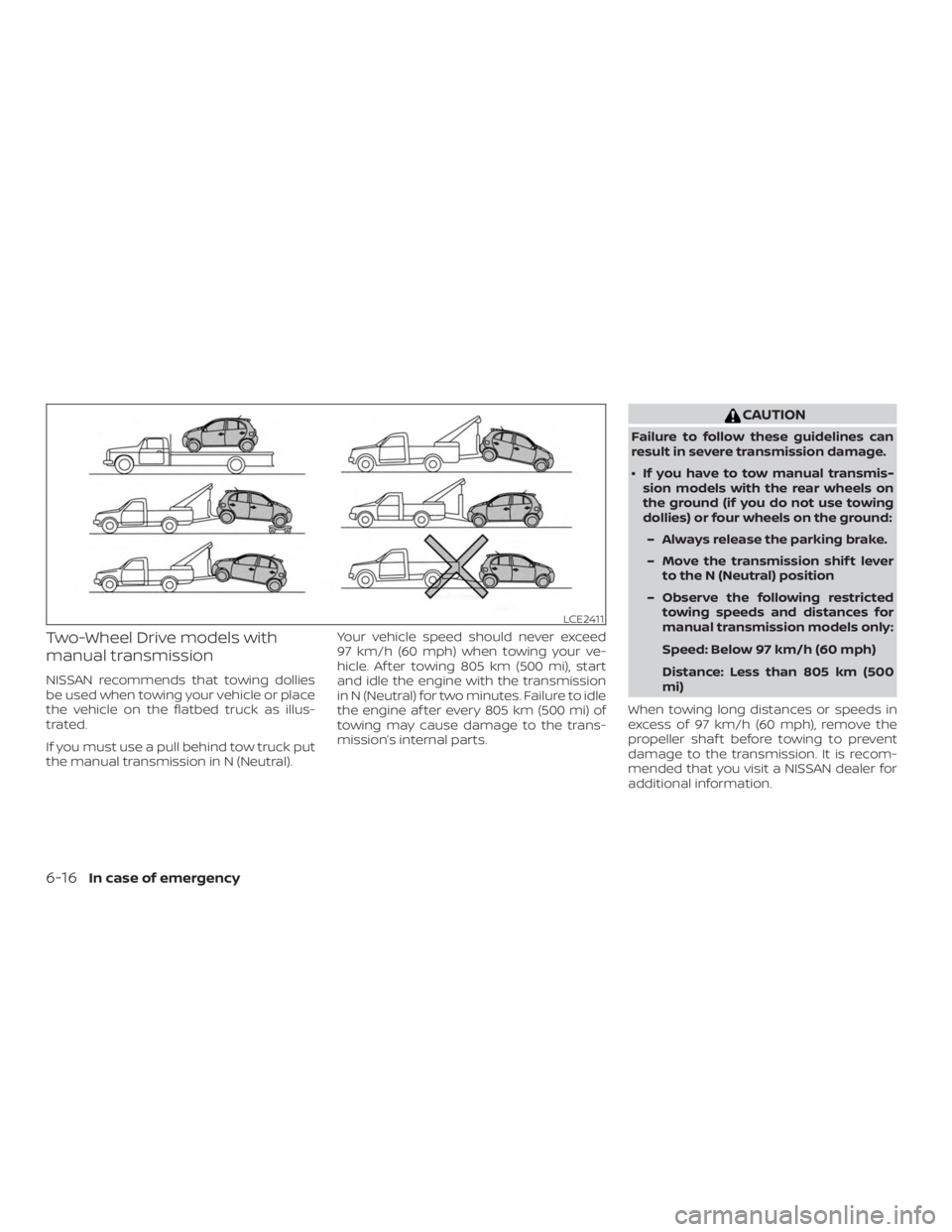
NISSAN recommends that towing dollies
be used when towing your vehicle or place
the vehicle on the flatbed truck as illus-
trated.
If you must use a pull behind tow truck put
the manual transmission in N (Neutral).Your vehicle speed should never exceed
97 km/h (60 mph) when towing your ve-
hicle. Af ter towing 805 km (500 mi), start
and idle the engine with the transmission
in N (Neutral) for two minutes. Failure to idle
the engine af ter every 805 km (500 mi) of
towing may cause damage to the trans-
mission’s internal parts.
Page 293 of 346
Snow tires
If snow tires are needed, it is necessary to
select tires equivalent in size and load rat-
ing to the original equipment tires. If you do
not, it can adversely affect the safety and
handling of your vehicle.
Generally, snow tires have lower speed rat-
ings than factory equipped tires and may
not match the potential maximum vehicle
speed. Never exceed the maximum speed
rating of the tire.
If you install snow tires, they must be the
same size, brand, construction and tread
pattern on all four wheels.
For additional traction on icy roads, stud-
ded tires may be used. However, some Ca-
nadian provinces prohibit their use. Check
local, state and provincial laws before in-
stalling studded tires. Skid and traction ca-
pabilities of studded snow tires on wet or
dry surfaces may be poorer than that of
non-studded snow tires.
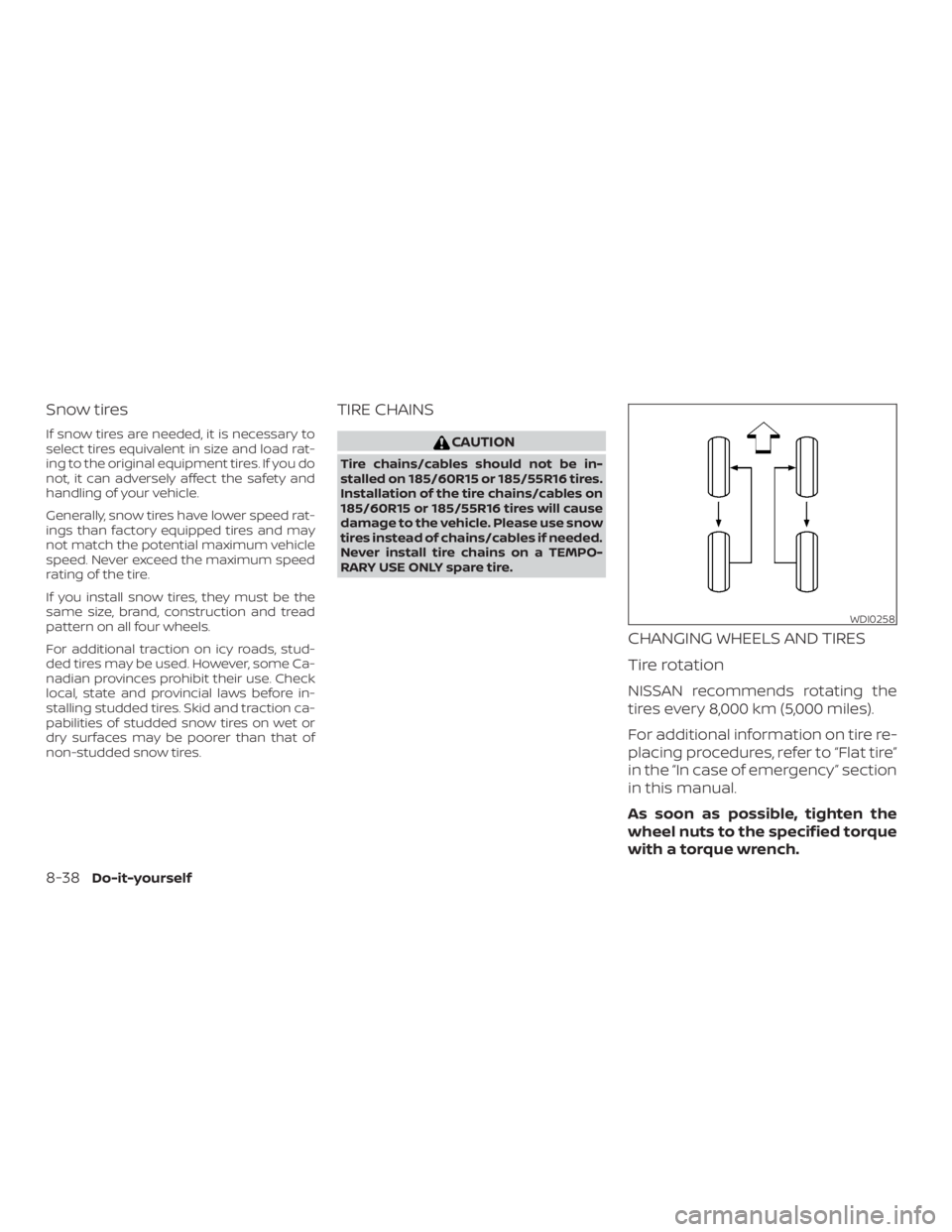
TIRE CHAINS
Page 294 of 346
Wheel nut tightening torque:113 N·m (83 f t-lb)
The wheel nuts must be kept tight-
ened to specifications at all times.
It is recommended that wheel nuts
be tightened to specification at
each tire rotation interval.