Page 28 of 500
1. Rear window defroster switch(P. 2-48)
2. Interior trunk lid release (P. 3-21)
3. High-mounted stop light (P. 8-23)
4. Exterior trunk lid release/request
button (P. 3-7)
Rearview camera (P. 4-3, 4-11)
Trunk lid (P. 3-21)
5. Rear sonar sensors (P. 5-126)
6. Replacing bulbs (P. 8-23)
7. Fuel-filler door (P. 3-23) Fuel recommendation (P. 10-2)
8. Child safety rear door locks (P. 3-4)
Refer to the page number indicated in
parentheses for operating details.
LII2609
EXTERIOR REAR
0-4Illustrated table of contents
Page 33 of 500
Warninglight Name Page
or
Anti-lock Braking
System (ABS)
warning light 2-9
Automatic Emer-
gency Braking
(AEB) with Pedes-
trian Detection
system warning
light2-9
or
Brake warning
light
2-9
Charge warning
light2-10
Engine oil pres-
sure warning light2-10
Warning
light Name Page
Low tire pressure
warning light 2-10
Master warning
light 2-12
Power steering
warning light2-12
Rear Automatic
Braking (RAB)
warning light2-12
Seat belt warning
light and chime
2-13
Supplemental air
bag warning light2-13
Indicator
light Name Page
Front fog light in-
dicator light
(green) (if so
equipped) 2-13
Front passenger
air bag status
light
2-13
High Beam Assist
indicator light
(green)2-14
High beam indi-
cator light (blue)
2-14
Malfunction Indi-
cator Light (MIL)2-14
Security indicator
light 2-15
Side light and
headlight indica-
tor light (green)2-15
WARNING AND INDICATOR LIGHTS
Illustrated table of contents0-9
Page 36 of 500

WARNING
∙ Do not ride in a moving vehicle whenthe seatback is reclined. This can be
dangerous. The shoulder belt will not
be against your body. In an accident,
you could be thrown into it and re-
ceive neck or other serious injuries.
You could also slide under the lap belt
and receive serious internal injuries. ∙ For the most effective protection
when the vehicle is in motion, the seat
should be upright. Always sit well
back and upright in the seat with both
feet on the floor and adjust the seat
properly. For additional information,
refer to “Precautions on seat belt us-
age” in this section.
∙ Af ter adjustment, gently rock in the seat to make sure it is securely locked. ∙ Do not leave children unattended in-
side the vehicle. They could unknow-
ingly activate switches or controls or
make the vehicle move. Unattended
children could become involved in se-
rious accidents.
∙ To help avoid risk of injury or death through unintended operation of the
vehicle and/or its systems, do not
leave children, people who require the
assistance of others or pets unat-
tended in your vehicle. Additionally,
the temperature inside a closed ve-
hicle on a warm day can quickly be-
come high enough to cause a signifi-
cant risk of injury or death to people
and pets.
∙ Do not adjust the driver’s seat while driving so full attention may be given
to vehicle operation. The seat may
move suddenly and could cause loss
of control of the vehicle.
∙ The seatback should not be reclined any more than needed for comfort.
Seat belts are most effective when the
passenger sits well back and straight
up in the seat. If the seatback is re-
clined, the risk of sliding under the lap
belt and being injured is increased.
ARS1152
SEATS
1-2Safety—Seats, seat belts and supplemental restraint system
Page 40 of 500

1. Move the front passenger seat to themost forward position.
2. Open the access cover on the rear par- cel shelf.
3. Push down on the button
�1on the
rear parcel shelf.
4. Fold down the passenger’s side seat- back
�2.
WARNING
∙ Never allow anyone to ride in thecargo area or on the rear seat when it
is in the fold-down position. Use of
these areas by passengers without
proper restraints could result in seri-
ous injury or death in an accident or
sudden stop.
∙ Properly secure all cargo with ropes or straps to help prevent it from sliding
or shif ting. Do not place cargo higher
than the seatbacks. In a sudden stop
or collision, unsecured cargo could
cause personal injury. ∙ When returning the seatbacks to the
upright position, be certain they are
completely secured in the latched po-
sition. If they are not completely se-
cured, passengers may be injured in
an accident or sudden stop.
∙ Closely supervise children when they are around cars to prevent them from
playing and becoming locked in the
trunk where they could be seriously
injured. Keep the car locked, with the
rear seatback and trunk lid securely
latched when not in use, and prevent
children’s access to car keys.
To fold down either side of the rear seat,
open the trunk and pull on the strap
�1.
For additional information, refer to “Interior
trunk access” in the “Pre-driving checks
and adjustments” section of this manual.
LRS2168
1-6Safety—Seats, seat belts and supplemental restraint system
Page 42 of 500

∙ Adjustable head restraints/headrestshave multiple notches along the stalk(s)
to lock them in a desired adjustment
position.
∙ The non-adjustable head restraints/ headrests have a single locking notch
to secure them to the seat frame.
∙ Proper Adjustment: – For the adjustable type, align thehead restraint/headrest so the cen-
ter of your ear is approximately level
with the center of the head
restraint/headrest.
– If your ear position is still higher than the recommended alignment, place
the head restraint/headrest at the
highest position.
∙ If the head restraint/headrest has been removed, ensure that it is reinstalled
and locked in place before riding in that
designated seating position.
ADJUSTABLE HEAD RESTRAINT/
HEADREST COMPONENTS
1. Removable head restraint/headrest
2. Multiple notches
3. Lock knob
4. Stalks
NON-ADJUSTABLE HEAD
RESTRAINT/HEADREST
COMPONENTS
1. Removable head restraint/headrest
2. Single notch
3. Lock knob
4. Stalks
LRS2300LRS2299
1-8Safety—Seats, seat belts and supplemental restraint system
Page 43 of 500
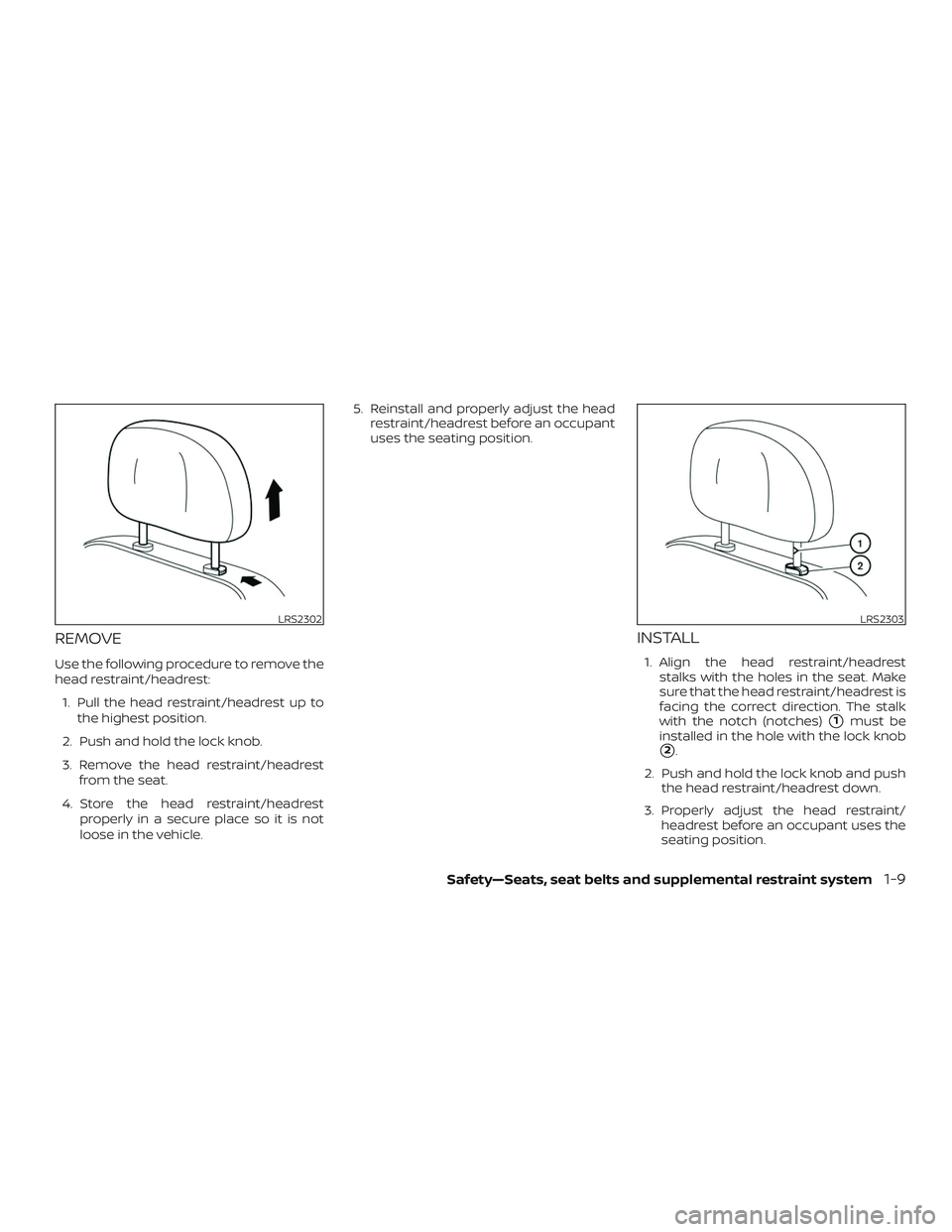
REMOVE
Use the following procedure to remove the
head restraint/headrest:1. Pull the head restraint/headrest up to the highest position.
2. Push and hold the lock knob.
3. Remove the head restraint/headrest from the seat.
4. Store the head restraint/headrest properly in a secure place so it is not
loose in the vehicle. 5. Reinstall and properly adjust the head
restraint/headrest before an occupant
uses the seating position.
INSTALL
1. Align the head restraint/headreststalks with the holes in the seat. Make
sure that the head restraint/headrest is
facing the correct direction. The stalk
with the notch (notches)
�1must be
installed in the hole with the lock knob
�2.
2. Push and hold the lock knob and push the head restraint/headrest down.
3. Properly adjust the head restraint/ headrest before an occupant uses the
seating position.
LRS2302LRS2303
Safety—Seats, seat belts and supplemental restraint system1-9
Page 44 of 500
ADJUST
For adjustable head restraint/headrest
Adjust the head restraint/headrest so the
center is level with the center of your ears. If
your ear position is still higher than the
recommended alignment, place the head
restraint/headrest at the highest position.For non-adjustable head restraint/
headrest
Make sure the head restraint/headrest is
positioned so the lock knob is engaged in
the notch before riding in that designated
seating position.
Raise
To raise the head restraint/headrest, pull it
up.
Make sure the head restraint/headrest is
positioned so the lock knob is engaged in
the notch before riding in that designated
seating position.
WRS0134LRS2351LRS2305
1-10Safety—Seats, seat belts and supplemental restraint system
Page 45 of 500
Lower
To lower, push and hold the lock knob and
push the head restraint/headrest down.
Make sure the head restraint/headrest is
positioned so the lock knob is engaged in
the notch before riding in that designated
seating position.
PRECAUTIONS ON SEAT BELT
USAGE
If you are wearing your seat belt properly
adjusted and you are sitting upright and
well back in your seat with both feet on the
floor, your chances of being injured or killed
in a collision and/or the severity of injury
may be greatly reduced. NISSAN strongly
encourages you and all of your passengers
to buckle up every time you drive, even if
your seating position includes a supple-
mental air bag.Most U.S. states and Canadian provinces
or territories specif y that seat belts be
worn at all times when a vehicle is being
driven.
LRS2306SSS0136
SEAT BELTS
Safety—Seats, seat belts and supplemental restraint system1-11