2020 MERCEDES-BENZ METRIS ECU
[x] Cancel search: ECUPage 303 of 320

X
Turn the jack back to its out-of-use position.
X Stow the jack and the rest of the tire-
change tool kit in the vehicle again.
X Wheel with hub cap: position the opening
for the tire valve in the hub cap over the tire
valve.
X Push the edge of the hub cap with both
hands against the wheel until it clicks into
place. Make sure the hub cap retaining
catches engage on the steel wheel.
X If included in the vehicle equipment, secure
the faulty wheel in the spare wheel bracket
(Y page
303). Otherwise, transport the
faulty wheel in the cargo compartment.
X Check the tire pressure of the newly moun-
ted wheel and adjust it if necessary.
Observe the recommended tire pressure
( Y page
282).
Vehicles with the tire pressure monitor sys-
tem: all mounted wheels must be equipped
with functioning sensors.
X Retighten the wheel bolts or wheel nuts to
the specified tightening torque after the
vehicle has been driven for
30 miles
(50 km).
When using a wheel/spare wheel with a new
or newly painted wheel rim, have the wheel
bolts/nuts retightened again after approx-
imately
600 to 3,000 miles (1,000 to
5,000 km). Observe the specified tightening
torque. Wheel and tire combinations
General notes
! Retreaded tires are neither tested nor rec-
ommended by Mercedes-Benz, since previ-
ous damage cannot always be detected on
retreaded tires. As a result, Mercedes-Benz
cannot guarantee vehicle safety if retreaded
tires are mounted. Do not mount used tires
if you have no information about their previ-
ous usage.
! For safety reasons, Mercedes-Benz recom-
mends that you only use tires, wheels and accessories which have been approved by
Mercedes-Benz specifically for your vehicle.
These tires have been specially adapted for
use with the driving safety systems, such as
ABS or ESP
®
.
Only use tires, wheels or accessories tested
and approved by Mercedes-Benz. Certain
characteristics, e.g. handling, vehicle noise
emissions or fuel consumption, may other-
wise be adversely affected. In addition,
when driving with a load, tire dimension var-
iations could cause the tires to come into
contact with the bodywork and axle compo-
nents. This could result in damage to the
tires or the vehicle.
Mercedes-Benz accepts no liability for dam-
age resulting from the use of tires, wheels
or accessories other than those tested and
approved.
Further information on wheels, tires and
approved combinations can be obtained
from a qualified specialist workshop.
! Large wheels: the lower the section width
for a certain wheel size, the lower the ride
comfort is on poor road surfaces. Roll com-
fort and suspension comfort are reduced
and the risk of damage to the wheels and
tires as a result of driving over obstacles
increases.
You will find a table with the recommended
tire pressures for various vehicle loads on the
inside of your vehicle's fuel filler flap or under
"Tire pressure tables"
(Y page 289). You can
find further information under "Tire pressure"
( Y page 282).
Check tire pressures regularly and only when
the tires are cold.
Notes on the vehicle equipment – always
equip the vehicle:
R with tires of the same size across an axle
(left/right)
R with the same type of tires on all wheels at
a given time (summer tires, winter tires)
i Not all wheel/tire combinations can be
installed at the factory in all countries. Wheel and tire combinations
301
Wheels and tires Z
Page 305 of 320
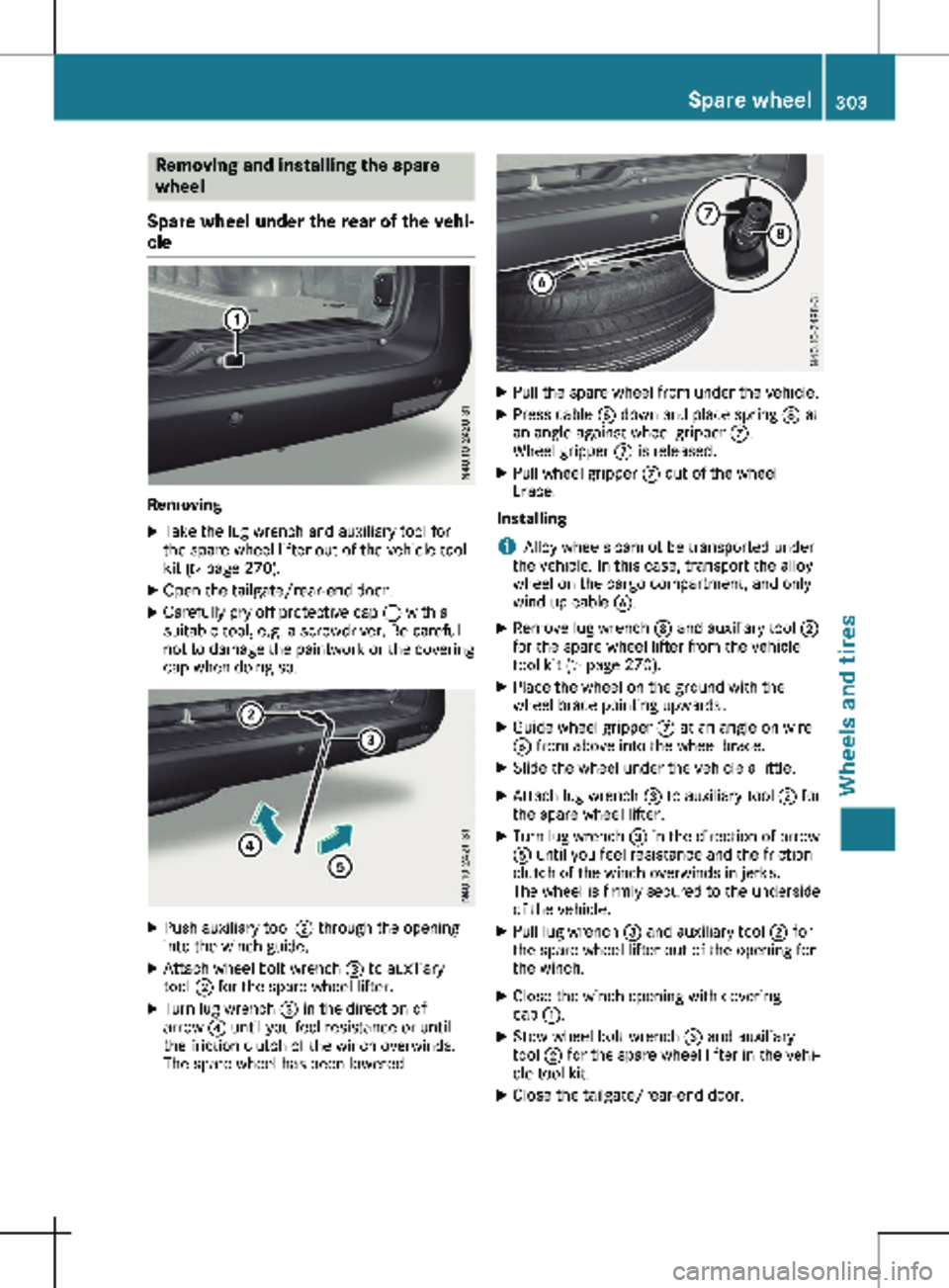
Removing and installing the spare
wheel
Spare wheel under the rear of the vehi-
cle Removing
X Take the lug wrench and auxiliary tool for
the spare wheel lifter out of the vehicle tool
kit
(Y page 270).
X Open the tailgate/rear-end door.
X Carefully pry off protective cap : with a
suitable tool, e.g. a screwdriver. Be careful
not to damage the paintwork or the covering
cap when doing so. X
Push auxiliary tool ; through the opening
into the winch guide.
X Attach wheel bolt wrench = to auxiliary
tool ; for the spare wheel lifter.
X Turn lug wrench = in the direction of
arrow ? until you feel resistance or until
the friction clutch of the winch overwinds.
The spare wheel has been lowered. X
Pull the spare wheel from under the vehicle.
X Press cable B down and place spring D at
an angle against wheel gripper C.
Wheel gripper C is released.
X Pull wheel gripper C out of the wheel
brace.
Installing
i Alloy wheels cannot be transported under
the vehicle. In this case, transport the alloy
wheel on the cargo compartment, and only
wind up cable B.
X Remove lug wrench = and auxiliary tool ;
for the spare wheel lifter from the vehicle
tool kit
(Y page 270).
X Place the wheel on the ground with the
wheel brace pointing upwards.
X Guide wheel gripper C at an angle on wire
B from above into the wheel brace.
X Slide the wheel under the vehicle a little.
X Attach lug wrench = to auxiliary tool ; for
the spare wheel lifter.
X Turn lug wrench = in the direction of arrow
A until you feel resistance and the friction
clutch of the winch overwinds in jerks.
The wheel is firmly secured to the underside
of the vehicle.
X Pull lug wrench = and auxiliary tool ; for
the spare wheel lifter out of the opening for
the winch.
X Close the winch opening with covering
cap :.
X Stow wheel bolt wrench = and auxiliary
tool ; for the spare wheel lifter in the vehi-
cle tool kit.
X Close the tailgate/rear-end door. Spare wheel
303
Wheels and tires Z
Page 315 of 320

Dimensions
Vehicle with tailgate
Vehicle with rear-end doors
The dimensions specified vary according to:
R Tires
R Load
R Condition of the suspension
R Optional equipment Model Cargo Van
Opening height of
the tailgate :
86.0 in (2185 mm)
Opening range of the
tailgate ;
41.2 in (1047 mm)
Opening range of the
rear-end doors
= 33.4 in (849 mm)
Load width
50.0 in (1270 mm)
Max. load width
66.3 in (1685 mm)
Load height
53.8 in (1367 mm)
Vehicle length
202.4 in
(5140 mm ) Model Cargo Van
Vehicle width
Including exterior mir-
rors
Excluding exterior mir-
rors
88.3 in
(2244 mm)
75.9 in (1928 mm) Wheelbase
126.0 in
(3200 mm
) Model Passenger Vans
Opening height of
the tailgate :
84.6 in (2150 mm)
Opening range of the
tailgate ;
41.2 in (1047 mm)
Opening range of the
rear-end doors
= 33.4 in (849 mm)
Load width
47.4 in (1205 mm)
Max. load width
61.1 in (1552 mm)
Load height
52.2 in (1326 mm)
Vehicle length
202.4 in
(5140 mm
) Vehicle width
Including exterior mir-
rors
Excluding exterior mir-
rors
88.3 in
(2244 mm)
75.9 in (1928 mm) Wheelbase
126.0 in
(3200 mm
) Cargo tie-down points and carrier
systems
Cargo tie-down points General notes
! Observe the information on the maximum
loading capacity of the individual cargo tie-
down points.
If you use several cargo tie-down points to
secure a load, you must always take the
maximum loading capacity of the weakest
cargo tie-down point into account. Vehicle data
313
Technical data Z
Page 316 of 320

If you brake hard, for example, the forces
acting could be up to several times the
weight force of the load. Always use multi-
ple cargo tie-down points in order to distrib-
ute the force absorption. Load the ancho-
rages evenly.
You will find additional information about
cargo tie-down points and cargo tie-down rings
in the "Securing loads" section
(Y page 244).
Cargo tie-down rings
The maximum tensile load of the cargo tie-
down rings is: Cargo tie-down
rings Permissible nomi-
nal tensile load Passenger Vans 786.5 lbf
(350 daN) Cargo Van 1124.0 lbf
(500 daN) Guide/load rails
The maximum tensile load for the cargo tie-
down points on a guide/load rail is: Cargo tie-down
point Permissible nomi-
nal tensile load Guide rail 786.5 lbf
(350 daN) Load rails on cargo
compartment floor 1124.0 lbf
(500 daN) Load rail on sidewall 225.0 lbf
(100 daN) The values specified apply only to loads placed
on the cargo compartment floor if:
R the load is secured to two cargo tie-down
points on the rail and
R the distance to the nearest load-securing
point on the same rail is approximately
3 ft
(1 m) Maximum roof load G
WARNING
If you use openings in the bodywork or
detachable parts as steps, you could:
R slip and/or fall
R damage the vehicle and cause yourself to
fall.
There is a risk of injury.
Always use secure climbing aids, e.g. a suit-
able ladder.
! Do not use the lower sliding door guide
(carriage) as a step. Otherwise, you could
damage the paneling and/or the sliding
door mechanism. G
WARNING
When you load the roof, the center of gravity
of the vehicle rises and the usual driving
characteristics, as well as steering and brak-
ing, change. The vehicle tilts more severely
when cornering and may react more slug-
gishly to steering input.
If you exceed the maximum roof load, the
driving characteristics, as well as the steer-
ing and braking, will be greatly impaired.
There is a risk of an accident.
Adjust your driving style and never exceed
the maximum roof load.
! The weight of any load carried on the roof,
including the roof carrier, must not exceed
the maximum permissible roof load.
The roof carrier supports must be mounted
at equal distances.
Install rail carriers in front of and behind the
middle prop.
! For safety reasons, only use roof carriers
that have been tested and approved for
Mercedes-Benz. This will help avoid damage. Maximum roof load
330 lbs (150 kg)
with at least three
pairs of support
points
The data is valid for a load distributed evenly
over the entire roof area. 314
Vehicle data
Technical data
Page 317 of 320

Reduce the load on shorter roof carriers pro-
portionately. The maximum load per pair of
roof carrier supports is
110 lbs (50 kg). The
maximum load of a rail carrier bar is 220 lbs
(100 kg).
Loading guidelines and other information con-
cerning load distribution and load securing can
be found in the "Transporting" section
(Y page 242). Trailer tow hitch
General notes Mercedes-Benz recommends having a trailer
tow hitch retrofitted at an authorized
Mercedes-Benz Van Dealer.
Use only a trailer tow hitch that has been tes-
ted and approved specially for your vehicle by
the distributor named on the inside of the
front cover. Only use a ball coupling for your
Metris trailer tow hitch if it has been approved
for your vehicle. You can also find information
on the permitted dimensions of the ball cou-
pling on the identification plate of the trailer
tow hitch.
You can obtain advice from a qualified special-
ist workshop. Also observe the information on
towing a trailer in the "Driving and parking"
section (Y page
168).
Trailer loads Make sure that you adhere to the local legal
requirements for trailer loads.
The permissible weights and loads which can-
not be exceeded can also be found:
R in your vehicle documents and
R on the identification plates of the trailer
hitch, the trailer and the vehicle
(Y page
304)
You will find the basic values approved by the
manufacturer in the following table. If the val-
ues differ, the lowest value applies.
Make sure that you adhere to the weight
restrictions by having the weight checked on a
calibrated weighbridge. Permissible gross
weight GVWR
6614 lbs (3000 kg)
Gross front axle
load GAWR (FA)
3307 lbs (1500 kg)
Gross rear axle
load GAWR (RA)
3307 lbs (1500 kg)
Maximum permis-
sible gross weight
of vehicle/trailer
combination
3
GCWR 11614 lbs (5268 kg)
Trailer load,
braked
4
GTW 5000 lbs (2268 kg)
Maximum permis-
sible nose weight
TWR
500 lbs (227 kg)
3
Maximum permissible gross weight of the vehicle and trailer.
4 Maximum permissible gross trailer weight, for trailers with independent braking system. Vehicle data
315
Technical data Z