2020 MERCEDES-BENZ GLS wheel
[x] Cancel search: wheelPage 206 of 682
Glide
mode canalso bepreve nted bythefo llo w‐
ing parame ters:
R Incline
R Downhill gradi ent
R Temp eratur e
R Height
R Speed
R Oper ating status oftheengine
R Traf fic situ ation Tr
ansf ercase Fu
nction ofthetransf ercase &
WARNIN GRisk ofskid ding and having
an acci dent whenin LO WRANGE onslip‐
per yro ad sur faces
If yo usele cttheLO WRANGE off-r oad gear
on aslippe ryroad sur face, thewheels could
lose traction inthefo llo wing situat ions:
R Ifyo ure lease theacceler ator pedal when
th eve hicle isin mo tion.
R Ifof f-r oad ABS interve nes when braki ng.
If th ewheels losetraction ,it will nolong erbe
possible tosteer theve hicle. #
Neversele cttheLO WRANGE off-r oad
ge ar when drivin gon slippe ryroad sur‐
fa ces. &
WARNIN GRisk ofacci dent whenth e
tr ans fercase isin neutr alposi tion
The transf ercase canbeinneutr alposi tion if
yo udo notwa itunt ilshif topera tioniscom ‐
ple te.The powe rtr ansmiss iontothedr iven
wheels isthen interru pted. The vehicle may
th er eb yinadv ertentl yro llaw ay. #
Waitunt ilth etra nsf ercase shiftoper a‐
tion iscom plete. This
funct ionisonl yav ailable invehicles with
Of f-road package .
Shif tth etransf ercase totheon- road posit ion
HIGH RANGEorintoth eLO WRAN GEoff-r oad
ge ar.
Do notswit choffth eengine during shif toper a‐
tion anddonotshif tth eaut omatic transmiss ion
to ano ther position . 20
4
Driving andparking
Page 208 of 682
In
theon-r oad posit ion,shiftto HIGH RANGE
Re quiremen ts:
R The engin eis running andyouar eno tdr ivin g
fa ster than 31 mp h(50 km/h). #
Pull LOWRAN GE1 rock er switc h.
The shiftre qu estst ay sactiv efo ra maximu m
of 30 seconds. Ifall requ iremen tsforshif t
oper ation have notbe en fulfilled within this
tim e,shif topera tionmustbe star tedag ain. #
Shif tth etra nsmiss iontoposition 005C.
If shif toper ation issucces sful,theLOW
RANGE Offmessag eappear sin theins tru‐
ment cluster,an audible signalsoun dsand
th eindicat orlam psgo out. #
Shif tth etra nsmiss iontoposition 005B. Fu
nction of4MA TIC
4MA TICensur esthat all four wheel sar edr iven
when needed. Toget her withESP ®
and 4ETS,
4MA TICimprove sth etra ction ofyour vehicle
whene vera dr iven whee lspins duetoinsuf fi‐
cie nttracti on. If
yo ufa ilto adap tyo ur drivin gst yle, 4MA TICcan
neit her reduce therisk ofan accident norover‐
ri de thelaws ofphysics. 4MA TICcannotta ke
acc oun tof road, weather and traf fic condi tions.
4MA TICisonly anaid. Youar ere sponsible espe‐
cially formaint ainingasaf edis tance from the
ve hicle infront, forve hicle speed, forbr aking in
good timeandforst ay ing inlane.
% Inwint ryroad con dition s,themaximum
ef fect of 4MA TICcan beachie vedonl yif yo u
use wint ertires (M+ Stir es), withsn ow
ch ains ifnec essar y. Re
fueli ng Re
fueli ngtheve hicl e &
WARNIN GRisk offire or explosion from
fuel
Fu els arehighly flammab le. #
Fire,open flames ,smo kingand creat ion
of spar ksmus tbe avo ided. #
Swit choffth eignition and,ifav ailable,
th est atio naryheat er,bef oreand while
re fuel ingtheve hicle. &
WARNIN GRisk ofinju ryfrom fuels
Fu els arepoisonous andhazar dous toyour
healt h. #
Donotsw allo wfuel orletit co me into
co ntact withsk in, eyes orclo thing. #
Donotinhale fuelvapor . #
Keep childr enaway from fuel. #
Keep door sand windo wsclos edduring
th ere fuel ingprocess.
If yo uor other people comeintocont actwith
fuel, obser vethefo llo wing: #
Imm ediat elyrinse fuelof fyo ur skin wit h
soap andwater. #
Iffuel comes intocont actwithyo ur
ey es, immediat elyrinse them thor‐
oughl ywit hclean water.Seek medical
att entio nimm ediately . 206
Driving and parking
Page 211 of 682
#
Ensu rethat thepar kedve hicle isalw ays
pr oper lysecur edagains tro lling away as
fo llo ws :
R Onuphil lor downhill gradients, turn
th efront wheels sothat theve hicle
ro lls towa rdsth ecurb ifit star ts
mo ving.
R App lythepar king brak e.
R Switc hth etra nsmiss iontoposition
005D. &
WARNIN GRisk offire cau sed byhot
ex haus tsy stem parts
Flammable material suc has lea ves, grass or
twigs mayignit eif th ey come intocont act
wi th hotpar tsof theex haus tsy stem or
ex haus tga sflow . #
Park theve hicle sothat no flammab le
mat erial can com eint ocon tact with hot
ve hicle component s. #
Inpar ticular ,do notpar kon drygr ass‐
land orhar vested grain fields. &
WARNIN GRisk ofacci dent andinjury
due tochildr enleftunat tende din the
ve hicle
If ch ildr enarelef tunat tende din theve hicle,
th ey cou ld:
R Ope ndoo rs,th er eb yendang ering other
per sons orroad user s.
R Getout and bestru ck byoncom ingtraf‐
fi c.
R Ope rate vehicle equipment andbecome
tr apped, forex am ple.
In addit ion,th ech ildr encould alsosetth e
ve hicle inmo tion, forex am ple by:
R Releasing thepar king brak e.
R Changing thetra nsmiss ionposition .
R Startin gth eve hicle. #
Neverlea vechildr enunat tende din the
ve hicle. #
When leaving theve hicle, alwaysta ke
th eke ywit hyo uand lockth eve hicle. #
Keep theve hicle keyout ofreac hof
ch ildr en. *
NO
TEDama getotheve hicle duetoit
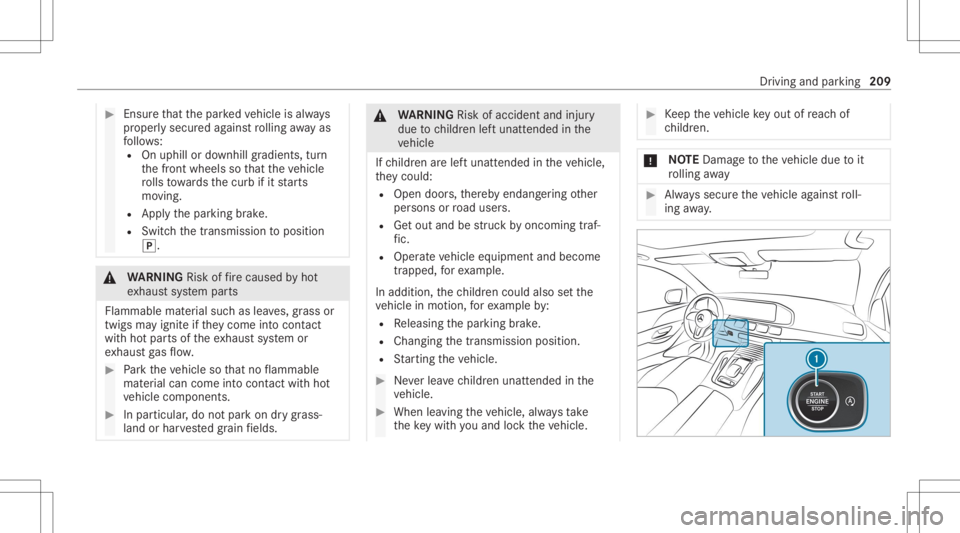
ro lling away #
Alw ayssecur eth eve hicle agains tro ll‐
ing away. Dr
iving and parking 209
Page 212 of 682
#
Bring theve hicle toast ands tillby appl ying
th ebr ak epedal. #
Onuphill ordownhill gradients, turnth efront
wheels sothat theve hicle rolls towa rdsth e
curb ifit star ts mo ving. #
App lytheelectr icpar king brak e. #
Engage trans missi on positio n005D inast atio n‐
ar yve hicle withth ebr ak epedal applied
(/ page200). #
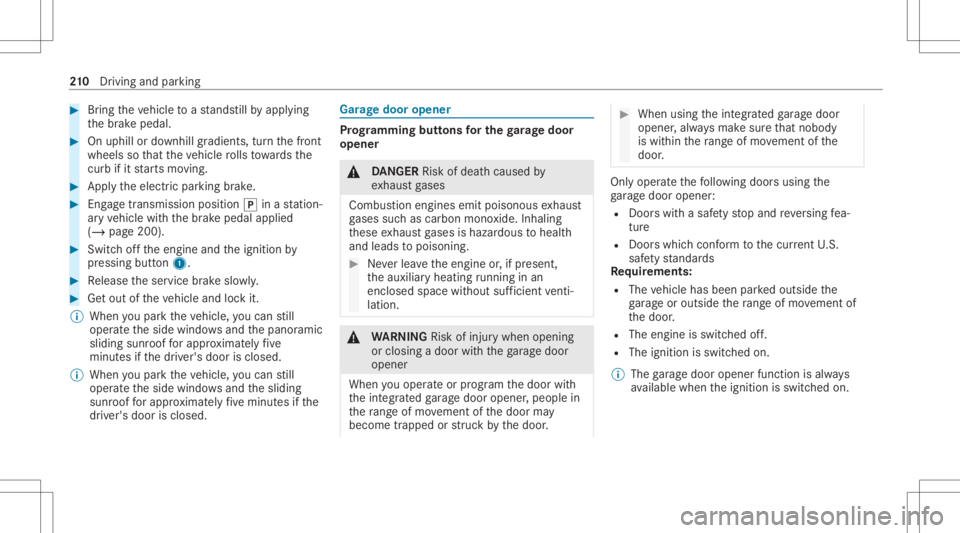
Switc hof fth eengine andtheignition by
pr essing button1. #
Release theser vice brak eslo wly. #
Getout oftheve hicle andlockit.
% When youpar kth eve hicle, youcan still
opera tetheside windo wsand thepanor amic
sliding sunroofforapp roxima tely five
minut esifth edr iver's door isclosed.
% When youpar kth eve hicle, youcan still
opera tetheside windo wsand thesliding
sunr oofforapp roxima tely five minut esifth e
dr iver's door isclosed. Gar
agedoor opener Pr
og rammin gbutt onsfo rthe garage doo r
ope ner &
DANG ER Risk ofdeat hcause dby
ex haus tga ses
Combus tionengines emitpoisonous exhaus t
ga ses suchas carbon monoxide.Inhaling
th ese exhaus tga ses ishazar dous tohealt h
and leads topoisonin g. #
Neverlea vetheengine or,if pr esent ,
th eauxiliar yheating running inan
encl osedspa cewithout sufficie ntventi‐
la tio n. &
WARNIN GRisk ofinju rywhen opening
or clos ingadoor withth ega rage door
opener
When youoper ateor program thedoor with
th eint egr ated garage door opener ,people in
th era ng eof mo vement ofthedoor may
become trapped orstru ck bythedoor . #
When usingtheint egr ated garage door
opener ,alw aysmak esur eth at nobody
is wit hin thera ng eof mo vement ofthe
door . Onl
yoper ateth efo llo wing doorsusing the
ga rage door opener :
R Door swit hasaf etyst op and reve rsing fea‐
tur e
R Doorswhic hcon form tothecur rent U.S.
sa fety standar ds
Re quirement s:
R The vehicle hasbeen parkedoutside the
ga rage oroutside thera ng eof mo vement of
th edoor .
R The engine isswitc hedoff.
R The ignition isswitc hedon.
% The garage door opener function isalw ays
av ailable whentheignition isswitc hedon. 21
0
Driving and parking
Page 221 of 682
Ov
ervie wof driving systems anddriving
saf etysy stems In
this sect ion, youwill find informa tionab ou t
th efo llo wing drivin gsy stems anddriving safety
sy stems:
R 360° Camer a(/ page27 8)
R ABS (Anti-lo ckBra king System)
(/ page21 9)
R ActiveDis tance AssistDIS TRONI C
(/ page 235)
R AIRMA TIC(/ page250)
R ActiveBr ak eAssi st(/ pag e225)
R ActiveLa ne Keeping Assist(/ page29 4)
R Start-of fassis t
R ATTENTION ASSIST(/ page28 7)
R BAS(B rake Assis tSys tem) (/ page220)
R Hill StartAs sis t(/ page24 8)
R DSR (Dow nhillSpe edRegulatio n)
(/ page 233)
R E-AC TIVE BODY CONTR OL(/ page258) R
EBD (Electr onicBrakeforc eDis tribution)
(/ page225)
R ESP®
(Elect ronic Stability Program)
(/ page22 0)
R Off-ro ad ESP®
(/ page22 3)
R ESP®
Cr oss wind Assis t(/ page22 4)
R ESP®
trailer stabiliz ation(/ page22 4)
R ActiveSpe edLimi tAssi st(/ pag e239)
R HOLD function (/page24 9)
R STEER CONTR OL(/ page 225)
R ActiveSt eer ing Assis twit hre scue lanefunc‐
tion (/page24 2)
R ActiveEmerg encyStop Assis t(/ page24 5)
R ActivePa rking Assist(/ page28 1)
R Parking AssistPA RK TRONI C(/ page26 9)
R Rear vie wcam era(/ page27 4)
R ActiveLa ne Chang eAssi st(/ pag e24 4)
R ActiveTr af fic Ja m Assi st(/ pag e24 6)
R Cruis econtr ol(/ page 231) R
Blind SpotAssis tand ActiveBli nd Spo tAssi st
wit hex itwa rning (/ page29 1)
R Traf fic Sign Assist(/ pag e289 ) Fu
nction ofABS The
Anti-loc kBr ak eSy stem (ABS )re gulat esthe
br ak epr essur ein critical driving situation s:
R Dur ing braking, e.g.atfull brak eapplication
or insuf ficie nttiretracti on, thewheels are
pr eve nted from lock ing.
R Vehicle steer ability whilebraking isensur ed.
If ABS interve nes when braki ng, youwill feel a
pulsing inthebr ak epedal. Thepulsating brak e
pedal canbeanindicat ionofhazar dous road
con dition sand canserveas are minder totak e
ex tra car ewh ile dr ivi ng.
Sy stem limit s
R ABSis act ive from speeds ofappr ox.5 mp h
(8 km/ h).
R ABSma ybe impair edorma yno tfunc tion ifa
malfunc tionhasoccurredand theye l‐
lo w 0025 ABSwa rning lam plight sup con tin‐ Dr
ivin gand parking 21
9
Page 222 of 682
uousl
yin theins trument clusteraf te rth e
engine isstar ted. Fu
nctions ofOff-road ABS %
Off-road ABS isactiv ated aut omaticall ywhen
yo usele cttheF orG drive pr ogr am.
Of f-road ABS isspeciall yadap tedfo rdr iving off-
ro ad:
R The fron twheels lockcy clic allydur ing brak‐
ing .
R The brakin gdis tance issho rtened duetothe
digging- ineffect.
Sy stem limit s
R Off-ro ad ABSfun ction sat spee dsbelo w
25 mph(40 km/h).
R IfOf f-road ABS interve nes, theability tosteer
ma ybe restrict ed. Fu
nction ofBA S(Br akeAssis tSy stem) &
WARNIN GRisk ofan acci dent caused by
a malf unctionin BA S(Br akeAssi stSys‐
te m)
If BA Sis mal functi oning,th ebr aking distance
in an eme rgency braki ng situa tionis
incr eased . #
Dep ress thebr ak epedal withfull forc e
in emer gency braki ng situa tions. ABS
pr eve nts thewheels from locking . BA
Ssu ppo rts yo ur eme rgency braking situation
wit hadditional brak efo rc e.
If yo udepr essthebr ak epedal quickl y, BA Sis
acti vated:
R BASau tomatical lyboos tsthebr ak epr es‐
sur e.
R BAScan shorten thebr aking distance.
R ABS preve nts thewheels from locking .
The brak es will func tion asusual onceyo u
re lease thebr ak epedal. BASis dea ctivated. Fu
nctions ofESP ®
(Electr onicStabil ityPro‐
gr am) &
WARNIN GRisk ofskid ding ifESP ®
is
mal functi oning
If ESP ®
is mal functi oning,ESP ®
canno tcar ry
out vehicle stabiliz ation.Inaddit ion,ot her
dr iving safetysy stems areswitc hedoff. #
Drive on car efull y. #
Have ESP ®
ch eckedat aqu alif ied spe‐
cialis two rkshop. &
WARNIN GRisk ofskid ding ifESP ®
is
dea ctivated
If yo udeac tivateES P®
,ES P®
can notcar ry
out vehicle stabiliz ation. #
ESP®
shoul don lybe deactiv ated inthe
fo llo wing situat ions. 220
Drivin gand parking
Page 223 of 682
ESP
®
can moni torand improve driving stabilit y
and tract ion inthefo llo wing situat ions,wit hin
ph ysical limit s:
R When pulling away on wetor slip pe ry road‐
wa ys.
R When braking.
R Vehicl eswith traile rhitc h:intrail er oper a‐
tion from spee dsof40 mph(65 km/h), ifth e
ve hicle/tr ailercombination beginstosw ay
fr om side toside.
R Instro ng side winds when youar edr ivin g
fa ster than 47 mp h(7 5 km/h).
If th eve hicle deviat esfrom thedir ect ion desir ed
by thedr iver ,ES P®
can stabiliz eth eve hicle by
int erve ning inthefo llo wing ways:
R One ormor ewheels arebr ak ed.
R The engine outputisadap tedaccor dingto
th esituation .
ES P®
is deactiv ated ifth e00BB ESP®
OFF warn‐
ing lam plight sup con tinuousl yin theins trument
clus ter:
R Driving stabilit ywill nolongerbe improve d. R
Vehicl eswith traile rhitc h:stabiliz ationof
th eve hicle/tr ailercombination isno long er
activ e.
R Crosswind Assistis no long eractiv e.
R The drive wheels couldspin.
R ETS/4E TStracti oncontr olisstill act ive.
% When ESP®
is deact ivat ed, youar est ill assis‐
te dby ESP ®
wh en braki ng.
If th e00E5 ESP®
wa rning lam pflashes inthe
ins trumen tclus ter,one orseveralve hicle wheels
has reac hed itsgrip limit :
R Adaptyo ur drivin gst yle to suit thecur rent
ro ad and weather condition s.
R Donotdeac tivateES P®
.
R Onlydepr esstheaccelera torpeda las faras
is necessar ywhen pulling away.
It can beadv antageous todeactiv ateES P®
in the
fo llo wing situat ionstoimprove tracti on:
R Whenusing snowch ains .
R Indeep snow .
R Onsand orgrave l. %
Spin ningth ewheels results inacutting
action, whichenhances traction.
If th e00E5 ESP®
wa rning lam plight sup con tinu‐
ousl y,ESP ®
is no tav ailable duetoamalf unction.
Obse rveth efo llo wing informatio n:
R Warning and indic ator lam ps(/ page62 1)
R Disp lay mess ages (/ page56 7)
ET S/4ET S(Electr onicTractio nSy stem)
ET S/ 4ETS tracti oncontr olispa rtof ESP ®
and
mak esitpossible topull away and accelerat eon
a slippe ryroadw ay.
If yo usele cttheF orG drive pr og ram, a
specia lET Ssy stem specif icallysuit edtooff-r oad
te rrain isaut omat icallyact ivat ed.
ET S/ 4ETS can improve theve hicle's traction by
int erve ning inthefo llo wing ways:
R The drive wheels arebr ak ed individually if
th ey spin.
R Mor edr ive to rq ue istrans ferred tothewheel
or wheels withtraction . Dr
iving andparking 22
1
Page 227 of 682
a
high centerof grav ity ma ytip over bef ore
ES P®
de tects this. #
Alw aysadap tyo ur drivin gst yle to suit
th ecur rent road and weather condi‐
tio ns. When
drivin gwit hatrailer ,ES P®
can stabiliz e
yo ur vehicle ifth etrailer begins tosw erve from
side toside:
R ESP ®
traile rst abiliz ationis act ive abo ve
speeds of40 mph(65 km/h).
R Slight swerving isreduced bymeans ofata r‐
ge ted, individual brak eapplication onone
side.
R Intheeve ntofsevere sw erving, theengine
output isalso reduced andallwheels are
br ak ed.
ES P®
tra iler stabiliz ationma ybe impair edor
ma yno tfun ction if:
R The trailer isno tcon nectedcor rectl yor is
no tde tected prope rly by theve hicle. Fu
nction ofEBD (electr onicbrak efo rc edis‐
tr ibut ion) EB
Dis ch aract erize dby thefo llo wing:
R Mon itor ing and regulating thebr ak epr essur e
on there ar wheels .
R Improve ddr iving stabilit ywhen brakin g,
espe ciallyon ben ds. Fu
nction ofSTEER CONT ROL ST
EER CONTR OLhelpsyo uby trans mitting a
no tice ablesteer ing forc eto thesteer ing wheel in
th edir ect ion requ ired forve hicle stabiliz ation.
This steer ing recomme ndation isgiv en particu‐
lar lyin thefo llo wing situat ions:
R Both right wheels orboth leftwheels areon
a we tor slip pe ry road sur face whe nyo u
br ak e
R The vehicle star ts to skid Sy
stem limit s
ST EER CONTR OLmaybe impa ired orma yno t
fu nctio nin thefo llo wing situat ions:
R ESP®
is deact ivat ed.
R ESP®
is malfun ctionin g.
R The steer ing ismalfunct ioning.
If ES P®
is malfunct ioning,youwill beassis ted
fur ther by theelectr icpo we rst eer ing. Fu
nction ofActiv eBr ak eAs sist Ac
tiveBr ak eAssi stconsi stsof thefo llo wing
func tions:
R Distance warning func tion
R Autonomo usbraki ng func tion
R Situ ation-d epend ent braki ng assist anc e
R Vehicl eswith Drivin gAss istanc ePa ck‐
ag e:Evasi ve Steer ing Assis tand corner ing
func tion
Ac tiveBr ak eAssi stcan helpyo uto minimize the
ri sk ofacollision withve hicles, cyclis tsor Dr
iving andparking 225