2020 MAZDA MODEL CX-30 trailer
[x] Cancel search: trailerPage 294 of 562

A vehicle is approaching from the
opposite direction on a steep
gradient.
1. Your vehicle
Directly after the SBS-RC system
becomes operable using the
personalization feature.
Radio wave interference from a
radar sensor equipped on a nearby
parked vehicle.
Turn off the SBS-RC system while
pulling a trailer or while an accessory
such as a bicycle carrier is installed to
the rear of the vehicle. Otherwise,
the radio waves emitted by the radar
will be blocked causing the system to
not operate normally.
In the following cases, a rear radar
and rear camera may detect
something as a target obstruction
which could cause the SBS-RC
system to operate.
Hanging curtains, gate poles such
as at toll gates and railroad
crossing.
When traveling near objects such
as foliage, barriers, vehicles, walls,
and fences along a road.
When driving off-road in areas
where there is grass and forage.
When passing through low gates,
narrow gates, car washing
machines, and tunnels.
A trailer is connected.A bright light source such as
sunlight hits the rear camera.
The surroundings are dark.
(Manual transmission)
If the vehicle is stopped by theSBS-RC operation and the clutch
pedal is not depressed, the engine
stops.
When the system operates, the user
is notified by the multi-information
display.
The collision warning beep sounds
intermittently while the SBS-RC
brake is operating.
If the vehicle is stopped by the SBS-RC operation and the brake
pedal is not depressed, displaying in
meter “Emergency Braking Activated.
Depress Brake Pedal to Hold Stop”,
after about 2 seconds and the SBS-RC brake is automatically
released.
▼ Collision Warning
If there is a possibility of a collision, the
collision warning sound is activated
continuously and a warning is
displayed on the active driving display
and the multi-information display.
Multi-information display
When Driving
i-ACTIVSENSE
4-158
CX-30_8HG6-EA-19I_Edition1_new
2019-6-13 18:45:11
Page 328 of 562

The height of the vehicle ahead is
low.
You drive your vehicle at the same
speed as the vehicle ahead.
Headlights are not turned on
during the night or when going
through a tunnel.
In the following cases, the Forward
Sensing Camera (FSC) may not be
able to detect target objects
correctly.
Under bad weather condition,
such as rain, fog and snow.
The window washer is being used
or the windshield wipers are not
used when it's raining.
Ice, fog, snow, frost, rainfall, dirt,
or foreign matter such as a plastic
bag is stuck on the windshield.
Trucks with low loading platforms
and vehicles with an extremely low
or high profile.
When driving next to walls with no
patterning (including fences and
longitudinally striped walls).
The taillights of the vehicle ahead
are turned off.
A vehicle is outside the
illumination range of the
headlights.
The vehicle is making a sharp turn,
or ascending or descending a steep
slope.
Entering or exiting a tunnel.Heavy luggage is loaded causing
the vehicle to tilt.
Strong light is shone at the front of
the vehicle (back light or
high-beam light from on-coming
vehicles).
There are many light emitters on
the vehicle ahead.
When the vehicle ahead is not
equipped with taillights or the
taillights are turned off at
nighttime.
Elongated luggage or cargo is
loaded onto installed roof rails and
covers the Forward Sensing
Camera (FSC).
Exhaust gas from the vehicle in
front, sand, snow, and water vapor
rising from manholes and grating ,
and water splashed into the air.
When towing a malfunctioning
vehicle.
The vehicle is driven with tires
having significantly different wear.
The vehicle is driven on down
slopes or bumpy roads.
There are water puddles on the
road.
The surroundings are dark such as
during the night, early evening, or
early morning , or in a tunnel or
indoor parking lot.
The illumination brightness of the
headlights is reduced or the
headlight illumination is weakened
due to dirt or a deviated optical
axis.
The target object enters the blind
spot of the Forward Sensing
Camera (FSC).
A person or object bursts onto the
road from the shoulder or cuts
right in front of you.
You change lanes and approach a
vehicle ahead.
When driving extremely close to
the target object.
Tire chains or a temporary spare
tire is installed.
The vehicle ahead has a special
shape. For example, a vehicle
towing a trailer house or a boat, or
a vehicle carrier carrying a vehicle
with its front pointed rearward.
When Driving
i-ACTIVSENSE
4-192
CX-30_8HG6-EA-19I_Edition1_new 2019-6-13 18:45:11
Page 331 of 562

NOTE
Under the following conditions, the
front radar sensor may not be able to
detect vehicles ahead or obstructions
correctly and each system may not
operate normally.
The rear surface of a vehicle ahead
does not reflect radio waves
effectively, such as an unloaded
trailer or an automobile with a
loading platform covered by a soft
top, vehicles with a hard plastic
tailgate, and round-shaped
vehicles.
Vehicles ahead with low vehicle
height and thus less area for
reflecting radio waves.
Visibility is reduced due to a
vehicle ahead casting off water,
snow, or sand from its tires and
onto your windshield.
The luggage compartment is
loaded with heavy objects or the
rear passenger seats are occupied.
Ice, snow, or soiling is on the front
surface of the front emblem.
During inclement weather such as
rain, snow, or sand storms.
When driving near facilities or
objects emitting strong radio
waves.
Under the following conditions, the
front radar sensor may not be able to
detect vehicles ahead or
obstructions.
The beginning and end of a curve.Roads with continuous curves.Narrow lane roads due to road
construction or lane closures.
The vehicle ahead enters the radar
sensor's blind spot.
The vehicle ahead is running
abnormally due to accident or
vehicle damage.
Roads with repeated up and down
slopes
Driving on poor roads or unpaved
roads.
The distance between your vehicle
and the vehicle ahead is extremely
short.
A vehicle suddenly comes close,
such as by cutting into your lane.
To prevent incorrect operation of the
system, use tires of the same
specified size, manufacturer, brand,
and tread pattern on all four wheels.
In addition, do not use tires with significantly different wear patterns
or tire pressures on the same vehicle
(Including the temporary spare tire).
If the battery power is weak, the
system may not operate correctly.
When driving on roads with little traffic and few vehicles ahead or
obstructions for the front radar
sensor to detect, “Safety and Driver
Support Systems Temporarily
Disabled. Front Radar Obscured.
Drive Safely” may be temporarily
displayed, however, this does not
indicate a problem.
The radar sensors are regulated by
the relevant radio wave laws of the
country in which the vehicle is
driven. If the vehicle is driven
abroad, authorization from the
country in which the vehicle is driven
may be required.
When Driving
i-ACTIVSENSE
4-195
CX-30_8HG6-EA-19I_Edition1_new 2019-6-13 18:45:11
Page 332 of 562

Front Side Radar Sensor*
▼Front Side Radar Sensor
Your vehicle is equipped with front
side radar sensor. The following
systems also use the front side radar
sensor.
Front Cross Traffic Alert (FCTA)
The front side radar sensor function by
detecting the radio waves reflected off
a vehicle approaching from the front or
an obstruction sent from the radar
sensor.
1. Front side radar sensor
The front side radar sensors are
installed inside the front bumper, one
on each side.
Always keep the surface of the front
bumper near the front side radar
sensors clean so that they operate
normally. Also, do not apply items such
as stickers.
Refer to Exterior Care on page 6-40.
CAUTION
If the front bumper receives a severe
impact, the system may no longer
operate normally. Stop the system
immediately and have the vehicle
inspected at an Authorized Mazda
Dealer.
NOTE
The detection ability of the front side
radar sensor has limitations. In the
following cases, the detection ability
may lower and the system may not
operate normally.
The front bumper near the front
side radar sensor has become
deformed.
Snow, ice or mud adheres to the
front side radar sensor on the front
bumper.
Under bad weather conditions
such as rain, snow and fog.
Under the following conditions, the
front side radar sensor cannot detect
target objects or it may be difficult to
detect them.
Small motorcycles, bicycles,
pedestrians, animals, shopping
carts, and stationary objects on a
road or a road side.
Vehicle shapes which do not
reflect radar waves well such as
empty trailers with a low vehicle
height and sports cars.
Vehicles are shipped with the
direction of the front side radar
sensor adjusted for each vehicle to a
loaded vehicle condition so that the
front side radar sensor detect
approaching vehicles correctly. If the
direction of the front side radar
sensor has deviated for some reason,
have the vehicle inspected at an
Authorized Mazda Dealer.
For repairs or replacement of the
front side radar sensor, or bumper
repairs, paintwork, and replacement
near the radar sensors, consult an
Authorized Mazda Dealer.
When Driving
i-ACTIVSENSE
4-196*Some models.
CX-30_8HG6-EA-19I_Edition1_new 2019-6-13 18:45:11
Page 334 of 562

NOTE
The detection ability of the rear side
radar sensor has limitations. In the
following cases, the detection ability
may lower and the system may not
operate normally.
The rear bumper near the rear side
radar sensor has become
deformed.
Snow, ice or mud adheres to the
rear side radar sensor on the rear
bumper.
Under bad weather conditions
such as rain, snow and fog.
Under the following conditions, the
rear side radar sensor cannot detect
target objects or it may be difficult to
detect them.
Small motorcycles, bicycles,
pedestrians, animals, shopping
carts, and stationary objects on a
road or a road side.
Vehicle shapes which do not reflect radar waves well such as
empty trailers with a low vehicle
height and sports cars.
Vehicles are shipped with the
direction of the rear side radar
sensor adjusted for each vehicle to a
loaded vehicle condition so that the
rear side radar sensor detect
approaching vehicles correctly. If the
direction of the rear side radar
sensor has deviated for some reason,
have the vehicle inspected at an
Authorized Mazda Dealer.
For repairs or replacement of the rear
side radar sensor, or bumper repairs,
paintwork, and replacement near the
radar sensors, consult an Authorized
Mazda Dealer.
The radar sensors are regulated by
the relevant radio wave laws of the
country in which the vehicle is
driven. If the vehicle is driven
abroad, authorization from the
country in which the vehicle is driven
may be required.
When Driving
i-ACTIVSENSE
4-198
CX-30_8HG6-EA-19I_Edition1_new 2019-6-13 18:45:11
Page 531 of 562

Ve h i c l e L o a d i n g
▼Ve h i c l e L o a d i n g
WARNING
Do not tow a trailer with this vehicle:
Towing a trailer with this vehicle is
dangerous because it has not been
designed to tow a trailer and doing so
will
affect the drive system which could
result in vehicle damage.
This section will guide you in the
proper loading of your vehicle, to keep
your loaded vehicle weight within its
design rating capability. Properly
loading your vehicle will provide
maximum return of vehicle design
performance. Before loading your
vehicle, familiarize yourself with the
following terms for determining your
vehicle's weight ratings, from the
vehicle's Safety Certification Label and
Tire and Load Information Label:
WARNING
Overloaded Vehicle:
Overloading a vehicle is dangerous.
The results of overloading can have
serious consequences in terms of
passenger safety. Too much weight on
a vehicle's suspension system can
cause spring or shock absorber failure,
brake failure, handling or steering
problems, irregular tire wear, tire
failure or other damage.
Overloading makes a vehicle harder to
drive and control. It also increases the
distance required for stopping. In cases
of serious overloading, brakes can fail
completely, particularly on steep
grades. The load a tire will carry safely
is a combination of the size of the tire,
its load range, and corresponding
inflation pressure.
Never overload the vehicle and always
observe the vehicle's weight ratings
from the vehicle's Safety Certification
and Tire and Load Information labels.
Base Curb Weight is the weight of the
vehicle including a full tank of fuel
and all standard equipment. It does
not include passengers, cargo, or
optional equipment.
Vehicle Curb Weight is the weight of
your new vehicle when you picked it
up from your dealer plus any
aftermarket equipment.
PAY LOA D
Pay l o a d is the combination weight of
cargo and passengers that the vehicle
is designed to carry. The maximum
payload for your vehicle can be found
on the Tire and Load Information label
on the driver's door frame or door
pillar. Look for “THE COMBINATION
WEIGHT OF OCCUPANTS AND
CARGO SHOULD NEVER EXCEED XXX
kg or XXX lbs” for your maximum
payload. The payload listed on the tire
label is the maximum payload for the
vehicle as built by the assembly plant.
If any aftermarket or dealer installed
equipment has been installed on the
vehicle, the weight of the equipment
must be subtracted from the payload
Customer Information and Reporting Safety Defects
Tire Information (U.S.A.)
8-29
CX-30_8HG6-EA-19I_Edition1_new 2019-6-13 18:45:11
Page 534 of 562

Steps for Determining the Correct Load Limit
▼Steps for Determining the Correct Load Limit
Steps for Determining Correct Load Limit-
(1) Locate the statement “The combined weight of occupants and cargo should
never exceed XXX kg or XXX lbs.” on your vehicle's placard.
(2) Determine the combined weight of the driver and passengers that will be riding in your vehicle.
(3) Subtract the combined weight of the dr iver and passengers from XXX kg or XXX
lbs.
(4) The resulting figure equals the available amount of cargo and luggage load capacity. For example, if the “XXX” am ount equals 1400 lbs. and there will be
five 150 lb passengers in your vehicle,
the amount of available cargo and
luggage load capacity is 650 lbs. (1400 - 750 (5 × 150) = 650 lbs.)
(5) Determine the combined weight of luggage and cargo being loaded on the
vehicle. That weight may not safely exceed the available cargo and luggage load
capacity calculated in Step 4.
(6) If your vehicle will be towing a trailer, load from your trailer will be transferred to
your vehicle. Consult this manual to determine how this reduces the available
cargo and luggage load capacity of your vehicle.
Customer Information and Reporting Safety Defects
Tire Information (U.S.A.)
8-32
CX-30_8HG6-EA-19I_Edition1_new 2019-6-13 18:45:11
Page 559 of 562
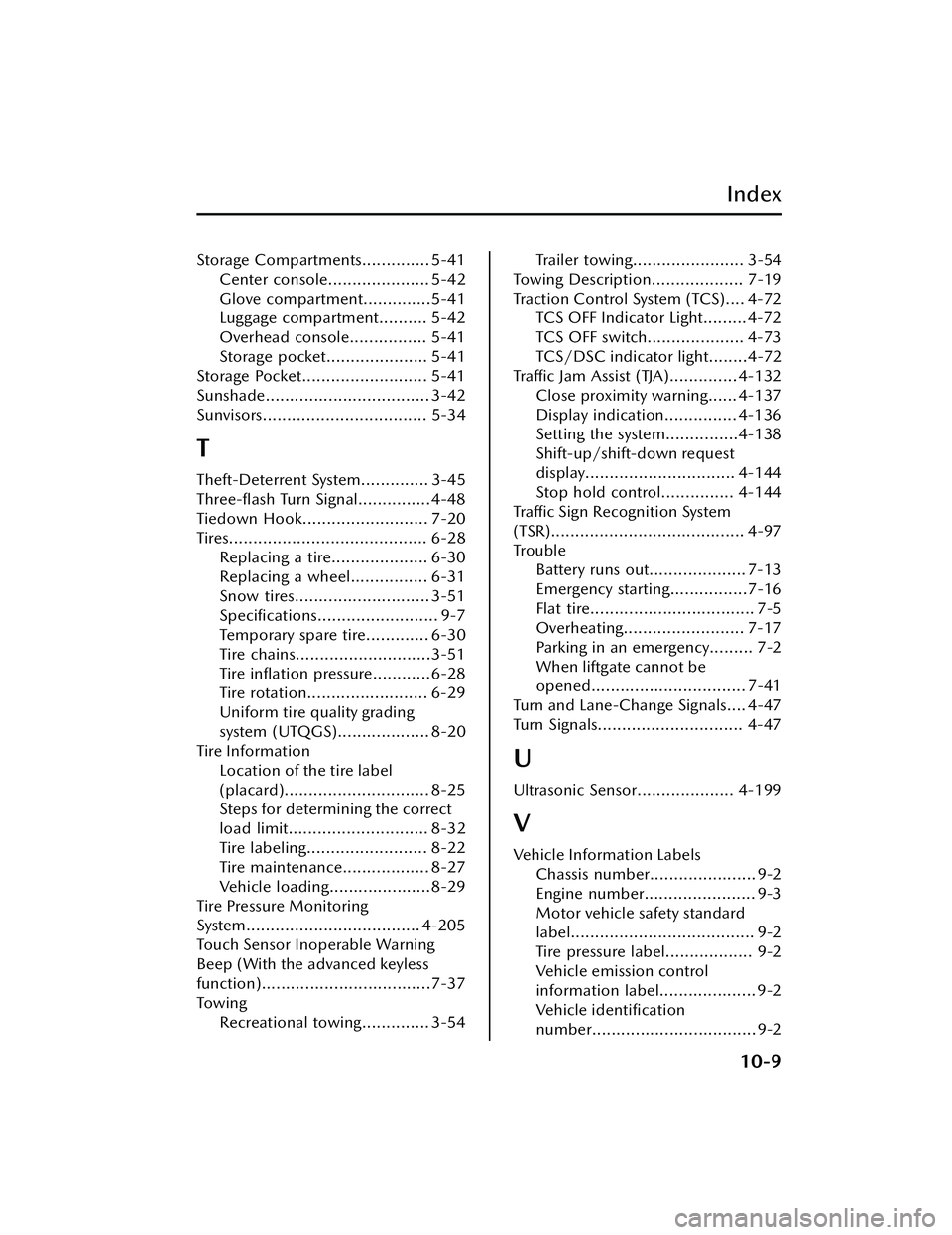
Index
Storage Compartments.............. 5-41Center console..................... 5-42
Glove compartment..............5-41
Luggage compartment.......... 5-42
Overhead console................ 5-41
Storage pocket..................... 5-41
Storage Pocket.......................... 5-41
Sunshade.................................. 3-42
Sunvisors.................................. 5-34
T
Theft-Deterrent System.............. 3-45
Three-flash Turn Signal...............4-48
Tiedown Hook.......................... 7-20
Tires......................................... 6-28 Replacing a tire.................... 6-30
Replacing a wheel................ 6-31
Snow tires............................ 3-51
Specifications......................... 9-7
Temporary spare tire............. 6-30
Tire chains............................3-51
Tire inflation pressure............6-28
Tire rotation......................... 6-29
Uniform tire quality grading
system (UTQGS)................... 8-20
Tire Information Location of the tire label
(placard).............................. 8-25
Steps for determining the correct
load limit............................. 8-32
Tire labeling......................... 8-22
Tire maintenance.................. 8-27
Vehicle loading.....................8-29
Tire Pressure Monitoring
System.................................... 4-205
Touch Sensor Inoperable Warning
Beep (With the advanced keyless
function)...................................7-37
To w i n g Recreational towing.............. 3-54
Trailer towing....................... 3-54
Towing Description................... 7-19
Traction Control System (TCS).... 4-72 TCS OFF Indicator Light......... 4-72
TCS OFF switch.................... 4-73
TCS/DSC indicator light........4-72
Tra ffi c Jam Assist (TJA).............. 4-132
Close proximity warning...... 4-137
Display indication............... 4-136
Setting the system...............4-138
Shift-up/shift-down request
display............................... 4-144
Stop hold control............... 4-144
Tra ffi c Sign Recognition System
(TSR)........................................ 4-97
Trouble Battery runs out.................... 7-13
Emergency starting................7-16
Flat tire.................................. 7-5
Overheating......................... 7-17
Parking in an emergency......... 7-2
When liftgate cannot be
opened................................ 7-41
Turn and Lane-Change Signals.... 4-47
Turn Signals.............................. 4-47
U
Ultrasonic Sensor.................... 4-199
V
Vehicle Information Labels Chassis number...................... 9-2
Engine number....................... 9-3
Motor vehicle safety standard
label...................................... 9-2
Tire pressure label.................. 9-2
Vehicle emission control
information label.................... 9-2
Ve h i c l e i d e n t i fi c a t i o n
number..................................9-2
10-9
CX-30_8HG6-EA-19I_Edition1_new 2019-6-13 18:45:11