2020 MAZDA MODEL CX-30 suspension
[x] Cancel search: suspensionPage 326 of 562

Forward Sensing Camera(FSC)
*
▼Forward Sensing Camera (FSC)
Your vehicle is equipped with a
Forward Sensing Camera (FSC). The
Forward Sensing Camera (FSC) is
positioned near the rearview mirror
and used by the following systems.
High Beam Control System (HBC)Lane Departure Warning System
(LDWS)
Tra ffi c
Sign Recognition System (TSR)Distance & Speed Alert (DSA)Driver Attention Alert (DAA)Mazda Radar Cruise Control
(MRCC)
Mazda Radar Cruise Control with
Stop & Go function (MRCC with
Stop & Go function)
Lane-keep Assist System (LAS)Tra ffi c Jam Assist (TJA)Smart Brake Support (SBS)
1. Forward Sensing Camera (FSC)
The Forward Sensing Camera (FSC)
determines the conditions ahead of
the vehicle while traveling at night and
detects traffic lanes. The distance in
which the Forward Sensing Camera
(FSC) can detect objects varies
depending on the surrounding
conditions.
WARNING
Do not modify the suspension:
If the vehicle height or inclination is
changed, the system will not be able to
correctly detect vehicles ahead. This
will result in the system not operating
normally or mistakenly operating,
which could cause a serious accident.
CAUTION
Do not apply accessories, stickers or
film to the windshield near the
Forward Sensing Camera (FSC).
If the area in front of the Forward
Sensing Camera (FSC) lens is
obstructed, it will cause the system
to not operate correctly.
Consequently, each system may not
operate normally which could lead
to an unexpected accident.
Do not disassemble or modify the
Forward Sensing Camera (FSC).
Disassembly or
modification of the
Forward Sensing Camera (FSC) will
cause a malfunction or mistaken
operation. Consequently, each
system may not operate normally
which could lead to an unexpected
accident.
Heed the following cautions to
assure the correct operation of the
Forward Sensing Camera (FSC).
Be careful not to scratch the
Forward Sensing Camera (FSC)
lens or allow it to get dirty.
Do not remove the Forward
Sensing Camera (FSC) cover.
Do not place objects on the
dashboard which reflect light.
When Driving
i-ACTIVSENSE
4-190*Some models.
CX-30_8HG6-EA-19I_Edition1_new 2019-6-13 18:45:11
Page 330 of 562

Front Radar Sensor*
▼Front Radar Sensor
Your vehicle is equipped with a front
radar sensor.
The following systems also use the
front radar sensor.
Distance & Speed Alert (DSA)Mazda Radar Cruise Control
(MRCC)
Mazda Radar Cruise Control with
Stop & Go function (MRCC with
Stop & Go function)
Tra ffi c Ja m A s s i s t ( TJ A )Smart Brake Support (SBS)
The front radar sensor functions by
detecting the radio waves reflected off
a vehicle ahead or an obstruction sent
from the radar sensor.
The front radar sensor is mounted
behind the front emblem.
1. Front radar sensor
If “Safety and Driver Support Systems
Temporarily Disabled. Front Radar
Obscured. Drive Safely” is displayed on
the multi-information display of the
instrument cluster, clean the area
around the front radar sensor.
CAUTION
Heed the following precautions to
assure correct operation of each
system.
Do not adhere stickers (including
transparent stickers) to the surface of
the radiator grille and front emblem
in and around the front radar sensor,
and do not replace the radiator grille
and front emblem with any product
that is not a genuine product
designed for use with the front radar
sensor.
The front radar sensor includes a
function for detecting soiling of the
radar sensor's front surface and
informing the driver, however,
depending on the conditions, it may
require time to detect or it may not
detect plastic shopping bags, ice or
snow. If this occurs, the system may
not operate correctly, therefore
always keep the front radar sensor
clean.
Do not install a grille guard.
If the front part of the vehicle has
been damaged in a vehicle accident,
the position of the front radar sensor
may have moved. Stop the system
immediately and always have the
vehicle inspected at an Authorized
Mazda Dealer.
Do not use the front bumper to push
other vehicles or obstructions such
as when pulling out of a parking
space. Otherwise, the front radar
sensor could be hit and its position
deviated.
Do not remove, disassemble, or
modify the front radar sensor.
For repairs, replacement or paint
work around the front radar sensor,
consult an Authorized Mazda Dealer.
Do not modify the suspensions. If
the suspensions are modified, the
vehicle's posture could change and
the front radar sensor may not be
able to correctly detect a vehicle
ahead or an obstruction.
When Driving
i-ACTIVSENSE
4-194*Some models.
CX-30_8HG6-EA-19I_Edition1_new 2019-6-13 18:45:11
Page 415 of 562

Maintenance ItemNormal Driving Scheduled Maintenance Intervals
1st 2nd 3rd 4th 5th 6th 7th 8th
Brake and clutch fluid level IIIIIIII
Brake fluid With electri-
cal boosterRRRR
Disc brakes IIIIIIII
Tire rotation Rotate every 16,000 km (10,000 miles).
Tire inflation pressure and tire wear
*4IIIIIIII
Steering operation and linkages II II
Front and rear suspension, ball joints and
wheel bearing axial play IIII
Rear differential oil
*5
Tra n s f e r o i l*5
Driveshaft dust boot II II
Bolts and nuts on chassis and body TTT T
Exhaust system and heat shields II
Emergency flat tire repair kit (if equipped)
*6Inspect annually.
Cabin air filter Replace every 48,000 km (30,000 miles) or 24 months.
Function of all lights IIIIIIII
Chart symbols:
I: Inspect: Inspect and clean, repair, adjust, fill up, or replace if necessary.
R: Replace
T: Tighten
Remarks:
*1 Reset the engine oil data whenever replacing the engine oil regardless of the message/wrench indicator light display.
*2 Use of FL-22 is recommended when replacing engine coolant. Using engine coolant other than FL-22
may cause serious damage to the engine and cooling system.
*3 According to state/provincial and federal regulations, failure to perform maintenance on these items
will not void your emissions warranties. However, Mazda recommends that all maintenance services
be performed at the recommended time or mileage/kilometer period to ensure long-term reliability.
*4 Inspect a spare tire if installed.*5 If this component has been submerged in water, the oil should be replaced.*6 Check the tire repair fluid expiration date every year when performing the periodic maintenance.Replace the tire repair fluid bottle with new one before the expiration date.
Maintenance and Care
Scheduled Maintenance
6-5
CX-30_8HG6-EA-19I_Edition1_new
2019-6-13 18:45:11
Page 417 of 562

Maintenance IntervalNumber of months or kilometers
(miles), whichever comes first.
Months 6 1218243036424854606672
×1000 km 8 1624324048566472808896
×1000 miles 5 10 15 20 25 30 35 40 45 50 55 60
Engine coolant level IIIIIIIIIIII
Engine coolant
*4Replace at first 192,000 km (120,000 miles) or 120
months; after that, every 96,000 km (60,000 miles) or 60 months.
Fuel lines & hoses
*5III
Hoses and tubes for emission
*5I
Brake lines, hoses and connections III
Vacuum brake booster and
hose With vacuum
booster
IIIIII
Brake fluid With electri-
cal booster RRR
Disc brakes I
C/LII/C/LIC/LII/C/L
Tire rotation Rotate every 8,000 km (5,000 miles).
Tire inflation pressure and tire wear
*6IIIIIIIIIIII
Steering operation and linkages III
Front and rear suspension, ball joints and
wheel bearing axial play III
Rear differential oil
*7
Tra n s f e r o i l*7
Body condition inspection for rust, corro-
sion and perforation IIIIII
Driveshaft dust boot I I I
Bolts and nuts on chassis and body TTT
Exhaust system and heat shields I
Emergency flat tire repair kit (if equipped)
*8Inspect annually.
Cabin air filter Replace every 40,000 km (25,000 miles) or 24 months.
Chart symbols:
I: Inspect: Inspect and clean, repair, adjust, fill up, or replace if necessary.
R: Replace
C: Clean
L: Lubricate
T: Tighten
Maintenance and Care
Scheduled Maintenance
6-7
CX-30_8HG6-EA-19I_Edition1_new 2019-6-13 18:45:11
Page 419 of 562
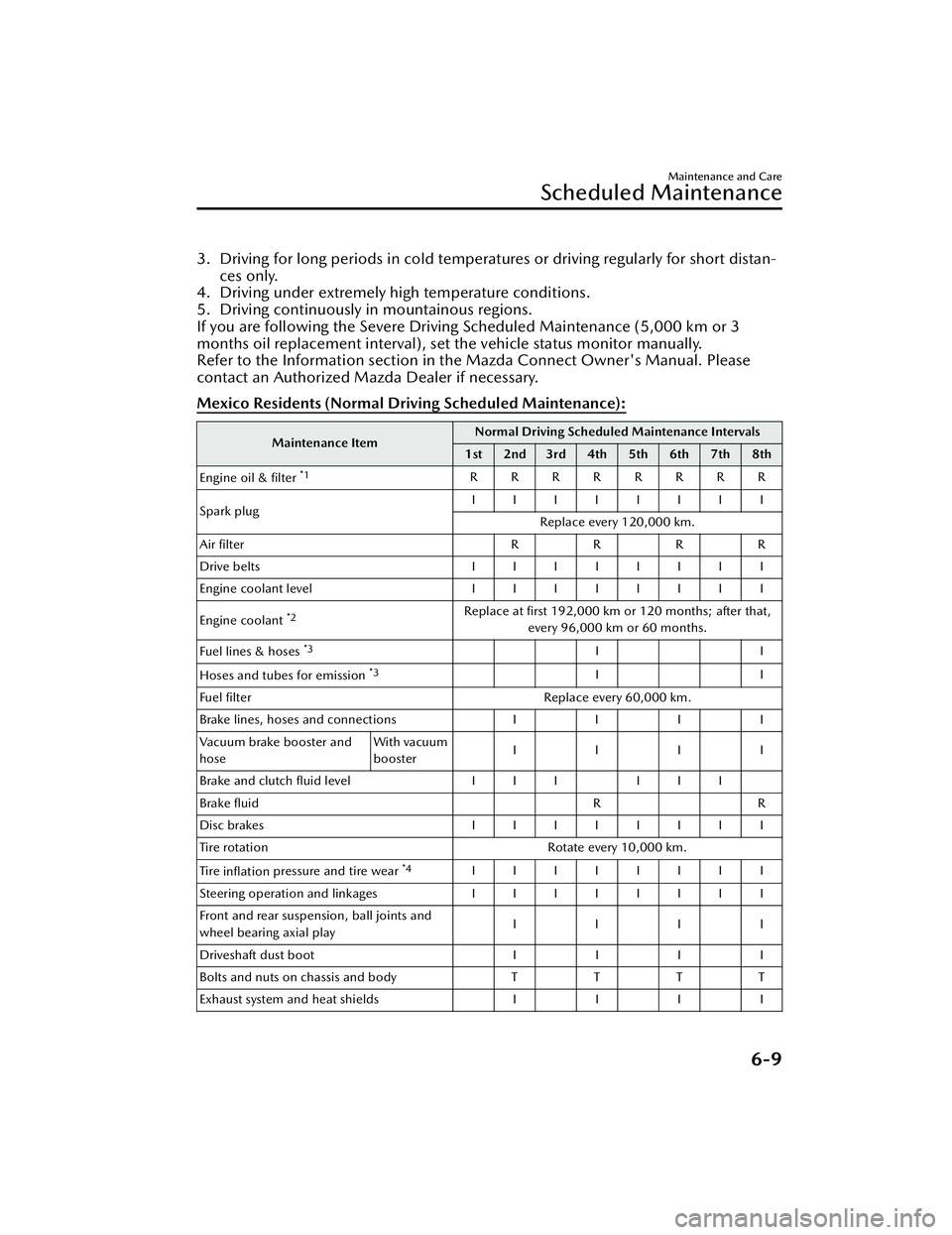
3. Driving for long periods in cold temperatures or driving regularly for short distan-
ces only.
4. Driving under extremely high temperature conditions.
5. Driving continuously in mountainous regions.
If you are following the Severe Driving Scheduled Maintenance (5,000 km or 3
months oil replacement interval), set the vehicle status monitor manually.
Refer to the Information section in th e Mazda Connect Owner's Manual. Please
contact an Authorized Mazda Dealer if necessary.
Mexico Residents (Normal Driv ing Scheduled Maintenance):
Maintenance Item Normal Driving Scheduled Maintenance Intervals
1st 2nd 3rd 4th 5th 6th 7th 8th
Engine oil & filter
*1RRRRRRRR
Spark plug IIIIIIII
Replace every 120,000 km.
Air filter RR RR
Drive belts IIIIIIII
Engine coolant level IIIIIIII
Engine coolant
*2Replace at first 192,000 km or 120 months; after that, every 96,000 km or 60 months.
Fuel lines & hoses
*3II
Hoses and tubes for emission
*3II
Fuel filter Replace every 60,000 km.
Brake lines, hoses and connections II II
Vacuum brake booster and
hose With vacuum
booster
IIII
Brake and clutch fluid level III III
Brake fluid RR
Disc brakes IIIIIIII
Tire rotation Rotate every 10,000 km.
Tire inflation pressure and tire wear
*4IIIIIIII
Steering operation and linkages IIIIIIII
Front and rear suspension, ball joints and
wheel bearing axial play IIII
Driveshaft dust boot II II
Bolts and nuts on chassis and body TTT T
Exhaust system and heat shields II II
Maintenance and Care
Scheduled Maintenance
6-9
CX-30_8HG6-EA-19I_Edition1_new 2019-6-13 18:45:11
Page 531 of 562

Ve h i c l e L o a d i n g
▼Ve h i c l e L o a d i n g
WARNING
Do not tow a trailer with this vehicle:
Towing a trailer with this vehicle is
dangerous because it has not been
designed to tow a trailer and doing so
will
affect the drive system which could
result in vehicle damage.
This section will guide you in the
proper loading of your vehicle, to keep
your loaded vehicle weight within its
design rating capability. Properly
loading your vehicle will provide
maximum return of vehicle design
performance. Before loading your
vehicle, familiarize yourself with the
following terms for determining your
vehicle's weight ratings, from the
vehicle's Safety Certification Label and
Tire and Load Information Label:
WARNING
Overloaded Vehicle:
Overloading a vehicle is dangerous.
The results of overloading can have
serious consequences in terms of
passenger safety. Too much weight on
a vehicle's suspension system can
cause spring or shock absorber failure,
brake failure, handling or steering
problems, irregular tire wear, tire
failure or other damage.
Overloading makes a vehicle harder to
drive and control. It also increases the
distance required for stopping. In cases
of serious overloading, brakes can fail
completely, particularly on steep
grades. The load a tire will carry safely
is a combination of the size of the tire,
its load range, and corresponding
inflation pressure.
Never overload the vehicle and always
observe the vehicle's weight ratings
from the vehicle's Safety Certification
and Tire and Load Information labels.
Base Curb Weight is the weight of the
vehicle including a full tank of fuel
and all standard equipment. It does
not include passengers, cargo, or
optional equipment.
Vehicle Curb Weight is the weight of
your new vehicle when you picked it
up from your dealer plus any
aftermarket equipment.
PAY LOA D
Pay l o a d is the combination weight of
cargo and passengers that the vehicle
is designed to carry. The maximum
payload for your vehicle can be found
on the Tire and Load Information label
on the driver's door frame or door
pillar. Look for “THE COMBINATION
WEIGHT OF OCCUPANTS AND
CARGO SHOULD NEVER EXCEED XXX
kg or XXX lbs” for your maximum
payload. The payload listed on the tire
label is the maximum payload for the
vehicle as built by the assembly plant.
If any aftermarket or dealer installed
equipment has been installed on the
vehicle, the weight of the equipment
must be subtracted from the payload
Customer Information and Reporting Safety Defects
Tire Information (U.S.A.)
8-29
CX-30_8HG6-EA-19I_Edition1_new 2019-6-13 18:45:11