2020 Lexus GS F fuel cap
[x] Cancel search: fuel capPage 327 of 600

GS350_GS F_OM_OM30J07U_(U)
3275-2. Using the air conditioning system and defogger
5
Interior features
■When the outside temperature exceeds 75°F (24°C) and the air conditioning system
is on
●In order to reduce the air co nditioning power consumption, the air conditioning system
may switch to recirculated air mode automa tically. This may also reduce fuel consump-
tion.
●Recirculated air mode is selected as a default mode when the engine switch is turned
on.
●It is possible to switch to outside air mode at any time by pressing .
■Automatic mode for air intake control
In automatic mode, the system detects exhaust gas and other pollutants and automati-
cally switches between outside air and recirculated air modes.
When the dehumidification function is off, and the fan is operating, turning automatic
mode on will activate the dehumidification function.
■Operation of the air conditioning system in Eco drive mode
In the Eco drive mode, the air conditioning sy stem is controlled as follows to prioritize
fuel efficiency:
●Engine speed and compressor operation controlled to restrict heating/cooling capac-
ity
●Fan speed restricted when automatic mode is selected
To improve air conditioning performanc e, perform the following operations:
●Turn off eco air conditioning mode
●Adjust the fan speed
●Turn off Eco drive mode ( P. 281)
■Eco air conditioning mode
When Eco drive mode is selected using the drive mode select switch, eco air condition-
ing mode turns on.
When a drive mode other than Eco drive mo de is selected, eco air conditioning mode
may turn off.
■When the S-FLOW mode operates
If air flows to the driver’s seat only, the te mperature setting for the front passenger’s seat
is not displayed.
■When the outside temperature is low
The dehumidification function may not operate even when “A/C” on the option control
screen is selected.
■Ventilation and air conditioning odors
●To let fresh air in, set the air conditioning system to the outside air mode.
●During use, various odors from inside and outside the vehicle may enter into and accu-
mulate in the air conditioning system. This may then cause odor to be emitted from the
vents.
●To reduce potential odors from occurring:
• It is recommended that the air conditioning system be set to outside air mode prior
to turning the vehicle off.
• The start timing of the blower may be dela yed for a short period of time immediately
after the air conditioning system is started in automatic mode.
Page 375 of 600

375
GS350_GS F_OM_OM30J07U_(U)6-2. Maintenance
6
Maintenance and care
Emission inspection and maintenance (I/M)
programs
The OBD system determines that a problem exists somewhere in the emission
control system. Your vehicle may not pass the I/M test and may need to be
repaired. Contact your Lexus dealer to service the vehicle.
●When the battery is disconnected or discharged
Readiness codes that are set duri
ng ordinary driving are erased.
Also, depending on your driving habits , the readiness codes may not be com-
pletely set.
●When the fuel tank cap is loose
The malfunction indicator lamp comes on indicating a temporary malfunction
and your vehicle may not pass the I/M test.
The error code in the OBD system will not be cleared unless the vehicle \
is driven
40 or more times.
Contact your Lexus dealer to pr epare the vehicle for re-testing.
Some states have vehicle emission in spection programs which include OBD
(On Board Diagnostics) checks. The OBD system monitors the operation of
the emission control system.
If the malfunction indicator lamp comes on
Your vehicle may not pass the I/M te st in the following situations:
When the malfunction indicator lamp still remains on after several driv-
ing trips
If your vehicle does not pass the I/M test
Page 405 of 600

GS350_GS F_OM_OM30J07U_(U)
4056-3. Do-it-yourself maintenance
6
Maintenance and care
Tire valve
Tire pressure gauge
Remove the tire valve cap.
Press the tip of the tire pressure gauge onto the tire valve.
Read the pressure using the gauge gradations.
If the tire inflation pressure is not at the recommended level, adjust the pres-
sure.
If you add too much air, press the center of the valve to deflate.
After completing the tire inflation pressure measurement and adjustment,
apply soapy water to the valve and check for leakage.
Put the tire valve cap back on.
■Tire inflation pressure check interval
You should check tire inflation pressure ev ery two weeks, or at least once a month.
Do not forget to check the spare.
■Effects of incorrect tire inflation pressure
Driving with incorrect tire inflation pressure may result in the following:
●Reduced fuel economy
●Reduced driving comfort and poor handling
●Reduced tire life due to wear
●Reduced safety
●Damage to the drive train
If a tire needs frequent inflating, ha ve it checked by your Lexus dealer.
Inspection and adjustment procedure
1
2
1
2
3
4
5
6
Page 439 of 600

4397-2. Steps to take in an emergency
GS350_GS F_OM_OM30J07U_(U)
7
When trouble arises
■SRS warning light
This warning light system monitors the airbag sensor assembly, front impact sensors, side
impact sensors (front door), side impact se nsors (front), side impact sensors (rear),
driver’s seat position sensor, driver’s seat belt buckle switch, front passenger occupant
classification system, “AIR BAG ON” indicat or light, “AIR BAG OFF” indicator light,
front passenger’s seat belt buckle switch, seat belt pretensioner assemblies, airbags,
interconnecting wiring and power sources. (P. 43)
■Front passenger detection sensor, seat belt reminder and warning buzzer
If luggage is placed on the front passenger seat, the front passenger detection sensor
may cause the warning light to flash and the warning buzzer to sound even if a passenger
is not sitting in the seat.
■If the malfunction indicator lamp comes on while driving
First check the following:
●Is the fuel tank empty?
If it is, fill the fu el tank immediately.
●Is the fuel tank cap loose?
If it is, tighten it securely.
The light will go off after several driving trips.
If the light does not go off even after severa l trips, contact your Lexus dealer as soon as
possible.
■Electric power steering system warning light (warning buzzer)
When the battery charge becomes insufficien t or the voltage temporarily drops, the
electric power steering system warning li ght may come on and the warning buzzer may
sound.
■When the tire pressure warning light comes on
Check the tire inflation pressure and adjust to the appropriate level. Initializing the tire
pressure warning system will not turn off the tire pressure warning light.
■The tire pressure warning light may come on due to natural causes
The tire pressure warning light may come on due to natural causes such as natural air
leaks and tire inflation pressure changes caus ed by temperature. In this case, adjusting
the tire inflation pressure will turn off the warning light (after a few minutes).
■When a tire is replaced with a spare tire
The compact spare tire is not equipped with a tire pressure warning valve and transmit-
ter. If a tire goes flat, the tire pressure warning light will not turn off even though the flat
tire has been replaced with the spare tire.
■Conditions that the tire pressure wa rning system may not function properly
P. 399
■If the tire pressure warning light freque ntly comes on after blinking for 1 minute
If the tire pressure warning light frequently comes on after blinking for 1 minute when the
engine switch is turned to IGNITION ON mo de, have it checked by your Lexus dealer.
Page 516 of 600

516
GS350_GS F_OM_OM30J07U_(U)8-1. Specifications
Maintenance data (fuel, oil level, etc.)
GS350
*1:Unladen vehicle
*2: Vehicles with 265/35R19 tires
GS F
*:Unladen vehicle
Dimensions and weight
Overall length190.9 in. (4850 mm)
Overall width72.4 in. (1840 mm)
Overall height*12WD57.3 in. (1455 mm)
AWD57.9 in. (1470 mm)
Wheelbase112.2 in. (2850 mm)
Tread*1
Front62.0 in. (1575 mm)
Rear62.6 in. (1590 mm)
61.4 in. (1560 mm)
*2
Vehicle capacity weight
(Occupants + luggage)825 lb. (370 kg)
Overall length193.5 in. (4915 mm)
Overall width72.6 in. (1845 mm)
Overall height*56.7 in. (1440 mm)
Wheelbase112.2 in. (2850 mm)
Tread*Front61.2 in. (1555 mm)
Rear61.4 in. (1560 mm)
Vehicle capacity weight
(Occupants + luggage)865 lb. (390 kg)
Page 519 of 600
GS350_GS F_OM_OM30J07U_(U)
5198-1. Specifications
8
Vehicle specifications
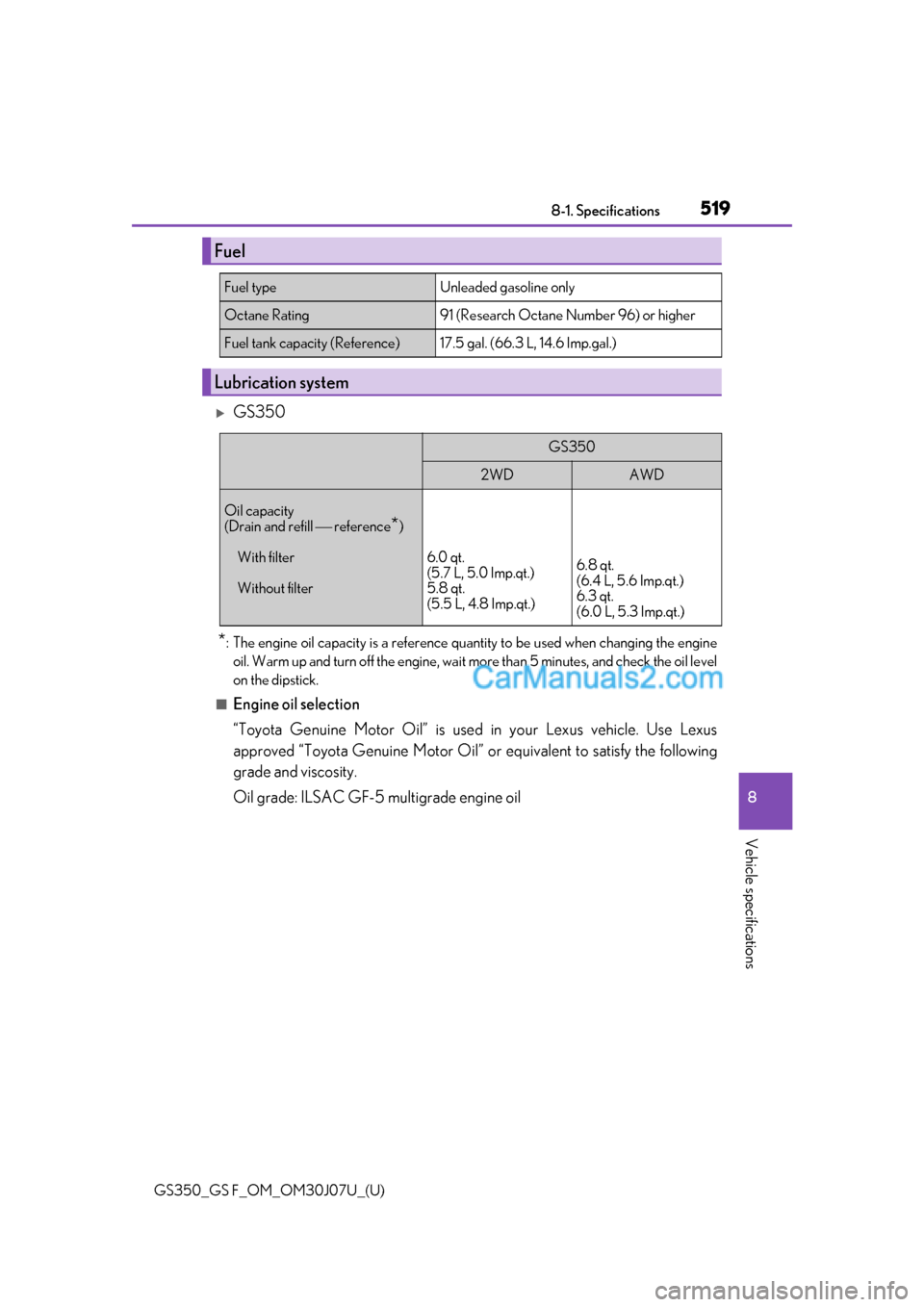
GS350
*: The engine oil capacity is a reference quantity to be used when changing the engineoil. Warm up and turn off the engine, wait more than 5 minutes, and check the oil level
on the dipstick.
■Engine oil selection
“Toyota Genuine Motor Oil” is used in your Lexus vehicle. Use Lexus
approved “Toyota Genuine Motor Oil” or equivalent to satisfy the following
grade and viscosity.
Oil grade: ILSAC GF-5 multigrade engine oil
Fuel
Fuel typeUnleaded gasoline only
Octane Rating91 (Research Octane Number 96) or higher
Fuel tank capacity (Reference)17.5 gal. (66.3 L, 14.6 Imp.gal.)
Lubrication system
GS350
2WDAWD
Oil capacity
(Drain and refill reference
*)
With filter
Without filter
6.0 qt.
(5.7 L, 5.0 Imp.qt.)
5.8 qt.
(5.5 L, 4.8 Imp.qt.)6.8 qt.
(6.4 L, 5.6 Imp.qt.)
6.3 qt.
(6.0 L, 5.3 Imp.qt.)
Page 520 of 600

520
GS350_GS F_OM_OM30J07U_(U)8-1. Specifications
Recommended viscosity: SAE 0W-20
SAE 0W-20 is the best choice for
good fuel economy and good start-
ing in cold weather.
If SAE 0W-20 is not available, SAE
5W-20 oil may be used. However, it
must be replaced with SAE 0W-20
at the next oil change.
Oil viscosity (0W-20 is explained here as an example):
• The 0W in 0W-20 indicates the characteristic of the oil which allows cold startability. Oils with a lower value be fore the W allow for easier starting of
the engine in cold weather.
• The 20 in 0W-20 indicates the viscos ity characteristic of the oil when the
oil is at high temperature. An oil with a higher viscosity (one with a higher
value) may be better suited if the vehicle is operated at high speeds, or
under extreme lo ad conditions.
How to read oil container label:
The International Lubricant Specifi-
cation Advisory Committee
(ILSAC) Certification Mark is added
to some oil containers to help you
select the oil you should use.
GS F
*: The engine oil capacity is a reference quantity to be used when changing the engine oil. Warm up and turn off the engine, wait more than 5 minutes, and check the oil level
on the dipstick.
Outside temperature
Oil capacity
(Drain and refill — reference*)
With filter
Without filter9.3 qt. (8.8 L, 7.7 Imp.qt.)
8.3 qt. (7.9 L, 7.0 Imp.qt.)
Page 537 of 600

GS350_GS F_OM_OM30J07U_(U)
5378-1. Specifications
8
Vehicle specifications
■Temperature A, B, C
The temperature grades are A (the highest), B, and C, representing the tire’s
resistance to the generation of heat and its ability to dissipate heat when
tested under controlled conditions on a specified indoor laboratory test
wheel.
Sustained high temperature can cause the ma terial of the tire to degenerate and
reduce tire life, and excessive temperature can lead to sudden tire failure.
Grade C corresponds to a level of perfor mance which all passenger car tires must
meet under the Federal Motor Vehicle Safety Standard No. 109.
Grades B and A represent higher levels of performance on the laboratory test
wheel than the minimum required by law.
Warning: The temperature grades of a tire assume that it is properly inflated and
not overloaded.
Excessive speed, underi nflation, or excessive loading, either separately or in com-
bination, can cause heat buildup and possible tire failure.
Glossary of tire terminology
Tire related termMeaning
Cold tire inflation pressure
Tire pressure when the vehicle has been parked for
three hours or more, or has not been driven more than 1
mile or 1.5 km un der that condition
Maximum inflation pres-
sureThe maximum cold inflated pr essure to which a tire may
be inflated, shown on the sidewall of the tire
Recommended inflation
pressureCold tire inflation pressure recommended by a manu-
facturer
Accessory weight
The combined weight (in exce ss of those standard items
which may be replaced) of automatic transmission,
power steering, power brakes, power windows, power
seats, radio and heater, to the extent that these items are
available as factory-installed equipment (whether
installed or not)
Curb weight
The weight of a motor vehicle with standard equipment,
including the maximum capacity of fuel, oil and coolant,
and if so equipped, air co nditioning and additional
weight optional engine
Maximum loaded vehicle
weight
The sum of:
(a) Curb weight
(b) Accessory weight
(c) Vehicle capacity weight
(d) Production options weight
Normal occupant weight150 lb. (68 kg) times the numb er of occupants specified
in the second column of Table 1
* that follows