Page 9 of 604

Introduction
61
This vehicle should not be modified.
Modification of your vehicle could
affect its performance, safety or dura-
bility and may even violate governmen-
tal safety and emissions regulations.
In addition, damage or performance
problems resulting from any modifi-
cation may not be covered under
warranty.
If you use unauthorized electronicdevices, it may cause the vehicle to
operate abnormally, wire damage,
battery discharge and fire. For your
safety, do not use unauthorized
electronic devices. As with other vehicles of this type,
failure to operate this vehicle correct-
ly may result in loss of control, an
accident or vehicle rollover.
Specific design characteristics (high-
er ground clearance, track, etc.) give
this vehicle a higher center of gravity
than other types of vehicles. In other
words they are not designed for cor-
nering at the same speeds as con-
ventional 2-wheel drive vehicles.
Avoid sharp turns or abrupt maneu-
vers. Again, failure to operate this
vehicle correctly may result in loss of
control, an accident or vehicle
rollover.
Be sure to read the
“Reducing the risk of a rollover”
driving guidelines, in section 5 of
this manual. No special break-in period is need-
ed. By following a few simple precau-
tions for the first 1,000 km (600
miles) you may add to the perform-
ance, economy and life of your vehi-
cle.
Do not race the engine.
While driving, keep your engine
speed (rpm, or revolutions per
minute) between 2,000 rpm and
4,000 rpm.
Do not maintain a single speed for long periods of time, either fast or
slow. Varying engine speed is
needed to properly break-in the
engine.
Avoid hard stops, except in emer- gencies, to allow the brakes to seat
properly.
Don't tow a trailer during the first 2,000 km (1,200 miles) of opera-
tion.
VEHICLE BREAK-IN
PROCESS
VEHICLE HANDLING
INSTRUCTIONS
VEHICLE MODIFICATIONS
Page 41 of 604
325
Safety features of your vehicle
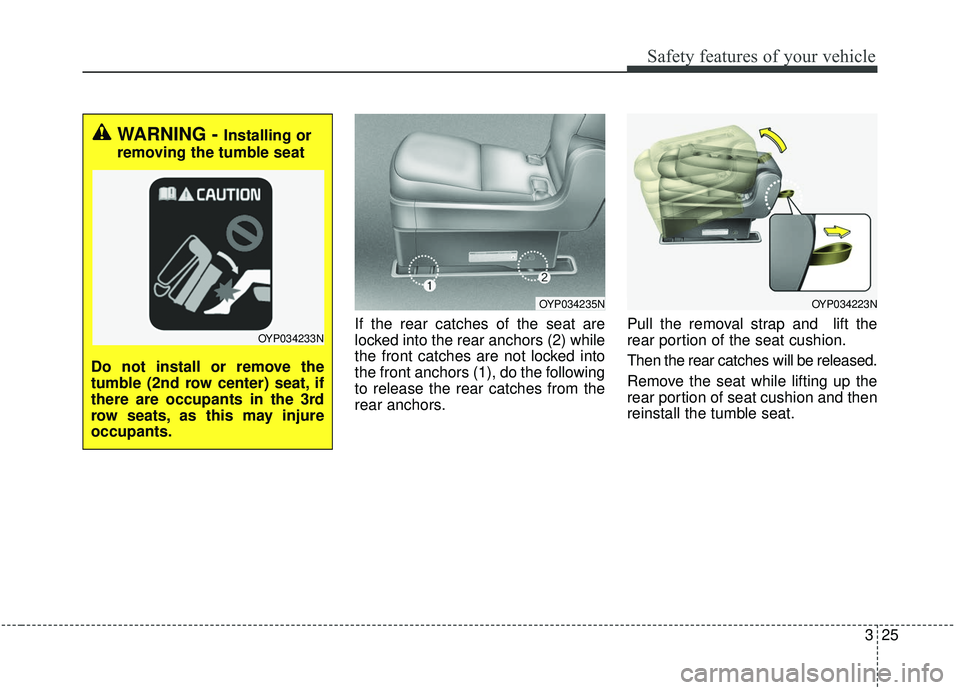
If the rear catches of the seat are
locked into the rear anchors (2) while
the front catches are not locked into
the front anchors (1), do the following
to release the rear catches from the
rear anchors.Pull the removal strap and lift the
rear portion of the seat cushion.
Then the rear catches will be released.
Remove the seat while lifting up the
rear portion of seat cushion and then
reinstall the tumble seat.
WARNING - Installing or
removing the tumble seat
Do not install or remove the
tumble (2nd row center) seat, if
there are occupants in the 3rd
row seats, as this may injure
occupants.
OYP034233N
OYP034235NOYP034223N
Page 42 of 604
Safety features of your vehicle
26
3
Stowing the rear seat
- 3rd row seat
The rear seat can be folded and
stowed in the luggage compartment
to provide additional cargo space. To stow the rear seat:
1. Lower the headrest to the lowest
position. To stow easily, adjust the
seatback to upright position. (if
necessary)
2. Pull up the seat by using the stow-ing lever.
3. Stow the seat by pushing down firmly.
OYP034240N
OYP037241
OYP034242N
Page 43 of 604
327
Safety features of your vehicle
To use the rear seat:
1. Lift the seat by pulling up the stow-ing lever.
CAUTION- To stow 3rd
row seat
Do not stow the 3rd row seatwhen the seat back is foldeddown. It may damage the 3rdseat mechanism.
OYP037304
OYP037286
WARNING
Make sure there is no body or
object around the seat and be
careful not to injure your hands
or body under the seat or in the
moving parts when stowing or
reinstalling the seat.
Page 46 of 604
Safety features of your vehicle
30
3
Armrest (2nd row seat)
The 2nd row seats have the armrest
located on the side of seatback. Type A
To use the armrest, swing down the
armrest to the lowest position.
Type B
To use the armrest, press the release
button (1) on the armrest and adjust
the angle to the desired position. And
then release the button (1).
Seatback pocket (for SXL package)
The seatback pocket is provided on
the back of the 2nd row outboard
seatbacks.
OYP034254N
OYP034300N/Q
■
Type A
■ Type B (for SXL package)
OYP034255N
Page 50 of 604
Safety features of your vehicle
34
3
Forward and backward adjustment
(2nd row seat for SXL package)
The headrest may be adjusted for-
ward or backward by pulling the
lower part of the headrest forward or
backward to the desired detent in the
direction of the arrow. Adjust the
headrest so that it properly supports
the head and neck.
Wing-out(2nd row seat for SXL package)
For rear outboard passenger's com-
fort, the ends of the headrest can be
adjusted inward.
OYP034295NOYP034296N
Page 52 of 604
Safety features of your vehicle
36
3
When you fasten the seat belt, be
careful not to latch the seat belt in
buckles of other seat. It's very dan-
gerous and you may not be pro-
tected by the seat belt properly.
Do not unfasten the seat belt and do not fasten and unfasten the seat
belt repeatedly while driving. This
could result in loss of control, and
an accident causing death, serious
injury, or property damage.
When fastening the seat belt, make sure that the seat belt does
not pass over objects that are hard
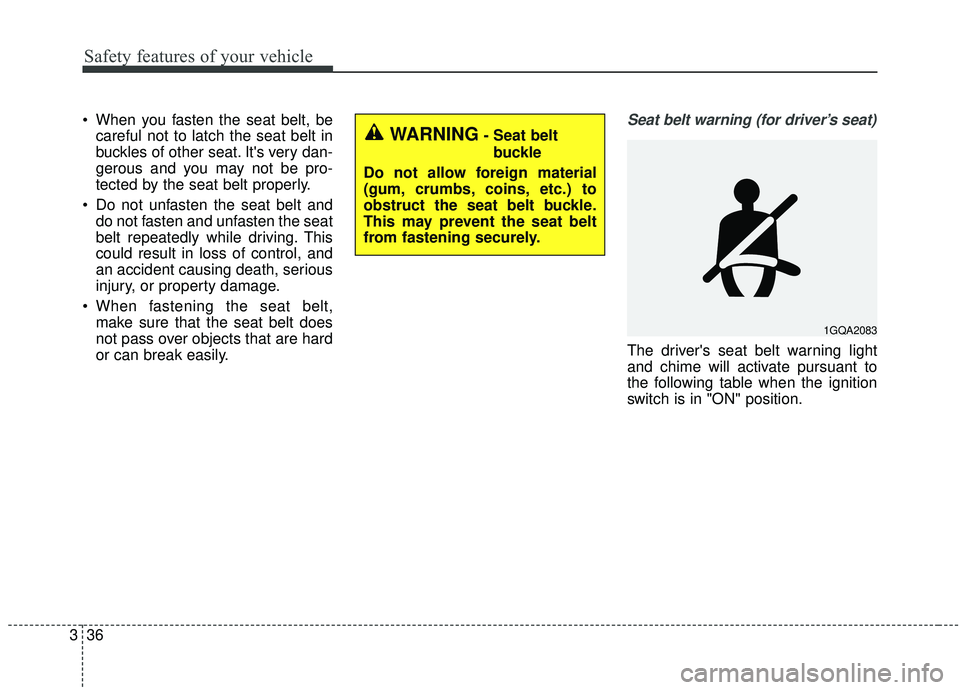
or can break easily.Seat belt warning (for driver’s seat)
The driver's seat belt warning light
and chime will activate pursuant to
the following table when the ignition
switch is in "ON" position.
1GQA2083
WARNING- Seat belt
buckle
Do not allow foreign material
(gum, crumbs, coins, etc.) to
obstruct the seat belt buckle.
This may prevent the seat belt
from fastening securely.
Page 53 of 604

337
Safety features of your vehicle
*1Warning pattern repeats 11 times with
an interval of 24 seconds. If the driver's
seat belt is buckled, the light will stop
within 6 seconds and chime will stop
immediately.
*
2The light will stop within 6 seconds and
chime will stop immediately.
Seat belt warning (for front passenger’s seat)
The front passenger's seat belt
warning light will activate to the fol-
lowing table when the ignition switch
is in "ON" position.
*1The seat belt warning light will go off if
the vehicle speed decreases below 5
km/h (3 mph). If the vehicle speed
increases above 5 km/h (3 mph), the
warning light will blink again.
ConditionsWarning Pattern
Seat BeltVehicle
SpeedLight-BlinkChime-Sound
Unbuckled6 seconds
Buckled6 secondsNone
Buckled →
Unbuckled
Below 5 km/h
(3 mph)6 secondsNone
5 km/h
(3 mph) ~ 10 km/h(6 mph)
6 seconds
Above 10 km/h (6 mph)6 sec. on / 24 sec. off (11 times)
Unbuckled
Above 10 km/h(6 mph)
↓
Below (5 km/h 3 mph)6 seconds *1
↓
Stop *2
ConditionsWarning Pattern
Seat BeltVehicle SpeedLight-Blink
Unbuckled6 seconds
UnbuckledAbove 10 km/h (6 mph)Continuously
Buckled6 seconds
Buckled →
Unbuckled
Above 10 km/h (6 mph)Continuously *1
Below 10 km/h(6 mph)None
OYP036258N
OYP034257N
■Type A
■Type B