Page 37 of 604
321
Safety features of your vehicle
To fold down the rear seatback :
1. Insert the rear seat belt buckle inthe pocket between the rear seat-
back and cushion, and insert the
rear seat belt webbing in the guide
to prevent the seat belt from being
damaged.
2. Set the front seatback to the upright position and if necessary,
slide the front seat forward.
3. Lower the rear headrests to the lowest position.
OYP034267N
OYP034212N
■2nd row center seat (for 8 passenger vehicle)
■3rd row seat
WARNING- Objects
Objects carried on the folded
down seatback should not
extend higher than the top of
the front seatbacks. This could
allow cargo to slide forward and
cause injury or damage during
sudden stops.
OYP034214N
Page 41 of 604
325
Safety features of your vehicle
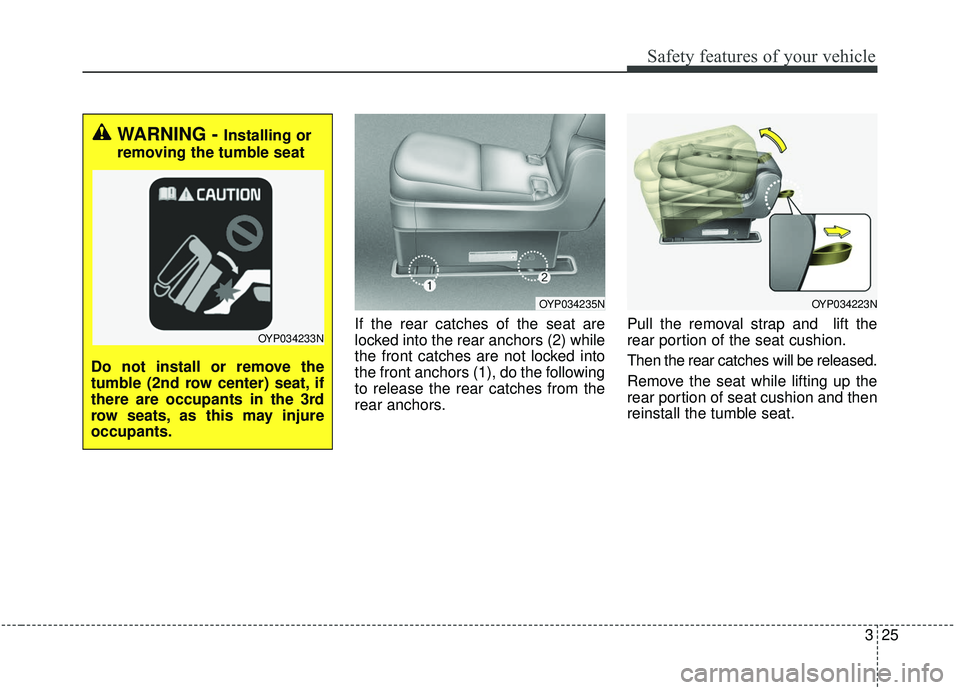
If the rear catches of the seat are
locked into the rear anchors (2) while
the front catches are not locked into
the front anchors (1), do the following
to release the rear catches from the
rear anchors.Pull the removal strap and lift the
rear portion of the seat cushion.
Then the rear catches will be released.
Remove the seat while lifting up the
rear portion of seat cushion and then
reinstall the tumble seat.
WARNING - Installing or
removing the tumble seat
Do not install or remove the
tumble (2nd row center) seat, if
there are occupants in the 3rd
row seats, as this may injure
occupants.
OYP034233N
OYP034235NOYP034223N
Page 43 of 604
327
Safety features of your vehicle
To use the rear seat:
1. Lift the seat by pulling up the stow-ing lever.
CAUTION- To stow 3rd
row seat
Do not stow the 3rd row seatwhen the seat back is foldeddown. It may damage the 3rdseat mechanism.
OYP037304
OYP037286
WARNING
Make sure there is no body or
object around the seat and be
careful not to injure your hands
or body under the seat or in the
moving parts when stowing or
reinstalling the seat.
Page 45 of 604

329
Safety features of your vehicle
WARNING- Cargo
Do not place heavy objects in
the rear seats, since they can-
not be properly secured and
may hit vehicle occupants in a
frontal collision.
OUN026140
WARNING - 3rd row seat
3rd row occupants should always
remain in the center of the seat
cushion so the occupants head
is protected by the headrest.
If not, the liftgate may hit the
occupant's head, which could
cause injury.
CAUTION
When you fold the rear (2nd and/or 3rd row) seatback, insertthe buckle in the pocketbetween the rear seatback andcushion. Doing so can preventthe buckle from being damagedby the rear seatback.
When returning the rear (2ndand/or 3rd row) seatbacks to theupright position, remember toreturn the rear shoulder belts totheir proper position. Routingthe seat belt webbing throughthe rear seat belt guides willhelp keep the belts from beingtrapped behind or under theseats. Make sure the engine isoff, the automatic transmissionis in P (Park) and the parkingbrake is securely applied when-ever loading or unloadingcargo. Failure to take thesesteps may allow the vehicle tomove if the shift lever is inad-vertently moved to anotherposition.
Page 47 of 604

331
Safety features of your vehicle
Headrest (for rear seat)
The rear seat(s) is equipped with
headrests in all the seating positions
for the occupant's safety and comfort.
The headrest not only provides com-
fort for passengers, but also helps
protect the head and neck in the
event of a collision.For maximum effectiveness in case
of an accident, the headrest should
be adjusted so the middle of the
headrest is at the same height as the
center of gravity of an occupant's
head.
Generally, the center of gravity of
most people's head is similar with
the height of the top of their eyes.
Also adjust the headrest as close to
your head as possible. For this rea-
son, the use of a cushion that holds
the body away from the seatback is
not recommended.
WARNING- Seatback
pockets
Do not put heavy or sharp
objects in the seatback pockets.
In an accident they could come
loose from the pocket and
injure vehicle occupants.
OYP034288N
* : if equipped
ODM032054
*
WARNING
Unless the driver's position is
properly set according to the
driver's physical figure, do not
fold the rear seat. It may
increase bodily injuries in a
sudden stop or collision.
Page 49 of 604

333
Safety features of your vehicle
Removal and reinstallation
To remove the headrest :
1. Raise it as far as it can go thenpress the release button (1) while
pulling the headrest up (2).
To reinstall the headrest :
1. Put the headrest poles (3) into the holes while pressing the release
button (1).
2. Adjust it to the appropriate height. After installing the headrest, make
sure that it is installed in the right
direction.
A headrest installed reversely could
increase whiplash injury during rear
impact.
2nd row outboard headrest
The headrest will fold down automat-
ically when the seat is in the walk in
potion.
Always be sure the headrest has
locked into position after you return
the seatback.
OYP034250NOYP034252N
CAUTION - Auto-folding
headrest
Do not remove the headrest in
vehicles equipped with the sec-ond row auto-folding function.The cable may become dislocat-ed or damaged when the head-rest is removed, and may lead toauto-folding function failure.
WARNING- Headrest
Removal
NEVER allow anyone to ride in a
seat with the headrest removed.
Headrests can provide critical
neck and head support in a
crash.
Page 51 of 604

335
Safety features of your vehicle
SEAT BELTS
Seat belt restraint system
Seat belts are designed to bear upon
the bony structure of the body, and
should be worn low across the front
of the pelvis, chest and shoulders, as
applicable; wearing the lap section of
the belt across the abdominal area
must be avoided.
Seat belts should be adjusted as
firmly as possible, consistent with
comfort, to provide the protection for
which they have been designed.
A slack belt will greatly reduce the
protection afforded to the wearer.Care should be taken to avoid con-
tamination of the webbing with pol-
ishes, oils and chemicals, and partic-
ularly battery acid. Cleaning may
safely be carried out using mild soap
and water. The belt should be
replaced if webbing becomes frayed,
contaminated or damaged.
For maximum restraint system pro-
tection, the seat belts must always
be used whenever the vehicle is
moving. A properly positioned
shoulder belt should be positioned
midway over your shoulder across
your collarbone.
Never allow children to ride in the front passenger seat. See child
restraint system section for further
discussion.
No modifications or additions should be made by the user which
will either prevent the seat belt
adjusting devices from operating to
remove slack, or prevent the seat
belt assembly from being adjusted
to remove slack.
WARNING- Damaged
seat belt
Replace the entire seat belt
assembly if any part of the web-
bing or hardware is damaged as
you can no longer be sure that a
damaged seat belt will provide
protection in a crash.
WARNING- Twisted seat belt
Make sure your seat belt is not
twisted when worn. A twisted
seat belt may not properly pro-
tect you in an accident and
could even cut into your body.
WARNING- Shoulder Belt
Never wear the shoulder belt under your arm or behind
your back. An improperly
positioned shoulder belt can-
not protect the occupant in a
crash.
Always wear both the shoul- der portion and lap portion of
the lap/shoulder belt.
Page 52 of 604
Safety features of your vehicle
36
3
When you fasten the seat belt, be
careful not to latch the seat belt in
buckles of other seat. It's very dan-
gerous and you may not be pro-
tected by the seat belt properly.
Do not unfasten the seat belt and do not fasten and unfasten the seat
belt repeatedly while driving. This
could result in loss of control, and
an accident causing death, serious
injury, or property damage.
When fastening the seat belt, make sure that the seat belt does
not pass over objects that are hard
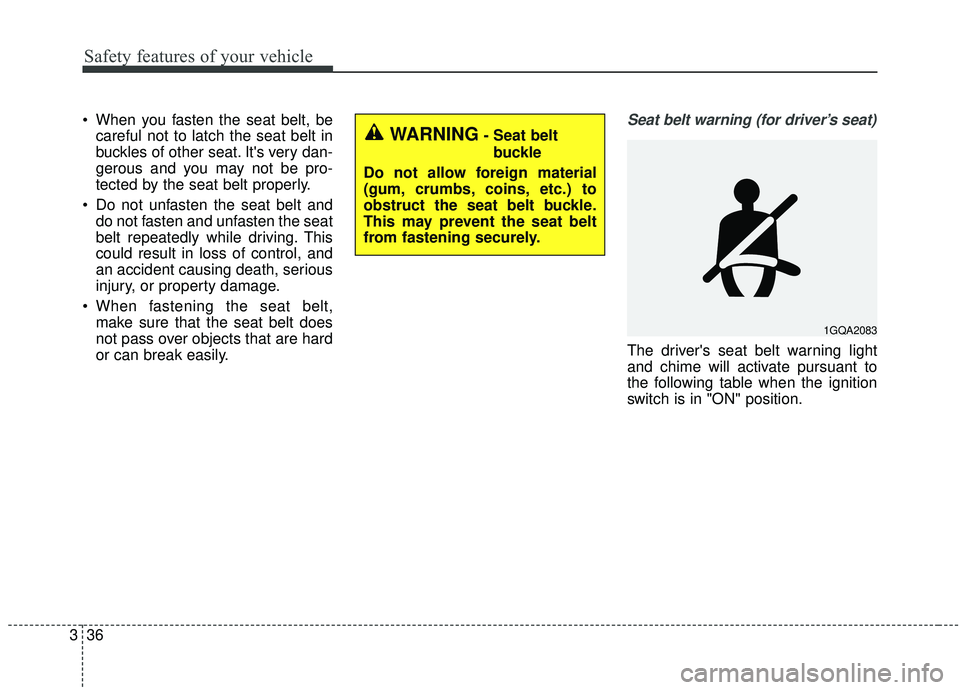
or can break easily.Seat belt warning (for driver’s seat)
The driver's seat belt warning light
and chime will activate pursuant to
the following table when the ignition
switch is in "ON" position.
1GQA2083
WARNING- Seat belt
buckle
Do not allow foreign material
(gum, crumbs, coins, etc.) to
obstruct the seat belt buckle.
This may prevent the seat belt
from fastening securely.