Page 459 of 516

Maintenance
76
8
Headlamp bulbSide marker (front) (Bulb type)
bulb replacement (Headlamp
Type A)
1. Open the hood.
2. Remove the bulb-socket from the
headlamp assembly by turning the
bulb-socket counterclockwise until
the tabs on the bulb-socket align with
the slots on the headlamp assembly.
3. Remove the bulb from the bulb-
socket by pulling it out.
OHD076046
WARNING- Halogen
bulbs
Handle halogen bulbs with care.
Halogen bulbs contain pres- surized gas that will produce
flying pieces of glass if bro-
ken.
(Continued)
(Continued)
Always handle them carefully,and avoid scratches and abra-
sions. If the bulbs are lit, avoid
contact with liquids. Never
touch the glass with bare
hands. Residual oil may cause
the bulb to overheat and burst
when lit. A bulb should be
operated only when installed
in a headlamp.
If a bulb becomes damaged or cracked, replace it immediate-
ly and carefully dispose of it.
Wear eye protection when changing a bulb. Allow the
bulb to cool down before han-
dling it.
OSC078051N
SC CAN (ENG) 8.qxp 6/7/2019 9:42 AM Page 76
Page 462 of 516
879
Maintenance
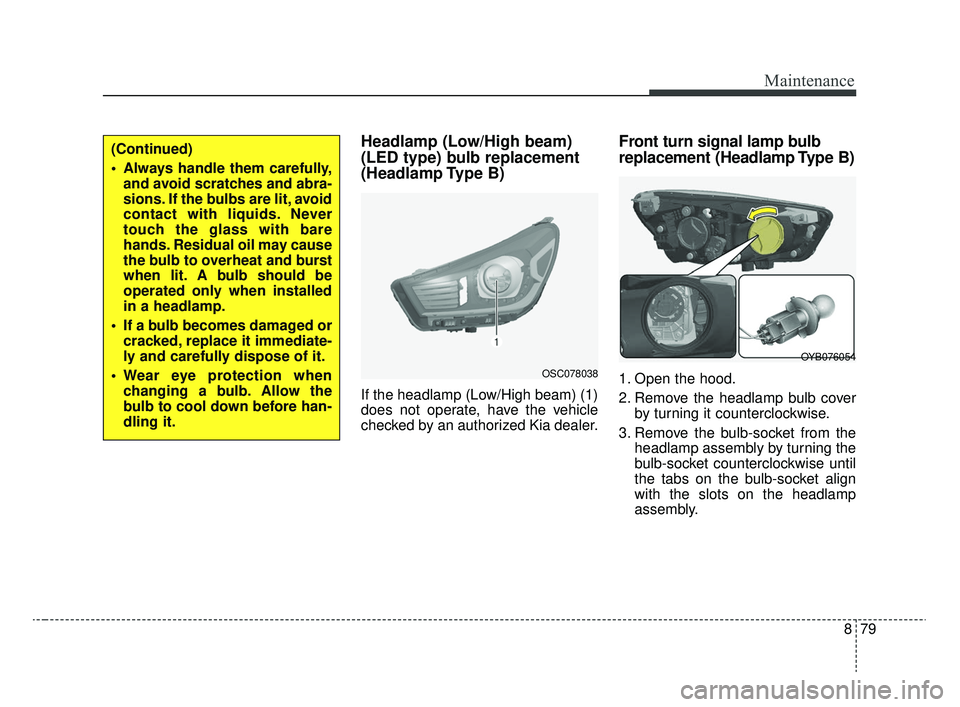
Headlamp (Low/High beam)
(LED type) bulb replacement
(Headlamp Type B)
If the headlamp (Low/High beam) (1)
does not operate, have the vehicle
checked by an authorized Kia dealer.
Front turn signal lamp bulb
replacement (Headlamp Type B)
1. Open the hood.
2. Remove the headlamp bulb coverby turning it counterclockwise.
3. Remove the bulb-socket from the headlamp assembly by turning the
bulb-socket counterclockwise until
the tabs on the bulb-socket align
with the slots on the headlamp
assembly.
(Continued)
Always handle them carefully,and avoid scratches and abra-
sions. If the bulbs are lit, avoid
contact with liquids. Never
touch the glass with bare
hands. Residual oil may cause
the bulb to overheat and burst
when lit. A bulb should be
operated only when installed
in a headlamp.
If a bulb becomes damaged or cracked, replace it immediate-
ly and carefully dispose of it.
Wear eye protection when changing a bulb. Allow the
bulb to cool down before han-
dling it.
OSC078038
OYB076054
SC CAN (ENG) 8.qxp 6/7/2019 9:43 AM Page 79
Page 483 of 516

Maintenance
100
8
High-pressure washing
When using high-pressure wash-
ers, make sure to maintain suffi-
cient distance from the vehicle.
Insufficient clearance or excessive
pressure can lead to component
damage or water penetration.
Do not spray the camera, sensors or its surrounding area directly with
a high pressure washer. Shock
applied from high pressure water
may cause the device to not oper-
ate normally.
Do not bring the nozzle tip close to boots (rubber or plastic covers) or
connectors as they may be dam-
aged if they come into contact with
high pressure water. Waxing
Wax the vehicle when water will no
longer bead on the paint.
Always wash and dry the vehicle
before waxing. Use a good quality
liquid or paste wax, and follow the
manufacturer’s instructions. Wax all
metal trim to protect it and to main-
tain its luster.
Removing oil, tar, and similar materi-
als with a spot remover will usually
strip the wax from the finish. Be sure
to re-wax these areas even if the rest
of the vehicle does not yet need wax-
ing.
Do not apply wax on an embossed
unpainted unit, as it may tarnish the
unit.
OJB037800
CAUTION - Wet engine
Washing the engine compart-
ment with water, includinghigh pressure water, maycause the failure of electricalcircuits located in the enginecompartment.
Never allow water or other liq- uids to come in contact withelectrical/electronic compo-nents inside the vehicle asthis may damage them.
SC CAN (ENG) 8.qxp 6/7/2019 9:44 AM Page 100
Page 488 of 516
8105
Maintenance
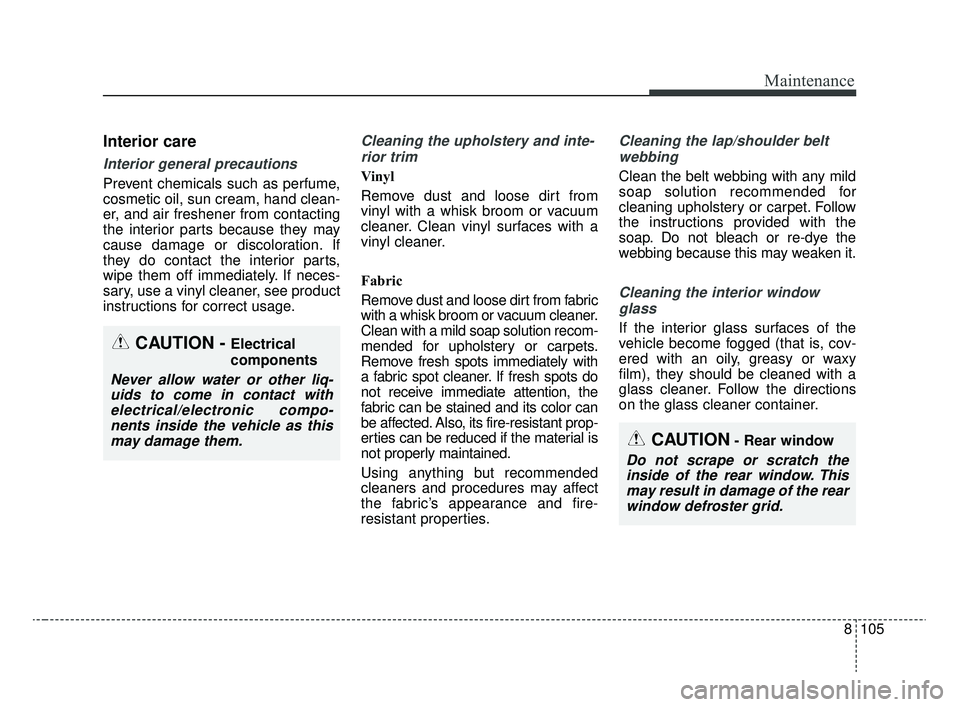
Interior care
Interior general precautions
Prevent chemicals such as perfume,
cosmetic oil, sun cream, hand clean-
er, and air freshener from contacting
the interior parts because they may
cause damage or discoloration. If
they do contact the interior parts,
wipe them off immediately. If neces-
sary, use a vinyl cleaner, see product
instructions for correct usage.
Cleaning the upholstery and inte-rior trim
Vinyl
Remove dust and loose dirt from
vinyl with a whisk broom or vacuum
cleaner. Clean vinyl surfaces with a
vinyl cleaner.
Fabric
Remove dust and loose dirt from fabric
with a whisk broom or vacuum cleaner.
Clean with a mild soap solution recom-
mended for upholstery or carpets.
Remove fresh spots immediately with
a fabric spot cleaner. If fresh spots do
not receive immediate attention, the
fabric can be stained and its color can
be affected. Also, its fire-resistant prop-
erties can be reduced if the material is
not properly maintained.
Using anything but recommended
cleaners and procedures may affect
the fabric’s appearance and fire-
resistant properties.
Cleaning the lap/shoulder beltwebbing
Clean the belt webbing with any mild
soap solution recommended for
cleaning upholstery or carpet. Follow
the instructions provided with the
soap. Do not bleach or re-dye the
webbing because this may weaken it.
Cleaning the interior windowglass
If the interior glass surfaces of the
vehicle become fogged (that is, cov-
ered with an oily, greasy or waxy
film), they should be cleaned with a
glass cleaner. Follow the directions
on the glass cleaner container.
CAUTION- Rear window
Do not scrape or scratch theinside of the rear window. Thismay result in damage of the rearwindow defroster grid.
CAUTION - Electrical
components
Never allow water or other liq-uids to come in contact withelectrical/electronic compo-nents inside the vehicle as thismay damage them.
SC CAN (ENG) 8.qxp 6/7/2019 9:44 AM Page 105
Page 489 of 516

Maintenance
106
8
Taking care of leather seats
(if equipped)
Vacuum the seat periodically to remove dust and sand on the seat.
It will prevent abrasion or damage of
the leather and maintain its quality.
Wipe the natural leather seat cover often with dry or soft cloth.
Sufficient use of a leather protec- tive may prevent abrasion of the
cover and helps maintain the color.
Be sure to read the instructions
and consult a specialist when
using leather coating or protective
agents.
Leather with bright colors(beige, cream beige) is easily contaminat-
ed and clear in appearance. Clean
the seats frequently.
Avoid wiping with wet cloth. It may cause the surface to crack.
Cleaning the leather seats
(if equipped)
Remove all contaminations instant- ly. Refer to instructions below for
removal of each contaminant.
Cosmetic products(sunscreen, foundation, etc.)
- Apply cleansing cream on a clothand wipe the contaminated point.
Wipe off the cream with a wet cloth
and remove water with a dry cloth.
Beverages(coffee, soft drink, etc.) - Apply a small amount of neutraldetergent and wipe until contami-
nations do not smear.
Oil - Remove oil instantly withabsorbable cloth and wipe with
stain remover for natural leather
only.
Chewing gum - Harden the gum with ice andremove gradually.
CAUTION - Leather
When cleaning leather products(steering wheel, seats etc.), useneutral detergents or low alco-hol content solutions. If you usehigh alcohol content solutionsor acid/alkaline detergents, thecolor of the leather may fade orthe surface may get stripped off.
SC CAN (ENG) 8.qxp 6/7/2019 9:44 AM Page 106
Page 490 of 516
8107
Maintenance
Fabric seat cover using precau-tions (If equipped)
Please clean the fabric seats regu-
larly with a vacuum cleaner in con-
sideration of fabric material charac-
teristics. If they are heavily soiled
with beverage stains, etc., use a suit-
able interior cleaner. To prevent dam-
age to seat covers, wipe off the seat
covers down to the seams with a
large wiping motion and moderate
pressure using a soft sponge or
microfiber cloth.
Velcro closures on clothing or sharp
objects may cause snagging or
scratches on the surface of the seats.
Make sure not to rub such objects
against the surface.
SC CAN (ENG) 8.qxp 6/7/2019 9:44 AM Page 107
Page 501 of 516

97
Specifications & Consumer information
RECOMMENDED LUBRICANTS AND CAPACITIES
To help achieve proper engine and powertrain performance and durability, use only lubricants of the proper quality.
The correct lubricants also help promote engine efficiency that results in improved fuel economy.
These lubricants and fluids are recommended for use in your vehicle.
LubricantVolumeClassification
Engine oil *1 *2 (drain and refill)
Recommends
Gamma II 1.6L MPI3.8 l(4.0 US qt.)API Latest (ILSAC Latest) or ACEA C5
Manual transmission fluidGamma II 1.6L MPI1.5 ~ 1.6 l
(1.4 ~ 1.5 US qt.)
API Service GL-4 SAE 70W - HK SYN MTF 70W
- SPIRAX S6 GHME 70W MTF - GS MTF HD 70W
Intelligent variable transmission
fluidGamma II 1.6L MPI6.5 l (6.87 US qt.)SP-CVT1 *3
Coolant Gamma II 1.6L
MPIM/T5.5 l (5.81 US qt.)Mixture of antifreeze and water
(Ethylene-glycol with phosphate
based coolant for cooling device)
IVT5.5 l (5.81 US qt.)
M/T : Manual transmission
IVT : Intelligent variable transmission
SC CAN (ENG) 9.qxp 12/12/2019 5:07 PM Page 7
Page 502 of 516
Specifications & Consumer information
89
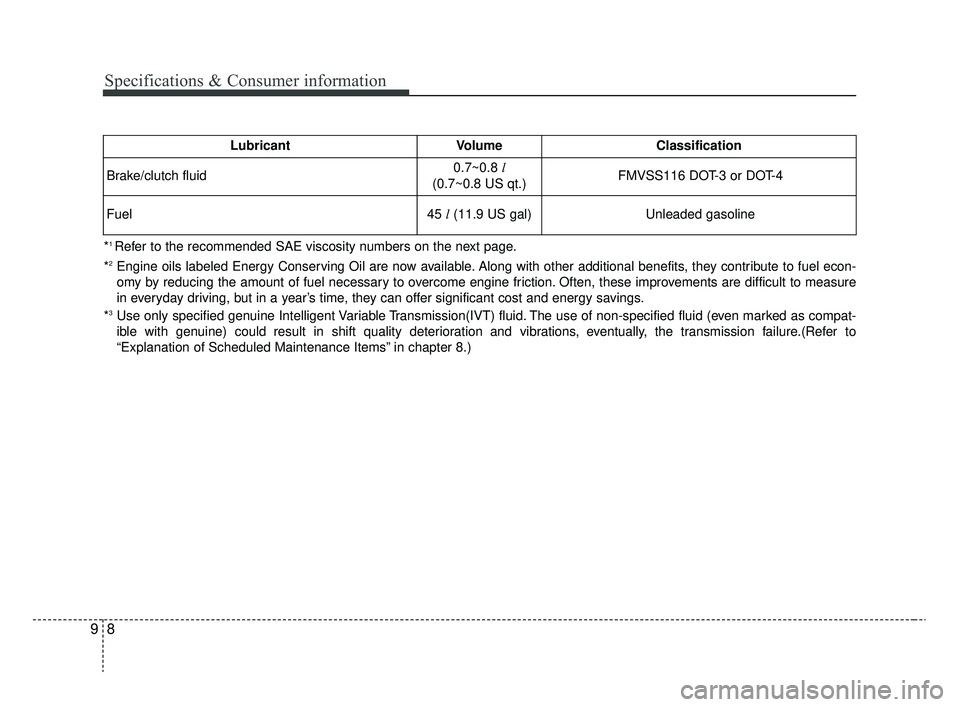
*1 Refer to the recommended SAE viscosity numbers on the next page.
*
2Engine oils labeled Energy Conserving Oil are now available. Along with other additional benefits, they contribute to fuel econ-
omy by reducing the amount of fuel necessary to overcome engine friction. Often, these improvements are difficult to measure
in everyday driving, but in a year’s time, they can offer significant cost and energy savings.
*
3Use only specified genuine Intelligent Variable Transmission(IVT) fluid. The use of non-specified fluid (even marked as compat-
ible with genuine) could result in shift quality deterioration and vibrations, eventually, the transmission failure.(Refer to
“Explanation of Scheduled Maintenance Items” in chapter 8.)
LubricantVolumeClassification
Brake/clutch fluid0.7~0.8 l
(0.7~0.8 US qt.)FMVSS116 DOT-3 or DOT-4
Fuel45 l(11.9 US gal)Unleaded gasoline
SC CAN (ENG) 9.qxp 12/12/2019 5:07 PM Page 8