2020 KIA OPTIMA ECU
[x] Cancel search: ECUPage 95 of 589

331
Safety features of your vehicle
Larger children
Children who are too large for child
restraint systems should always
occupy the rear seat and use the
available lap/shoulder belts. The lap
portion should be fastened and
snugged on the hips as low as possi-
ble. Check periodically to insure that
the belt fits. A child's squirming could
put the belt out of position. Children
are given the most safety in the event
of an accident when they are
restrained by a proper restraint sys-
tem in the rear seat. If a larger child
(over age 13) must be seated in the
front seat, the child should be
securely restrained by the available
lap/shoulder belt and the seat should
be placed in the rearmost position.
Children age 13 and under should be
restrained securely in the rear seat.
NEVER place a child age 13 and
under in the front seat. NEVER place
a rear facing child seat in the front
seat of a vehicle.If the shoulder belt portion slightly
touches the child’s neck or face, try
placing the child closer to the center of
the vehicle. If the shoulder belt still
touches their face or neck they need to
be returned to a child restraint system.
Restraint of pregnant women
Pregnant women should wear
lap/shoulder belt assemblies when-
ever possible according to specific
recommendations by their doctors.
The lap portion of the belt should be
worn AS SECURELY AND LOW AS
POSSIBLE.
WARNING- Small children
Do not allow small children to
ride in the vehicle without an
appropriate child restraint sys-
tem. If the shoulder belt comes
in contact with your child's neck
or face your child is too small to
ride in the vehicle. In a crash the
seat belt will inflict injury to your
child's neck, throat and face.
WARNING - Pregnant women
Pregnant women must never
place the lap portion of the seat
belt above or on the abdomen
where the fetus is located. The
force of the seat belt during a
collision will crush the fetus.
Page 97 of 589

333
Safety features of your vehicle
CHILD RESTRAINT SYSTEM (CRS)
Children Always in the RearChildren under age 13 must always
ride in the rear seats and must always
be properly restrained to minimize the
risk of injury in an accident, sudden
stop or sudden maneuver. According
to accident statistics, children are
safer when properly restrained in the
rear seats than in the front seat. Even
with air bags, children can be serious-
ly injured or killed. Children too large
for a child restraint must use the seat
belts provided.
Most countries have child restraint
laws which require children to travel
in approved child restraint devices.
The laws governing the age or
height/weight restrictions at which
seat belts can be used instead of
child restraints differs among coun-
tries, so you should be aware of the
specific requirements in your coun-
try, and where you are travelling.Child restraint systems must be
properly placed and installed in the
rear seat. You must use a commer-
cially available child restraint system
that meets the requirements of the
Safety Standards of your country.
Child restraint systems are generally
designed to be secured in a vehicle
seat by lap belt portion of a
lap/shoulder belt, or by a LATCH sys-
tem in the rear seats of the vehicle.
WARNING - Restraint
Location
Never install a child or infant
seat on the front passenger's
seat. A child riding in the front
passenger seat can be forceful-
ly struck by an inflating airbag
and seriously injured.
WARNING - Hot Child
Restraint
A child restraint system can
become very hot if it is left in a
closed vehicle on a sunny day.
Be sure to check the seat cover,
buckles and latches before
placing a child in the restraint
system.
Page 98 of 589
Safety features of your vehicle
34
3
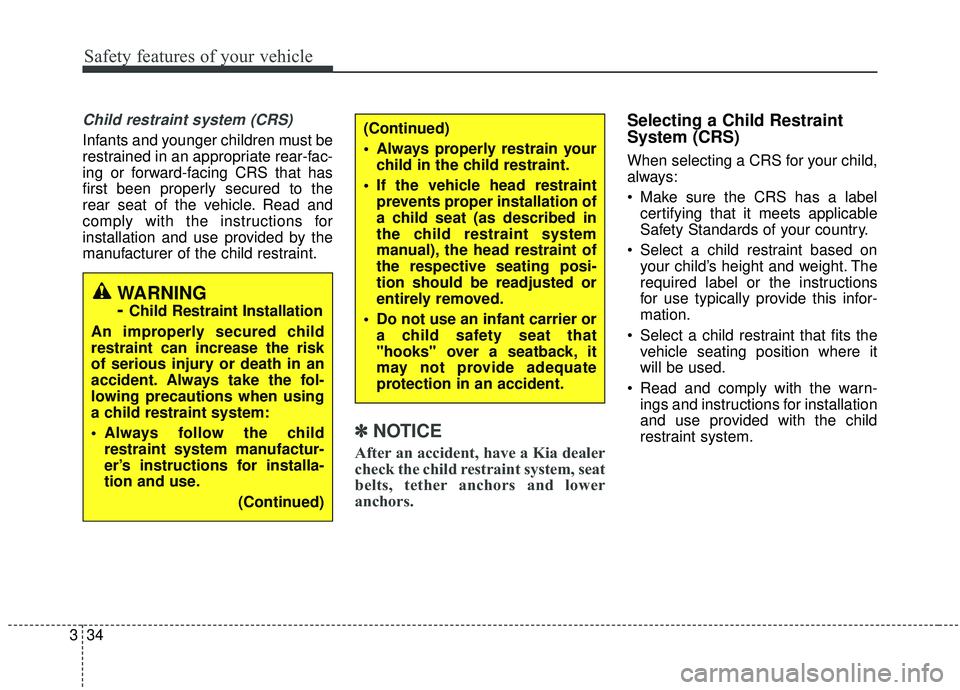
Child restraint system (CRS)
Infants and younger children must be
restrained in an appropriate rear-fac-
ing or forward-facing CRS that has
first been properly secured to the
rear seat of the vehicle. Read and
comply with the instructions for
installation and use provided by the
manufacturer of the child restraint.
✽ ✽
NOTICE
After an accident, have a Kia dealer
check the child restraint system, seat
belts, tether anchors and lower
anchors.
Selecting a Child Restraint
System (CRS)
When selecting a CRS for your child,
always:
Make sure the CRS has a label
certifying that it meets applicable
Safety Standards of your country.
Select a child restraint based on your child’s height and weight. The
required label or the instructions
for use typically provide this infor-
mation.
Select a child restraint that fits the vehicle seating position where it
will be used.
Read and comply with the warn- ings and instructions for installation
and use provided with the child
restraint system.
WARNING
-
Child Restraint Installation
An improperly secured child
restraint can increase the risk
of serious injury or death in an
accident. Always take the fol-
lowing precautions when using
a child restraint system:
Always follow the child restraint system manufactur-
er’s instructions for installa-
tion and use.
(Continued)
(Continued)
Always properly restrain yourchild in the child restraint.
If the vehicle head restraint prevents proper installation of
a child seat (as described in
the child restraint system
manual), the head restraint of
the respective seating posi-
tion should be readjusted or
entirely removed.
Do not use an infant carrier or a child safety seat that
"hooks" over a seatback, it
may not provide adequate
protection in an accident.
Page 101 of 589

337
Safety features of your vehicle
Installing a Child Restraint
System (CRS)
After selecting a proper child seat for
your child, check to make sure it fits
properly in your vehicle. Follow the
instructions provided by the manu-
facturer when installing the child
seat. Note these general steps when
installing the seat to your vehicle:
Properly secure the child
restraint to the vehicle. All child
restraints must be secured to the
vehicle with the lap part of a
lap/shoulder belt or with the
LATCH system.
Make sure the child restraint is
firmly secured. After installing a
child restraint to the vehicle, push
and pull the seat forward and from
side-to-side to verify that it is
securely attached to the seat. A
child restraint secured with a seat
belt should be installed as firmly as
possible. However, some side-to-
side movement can be expected.
Secure the child in the child
restraint. Make sure the child is
properly strapped in the child
restraint according to the manufac-
turer instructions.
Lower Anchors and Tether for
Children (LATCH) System
The LATCH system holds a child
restraint during driving and in an
accident. This system is designed to
make installation of the child restraint
easier and reduce the possibility of
improperly installing your child
restraint. The LATCH system uses
anchors in the vehicle and attach-
ments on the child restraint. The
LATCH system eliminates the need
to use seat belts to secure the child
restraint to the rear seats.
Lower anchors are metal bars built
into the vehicle. There are two lower
anchors for each LATCH seating
position that will accommodate a
child restraint with lower attach-
ments.
To use the LATCH system in your
vehicle, you must have a child
restraint with LATCH attachments.
The child seat manufacturer will pro-
vide you with instructions on how to
use the child seat with its attach-
ments for the LATCH lower anchors.
Page 103 of 589
339
Safety features of your vehicle
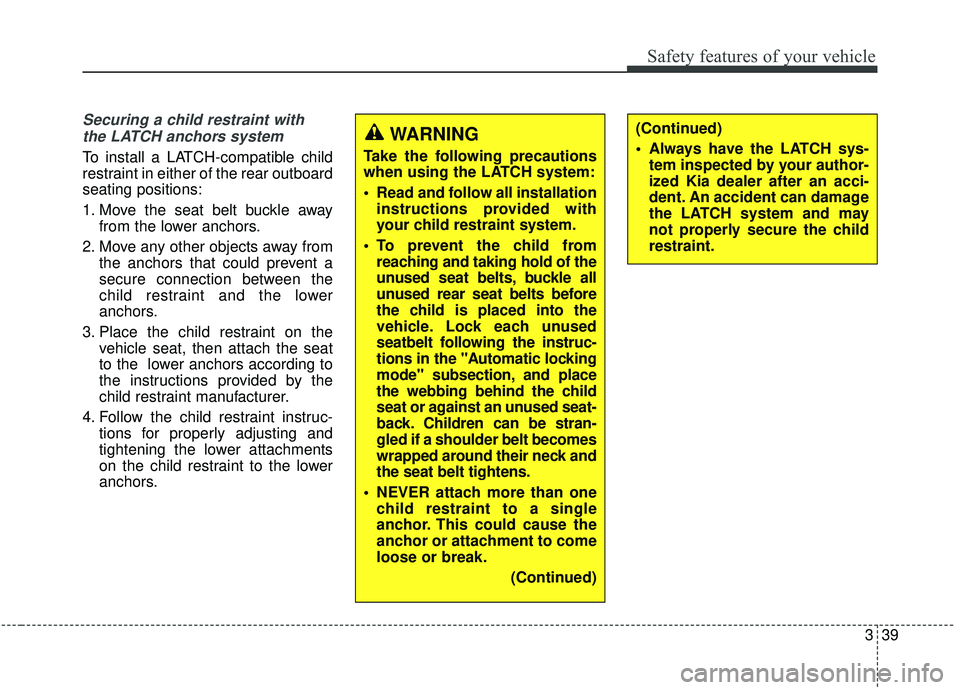
Securing a child restraint withthe LATCH anchors system
To install a LATCH-compatible child
restraint in either of the rear outboard
seating positions:
1. Move the seat belt buckle away from the lower anchors.
2. Move any other objects away from the anchors that could prevent a
secure connection between the
child restraint and the lower
anchors.
3. Place the child restraint on the vehicle seat, then attach the seat
to the lower anchors according to
the instructions provided by the
child restraint manufacturer.
4. Follow the child restraint instruc- tions for properly adjusting and
tightening the lower attachments
on the child restraint to the lower
anchors.
WARNING
Take the following precautions
when using the LATCH system:
Read and follow all installationinstructions provided with
your child restraint system.
To prevent the child from reaching and taking hold of the
unused seat belts, buckle all
unused rear seat belts before
the child is placed into the
vehicle. Lock each unused
seatbelt following the instruc-
tions in the "Automatic locking
mode" subsection, and place
the webbing behind the child
seat or against an unused seat-
back. Children can be stran-
gled if a shoulder belt becomes
wrapped around their neck and
the seat belt tightens.
NEVER attach more than one child restraint to a single
anchor. This could cause the
anchor or attachment to come
loose or break.
(Continued)
(Continued)
Always have the LATCH sys-tem inspected by your author-
ized Kia dealer after an acci-
dent. An accident can damage
the LATCH system and may
not properly secure the child
restraint.
Page 104 of 589

Safety features of your vehicle
40
3
Securing a child restraint seat
with "Tether Anchor" system
First secure the child restraint with
the LATCH lower anchors or the seat
belt. If the child restraint manufactur-
er recommends that the top tether
strap be attached, attach and tighten
the top tether strap to the top tether
strap anchor.
Child restraint hook holders are
located on the shelf behind the rear
seats. To install the tether anchor:
1. Route the child restraint tether
strap over the child restraint seat-
back. Route the tether strap under
the head restraint and between
the head restraint posts, or route
the tether strap over the top of the
vehicle seatback. Make sure the
strap is not twisted.
2. Connect the tether strap hook to the tether anchor, then tighten the
tether strap according to the child
seat manufacturer’s instructions to
firmly secure the child restraint to
the seat.
WARNING
Take the following precautions
when installing the tether strap:
Read and follow all installationinstructions provided with
your child restraint system.
NEVER attach more than one child restraint to a single teth-
er anchor. This could cause
the anchor or attachment to
come loose or break.
Do not attach the tether strap to anything other than the cor-
rect tether anchor. It may not
work properly if attached to
something else.
Do not use the tether anchors for adult seat belts or harness-
es, or for attaching other items
or equipment to the vehicle.
Always fasten the seat belts behind the child restraint seat
when they are not used to
secure the child seat. Failure
to do so may result in child
strangulation.
OJFA035095
OJF035034
Page 105 of 589

341
Safety features of your vehicle
3. Check that the child restraint issecurely attached to the seat by
pushing and pulling the seat for-
ward and from side-to-side.
Securing a child restraint with a
lap belt or lap/shoulder belt
When not using the LATCH system,
all child restraints must be secured to
a vehicle rear seat with the lap part
of a lap/shoulder belt.
Automatic locking mode
Since all passenger seat belts move
freely under normal conditions and
only lock under extreme or emer-
gency conditions (emergency locking
mode), you must manually pull the
seat belt all the way out to shift the
retractor to the “Automatic Locking”
mode to secure a child restraint.
The “Automatic Locking” mode will
help prevent the normal movement
of the child in the vehicle from caus-
ing the seat belt to loosen and com-
promise the child restraint system. To
secure a child restraint system, use
the following procedure.To install a child restraint system on
the rear seats, do the following:
1.Place the child restraint system on
a rear seat and route the lap/ shoul-
der belt around or through the child
restraint, following the restraint
manufacturer’s instructions.
Be sure the seat belt webbing is
not twisted.
OLMB033044
Page 148 of 589

413
Features of your vehicle
DOOR LOCKS
Operating door locks from
outside the vehicle
To remove the cover
1. Pull out the door handle.
2. Press the lever (1) located insidethe bottom part of the cover with a
key or flat-head screwdriver.
3. Push out the cover while pressing the lever.
Turn the key clockwise to lock and counterclockwise to unlock.
If you lock the driver’s door with a key, all vehicle doors will lock auto-
matically. From the driver’s door, turn the key
to the right once to unlock the door
and once more within 4 seconds to
unlock all doors.
Doors can also be locked and unlocked with the transmitter.
Once the doors are unlocked, they may be opened by pulling the door
handle.
When closing the door, push the door by hand. Make sure the doors
are closed securely.
✽ ✽ NOTICE
• In cold and wet climates, door lock
and door mechanisms may not
work properly due to freezing con-
ditions.
• If the door is locked/unlocked multiple times in rapid succession
with either the vehicle key or door
lock switch, the system may stop
operating temporarily in order to
protect the circuit and prevent
damage to system components.
OQLE045066WARNING
• If you don’t close the door
securely, the door may open
again.
Be careful that someone’s body or hands are not trapped
when closing the door.