2020 JEEP GRAND CHEROKEE spark
[x] Cancel search: sparkPage 228 of 378

WARNING!
Do not attempt jump starting if the battery
is frozen. It could rupture or explode and
cause personal injury.
CAUTION!
Do not use a portable battery booster pack
or any other booster source with a system
voltage greater than 12 Volts or damage to
the battery, starter motor, alternator or
electrical system may occur.
NOTE:
When using a portable battery booster pack,
follow the manufacturer's operating instruc-
tions and precautions.
Preparations For Jump Start
The battery in your vehicle is located under
the passenger's front seat. There are remote
terminals located under the hood to assist in
jump starting.WARNING!
• Take care to avoid the radiator cooling
fan whenever the hood is raised. It can
start anytime the ignition switch is ON.
You can be injured by moving fan
blades.
WARNING!
• Remove any metal jewelry such as rings,
watch bands and bracelets that could
make an inadvertent electrical contact.
You could be seriously injured.
• Batteries contain sulfuric acid that can
burn your skin or eyes and generate
hydrogen gas which is flammable and
explosive. Keep open flames or sparks
away from the battery.
NOTE:
Be sure that the disconnected cable ends do
not touch each other, or either vehicle, until
properly connected for jump starting.
1. Apply the parking brake, shift the auto-
matic transmission into PARK and turn
the ignition OFF.
2. Turn off the heater, radio, and all unnec-
essary electrical accessories.
3. Remove the protective cover over the re-
mote positive(+)battery post. Pull up-
ward on the cover to remove it.
Jump Starting Locations
(+) — Remote Positive Post
(-) — Remote Negative Post
IN CASE OF EMERGENCY
226
Page 229 of 378

4. If using another vehicle to jump start the
battery, park the vehicle within the jumper
cables reach, apply the parking brake and
make sure the ignition is OFF.
WARNING!
Do not allow vehicles to touch each other
as this could establish a ground connec-
tion and personal injury could result.
Jump Starting Procedure
WARNING!
Failure to follow this jump starting proce-
dure could result in personal injury or
property damage due to battery explosion.
CAUTION!
Failure to follow these procedures could
result in damage to the charging system of
the booster vehicle or the discharged ve-
hicle.NOTE:
Make sure at all times that unused ends of
jumper cables are not contacting each other
or either vehicle while making connections.
Connecting The Jumper Cables
1. Connect the positive(+)end of the jumper
cable to the remote positive(+)post of the
discharged vehicle.
2. Connect the opposite end of the positive
(+)jumper cable to the positive(+)post of
the booster battery.
3. Connect the negative end(-)of the jumper
cable to the negative(-)post of the
booster battery.
4. Connect the opposite end of the negative
(-)jumper cable to the remote negative(-)
post of the vehicle with the discharged
battery.WARNING!
Do not connect the jumper cable to the
negative (-) post of the discharged battery.
The resulting electrical spark could cause
the battery to explode and could result in
WARNING!
personal injury. Only use the specific
ground point, do not use any other exposed
metal parts.
5. Start the engine in the vehicle that has the
booster battery, let the engine idle a few
minutes, and then start the engine in the
vehicle with the discharged battery.
CAUTION!
Do not run the booster vehicle engine
above 2,000 rpm since it provides no
charging benefit, wastes fuel, and can
damage booster vehicle engine.
6. Once the engine is started, remove the
jumper cables in the reverse sequence:
Disconnecting The Jumper Cables
1. Disconnect the negative(-)end of the
jumper cable from the remote negative(-)
post of the discharged vehicle.
2. Disconnect the opposite end of the nega-
tive(-)jumper cable from the negative(-)
post of the booster battery.
227
Page 241 of 378

Mileage or time passed (whichever comes first)7,500
15,000
22,500
30,000
37,500
45,000
52,500
60,000
67,500
75,000
82,500
90,000
97,500
105,000
112,500
120,000
127,500
135,000
142,500
150,000
Or Months: 12 24 36 48 60 72 84 96 108 120 132 144 156 168 180 192 204 216 228 240
Kilometers or time passed (whichever comes
first):
12,000
24,000
36,000
48,000
60,000
72,000
84,000
96,000
108,000
120,000
132,000
144,000
156,000
168,000
180,000
192,000
204,000
216,000
228,000
240,000
Adjust parking brake on vehicles equipped
with four-wheel disc brakes.XXXXX
Replace engine air cleaner filter.XXXXX
Replace spark plugs *XX
Replace accessory drive belt(s).X
Flush and replace the engine coolant at
120 months or 240,000 km whichever
comes first.XX
Inspect or change the transfer case fluid if
using your vehicle for any of the following:
police, taxi, fleet, or frequent trailer towing.XXX
Change Transfer Case Fluid. X X
Inspect and replace PCV valve if neces-
sary.***X
* The spark plug change interval is mileage
based only, yearly intervals do not apply.
** DOT 4 brake fluid is time based only;
mileage intervals do not apply.*** This maintenance is recommended by
the manufacturer to the owner, but is not
required to maintain emissions warranty.WARNING!
• You can be badly injured working on or
around a motor vehicle. Do only service
work for which you have the knowledge
and the right equipment. If you have any
239
Page 245 of 378

Miles:6,000
12,000
18,000
24,000
30,000
36,000
42,000
48,000
54,000
60,000
66,000
72,000
78,000
84,000
90,000
96,000
102,000
108,000
114,000
120,000
126,000
132,000
138,000
144,000
150,000
Or Months: 6 12 18 24 30 36 42 48 54 60 66 72 78 84 90 96 102 108 114 120 126 132 138 144 150
Or Kilometers:
10,000
20,000
30,000
40,000
50,000
60,000
70,000
80,000
90,000
100,000
110,000
120,000
130,000
140,000
150,000
160,000
170,000
180,000
190,000
200,000
210,000
220,000
230,000
240,000
250,000
Change brake fluid every 24 months if using
DOT 4 brake fluid. (*)XX XXXX
Inspect the front and rear axle fluid. Change
if using your vehicle for any of the following:
police, taxi, fleet, sustained high speed driv-
ing, off-road or frequent trailer towing .XX XXXX
Inspect front suspension, tie rod ends, and
boot seals, for cracks or leaks and all parts
for damage, wear, improper looseness or end
play; replace if necessary.XXXX XXXXXXXX
Replace the engine air cleaner filter. X X X X X
Replace the air conditioning filter. X X X X X X
Inspect and replace the PCV Valve if neces-
sary. (***)X
Replace the spark plugs 6.4L Engine. (**) X X
Replace the spark plugs 6.2L Engine. (**) X X X X
Flush and replace the engine coolant at
120 months if not done at 150,000 miles
(240,000 km).XX
(*) The brake fluid change interval is time based
only, Mileage intervals do not apply.(**) The spark plug change interval is mileage
based only, Monthly intervals do not apply.(***) This maintenance is recommended by the
manufacturer to the owner, but is not required to
maintain emissions warranty.
243
Page 258 of 378

WARNING!
boiling point. This may cause it to boil
unexpectedly during hard or prolonged
braking, resulting in sudden brake fail-
ure. This could result in a collision.
• Overfilling the brake fluid reservoir can
result in spilling brake fluid on hot en-
gine parts, causing the brake fluid to
catch fire. Brake fluid can also damage
painted and vinyl surfaces, care should
be taken to avoid its contact with these
surfaces.
• Do not allow petroleum based fluid to
contaminate the brake fluid. Brake seal
components could be damaged, causing
partial or complete brake failure. This
could result in a collision.
Automatic Transmission
Fluid Level Check
The fluid level is preset at the factory and
does not require adjustment under normal
operating conditions. Routine fluid level
checks are not required; therefore the trans-
mission has no dipstick. An authorized dealercan check your transmission fluid level using
special service tools. If you notice fluid leak-
age or transmission malfunction, visit an au-
thorized dealer immediately to have the
transmission fluid level checked. Operating
the vehicle with an improper fluid level can
cause severe transmission damage.
CAUTION!
If a transmission fluid leak occurs, visit an
authorized dealer immediately. Severe
transmission damage may occur. An au-
thorized dealer has the proper tools to
adjust the fluid level accurately.
Maintenance-Free Battery
Your vehicle is equipped with a maintenance-
free battery. You will never have to add water,
nor is periodic maintenance required.
WARNING!
• Using the battery with low fluid will
irreparably damage the battery and may
cause an explosion.
WARNING!
• When performing any operation on the
battery or near it, always protect your
eyes with special goggles.
• Batteries contain substances which are
very dangerous for the environment. For
battery replacement, contact an autho-
rized dealership.
• Battery fluid is a corrosive acid solution
and can burn or even blind you. Do not
allow battery fluid to contact your eyes,
skin, or clothing. Do not lean over a
battery when attaching clamps. If acid
splashes in eyes or on skin, flush the
area immediately with large amounts of
water. Refer to “Jump Starting Proce-
dure” in “In Case Of Emergency” for
further information.
• Battery gas is flammable and explosive.
Keep flame or sparks away from the
battery. Do not use a booster battery or
any other booster source with an output
greater than 12 Volts. Do not allow cable
clamps to touch each other.
SERVICING AND MAINTENANCE
256
Page 284 of 378

CAUTION!
Do not load your vehicle any heavier than
the GVWR or the maximum front and rear
GAWR. If you do, parts on your vehicle can
break, or it can change the way your ve-
hicle handles. This could cause you to lose
control. Also overloading can shorten the
life of your vehicle. Never exceed the maxi-
mum combined vehicle load value: the
maximum towable load is only allowed if it
does not exceed the maximum combined
vehicle load.
FUEL REQUIREMENTS —
GASOLINE ENGINES
3.6L Engine
These engines are designed to meet all emis-
sions regulations and provide excellent fuel
economy and performance when using high-
quality unleaded gasoline with a minimum
Research Octane Number (RON) of 91.Light spark knock at low engine speeds is not
harmful to your engine. However, continued
heavy spark knock at high speeds can cause
damage, and immediate service is required.
Besides using unleaded gasoline with the
proper octane rating, gasolines that contain
detergents, corrosion and stability additives
are recommended. Using gasolines that have
these additives may help improve fuel
economy, reduce emissions, and maintain
vehicle performance.
Poor quality gasoline can cause problems
such as hard starting, stalling and stumble. If
you experience these problems, try another
brand of gasoline before considering service
for the vehicle.
5.7L Engine
Theses engines are designed to meet all
emissions regulations and provide satisfac-
tory fuel economy and performance when
using high-quality unleaded gasoline having
an Research Octane Number (RON) of 91 to
95. The manufacturer recommends the use
of a 95 Research Octane Number for opti-
mum performance.Light spark knock at low engine speeds is not
harmful to your engine. However, continued
heavy spark knock at high speeds can cause
damage, and immediate service is required.
Poor quality gasoline can cause problems
such as hard starting, stalling, and hesita-
tions. If you experience these symptoms, try
another brand of gasoline before considering
service for the vehicle.
Besides using unleaded gasoline with the
proper octane rating, gasolines that contain
detergents, corrosion and stability additives
are recommended. Using gasolines that have
these additives may help improve fuel
economy, reduce emissions, and maintain
vehicle performance.
Poor quality gasoline can cause problems
such as hard starting, stalling and stumble. If
you experience these problems, try another
brand of gasoline before considering service
for the vehicle.
TECHNICAL SPECIFICATIONS
282
Page 285 of 378

6.2L/6.4L Engine
Your vehicle is designed to meet all emissions
regulations and provide excellent fuel
economy and performance when using high-
quality unleaded gasoline having an Re-
search Octane Number (RON) of 98 or
higher. The manufacturer recommends the
use of 98 Research Octane Number (RON) or
higher for optimum performance.
Light spark knock at low engine speeds is not
harmful to your engine. However, continued
heavy spark knock at high speeds can cause
damage and immediate service is required.
Poor quality gasoline can cause problems
such as hard starting, stalling, and hesita-
tions. If you experience these symptoms, try
another brand of gasoline before considering
service for the vehicle.
Methanol
(Methyl) is used in a variety of concentrations
when blended with unleaded gasoline. You
may find fuels containing 3% or more metha-
nol along with other alcohols called cosol-
vents. Problems that result from using
methanol/gasoline are not the responsibility
of the manufacturer. While MTBE is an oxy-
genate made from Methanol, it does not have
the negative effects of Methanol.
WARNING!
Do not use gasolines containing Methanol.
Use of these blends may result in starting
and drivability problems and may damage
critical fuel system components.
Ethanol
The manufacturer recommends that your ve-
hicle be operated on fuel containing no more
than 15% ethanol. Purchasing your fuel from
a reputable supplier may reduce the risk of
exceeding this 15% limit and/or of receiving
fuel with abnormal properties. It should also
be noted that an increase in fuel consump-
tion should be expected when using ethanol-
blended fuels, due to the lower energy con-
tent of ethanol. Problems that result from
using methanol/gasoline or E-85 ethanol
blends are not the responsibility of the
manufacturer.
CAUTION!
Use of fuel with Ethanol content higher
than 15% may result in engine malfunc-
tion, starting and operating difficulties,
and materials degradation. These adverse
effects could result in permanent damage
to your vehicle.
283
Page 294 of 378
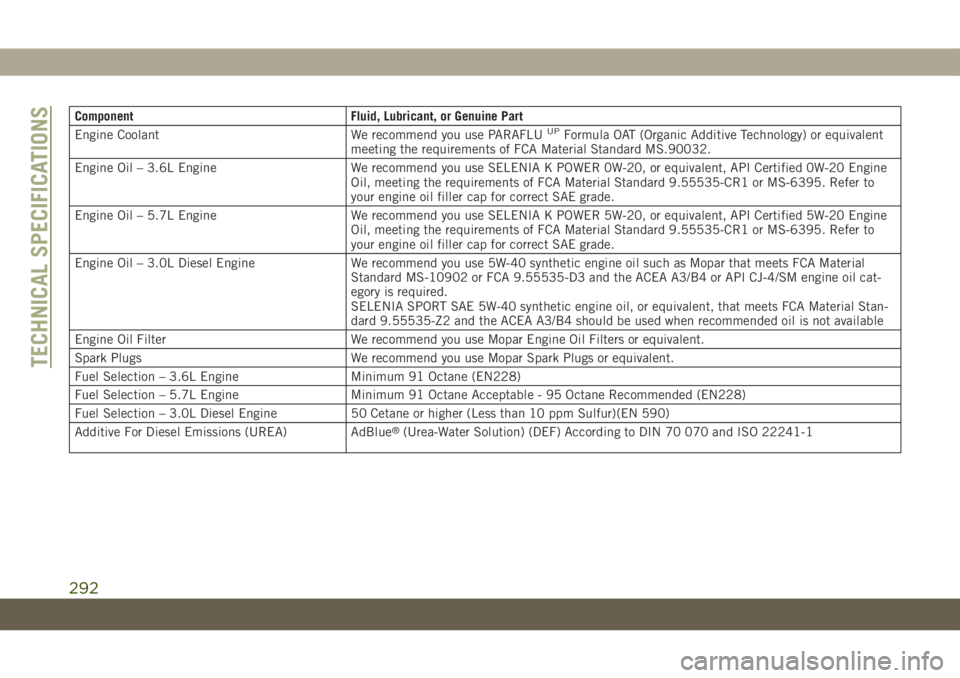
Component Fluid, Lubricant, or Genuine Part
Engine Coolant We recommend you use PARAFLUUPFormula OAT (Organic Additive Technology) or equivalent
meeting the requirements of FCA Material Standard MS.90032.
Engine Oil – 3.6L Engine We recommend you use SELENIA K POWER 0W-20, or equivalent, API Certified 0W-20 Engine
Oil, meeting the requirements of FCA Material Standard 9.55535-CR1 or MS-6395. Refer to
your engine oil filler cap for correct SAE grade.
Engine Oil – 5.7L Engine We recommend you use SELENIA K POWER 5W-20, or equivalent, API Certified 5W-20 Engine
Oil, meeting the requirements of FCA Material Standard 9.55535-CR1 or MS-6395. Refer to
your engine oil filler cap for correct SAE grade.
Engine Oil – 3.0L Diesel Engine We recommend you use 5W-40 synthetic engine oil such as Mopar that meets FCA Material
Standard MS-10902 or FCA 9.55535-D3 and the ACEA A3/B4 or API CJ-4/SM engine oil cat-
egory is required.
SELENIA SPORT SAE 5W-40 synthetic engine oil, or equivalent, that meets FCA Material Stan-
dard 9.55535-Z2 and the ACEA A3/B4 should be used when recommended oil is not available
Engine Oil Filter We recommend you use Mopar Engine Oil Filters or equivalent.
Spark Plugs We recommend you use Mopar Spark Plugs or equivalent.
Fuel Selection – 3.6L Engine Minimum 91 Octane (EN228)
Fuel Selection – 5.7L Engine Minimum 91 Octane Acceptable - 95 Octane Recommended (EN228)
Fuel Selection – 3.0L Diesel Engine 50 Cetane or higher (Less than 10 ppm Sulfur)(EN 590)
Additive For Diesel Emissions (UREA) AdBlue
®(Urea-Water Solution) (DEF) According to DIN 70 070 and ISO 22241-1
TECHNICAL SPECIFICATIONS
292