Wrinkles or abrasions which
appear naturally from usage are
not covered by warranty.
Belts with metallic accessories,
zippers or keys inside the back
pocket may damage the seat
fabric.
Make sure not to wet the seat. It
may change the nature of natu-
ral leather.
Jeans or clothes which could
bleach may contaminate the sur-
face of the seat covering fabric. Caring for the leather seats
- Vacuum the seat periodically to
remove dust and sand on the seat.
It will prevent abrasion or damage
of the leather and maintain its qual-
ity.
- Wipe the natural leather seat cover
often with dry or soft cloth.
- Use of proper leather protector
may prevent abrasion of the cover
and helps maintain the color. Be
sure to read the instructions and
consult a specialist when using
leather coating or protective agent.
- Light colored (beige, cream beige)
leather is easily contaminated and
the stain is noticeable. Clean the
seats frequently.
- Avoid wiping with wet cloth. It may
cause the surface to crack. Cleaning the leather seats
- Remove all contaminations instant-
ly. Refer to instructions below for
removal of each contaminant.
- Cosmetic products (sunscreen,
foundation, etc.)
Apply cleansing cream on a cloth
and wipe the contaminated spot.
Wipe off the cream with a wet cloth
and remove water with a dry cloth.
- Beverages (coffee, soft drink, etc.)
Apply a small amount of neutral
detergent and wipe until contami-
nations do not smear.
- Oil
Remove oil instantly with
absorbable cloth and wipe with
stain remover used only for natu-
ral leather.
- Chewing gum
Harden the gum with ice and
remove gradually.
NOTICE
7-74
Maintenance
8-8
Specifications, Consumer information and Reporting safety defects
Recommended SAE Viscosity
Number
Always be sure to clean the area
around any filler plug, drain
plug, or dipstick before check-
ing or draining any lubricant.
This is especially important in
dusty or sandy areas and when
the vehicle is used on unpaved
roads. Cleaning the plug and
dipstick areas will prevent dirt
and grit from entering the
engine and other mechanisms
that could be damaged.
CAUTION
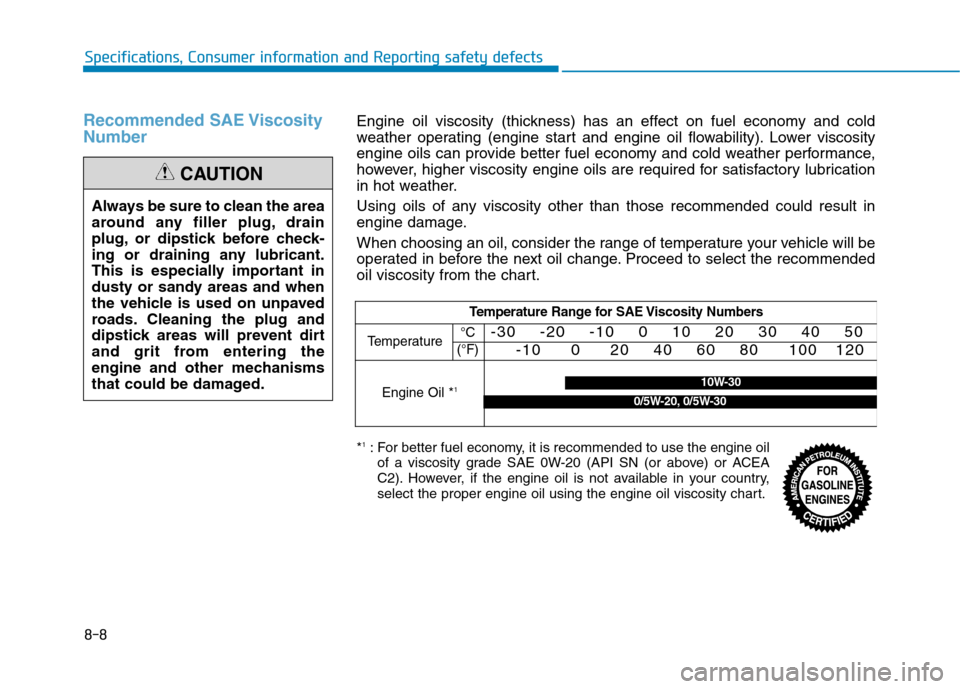
Temperature Range for SAE Viscosity Numbers
Temperature -30 -20 -10 0 10 20 30 40 50
-10 0 20 40 60 80 100 120
Engine Oil *1
°C
(°F)
*1: For better fuel economy, it is recommended to use the engine oil
of a viscosity grade SAE 0W-20 (API SN (or above) or ACEA
C2). However, if the engine oil is not available in your country,
select the proper engine oil using the engine oil viscosity chart.
10W-30
0/5W-20, 0/5W-30
Engine oil viscosity (thickness) has an effect on fuel economy and cold
weather operating (engine start and engine oil flowability). Lower viscosity
engine oils can provide better fuel economy and cold weather performance,
however, higher viscosity engine oils are required for satisfactory lubrication
in hot weather.
Using oils of any viscosity other than those recommended could result in
engine damage.
When choosing an oil, consider the range of temperature your vehicle will be
operated in before the next oil change. Proceed to select the recommended
oil viscosity from the chart.