2020 FORD TRANSIT coolant
[x] Cancel search: coolantPage 171 of 529

WARNING: The normal operating
temperature of the exhaust system is
very high. Never work around or attempt
to repair any part of the exhaust system
until it has cooled. Use special care when
working around the diesel oxidation
catalytic converter or the diesel
particulate filter. The diesel oxidation
catalytic converter and the diesel
particulate filter heat up to very high
temperatures after only a short period
of engine operation and remain hot after
you switch the engine off. WARNING:
Exhaust leaks may
result in entry of harmful and potentially
lethal fumes into the passenger
compartment. If you smell exhaust
fumes inside your vehicle, have your
vehicle inspected immediately. Do not
drive if you smell exhaust fumes.
Your vehicle has various emission control
components and a diesel particulate filter
that enables it to comply with applicable
exhaust emission standards. It filters
harmful diesel particulates, for example
soot from the exhaust gas.
To avoid damaging the diesel particulate
filter:
• Do not crank the engine for more than
10 seconds at a time.
• Do not push-start or tow-start your
vehicle. Use booster cables.
• Do not switch the ignition off when your
vehicle is moving.
• Do not ignore warning lamps or
information messages regarding
exhaust system cleaning and
regeneration.
Note: This could result in damage not
covered by the vehicle Warranty. On-Board Diagnostics System
Your vehicle has an on-board diagnostics
system that monitors the emission control
system. If any of the following warning
lamps illuminate, this indicates that the
on-board diagnostics system has detected
an emission control system malfunction.
Engine coolant temperature
warning lamp.
Ignition warning lamp.
Malfunction indicator lamp.
Water in fuel warning lamp.
If you continue to drive your vehicle when
the warning lamp is illuminated, the engine
could stop without warning. This could
result in damage not covered by the vehicle
Warranty. Have your vehicle checked as
soon as possible.
Diesel Particulate Filter Automatic
Regeneration WARNING:
Do not park or idle your
vehicle over dry leaves, dry grass or other
combustible materials. The regeneration
process creates very high exhaust gas
temperatures and the exhaust will
radiate a considerable amount of heat
during and after regeneration and after
you have switched the engine off. This is
a potential fire hazard.
168
2020 Transit (TTH) Canada/United States of America, LK3J 19A321 HA enUSA, Edition date: 201911, First-Printing Engine Emission Control
Page 173 of 529

The automatic regeneration process is
most effective when you drive at a steady
vehicle speed of 30 mph (48 km/h) or
above for approximately 20 minutes. The
frequency and duration of the regeneration
process varies by how you drive your
vehicle, the outside air temperature and
altitude. Frequency varies between 100 mi
(160 km)
and 310 mi (500 km) and each
regeneration process lasts between 10 and
20 minutes.
Note: Changes in the engine or exhaust
sound may be heard during the regeneration
process.
Note: During regeneration at low speed or
engine idle, you may smell a hot metallic
odor and could notice a clicking metallic
sound. This is due to the high temperatures
reached during the regeneration process.
This is normal.
Diesel Particulate Filter Manual
Regeneration
(If Equipped) WARNING:
Do not park or idle your
vehicle over dry leaves, dry grass or other
combustible materials. The regeneration
process creates very high exhaust gas
temperatures and the exhaust will
radiate a considerable amount of heat
during and after regeneration and after
you have switched the engine off. This is
a potential fire hazard. WARNING:
The normal operating
temperature of the exhaust system is
very high. Never work around or attempt
to repair any part of the exhaust system
until it has cooled. Use special care when
working around the diesel oxidation
catalytic converter or the diesel particulate filter. The diesel oxidation
catalytic converter and the diesel
particulate filter heat up to very high
temperatures after only a short period
of engine operation and remain hot after
you switch the engine off.
If the diesel particulate filter is near or at
saturation, an information message
appears in the information display advising
you to initiate diesel particulate filter
manual regeneration.
Before you start manual regeneration, do
the following:
• Park your vehicle outside of any
enclosed structure.
• Make sure the transmission is in park
(P) or neutral (N).
• Make sure the parking brake is on.
• Park your vehicle a minimum of
10 ft
(3 m) from any obstructions and
materials that can easily combust or
melt, for example, paper, leaves, fuels,
plastics and other dry organic material.
• Make sure there is a minimum of 3.2 gal
(12 L)
of fuel in the fuel tank.
• Check the engine oil level.
• Check the engine coolant level.
Manual Regeneration
Where vehicle use has significant engine
idle operation, frequent vehicle speed less
than
25 mph (40 km/h), or driving short
distances where the engine does not fully
warm up, manual regeneration allows you
to start diesel particulate filter cleaning
when the engine is idling.
170
2020 Transit (TTH) Canada/United States of America, LK3J 19A321 HA enUSA, Edition date: 201911, First-Printing Engine Emission Control
Page 257 of 529

REDUCED ENGINE
PERFORMANCE
WARNING: If you continue to drive
your vehicle when the engine is
overheating, the engine could stop
without warning. Failure to follow this
instruction could result in the loss of
control of your vehicle.
If the engine coolant temperature gauge
needle moves to the upper limit position,
the engine is overheating. See Gauges
(page 111).
You must only drive your vehicle for a short
distance if the engine overheats. The
distance you can travel depends on
ambient temperature, vehicle load and
terrain. The engine continues to operate
with limited power for a short period of
time.
If the engine temperature continues to rise,
the fuel supply to the engine reduces. The
air conditioning switches off and the engine
cooling fan operates continually.
1. Gradually reduce your speed and stop your vehicle as soon as it is safe to do
so.
2. Immediately switch the engine off to prevent severe engine damage.
3. Wait for the engine to cool down.
4. Check the coolant level. See
Engine
Coolant Check (page 298).
5. Have your vehicle checked as soon as possible. ECONOMICAL DRIVING
The following helps to improve fuel
consumption:
•
Regularly check your tire pressures and
make sure that they are inflated to the
correct pressure.
• Follow the recommended maintenance
schedule and carry out the
recommended checks.
• Plan your journey and check the traffic
before you set off.
• Avoid idling the engine in cold weather
or for extended periods. Start the
engine only when you are ready to set
off.
• Do not carry unnecessary weight in your
vehicle as extra weight wastes fuel.
• Do not add unnecessary accessories
to the exterior of your vehicle, for
example running boards. If you use a
roof rack, remember to fold it down or
remove it when not in use.
• Drive smoothly, accelerate gently and
anticipate the road ahead to avoid
heavy braking.
• Switch off all electric systems when
not in use, for example air conditioning.
Make sure that you unplug any
accessories from the auxiliary power
points when not in use.
COLD WEATHER
PRECAUTIONS
The functional operation of some
components and systems can be affected
at temperatures below
-13°F (-25°C).
254
2020 Transit (TTH) Canada/United States of America, LK3J 19A321 HA enUSA, Edition date: 201911, First-Printing Driving Hints
Page 278 of 529

Protected Component
Fuse Rating
Item
Left-hand heated windshield element.
40 A
8
Rear door latch.
15 A
9
Not used.
-
10
Auxiliary power point.
40 A
11
USB port.
Horn.
20 A
12
Selective catalytic reduction system.
10 A
13
Vehicle power 5.
15 A
14
Not used.
-
15
Not used.
-
16
Right-hand high-intensity discharge headlamps.
10 A
17
Rear window defroster.
40 A
18
Front fog lamps.
20 A
19
Power folding mirrors.
10 A
20
Vehicle power 4.
15 A
21
Rear blower motor.
40 A
22
Fuel pump.
20 A
23
Run/Start relay.
40 A
24
Auxiliary power points.
40 A
25
Left-hand high-intensity discharge headlamps.
10 A
26
Not used.
-
27
Vehicle power 1.
20 A
28
Fuel filter heater.
40 A
29
Coolant pump.
15 A
30
Anti-lock brake system.
5 A
31
Transmission control module.
15 A
32
Starter motor.
30 A
33
275
2020 Transit (TTH) Canada/United States of America, LK3J 19A321 HA enUSA, Edition date: 201911, First-Printing Fuses
Page 279 of 529

Protected Component
Fuse Rating
Item
Selective catalytic reduction system.
15 A
34
Vehicle power 2.
15 A
35
Engine coolant bypass valve.
5 A
36
Glow plugs.
5 A
37
Powertrain control module.
Cooling fan.
60 A
38
Selective catalytic reduction system.
15 A
39
Vehicle power 3.
10 A
40
Controller glow plug.
10 A
41
Transmission control unit.
15 A
42
Anti-lock brake system pump.
60 A
43
Cooling fan.
25 A
44
Trailer socket.
30 A
45
Glow plugs.
40 A
46
Glow plugs.
40 A
47
Cooling fan.
50 A
48
Nitrogen oxides sensor.
15 A
49
Closed crankcase ventilation heater.
5 A
50
Air conditioning clutch.
10 A
51
Cooling fan.
50 A
52
Not used.
-
53
Backup alarm.
20 A
54
Transmission oil pump.
25 A
55
Fuel fired booster heater.
20 A
56
Anti-lock brake system with electronic stability
control.
25 A
57
Trailer socket.
30 A
58
Cooling fan relay.
-
59
276
2020 Transit (TTH) Canada/United States of America, LK3J 19A321 HA enUSA, Edition date: 201911, First-Printing Fuses
Page 293 of 529

UNDER HOOD OVERVIEW - 2.0L ECOBLUE
Air filter assembly.
A
Engine oil filler cap. See Engine Oil Check (page 293).
B
Engine oil dipstick. See
Engine Oil Dipstick (page 293).
C
Brake fluid reservoir.
See Brake Fluid Check (page 302).
D
Engine coolant reservoir. See
Engine Coolant Check (page 298).
E
Engine compartment fuse box. See
Fuses (page 273).
F
Battery connection. See
Jump Starting the Vehicle (page 259).
G
Washer fluid reservoir.
See Washer Fluid Check (page 307).
H
290
2020 Transit (TTH) Canada/United States of America, LK3J 19A321 HA enUSA, Edition date: 201911, First-Printing MaintenanceABCDE
FGHE306490
Page 294 of 529
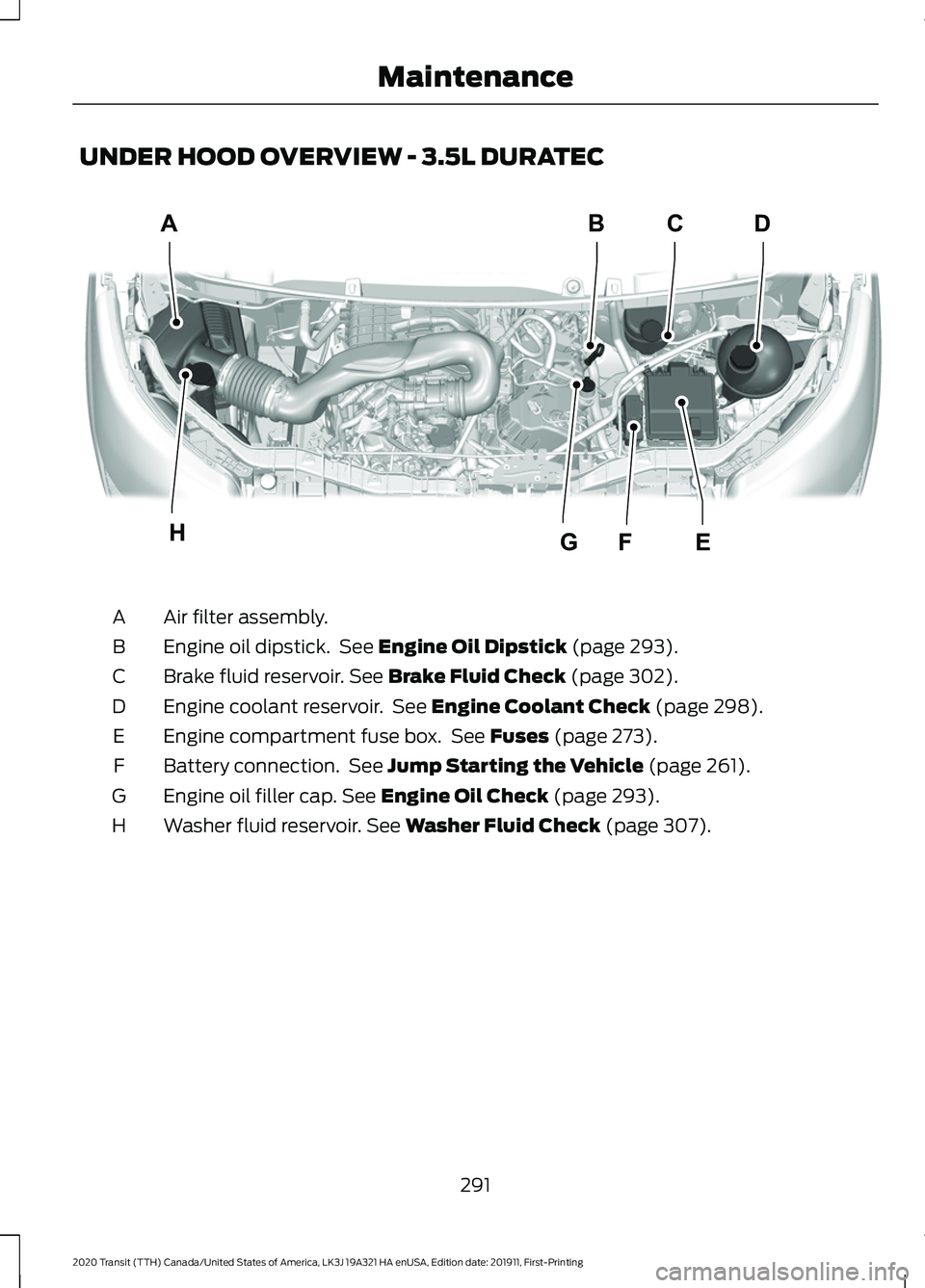
UNDER HOOD OVERVIEW - 3.5L DURATEC
Air filter assembly.
A
Engine oil dipstick. See Engine Oil Dipstick (page 293).
B
Brake fluid reservoir.
See Brake Fluid Check (page 302).
C
Engine coolant reservoir. See
Engine Coolant Check (page 298).
D
Engine compartment fuse box. See
Fuses (page 273).
E
Battery connection. See
Jump Starting the Vehicle (page 261).
F
Engine oil filler cap.
See Engine Oil Check (page 293).
G
Washer fluid reservoir.
See Washer Fluid Check (page 307).
H
291
2020 Transit (TTH) Canada/United States of America, LK3J 19A321 HA enUSA, Edition date: 201911, First-Printing MaintenanceABDC
EFGHE306489
Page 295 of 529

UNDER HOOD OVERVIEW - 3.5L ECOBOOST™
Air filter assembly.
A
Engine oil dipstick. See Engine Oil Dipstick (page 293).
B
Brake fluid reservoir.
See Brake Fluid Check (page 302).
C
Engine coolant reservoir. See
Engine Coolant Check (page 298).
D
Engine compartment fuse box. See
Fuses (page 273).
E
Battery connection. See
Jump Starting the Vehicle (page 261).
F
Engine oil filler cap.
See Engine Oil Check (page 293).
G
Washer fluid reservoir.
See Washer Fluid Check (page 307).
H
292
2020 Transit (TTH) Canada/United States of America, LK3J 19A321 HA enUSA, Edition date: 201911, First-Printing MaintenanceA
H
BD
EG
C
FE306483