2020 FORD TRANSIT air filter
[x] Cancel search: air filterPage 172 of 529

WARNING: The normal operating
temperature of the exhaust system is
very high. Never work around or attempt
to repair any part of the exhaust system
until it has cooled. Use special care when
working around the diesel oxidation
catalytic converter or the diesel
particulate filter. The diesel oxidation
catalytic converter and the diesel
particulate filter heat up to very high
temperatures after only a short period
of engine operation and remain hot after
you switch the engine off.
The diesel particulate filter on your vehicle
requires periodic regeneration to maintain
correct operation. The emission control
system automatically carries out this
process. As soot gathers in the system it
begins to restrict the filter. The soot that
gathers inside the filter is cleaned in two
different ways, passive regeneration and
active regeneration. Both methods occur
automatically and require no actions from
the driver. During automatic regeneration,
the system cleans the diesel particulate
filter by oxidizing the soot. Cleaning
happens during normal engine operating
conditions at varying levels depending on
driving conditions.
If the diesel particulate filter is near or at
saturation, an information message
appears in the information display. Drive
your vehicle in a manner to allow effective
diesel particulate filter cleaning.
Failure to carry out regeneration when
required could result in a clogged diesel
particulate filter. If the diesel particulate
filter fills beyond the regeneration
threshold, the system disables the ability
to carry out regeneration. This could result
in damage not covered by the vehicle
Warranty. Where vehicle use meets any of the
following conditions:
•
Driving short distances.
• Prolonged engine idling.
• Frequently switching the engine on and
off.
• High levels of acceleration and
deceleration.
We recommend you assist the
regeneration process by:
• Avoiding prolonged engine idling.
• Drive your vehicle in a manner to allow
effective cleaning. Drive at a steady
vehicle speed of 30 mph (48 km/h) or
above for approximately 20 minutes. If the warning lamp illuminates
the diesel particulate filter could
have become overloaded. Have
your vehicle checked as soon as possible.
Automatic regeneration raises the exhaust
temperature to eliminate the soot
particles. During cleaning soot particles are
converted to harmless gasses. Once
cleaned the diesel particulate filter
continues to trap harmful diesel particles.
If you are driving your vehicle in a manner
that allows effective cleaning, a message
may appear in the information display to
indicate automatic regeneration is in
progress.
If you are not driving your vehicle in a
manner that allows effective cleaning, a
message may appear in the information
display to instruct you to drive in a manner
that allows automatic regeneration.
169
2020 Transit (TTH) Canada/United States of America, LK3J 19A321 HA enUSA, Edition date: 201911, First-Printing Engine Emission Control
Page 173 of 529

The automatic regeneration process is
most effective when you drive at a steady
vehicle speed of 30 mph (48 km/h) or
above for approximately 20 minutes. The
frequency and duration of the regeneration
process varies by how you drive your
vehicle, the outside air temperature and
altitude. Frequency varies between 100 mi
(160 km)
and 310 mi (500 km) and each
regeneration process lasts between 10 and
20 minutes.
Note: Changes in the engine or exhaust
sound may be heard during the regeneration
process.
Note: During regeneration at low speed or
engine idle, you may smell a hot metallic
odor and could notice a clicking metallic
sound. This is due to the high temperatures
reached during the regeneration process.
This is normal.
Diesel Particulate Filter Manual
Regeneration
(If Equipped) WARNING:
Do not park or idle your
vehicle over dry leaves, dry grass or other
combustible materials. The regeneration
process creates very high exhaust gas
temperatures and the exhaust will
radiate a considerable amount of heat
during and after regeneration and after
you have switched the engine off. This is
a potential fire hazard. WARNING:
The normal operating
temperature of the exhaust system is
very high. Never work around or attempt
to repair any part of the exhaust system
until it has cooled. Use special care when
working around the diesel oxidation
catalytic converter or the diesel particulate filter. The diesel oxidation
catalytic converter and the diesel
particulate filter heat up to very high
temperatures after only a short period
of engine operation and remain hot after
you switch the engine off.
If the diesel particulate filter is near or at
saturation, an information message
appears in the information display advising
you to initiate diesel particulate filter
manual regeneration.
Before you start manual regeneration, do
the following:
• Park your vehicle outside of any
enclosed structure.
• Make sure the transmission is in park
(P) or neutral (N).
• Make sure the parking brake is on.
• Park your vehicle a minimum of
10 ft
(3 m) from any obstructions and
materials that can easily combust or
melt, for example, paper, leaves, fuels,
plastics and other dry organic material.
• Make sure there is a minimum of 3.2 gal
(12 L)
of fuel in the fuel tank.
• Check the engine oil level.
• Check the engine coolant level.
Manual Regeneration
Where vehicle use has significant engine
idle operation, frequent vehicle speed less
than
25 mph (40 km/h), or driving short
distances where the engine does not fully
warm up, manual regeneration allows you
to start diesel particulate filter cleaning
when the engine is idling.
170
2020 Transit (TTH) Canada/United States of America, LK3J 19A321 HA enUSA, Edition date: 201911, First-Printing Engine Emission Control
Page 174 of 529

Use the manual regeneration feature
when:
•
You are not able to drive in a manner
that allows effective automatic
cleaning. The automatic regeneration
process is most effective when you
drive at a steady vehicle speed of
30 mph (48 km/h) or above for
approximately 20 minutes. .
• You choose to manually start the
regeneration process when the engine
is idling.
Note: Changes in the engine or exhaust
sound may be heard during the regeneration
process.
Note: During regeneration at low speed or
engine idle, you may smell a hot metallic
odor and could notice a clicking metallic
sound. This is due to the high temperatures
reached during the regeneration process.
This is normal.
Starting Manual Regeneration
You can only start manual regeneration
with the engine running at normal
operating temperature using the
information display.
Note: During the use of manual
regeneration, you may observe a light
amount of white smoke. This is normal.
Note: If you press any pedal during manual
regeneration the engine may turn off. To
protect the exhaust system you may not be
able to restart the engine for 10 minutes.
1. Using the information display controls on the steering wheel, select Settings.
2. Select
Vehicle Maintenance.
3. Select
Exhaust Filter.
4. Press and hold the
OK button until a
confirmation message appears in the
information display. If a warning illuminates you may
not be able to start manual
regeneration.
When you start manual regeneration the
engine speed rises to approximately
2000– 2500 rpm and the cooling fan
speed increases. A change in engine noise
due to the cooling fan and engine speed
increase may be heard during the
regeneration process.
Depending on the amount of soot
collected by the diesel particulate filter,
the regeneration process varies depending
on the outside air temperature and
altitude. Manual regeneration may last up
to 40 minutes.
When manual regeneration is complete
the cooling fan and engine speed return to
normal idling. The exhaust system remains
very hot for several minutes after
regeneration is complete. Do not reposition
the vehicle over dry leaves, dry grass or
other combustible materials until the
exhaust system has had sufficient time to
cool.
Interrupting or Cancelling Manual
Regeneration
You can interrupt or cancel manual
regeneration by switching the engine off.
It may be possible to interrupt or cancel
manual regeneration by pressing any
pedal.
Note: To protect the exhaust system you
may not be able to restart the engine for 10
minutes.
Depending on the amount of time allowed
for manual regeneration to operate, soot
may not have had sufficient time to be
eliminated. The exhaust system may still
be very hot for several minutes after
regeneration.
171
2020 Transit (TTH) Canada/United States of America, LK3J 19A321 HA enUSA, Edition date: 201911, First-Printing Engine Emission Control
Page 258 of 529

BREAKING-IN
You need to break in new tires for
approximately 300 mi (480 km). During
this time, your vehicle may exhibit some
unusual driving characteristics. The engine
also needs to break in. Avoid hard
accelerations and driving too fast for the
first 1,000 mi (1,600 km). If possible, avoid
carrying heavy loads up steep grades
during the break-in period.
DRIVING THROUGH WATER WARNING:
Do not drive through
flowing or deep water as you may lose
control of your vehicle.
Note: Driving through standing water can
cause vehicle damage.
Note: Engine damage can occur if water
enters the air filter.
Before driving through standing water,
check the depth. Never drive through water
that is higher than the bottom of the wheel
hubs. When driving through standing water, drive
very slowly and do not stop your vehicle.
Your brake performance and traction may
be limited. After driving through water and
as soon as it is safe to do so: •
Lightly press the brake pedal to dry the
brakes and to check that they work.
• Check that the horn works.
• Check that the exterior lights work.
• Turn the steering wheel to check that
the steering power assist works.
FLOOR MATS
(IF EQUIPPED) WARNING:
Use a floor mat
designed to fit the footwell of your
vehicle that does not obstruct the pedal
area. Failure to follow this instruction
could result in the loss of control of your
vehicle, personal injury or death. WARNING:
Pedals that cannot
move freely can cause loss of vehicle
control and increase the risk of serious
personal injury. WARNING:
Secure the floor mat
to both retention devices so that it
cannot slip out of position and interfere
with the pedals. Failure to follow this
instruction could result in the loss of
control of your vehicle, personal injury or
death. WARNING: Do not place additional
floor mats or any other covering on top
of the original floor mats. This could
result in the floor mat interfering with the
operation of the pedals. Failure to follow
this instruction could result in the loss of
control of your vehicle, personal injury or
death. WARNING:
Always make sure that
objects cannot fall into the driver foot
well while your vehicle is moving. Objects
that are loose can become trapped
under the pedals causing a loss of
vehicle control.
255
2020 Transit (TTH) Canada/United States of America, LK3J 19A321 HA enUSA, Edition date: 201911, First-Printing Driving HintsE176913
Page 293 of 529

UNDER HOOD OVERVIEW - 2.0L ECOBLUE
Air filter assembly.
A
Engine oil filler cap. See Engine Oil Check (page 293).
B
Engine oil dipstick. See
Engine Oil Dipstick (page 293).
C
Brake fluid reservoir.
See Brake Fluid Check (page 302).
D
Engine coolant reservoir. See
Engine Coolant Check (page 298).
E
Engine compartment fuse box. See
Fuses (page 273).
F
Battery connection. See
Jump Starting the Vehicle (page 259).
G
Washer fluid reservoir.
See Washer Fluid Check (page 307).
H
290
2020 Transit (TTH) Canada/United States of America, LK3J 19A321 HA enUSA, Edition date: 201911, First-Printing MaintenanceABCDE
FGHE306490
Page 294 of 529
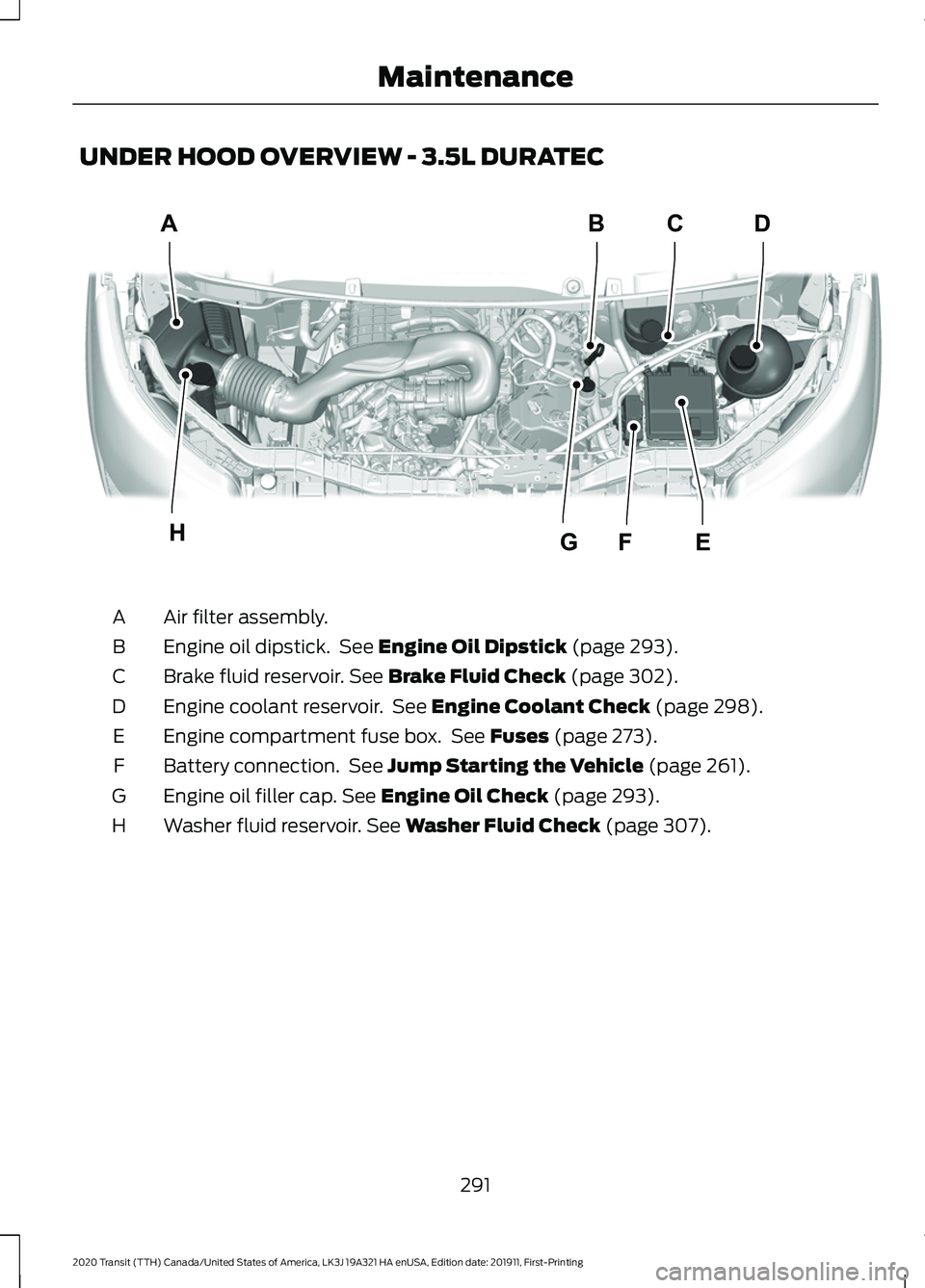
UNDER HOOD OVERVIEW - 3.5L DURATEC
Air filter assembly.
A
Engine oil dipstick. See Engine Oil Dipstick (page 293).
B
Brake fluid reservoir.
See Brake Fluid Check (page 302).
C
Engine coolant reservoir. See
Engine Coolant Check (page 298).
D
Engine compartment fuse box. See
Fuses (page 273).
E
Battery connection. See
Jump Starting the Vehicle (page 261).
F
Engine oil filler cap.
See Engine Oil Check (page 293).
G
Washer fluid reservoir.
See Washer Fluid Check (page 307).
H
291
2020 Transit (TTH) Canada/United States of America, LK3J 19A321 HA enUSA, Edition date: 201911, First-Printing MaintenanceABDC
EFGHE306489
Page 295 of 529

UNDER HOOD OVERVIEW - 3.5L ECOBOOST™
Air filter assembly.
A
Engine oil dipstick. See Engine Oil Dipstick (page 293).
B
Brake fluid reservoir.
See Brake Fluid Check (page 302).
C
Engine coolant reservoir. See
Engine Coolant Check (page 298).
D
Engine compartment fuse box. See
Fuses (page 273).
E
Battery connection. See
Jump Starting the Vehicle (page 261).
F
Engine oil filler cap.
See Engine Oil Check (page 293).
G
Washer fluid reservoir.
See Washer Fluid Check (page 307).
H
292
2020 Transit (TTH) Canada/United States of America, LK3J 19A321 HA enUSA, Edition date: 201911, First-Printing MaintenanceA
H
BD
EG
C
FE306483
Page 299 of 529

OIL CHANGE INDICATOR
RESET - GASOLINE
Only reset the system after changing the
engine oil and oil filter.
Resetting the Oil Life Monitoring
System
1.
Switch the ignition on. Do not start the
engine.
2. Fully press the accelerator and brake pedals at the same time.
3. Keep the accelerator and brake pedals
fully pressed.
4. After 25 seconds, the oil change reminder resets.
5. Release the accelerator and brake pedals.
6. Switch the ignition off.
7. Switch the ignition on to confirm that the oil change reminder does not
display.
CHANGING THE ENGINE AIR
FILTER WARNING: To reduce the risk of
vehicle damage and personal burn
injuries, do not start your engine with the
air cleaner removed and do not remove
it while the engine is running.
Note: Failure to use the correct air filter
element may result in severe engine
damage. The vehicle Warranty may be void
for any damage to the engine if the correct
air filter element is not used.
Only use the specified air filter.
See
Capacities and Specifications (page
362). Change the air filter element at the proper
interval.
See Scheduled Maintenance
(page 462). 1. Disconnect the intake air temperature
sensor electrical connector and cable
from the air filter cover.
2. Clean the area around the air tube to air filter cover connection to prevent
debris from entering the system and
then loosen the bolt on the air tube
clamp so the clamp is no longer snug
to the air tube. It is not necessary to
completely remove the clamp. Pull the
air tube off from the air filter cover.
3. Release the clamps that secure the air
filter cover to the air filter housing. 296
2020 Transit (TTH) Canada/United States of America, LK3J 19A321 HA enUSA, Edition date: 201911, First-Printing MaintenanceE174607
12
3 E174669