2020 DODGE CHALLENGER transmission
[x] Cancel search: transmissionPage 234 of 396

232IN CASE OF EMERGENCY
TOWING A DISABLED VEHICLE
This section describes procedures for towing a disabled vehicle using a commercial towing service.
Proper towing or lifting equipment is required to
prevent damage to your vehicle. Use only tow
bars and other equipment designed for this
purpose, following equipment manufacturer’s
instructions. Use of safety chains is mandatory.
Attach a tow bar or other towing device to main
structural members of the vehicle, not to
bumpers or associated brackets. State and
local laws regarding vehicles under tow must be
observed. If you must use the accessories (wipers,
defrosters, etc.) while being towed, the ignition
must be in the ON/RUN mode, not the ACC
mode.
If the key fob is unavailable, or the vehicle's
battery is discharged, refer to "Manual Park
Release" in this section for instructions on
shifting the transmission out of PARK for
towing.
Towing Condition
Wheels OFF The Ground RWD MODELS AWD MODELS
Flat Tow NONEIf transmission is operable:
• Transmission in NEUTRAL
• 30 mph (48 km/h) max speed
• 30 miles (48 km) max distance NOT ALLOWED
Wheel Lift Or Dolly Tow Front
NOT RECOMMENDED (but, if used,
same limitations as above)NOT ALLOWED
Rear NOT RECOMMENDEDNOT RECOMMENDED, but, if used:
Ignition in ON/RUN mode
Transmission in
NEUTRAL (NOT
in PARK)
Flatbed ALLBEST METHODBEST METHOD
20_LA_OM_EN_USC_t.book Page 232
Page 235 of 396

IN CASE OF EMERGENCY233
REAR-WHEEL DRIVE (RWD) MODELS
The manufacturer recommends towing your
vehicle with all four wheels OFF the ground
using a flatbed. If flatbed equipment is not available, and the
transmission is operable, the vehicle may be
flat towed (with all four wheels on the ground)
under the following conditions:
The transmission must be in NEUTRAL. Refer
to "Manual Park Release" in this section for
instructions on shifting the automatic trans
-
mission to NEUTRAL when the engine is off.
The towing distance must not exceed
30 miles (48 km).
The towing speed must not exceed 30 mph
(48 km/h).
If the transmission is not operable, or the
vehicle must be towed faster than 30 mph
(48 km/h) or farther than 30 miles (48 km),
then the only acceptable method of towing is
with a flatbed truck.
ENHANCED ACCIDENT RESPONSE SYSTEM
(EARS)
This vehicle is equipped with an Enhanced
Accident Response System.
Please refer to “Occupant Restraint Systems” in
“Safety” for further information on the
Enhanced Accident Response System (EARS)
function.
EVENT DATA RECORDER (EDR)
This vehicle is equipped with an event data
recorder (EDR). The main purpose of an EDR is
to record data that will assist in understanding
how a vehicle’s systems performed under
certain crash or near crash-like situations, such
as an air bag deployment or hitting a road
obstacle.
Please refer to “Occupant Restraint Systems” in
“Safety” for further information on the Event
Data Recorder (EDR).
CAUTION!
Do not use sling type equipment when
towing. Vehicle damage may occur.
When securing the vehicle to a flat bed
truck, do not attach to front or rear suspen -
sion components. Damage to your vehicle
may result from improper towing.
The manufacturer does not recommend
towing this vehicle using a tow dolly.
Vehicle damage may occur.
CAUTION!
Towing this vehicle in violation of the above
requirements can cause severe engine and/
or transmission damage. Damage from
improper towing is not covered under the New
Vehicle Limited Warranty.
6
20_LA_OM_EN_USC_t.book Page 233
Page 238 of 396

236SERVICING AND MAINTENANCE
Inspect the rear axle fluid. Inspect
the front axle fluid (All Wheel Drive
Only). X
XX X X XX
Inspect the manual transmission
fluid (if equipped). X
XX X X XX
Inspect the brake linings, replace as
necessary. X
XX X X XX
Adjust parking brake on vehicles
equipped with four wheel disc
brakes. X
XX X X XX
Inspect transfer case fluid (All Wheel
Drive Only). X
X X X X
Additional Maintenance
Replace engine air cleaner filter. XX X X X
Replace cabin/air conditioning filter. X XX X X XX
Replace spark plugs.
1X
Mileage or time passed (whichever
comes first)
20,000
30,000
40,000
50,000
60,000
70,000
80,000
90,000
100,000
110,000
120,000
130,000
140,000
150,000
Or Years: 2 3 4 5 6 7 8 9 10 11 12 13 14 15
Or Kilometers:
32,000
48,000
64,000
80,000
96,000
112,000
128,000
144,000
160,000
176,000
192,000
208,000
224,000
240,000
20_LA_OM_EN_USC_t.book Page 236
Page 239 of 396

SERVICING AND MAINTENANCE237
Flush and replace the
engine coolant at 10 years or
150,000 miles (240,000 km)
whichever comes first. X
X
Change the manual transmission
fluid (if equipped) if using your
vehicle for any of the following: Most
of your driving is at sustained
speeds during hot weather, above
90°F (32°C), driving in dusty
conditions, or stop and go driving. X
X X
Change the transfer case fluid; if
using your vehicle for any of the
following: police, taxi, fleet, off-road,
or frequent trailer towing. (All Wheel
Drive Only). X
X
Mileage or time passed (whichever
comes first)
20,000
30,000
40,000
50,000
60,000
70,000
80,000
90,000
100,000
110,000
120,000
130,000
140,000
150,000
Or Years: 2 3 4 5 6 7 8 9 10 11 12 13 14 15
Or Kilometers:
32,000
48,000
64,000
80,000
96,000
112,000
128,000
144,000
160,000
176,000
192,000
208,000
224,000
240,000
7
20_LA_OM_EN_USC_t.book Page 237
Page 244 of 396
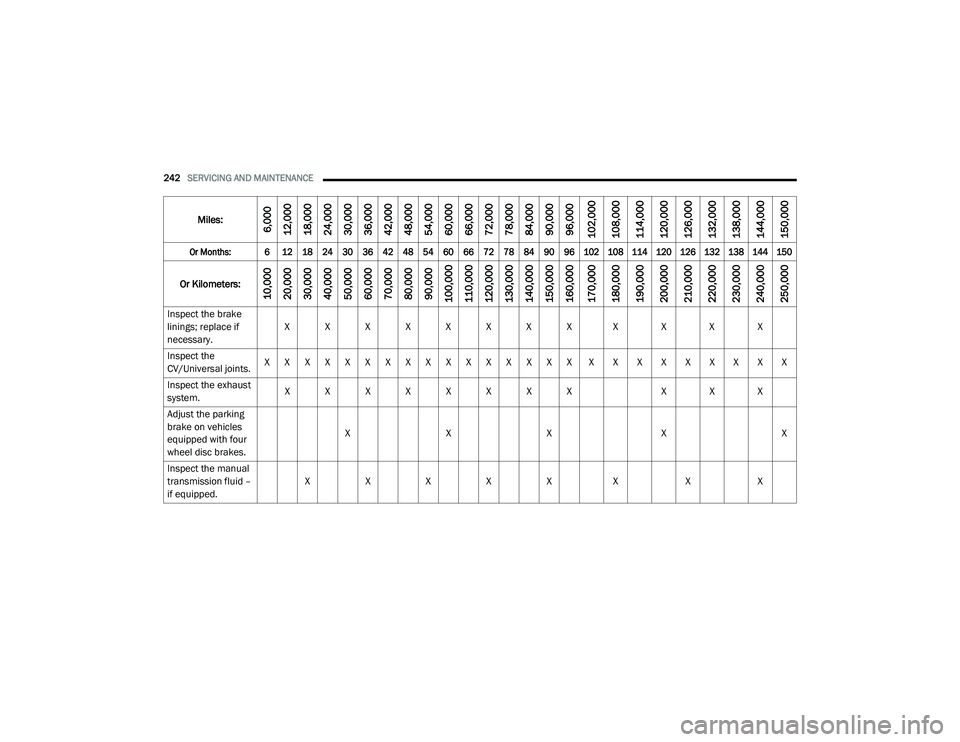
242SERVICING AND MAINTENANCE
Inspect the brake
linings; replace if
necessary.X X X X X X X X X X X X
Inspect the
CV/Universal joints. X X X X X X X X X X X X X X X X X X X X X X X X X
Inspect the exhaust
system. X X X X X X X X
X X X
Adjust the parking
brake on vehicles
equipped with four
wheel disc brakes. X
XX X X
Inspect the manual
transmission fluid –
if equipped. X
XXXX X XX
Miles:
6,000
12,000
18,000
24,000
30,000
36,000
42,000
48,000
54,000
60,000
66,000
72,000
78,000
84,000
90,000
96,000
102,000
108,000
114,000
120,000
126,000
132,000
138,000
144,000
150,000
Or Months: 6 12 18 24 30 36 42 48 54 60 66 72 78 84 90 96 102 108 114 120 126 132 138 144 150
Or Kilometers:
10,000
20,000
30,000
40,000
50,000
60,000
70,000
80,000
90,000
100,000
110,000
120,000
130,000
140,000
150,000
160,000
170,000
180,000
190,000
200,000
210,0 00
220,000
230,000
240,000
250,000
20_LA_OM_EN_USC_t.book Page 242
Page 245 of 396

SERVICING AND MAINTENANCE243
Inspect the rear axle
fluid.X
XXXX X XX
Change the manual
transmission fluid –
if equipped. X
X X
Change the rear
axle fluid if using
your vehicle for any
of the following:
police, taxi, fleet or
frequent trailer
towing.
1
X X X
Replace the engine
air cleaner filter. X
XX X X
Replace the air
conditioning filter. X X X X X X X X X X X X
Miles:
6,000
12,000
18,000
24,000
30,000
36,000
42,000
48,000
54,000
60,000
66,000
72,000
78,000
84,000
90,000
96,000
102,000
108,000
114,000
120,000
126,000
132,000
138,000
144,000
150,000
Or Months: 6 12 18 24 30 36 42 48 54 60 66 72 78 84 90 96 102 108 114 120 126 132 138 144 150
Or Kilometers:
10,000
20,000
30,000
40,000
50,000
60,000
70,000
80,000
90,000
100,000
110,000
120,000
130,000
140,000
150,000
160,000
170,000
180,000
190,000
200,000
210,000
220,000
230,000
240,000
250,0 00
7
20_LA_OM_EN_USC_t.book Page 243
Page 264 of 396
262SERVICING AND MAINTENANCE
(Continued)
Under normal operating conditions, the
catalytic converter will not require
maintenance. However, it is important to keep
the engine properly tuned to ensure proper
catalyst operation and prevent possible catalyst
damage.
NOTE:
Intentional tampering with emissions control
systems can result in civil penalties being
assessed against you.
In unusual situations involving grossly
malfunctioning engine operation, a scorching
odor may suggest severe and abnormal catalyst
overheating. If this occurs, stop the vehicle, turn
off the engine and allow it to cool. Service,
including a tune-up to manufacturer's
specifications, should be obtained immediately.
To minimize the possibility of catalytic converter
damage:
Do not shut off the engine or interrupt the
ignition when the transmission is in gear and
the vehicle is in motion.
Do not try to start the engine by pushing or
towing the vehicle.
Do not idle the engine with any spark plug
wires disconnected or removed, such as
when diagnostic testing, or for prolonged
periods during very rough idle or malfunc-
tioning operating conditions.
NOTE:
The vehicle exhaust system may be equipped
with an Electronic Exhaust Valve (EEV) system,
if the exhaust system is replaced with after -
market products a Malfunction Indicator Lamp
(MIL) will illuminate.
COOLING SYSTEM
Coolant Checks
Check engine coolant (antifreeze) protection
every 12 months (before the onset of freezing
weather, where applicable). If coolant is dirty or
rusty in appearance, the system should be
drained, flushed, and refilled with fresh coolant.
Check the front of the radiator for any
accumulation of bugs, leaves, etc. If dirty, clean
by gently spraying water from a garden hose
vertically down the face of the condenser.
Check the coolant recovery bottle tubing for
brittle rubber, cracking, tears, cuts, and
tightness of the connection at the bottle and
radiator. Inspect the entire system for leaks. DO
NOT REMOVE THE COOLANT PRESSURE CAP
WHEN THE COOLING SYSTEM IS HOT.
WARNING!
You or others can be badly burned by hot
engine coolant (antifreeze) or steam from
your radiator. If you see or hear steam
coming from under the hood, do not open
the hood until the radiator has had time to
cool. Never open a cooling system pressure
cap when the radiator or coolant bottle is
hot.
Keep hands, tools, clothing, and jewelry
away from the radiator cooling fan when
the hood is raised. The fan starts automati -
cally and may start at any time, whether the
engine is running or not.
When working near the radiator cooling fan,
disconnect the fan motor lead or turn the
ignition to the OFF mode. The fan is
temperature controlled and can start at any
time the ignition is in the ON mode.
WARNING! (Continued)
20_LA_OM_EN_USC_t.book Page 262
Page 269 of 396

SERVICING AND MAINTENANCE267
CLUTCH HYDRAULIC SYSTEM — MANUAL
T
RANSMISSION (IF EQUIPPED)
The clutch hydraulic system is fed by a
segregated volume of fluid within the brake
system master cylinder reservoir. In the event of
leakage or wear, use only the manufacturer's
recommended brake fluid. Refer to “Fluids And
Lubricants” in “Technical Specifications” for
further information.
MANUAL TRANSMISSION — IF EQUIPPED
Fluid Level Check
Check the fluid level by removing the fill plug on
the left side of the transmission. The fluid level
should be 1/4 inch (6.4mm) below the bottom
of the fill hole. Add fluid, if necessary, to
maintain the proper level. Refer to “Fluids And
Lubricants” in “Technical Specifications” for
further information.
Change Transmission Fluid
If contaminated with water, change the fluid
immediately. See an authorized dealer for
service.
Refer to the “Maintenance Plan” in this section
for the proper maintenance intervals.
AUTOMATIC TRANSMISSION — IF
E
QUIPPED
Selection Of Lubricant
It is important to use the proper transmission
fluid to ensure optimum transmission
performance and life. Use only the
manufacturer's specified transmission fluid.
Refer to “Fluids And Lubricants” in “Technical
Specifications” for fluid specifications. It is
important to maintain the transmission fluid at
the correct level using the recommended fluid.
NOTE:
No chemical flushes should be used in any
transmission; only the approved lubricant
should be used.
Special Additives
The manufacturer strongly recommends
against using any special additives in the
transmission. Automatic Transmission Fluid
(ATF) is an engineered product and its
performance may be impaired by supplemental
additives. Therefore, do not add any fluid
additives to the transmission. Avoid using
transmission sealers as they may adversely
affect seals.
CAUTION!
Using a transmission fluid other than the
manufacturer's recommended fluid may
cause deterioration in transmission shift
quality and/or damage to the transmission.
Refer to “Fluids And Lubricants” in “Technical
Specifications” for fluid specifications.
CAUTION!
Using a transmission fluid other than the
manufacturer’s recommended fluid may
cause deterioration in transmission shift
quality and/or torque converter shudder.
Refer to “Fluids And Lubricants” in “Technical
Specifications” for fluid specifications.
CAUTION!
Do not use chemical flushes in your
transmission as the chemicals can damage
your transmission components. Such damage
is not covered by the New Vehicle Limited
Warranty.
7
20_LA_OM_EN_USC_t.book Page 267