2020 DODGE CHALLENGER lock
[x] Cancel search: lockPage 28 of 396

26GETTING TO KNOW YOUR VEHICLE
To Unlock From The Driver's Side:
With a Passive Entry key fob within 5 ft (1.5 m)
of the driver door handle, grab the front driver
door handle to unlock the driver's door
automatically. The interior door panel lock knob
will raise when the door is unlocked.
Upon unlocking the door with Passive Entry, the
turn signals will flash twice, and the low beams,
license plate lamp, and position lamps can be
set to illuminate for 0, 30 (default), 60, or
90 seconds.
Grab The Door Handle To Unlock
NOTE:
If “Unlock All Doors 1st Press” is programmed,
all doors will unlock when you grab hold of the
front driver’s door handle. To select between “Unlock Driver Door 1st Press” and “Unlock All
Doors 1st Press,” refer to “Uconnect Settings”
in “Multimedia” for further information.
To Unlock From The Passenger Side:
With a Passive Entry key fob within 5 ft (1.5 m)
of the passenger door handle, grab the front
passenger door handle to unlock both doors
automatically. The interior door panel lock knob
will raise when the door is unlocked.
NOTE:
All doors will unlock when the front passenger
door handle is grabbed regardless of the
driver’s door unlock preference setting (“Unlock
Driver Door 1st Press” or “Unlock All Doors 1st
Press”).
Preventing Inadvertent Locking Of Passive Entry
Key Fob In Vehicle (FOBIK-Safe)
To minimize the possibility of unintentionally
locking a Passive Entry key fob inside your
vehicle, the Passive Entry system is equipped
with an automatic door unlock feature which
will function if the ignition is in the OFF position.
FOBIK-Safe only executes in vehicles with
Passive Entry. There are three situations that
trigger a FOBIK-Safe search in any Passive Entry
vehicle.
1. A lock request is made by a valid Passive
Entry key fob while a door is open.
2. A lock request is made by the Passive Entry door handle while a door is open.
3. A lock request is made by the door panel switch while the door is open.
When any of these situations occur, after all
open doors are shut, the FOBIK-Safe search will
be executed. If it finds a Passive Entry key fob
inside the car, and it does not find any Passive
Entry key fobs outside the car, the car will
unlock and alert the customer.
NOTE:
The vehicle will only unlock the doors when a
valid Passive Entry key fob is detected inside
the vehicle, and no valid Passive Entry key fob is
detected outside the vehicle. The vehicle will
not unlock the doors when any of the following
conditions are true:
The doors are manually locked using the door
lock knobs.
There is a valid Passive Entry key fob outside
the vehicle and within 5 ft (1.5 m) of either
Passive Entry door handle.
20_LA_OM_EN_USC_t.book Page 26
Page 29 of 396
GETTING TO KNOW YOUR VEHICLE27
Three attempts are made to lock the doors
using the door panel switch and then the
doors are closed.
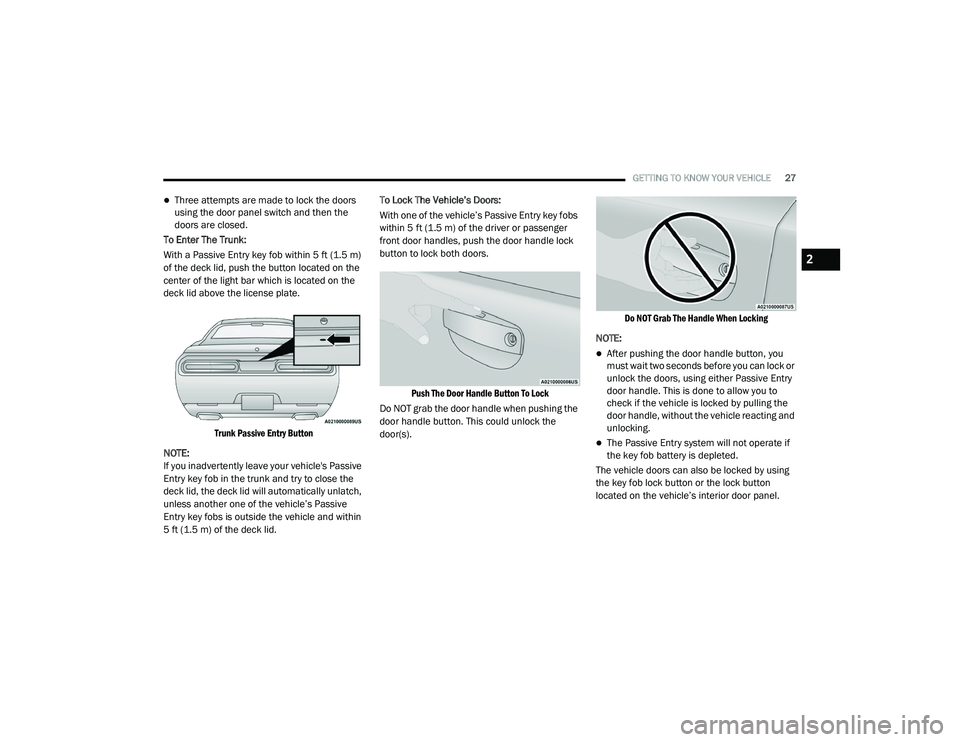
To Enter The Trunk:
With a Passive Entry key fob within 5 ft (1.5 m)
of the deck lid, push the button located on the
center of the light bar which is located on the
deck lid above the license plate.
Trunk Passive Entry Button
NOTE:
If you inadvertently leave your vehicle's Passive
Entry key fob in the trunk and try to close the
deck lid, the deck lid will automatically unlatch,
unless another one of the vehicle’s Passive
Entry key fobs is outside the vehicle and within
5 ft (1.5 m) of the deck lid. To Lock The Vehicle’s Doors:
With one of the vehicle’s Passive Entry key fobs
within 5 ft (1.5 m) of the driver or passenger
front door handles, push the door handle lock
button to lock both doors.
Push The Door Handle Button To Lock
Do NOT grab the door handle when pushing the
door handle button. This could unlock the
door(s).
Do NOT Grab The Handle When Locking
NOTE:
After pushing the door handle button, you
must wait two seconds before you can lock or
unlock the doors, using either Passive Entry
door handle. This is done to allow you to
check if the vehicle is locked by pulling the
door handle, without the vehicle reacting and
unlocking.
The Passive Entry system will not operate if
the key fob battery is depleted.
The vehicle doors can also be locked by using
the key fob lock button or the lock button
located on the vehicle’s interior door panel.
2
20_LA_OM_EN_USC_t.book Page 27
Page 30 of 396
28GETTING TO KNOW YOUR VEHICLE
General Information
The following regulatory statement applies to all
Radio Frequency (RF) devices equipped in this
vehicle:
This device complies with Part 15 of the FCC
Rules and with Innovation, Science and
Economic Development Canada license-exempt
RSS standard(s). Operation is subject to the
following two conditions:
1. This device may not cause harmful
interference, and
2. This device must accept any interference received, including interference that may
cause undesired operation.
Le présent appareil est conforme aux CNR
d`Innovation, Science and Economic
Development applicables aux appareils radio
exempts de licence. L'exploitation est autorisée
aux deux conditions suivantes:
1. l'appareil ne doit pas produire de brouillage, et
2. l'utilisateur de l'appareil doit accepter tout brouillage radioélectrique subi, même si le
brouillage est susceptible d'en compro -
mettre le fonctionnement. La operación de este equipo está sujeta a las
siguientes dos condiciones:
1. es posible que este equipo o dispositivo no
cause interferencia perjudicial y
2. este equipo o dispositivo debe aceptar cualquier interferencia, incluyendo la que
pueda causar su operación no deseada.
NOTE:
Changes or modifications not expressly
approved by the party responsible for compli -
ance could void the user’s authority to operate
the equipment.
AUTOMATIC UNLOCK DOORS ON EXIT
The doors will unlock automatically on vehicles
with power door locks if:
1. The Automatic Unlock Doors On Exit feature is enabled.
2. The vehicle was in motion, then speed returned to 0 mph (0 km/h) and the
transmission is placed in PARK.
3. The driver door is opened.
4. The doors were not previously unlocked. Automatic Unlock Doors On Exit Programming
To change the current setting, refer to
“Uconnect Settings” in “Multimedia” for further
information.
NOTE:
Use the Automatic Unlock Doors On Exit feature
in accordance with local laws.
AUTOMATIC DOOR LOCKS — IF
E
QUIPPED
The auto door lock feature default condition is
enabled. When enabled, the door locks will lock
automatically when the vehicle's speed exceeds
15 mph (24 km/h). The auto door lock feature
can be enabled or disabled by an authorized
dealer per written request of the customer.
Please see an authorized dealer for service.
20_LA_OM_EN_USC_t.book Page 28
Page 32 of 396

30GETTING TO KNOW YOUR VEHICLE
(Continued)
Manual Front Seat Recline
To adjust the seatback, lift the lever located on
the outboard side of the seat, lean back to the
desired position and release the lever. To return
the seatback, lift the lever, lean forward and
release the lever.
Recline Lever
MANUAL ADJUSTMENT (REAR SEATS)
Folding Rear Seat
The rear seatbacks can be folded forward to
provide additional storage area. Pull on the
loops located on the upper part of the rear
seatback to fold down either or both seatbacks.
These loops can be tucked away when not in
use.
NOTE:
You may experience deformation in the seat
cushion from the seat belt buckles if the seats
are left folded for an extended period of time.
This is normal and, by simply opening the seats
to the open position, over time the seat cushion
will return to its normal shape.
Folding Rear Seatback Loop Locations Folded Rear Seat
When the seatback is folded to the upright
position, make sure it is latched by strongly
pulling on the top of the seatback above the
seat strap.
WARNING!
Do not ride with the seatback reclined so that
the shoulder belt is no longer resting against
your chest. In a collision you could slide under
the seat belt, which could result in serious
injury or death.
WARNING!
Be certain that the seatback is securely
locked into position. If the seatback is not
securely locked into position, the seat will
not provide the proper stability for child
seats and/or passengers. An improperly
latched seat could cause serious injury.
20_LA_OM_EN_USC_t.book Page 30
Page 33 of 396
GETTING TO KNOW YOUR VEHICLE31
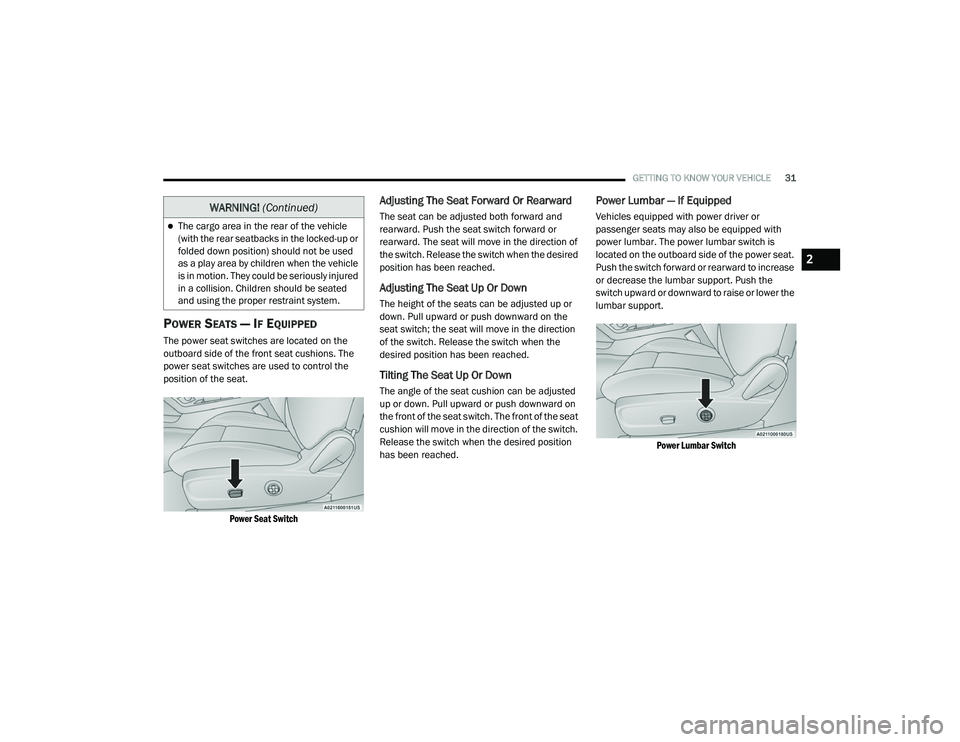
POWER SEATS — IF EQUIPPED
The power seat switches are located on the
outboard side of the front seat cushions. The
power seat switches are used to control the
position of the seat.
Power Seat Switch
Adjusting The Seat Forward Or Rearward
The seat can be adjusted both forward and
rearward. Push the seat switch forward or
rearward. The seat will move in the direction of
the switch. Release the switch when the desired
position has been reached.
Adjusting The Seat Up Or Down
The height of the seats can be adjusted up or
down. Pull upward or push downward on the
seat switch; the seat will move in the direction
of the switch. Release the switch when the
desired position has been reached.
Tilting The Seat Up Or Down
The angle of the seat cushion can be adjusted
up or down. Pull upward or push downward on
the front of the seat switch. The front of the seat
cushion will move in the direction of the switch.
Release the switch when the desired position
has been reached.
Power Lumbar — If Equipped
Vehicles equipped with power driver or
passenger seats may also be equipped with
power lumbar. The power lumbar switch is
located on the outboard side of the power seat.
Push the switch forward or rearward to increase
or decrease the lumbar support. Push the
switch upward or downward to raise or lower the
lumbar support.
Power Lumbar Switch
The cargo area in the rear of the vehicle
(with the rear seatbacks in the locked-up or
folded down position) should not be used
as a play area by children when the vehicle
is in motion. They could be seriously injured
in a collision. Children should be seated
and using the proper restraint system.
WARNING! (Continued)
2
20_LA_OM_EN_USC_t.book Page 31
Page 36 of 396

34GETTING TO KNOW YOUR VEHICLE
PASSENGER SEAT EASY ENTRY
On the passenger seat, pull forward on the lever
located on the side of the seatback in order to
dump the seatback and slide the seat forward.
You can also temporarily remove the seat belt
from the guide loop on the seat and allow the
seat belt to retract out of the way. This allows for easier access to the rear seat. To
return the seat to a normal seating position,
first return the seatback to its original recline
location and then slide the entire seat back to
the pre-set lock position.
Easy Entry Lever
NOTE:
The front passenger seat needs to slide back
to a pre-set position for the fore-aft adjuster
to be properly locked. For example, if the
front passenger has the seat adjusted full
rear and exits the vehicle to let a rear
passenger enter using the easy entry handle,
the fore-aft adjuster needs to slide back
about 2/3 of the way rearward to hit the lock
position. If the adjuster is not returned to this
pre-set position, the seat will appear to be
loose.
Also, if the front passenger uses the easy
entry handle and then lifts up the recliner
handle without moving the seat back to its
original pre-set position, the recliner will not
lock until it is moved to the full recline
position.
Driver’s Side Easy Entry
The easy entry lever on the outboard side of the
driver’s seatback will dump the seatback
forward to allow for easier access to the rear
seats. The seat bottom will not slide forward as
the passenger side easy entry will. If needed,
use the driver’s side seat control to slide
forward.
To return the seat to the normal position, push
the seatback up and it will lock into the
previously set recline position. Then if needed,
use the seat control to adjust the forward/
rearward position.
HEAD RESTRAINTS
Head restraints are designed to reduce the risk
of injury by restricting head movement in the
event of a rear impact. Head restraints should
be adjusted so that the top of the head restraint
is located above the top of your ear.
Be sure everyone in your vehicle is in a seat
and using a seat belt properly. Occupants,
including the driver, should always wear
their seat belts whether or not an air bag is
also provided at their seating positions to
minimize the risk of severe injury or death
in the event of a crash.
All occupants, including the driver, should
not operate a vehicle or sit in a vehicle’s
seat if the head restraints are not in place
of their proper positions in order to mini -
mize the risk of neck injury in the event of a
crash.
Head restraints should never be adjusted
while the vehicle is in motion. Driving a
vehicle with the head restraints improperly
adjusted or removed could cause serious
injury or death in the event of a collision.
WARNING! (Continued)
20_LA_OM_EN_USC_t.book Page 34
Page 39 of 396

GETTING TO KNOW YOUR VEHICLE37
STEERING WHEEL
MANUAL TILT/TELESCOPING STEERING
C
OLUMN — IF EQUIPPED
This feature allows you to tilt the steering
column upward or downward. It also allows you
to lengthen or shorten the steering column. The
tilt/telescoping lever is located below the
steering wheel at the end of the steering
column.
Manual Tilt/Telescoping Control Handle
To unlock the steering column, pull the lever
downward. To tilt the steering column, move the
steering wheel upward or downward as desired.
To lengthen or shorten the steering column, pull
the steering wheel outward or push it inward as
desired. To lock the steering column in position,
push the lever upward until fully engaged.
POWER TILT/TELESCOPING STEERING
C
OLUMN — IF EQUIPPED
This feature allows you to tilt the steering
column upward or downward. It also allows you
to lengthen or shorten the steering column. The
power tilt/telescoping steering column switch is
located below the multifunction switch on the
steering column.
Power Tilt/Telescoping Switch
To tilt the steering column, move the switch up
or down as desired. To lengthen or shorten the
steering column, pull the switch toward you or
push the switch away from you as desired.
WARNING!
Do not adjust the steering column while
driving. Adjusting the steering column while
driving or driving with the steering column
unlocked, could cause the driver to lose
control of the vehicle. Failure to follow this
warning may result in serious injury or death.
WARNING!
Do not adjust the steering column while
driving. Adjusting the steering column while
driving or driving with the steering column
unlocked, could cause the driver to lose
control of the vehicle. Failure to follow this
warning may result in serious injury or death.
2
20_LA_OM_EN_USC_t.book Page 37
Page 42 of 396

40GETTING TO KNOW YOUR VEHICLE
ILLUMINATED VANITY MIRRORS
An illuminated vanity mirror is on the sun visor.
To use the mirror, rotate the sun visor
downward and swing the mirror cover upward.
The light turns on automatically. Close the
mirror cover to turn off the light.
Illuminated Vanity Mirror
“Slide-On-Rod” And Extender Features Of
Sun Visor
To use the “Slide-On-Rod” feature of the sun
visor, rotate the sun visor downward and swing
the sun visor so it is parallel to the side window,
pull the sun visor rearwards until it is in the
desired position. To use the extender feature of the sun visor,
grab the extender which is located at the rear of
the visor and pull rearward.
Slide-On-Rod Extender
EXTERIOR LIGHTS
HEADLIGHT SWITCH
The headlight switch is located on the left side
of the instrument panel. This switch controls the
operation of the headlights, parking lights,
instrument panel lights, instrument panel
light dimming, interior lights and fog lights
(if equipped).
Headlight Switch
Rotate the headlight switch clockwise to the
first detent for parking light and instrument
panel light operation. Rotate the headlight
switch to the second detent for headlight,
parking light and instrument panel light
operation. Push the switch to enable fog lights
(if equipped).
1 — Rotate Headlight Control
2 — Push Fog Light Control
3 — Instrument Panel Dimmer Control
4 — Ambient Light Dimmer Control
20_LA_OM_EN_USC_t.book Page 40