2020 DODGE CHALLENGER load capacity
[x] Cancel search: load capacityPage 279 of 396
SERVICING AND MAINTENANCE277
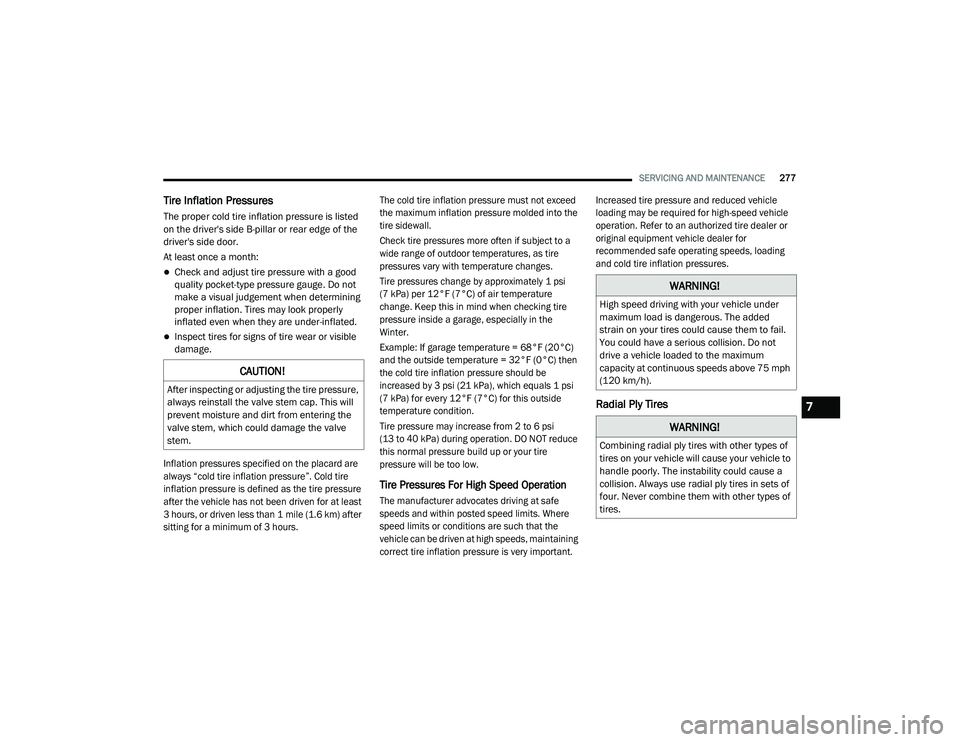
Tire Inflation Pressures
The proper cold tire inflation pressure is listed
on the driver's side B-pillar or rear edge of the
driver's side door.
At least once a month:
Check and adjust tire pressure with a good
quality pocket-type pressure gauge. Do not
make a visual judgement when determining
proper inflation. Tires may look properly
inflated even when they are under-inflated.
Inspect tires for signs of tire wear or visible
damage.
Inflation pressures specified on the placard are
always “cold tire inflation pressure”. Cold tire
inflation pressure is defined as the tire pressure
after the vehicle has not been driven for at least
3 hours, or driven less than 1 mile (1.6 km) after
sitting for a minimum of 3 hours. The cold tire inflation pressure must not exceed
the maximum inflation pressure molded into the
tire sidewall.
Check tire pressures more often if subject to a
wide range of outdoor temperatures, as tire
pressures vary with temperature changes.
Tire pressures change by approximately 1 psi
(7 kPa) per 12°F (7°C) of air temperature
change. Keep this in mind when checking tire
pressure inside a garage, especially in the
Winter.
Example: If garage temperature = 68°F (20°C)
and the outside temperature = 32°F (0°C) then
the cold tire inflation pressure should be
increased by 3 psi (21 kPa), which equals 1 psi
(7 kPa) for every 12°F (7°C) for this outside
temperature condition.
Tire pressure may increase from 2 to 6 psi
(13 to 40 kPa) during operation. DO NOT reduce
this normal pressure build up or your tire
pressure will be too low.
Tire Pressures For High Speed Operation
The manufacturer advocates driving at safe
speeds and within posted speed limits. Where
speed limits or conditions are such that the
vehicle can be driven at high speeds, maintaining
correct tire inflation pressure is very important.Increased tire pressure and reduced vehicle
loading may be required for high-speed vehicle
operation. Refer to an authorized tire dealer or
original equipment vehicle dealer for
recommended safe operating speeds, loading
and cold tire inflation pressures.
Radial Ply Tires
CAUTION!
After inspecting or adjusting the tire pressure,
always reinstall the valve stem cap. This will
prevent moisture and dirt from entering the
valve stem, which could damage the valve
stem.
WARNING!
High speed driving with your vehicle under
maximum load is dangerous. The added
strain on your tires could cause them to fail.
You could have a serious collision. Do not
drive a vehicle loaded to the maximum
capacity at continuous speeds above 75 mph
(120 km/h).
WARNING!
Combining radial ply tires with other types of
tires on your vehicle will cause your vehicle to
handle poorly. The instability could cause a
collision. Always use radial ply tires in sets of
four. Never combine them with other types of
tires.
7
20_LA_OM_EN_USC_t.book Page 277
Page 280 of 396

278SERVICING AND MAINTENANCE
Tire Repair
If your tire becomes damaged, it may be
repaired if it meets the following criteria:
The tire has not been driven on when flat.
The damage is only on the tread section of
your tire (sidewall damage is not repairable).
The puncture is no greater than a ¼ of an
inch (6 mm).
Consult an authorized tire dealer for tire repairs
and additional information.
Damaged Run Flat tires, or Run Flat tires that
have experienced a loss of pressure should be
replaced immediately with another Run Flat tire
of identical size and service description (Load
Index and Speed Symbol). Replace the tire
pressure sensor as well as it is not designed to
be reused.
Run Flat Tires — If Equipped
Run Flat tires allow you the capability to drive
50 miles (80 km) at 50 mph (80 km/h) after a
rapid loss of inflation pressure. This rapid loss
of inflation is referred to as the Run Flat mode.
A Run Flat mode occurs when the tire inflation
pressure is of/or below 14 psi (96 kPa). Once a
Run Flat tire reaches the run flat mode it has
limited driving capabilities and needs to be
replaced immediately. A Run Flat tire is not
repairable. When a run flat tire is changed after
driving with underinflated tire condition, please
replace the TPM sensor as it is not designed to
be reused when driven under run flat mode
14 psi (96 kPa) condition.
NOTE:
TPM Sensor must be replaced after driving the
vehicle on a flat tire condition.
It is not recommended driving a vehicle loaded
at full capacity or to tow a trailer while a tire is in
the run flat mode.
See the tire pressure monitoring section for
more information.
Tire Spinning
When stuck in mud, sand, snow, or ice
conditions, do not spin your vehicle's wheels
above 30 mph (48 km/h) or for longer than
30 seconds continuously without stopping.
Refer to “Freeing A Stuck Vehicle” in “In Case Of
Emergency” for further information.
Tread Wear Indicators
Tread wear indicators are in the original
equipment tires to help you in determining
when your tires should be replaced.
WARNING!
Fast spinning tires can be dangerous. Forces
generated by excessive wheel speeds may
cause tire damage or failure. A tire could
explode and injure someone. Do not spin your
vehicle's wheels faster than 30 mph
(48 km/h) for more than 30 seconds
continuously when you are stuck, and do not
let anyone near a spinning wheel, no matter
what the speed.
20_LA_OM_EN_USC_t.book Page 278
Page 282 of 396

280SERVICING AND MAINTENANCE
(Continued)
It is recommended to replace the two front tires
or two rear tires as a pair. Replacing just one tire
can seriously affect your vehicle’s handling. If
you ever replace a wheel, make sure that the
wheel’s specifications match those of the
original wheels.
It is recommended you contact an authorized
tire dealer or original equipment dealer with any
questions you may have on tire specifications or
capability. Failure to use equivalent
replacement tires may adversely affect the
safety, handling, and ride of your vehicle.
TIRE TYPES
All Season Tires — If Equipped
All Season tires provide traction for all seasons
(Spring, Summer, Autumn, and Winter). Traction
levels may vary between different all season
tires. All season tires can be identified by the
M+S, M&S, M/S or MS designation on the tire
sidewall. Use all season tires only in sets of four; failure to do so may adversely affect the safety
and handling of your vehicle.
Summer Or Three Season Tires — If
Equipped
Summer tires provide traction in both wet and
dry conditions, and are not intended to be
driven in snow or on ice. If your vehicle is
equipped with Summer tires, be aware these
tires are not designed for Winter or cold driving
conditions. Install Winter tires on your vehicle
when ambient temperatures are less than 40°F
(5°C) or if roads are covered with ice or snow.
For more information, contact an authorized
dealer.
Summer tires do not contain the all season
designation or mountain/snowflake symbol on
the tire sidewall. Use Summer tires only in sets
of four; failure to do so may adversely affect the
safety and handling of your vehicle.
WARNING!
Do not use a tire, wheel size, load rating, or
speed rating other than that specified for
your vehicle. Some combinations of unap
-
proved tires and wheels may change
suspension dimensions and performance
characteristics, resulting in changes to
steering, handling, and braking of your
vehicle. This can cause unpredictable
handling and stress to steering and
suspension components. You could lose
control and have a collision resulting in
serious injury or death. Use only the tire and
wheel sizes with load ratings approved for
your vehicle.
Never use a tire with a smaller load index or
capacity, other than what was originally
equipped on your vehicle. Using a tire with
a smaller load index could result in tire
overloading and failure. You could lose
control and have a collision.
Failure to equip your vehicle with tires
having adequate speed capability can
result in sudden tire failure and loss of
vehicle control.
CAUTION!
Replacing original tires with tires of a
different size may result in false speedometer
and odometer readings.
WARNING! (Continued)
WARNING!
Do not use Summer tires in snow/ice
conditions. You could lose vehicle control,
resulting in severe injury or death. Driving too
fast for conditions also creates the possibility
of loss of vehicle control.
20_LA_OM_EN_USC_t.book Page 280
Page 383 of 396

381
Automatic Transmission Limp
Home Mode
............................................ 28, 163AutoPark........................................................ 150Autostick Operation.................................................. 164Aux Mode....................................................... 350Axle Fluid........................... 299, 301, 302, 304Axle Lubrication................. 299, 301, 302, 304
B
Back-Up......................................................... 186Battery.................................................... 84, 251Charging System Light................................. 84Keyless Key Fob Replacement.................... 14Location.................................................... 251Belts, Seat..................................................... 146Blind Spot Monitoring.................................... 100BluetoothConnect Or Disconnect Link Betweenthe Uconnect Phone And Mobile
Phone
................................................... 366Connecting To A Particular Mobile PhoneOr Audio Device After Pairing................361Bluetooth Mode............................................. 351Body Mechanism Lubrication........................ 259B-Pillar Location............................................. 273Brake Assist System........................................ 94Brake Control System...................................... 94Brake Fluid...............266, 299, 301, 302, 304
Brake System...................................... 266, 291Fluid Check.......... 266, 299, 301, 302, 304Master Cylinder........................................ 266Parking..................................................... 154Warning Light.....................................83, 291Brake/Transmission Interlock...................... 160Break-In Recommendations, New Vehicle.... 152Brightness, Interior Lights................................ 44Bulb Replacement........................................ 204Bulbs, Light.......................................... 147, 204
C
Camera, Rear................................................ 186Capacities, Fluid.................................. 297, 298Caps, FillerFuel.......................................................... 188Oil (Engine)...................................... 246, 254Radiator (Coolant Pressure)..................... 264Car Washes................................................... 288Carbon Monoxide Warning................... 145, 296CargoVehicle Loading........................................ 189Cellular Phone.............................................. 368Certification Label......................................... 189Chains, Tire.......................................... 284, 285Changing A Flat Tire...................................... 269Chart, Tire Sizing........................................... 270
Check Engine Light
(Malfunction Indicator Light)............................92Checking Your Vehicle For Safety.................. 145Checks, Safety.............................................. 145Child Restraint.............................................. 130Child RestraintsBooster Seats........................................... 133Child Seat Installation............................... 142How To Stow An unused ALR Seat Belt..... 139Infant And Child Restraints....................... 132Lower Anchors And Tethers For Children................................................ 135Older Children And Child Restraints.......... 132Seating Positions...................................... 134Clean Air Gasoline......................................... 294CleaningWheels...................................................... 283Climate Control................................................47Cold Weather Operation................................ 151Compact Spare Tire...................................... 281Contract, Service........................................... 377Cooling Pressure Cap (Radiator Cap)............ 264Cooling System............................................. 262Adding Coolant (Antifreeze)...................... 263Coolant Level................................... 262, 265Cooling Capacity.............................. 297, 298Disposal Of Used Coolant......................... 26511
20_LA_OM_EN_USC_t.book Page 381
Page 387 of 396
385
Loading Vehicle
................................... 189, 190Capacities................................................. 190Tires.......................................................... 273Locks Auto Unlock................................................. 28Automatic Door........................................... 28Power Door.................................................. 25Low Tire Pressure System............................. 107Lubrication, Body........................................... 259Lug Nuts/Bolts.............................................. 291
M
Maintenance................................................... 57Maintenance Free Battery............................. 251Maintenance Schedule............... 234, 239, 240Malfunction Indicator Light
(Check Engine)......................................... 86, 92ManualBackward............................................. 29, 30Forward................................................ 29, 30Park Release............................................. 229Rearward..................................................... 29Service...................................................... 379Tilt............................................................... 30Manual Transmission................. 155, 267, 268Fluid Level Check............................ 267, 268Map/Reading Lights........................................ 43Methanol....................................................... 295
Mirrors............................................................. 38Electric Powered.......................................... 39Electric Remote........................................... 39Heated......................................................... 39Outside........................................................ 39Rearview.............................................38, 199Vanity.......................................................... 40Modifications/AlterationsVehicle......................................................... 10Monitor, Tire Pressure System...................... 107Mopar Parts.................................................. 378Multi-Function Control Lever............................ 41
N
New Vehicle Break-In Period......................... 152
O
Occupant Restraints..................................... 111Octane Rating, Gasoline (Fuel)... 293, 299, 302Oil Change Indicator........................................ 75Reset........................................................... 75Oil Filter, Change.......................................... 255Oil Filter, Selection........................................ 255Oil Pressure Light............................................. 84Oil, Engine................................... 252, 299, 302Capacity........................................... 297, 298Change Interval........................................ 252Checking................................................... 250Dipstick.................................................... 250Disposal................................................... 255
Filter....................................... 255, 299, 302Filter Disposal........................................... 255Identification Logo.................................... 253Materials Added To................................... 255Pressure Warning Light................................84Recommendation................... 252, 297, 298Synthetic................................................... 254Viscosity........................ 253, 254, 297, 298Onboard Diagnostic System.............................91Operating Precautions.....................................91Operator ManualOwner's Manual....................................9, 379Outside Rearview Mirrors.................................39Overheating, Engine...................................... 229Owner’s Manual (Operator Manual)................... 9
P
Paddle Shift Mode........................................ 164Paddle Shifters............................................. 164Paint Care..................................................... 287Panic Alarm......................................................14Parking Brake............................................... 154ParkSense System, Rear............................... 181Passenger SeatEasy Entry....................................................34Passing Light....................................................42Performance....................................................77Pets............................................................... 145Pinch Protection...............................................56Placard, Tire And Loading Information.......... 273
11
20_LA_OM_EN_USC_t.book Page 385
Page 390 of 396

388 Changing
................................ 216, 217, 269Compact Spare......................................... 281General Information........................ 276, 281High Speed................................................ 277Inflation Pressure...................................... 277Jacking............................................ 217, 269Life Of Tires............................................... 279Load Capacity............................................ 273Pressure Monitoring System(TPMS)........................................... 87, 107Quality Grading.......................................... 286Radial........................................................ 277Replacement............................................. 279Rotation.................................................... 285Safety.............................................. 269, 276Sizes.......................................................... 270Snow Tires................................................. 281Spare Tires............................. 216, 281, 282Spinning.................................................... 278Trailer Towing............................................ 194Tread Wear Indicators............................... 278Wheel Nut Torque..................................... 291To Open Hood.................................................. 57Tongue Weight/Trailer Weight....................... 193Towing........................................................... 190Disabled Vehicle........................................ 232Guide......................................................... 192Recreational.............................................. 197Weight....................................................... 192
Towing Behind A Motorhome........................ 197Traction......................................................... 197Traction Control............................................ 100Trailer Towing............................................... 190Cooling System Tips................................. 196Hitches..................................................... 191Minimum Requirements........................... 193Tips........................................................... 196Trailer And Tongue Weight........................ 193Wiring....................................................... 195Trailer Towing Guide..................................... 192Trailer Weight................................................ 192Transfer CaseFluid.............................. 268, 299, 301, 302Maintenance............................................ 268Transmission................................................ 160Automatic............................... 158, 160, 267Fluid.............................. 299, 301, 302, 304Maintenance............................................ 267Manual..................................................... 155Shifting..................................................... 158Transporting Pets.......................................... 145Tread Wear Indicators.................................. 278Trunk Lid (Deck Lid)......................................... 58Trunk Release Remote Control........................ 58Turn Signals.............................................. 43, 89
U
UconnectAdvanced Phone Connectivity
................... 366Phone Call Features................................. 363Things You Should Know About YourUconnect Phone................................... 366Uconnect Settings............... 13, 14, 21, 317Uconnect 4 With 7-Inch Display.................... 307Uconnect 4C/4C Nav With 8.4-Inch
Display.......................................................... 323Uconnect Phone................ 359, 360, 361, 362Answer Or Ignore An Incoming Call — Call Currently In Progress..................... 364Answer Or Ignore An Incoming Call — No Call Currently In Progress................ 364Bluetooth Communication Link................ 367Call By Saying A Phonebook Name........... 363Call Continuation...................................... 366Call Controls............................................. 364Call Termination....................................... 365Cancel Command..................................... 359Connect Or Disconnect Link Between The Uconnect Phone And Mobile
Phone
................................................... 366Connecting To A Particular Mobile Phone Or Audio Device After Pairing..... 361Deleting A Phone Or Audio Device............ 362Dial By Saying A Number.......................... 363
20_LA_OM_EN_USC_t.book Page 388