Page 241 of 396

SERVICING AND MAINTENANCE239
Heavy Duty Use Of The Vehicle
Change engine oil at 4,000 miles (6,500 km) or
350 hours of engine run time if the vehicle is
operated in a dusty and off road environment or
is operated predominately at idle or only very
low engine RPM. This type of vehicle use is
considered Severe Duty.
6.2L SUPERCHARGED AND 6.4L
E
NGINES
The scheduled maintenance services listed in
this manual must be done at the times or
mileages specified to protect your vehicle
warranty and ensure the best vehicle
performance and reliability. More frequent
maintenance may be needed for vehicles in
severe operating conditions, such as dusty
areas and very short trip driving. Inspection and
service should also be done anytime a
malfunction is suspected.
The oil change indicator system will remind you
that it is time to take your vehicle in for
scheduled maintenance.
An “Oil Change Required” message will be
displayed in the instrument cluster and a single
chime will sound, indicating that an oil change
is necessary. Based on engine operation conditions, the oil
change indicator message will illuminate. This
means that service is required for your vehicle.
Have your vehicle serviced as soon as possible,
within the next 500 miles (805 km).
NOTE:
The oil change indicator message will not
monitor the time since the last oil change.
Change your vehicle's oil if it has been six
months since your last oil change, even if the
oil change indicator message is NOT illumi-
nated.
Change your engine oil more often if you drive
your vehicle off-road/track usage for an
extended period of time.
Under no circumstances should oil change
intervals exceed 6,000 miles (10,000 km) or
6 months, whichever comes first.
An authorized dealer will reset the oil change
indicator message after completing the
scheduled oil change. If a scheduled oil change
is performed by someone other than an
authorized dealer, the message can be reset by
referring to the steps described under
“Instrument Cluster Display” in “Getting To
Know Your Instrument Panel” for further
information. At Each Stop For Fuel
Check the engine oil level. Refer to “Engine
Compartment” in this chapter for further
information.
Check the windshield washer solvent and
add if required.
Once A Month
Check tire pressure and look for unusual
wear or damage.
Inspect the battery, and clean and tighten the
terminals as required.
Check the fluid levels of the coolant reservoir,
brake master cylinder and add as needed.
Check all lights and other electrical items for
correct operation.
At Each Oil Change
Change the engine oil filter.
Inspect the brake hoses and lines.
Inspect the CV/Universal joints.
CAUTION!
Failure to perform the required maintenance
items may result in damage to the vehicle.
7
20_LA_OM_EN_USC_t.book Page 239
Page 244 of 396
242SERVICING AND MAINTENANCE
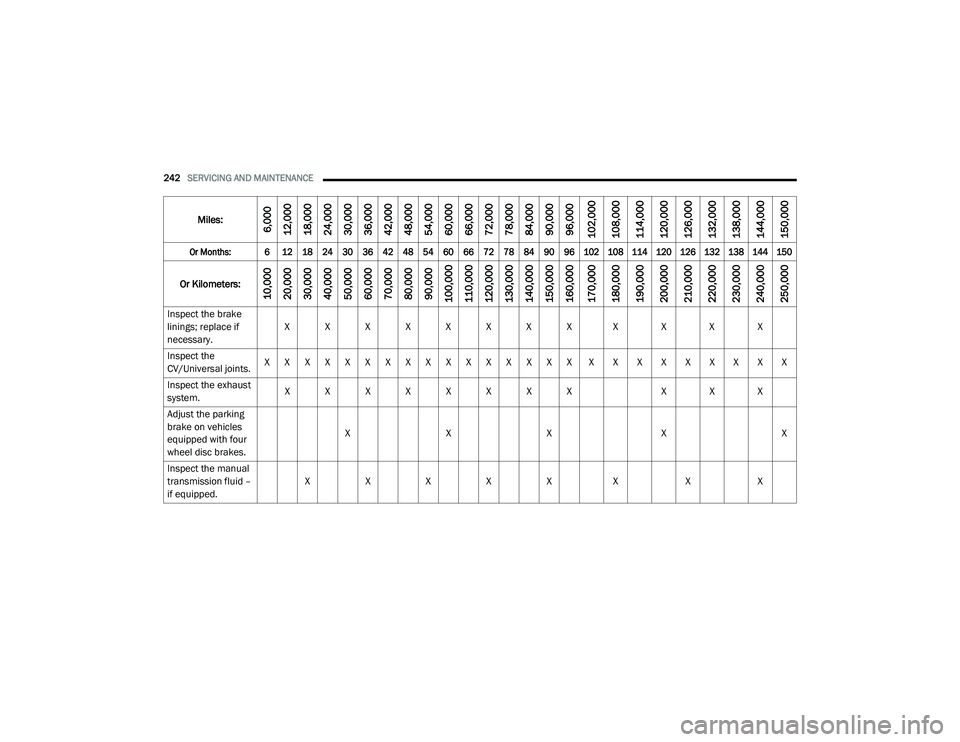
Inspect the brake
linings; replace if
necessary.X X X X X X X X X X X X
Inspect the
CV/Universal joints. X X X X X X X X X X X X X X X X X X X X X X X X X
Inspect the exhaust
system. X X X X X X X X
X X X
Adjust the parking
brake on vehicles
equipped with four
wheel disc brakes. X
XX X X
Inspect the manual
transmission fluid –
if equipped. X
XXXX X XX
Miles:
6,000
12,000
18,000
24,000
30,000
36,000
42,000
48,000
54,000
60,000
66,000
72,000
78,000
84,000
90,000
96,000
102,000
108,000
114,000
120,000
126,000
132,000
138,000
144,000
150,000
Or Months: 6 12 18 24 30 36 42 48 54 60 66 72 78 84 90 96 102 108 114 120 126 132 138 144 150
Or Kilometers:
10,000
20,000
30,000
40,000
50,000
60,000
70,000
80,000
90,000
100,000
110,000
120,000
130,000
140,000
150,000
160,000
170,000
180,000
190,000
200,000
210,0 00
220,000
230,000
240,000
250,000
20_LA_OM_EN_USC_t.book Page 242
Page 248 of 396
246SERVICING AND MAINTENANCE
ENGINE COMPARTMENT
3.6L ENGINE
1 — Power Distribution Center (Fuses) 5 — Engine Air Cleaner Filter
2 — Engine Oil Fill 6 — Engine Oil Dipstick
3 — Brake Fluid Reservoir Access Cover 7 — Washer Fluid Reservoir Cap
4 — Engine Coolant Pressure Reservoir
20_LA_OM_EN_USC_t.book Page 246
Page 249 of 396
SERVICING AND MAINTENANCE247
5.7L ENGINE
1 — Power Distribution Center (Fuses) 5 — Engine Air Cleaner Filter
2 — Engine Oil Fill 6 — Engine Oil Dipstick
3 — Brake Fluid Reservoir Access Cover 7 — Washer Fluid Reservoir Cap
4 — Engine Coolant Pressure Reservoir
7
20_LA_OM_EN_USC_t.book Page 247
Page 250 of 396
248SERVICING AND MAINTENANCE
6.2L SUPERCHARGED ENGINE
1 — Intercooler Fluid Pressure Reservoir 5 — Engine Air Cleaner Filter
2 — Engine Oil Fill 6 — Engine Oil Dipstick
3 — Brake Fluid Reservoir Access Cover 7 — Power Distribution Center (Fuses)
4 — Engine Coolant Pressure Reservoir 8 — Washer Fluid Reservoir Cap
20_LA_OM_EN_USC_t.book Page 248
Page 251 of 396
SERVICING AND MAINTENANCE249
6.4L ENGINE
1 — Power Distribution Center (Fuses) 5 — Engine Air Cleaner Filter
2 — Engine Oil Fill 6 — Engine Oil Dipstick
3 — Brake Fluid Reservoir Access Cover 7 — Washer Fluid Reservoir Cap
4 — Engine Coolant Pressure Reservoir
7
20_LA_OM_EN_USC_t.book Page 249
Page 268 of 396

266SERVICING AND MAINTENANCE
(Continued)
BRAKE SYSTEM
In order to ensure brake system performance,
all brake system components should be
inspected periodically. Refer to the
“Maintenance Plan” in this section for the
proper maintenance intervals.
Fluid Level Check — Brake Master Cylinder
Check the fluid level in the master cylinder
immediately if the brake system warning light
indicates system failure.
Check the fluid level in the master cylinder
when performing underhood services.
Clean the top of the master cylinder area before
removing the cap. Add fluid to bring the level up
to the top of the “FULL” mark on the side of the
master cylinder reservoir.Overfilling of fluid is not recommended because
it may cause leaking in the system.
Add enough fluid to bring the level up to the
requirements described on the brake fluid
reservoir. With disc brakes, fluid level can be
expected to fall as the brake pads wear.
However, low fluid level may be caused by a
leak and a checkup may be needed.
Use only brake fluid that has been
recommended by the manufacturer, and has
been kept in a tightly closed container to avoid
contamination from foreign matter or moisture.
Refer to “Fluids And Lubricants” in “Technical
Specifications” for further information.
WARNING!
Riding the brakes can lead to brake failure
and possibly a collision. Driving with your foot
resting or riding on the brake pedal can result
in abnormally high brake temperatures,
excessive lining wear, and possible brake
damage. You would not have your full braking
capacity in an emergency.
WARNING!
Use only manufacturer's recommended
brake fluid. Refer to “Fluids And Lubri
-
cants” in “Technical Specifications” for
further information. Using the wrong type of
brake fluid can severely damage your brake
system and/or impair its performance. The
proper type of brake fluid for your vehicle is
also identified on the original factory
installed hydraulic master cylinder
reservoir.
To avoid contamination from foreign matter
or moisture, use only new brake fluid or
fluid that has been in a tightly closed
container. Keep the master cylinder reser -
voir cap secured at all times. Brake fluid in
a open container absorbs moisture from
the air resulting in a lower boiling point. This
may cause it to boil unexpectedly during
hard or prolonged braking, resulting in
sudden brake failure. This could result in a
collision.
Overfilling the brake fluid reservoir can
result in spilling brake fluid on hot engine
parts, causing the brake fluid to catch fire.
Brake fluid can also damage painted and
vinyl surfaces, care should be taken to
avoid its contact with these surfaces.
Do not allow petroleum based fluid to
contaminate the brake fluid. Brake seal
components could be damaged, causing
partial or complete brake failure. This could
result in a collision.
WARNING! (Continued)
20_LA_OM_EN_USC_t.book Page 266
Page 269 of 396

SERVICING AND MAINTENANCE267
CLUTCH HYDRAULIC SYSTEM — MANUAL
T
RANSMISSION (IF EQUIPPED)
The clutch hydraulic system is fed by a
segregated volume of fluid within the brake
system master cylinder reservoir. In the event of
leakage or wear, use only the manufacturer's
recommended brake fluid. Refer to “Fluids And
Lubricants” in “Technical Specifications” for
further information.
MANUAL TRANSMISSION — IF EQUIPPED
Fluid Level Check
Check the fluid level by removing the fill plug on
the left side of the transmission. The fluid level
should be 1/4 inch (6.4mm) below the bottom
of the fill hole. Add fluid, if necessary, to
maintain the proper level. Refer to “Fluids And
Lubricants” in “Technical Specifications” for
further information.
Change Transmission Fluid
If contaminated with water, change the fluid
immediately. See an authorized dealer for
service.
Refer to the “Maintenance Plan” in this section
for the proper maintenance intervals.
AUTOMATIC TRANSMISSION — IF
E
QUIPPED
Selection Of Lubricant
It is important to use the proper transmission
fluid to ensure optimum transmission
performance and life. Use only the
manufacturer's specified transmission fluid.
Refer to “Fluids And Lubricants” in “Technical
Specifications” for fluid specifications. It is
important to maintain the transmission fluid at
the correct level using the recommended fluid.
NOTE:
No chemical flushes should be used in any
transmission; only the approved lubricant
should be used.
Special Additives
The manufacturer strongly recommends
against using any special additives in the
transmission. Automatic Transmission Fluid
(ATF) is an engineered product and its
performance may be impaired by supplemental
additives. Therefore, do not add any fluid
additives to the transmission. Avoid using
transmission sealers as they may adversely
affect seals.
CAUTION!
Using a transmission fluid other than the
manufacturer's recommended fluid may
cause deterioration in transmission shift
quality and/or damage to the transmission.
Refer to “Fluids And Lubricants” in “Technical
Specifications” for fluid specifications.
CAUTION!
Using a transmission fluid other than the
manufacturer’s recommended fluid may
cause deterioration in transmission shift
quality and/or torque converter shudder.
Refer to “Fluids And Lubricants” in “Technical
Specifications” for fluid specifications.
CAUTION!
Do not use chemical flushes in your
transmission as the chemicals can damage
your transmission components. Such damage
is not covered by the New Vehicle Limited
Warranty.
7
20_LA_OM_EN_USC_t.book Page 267