2020 DACIA DUSTER eco
[x] Cancel search: ecoPage 175 of 244

Downloaded from www.Manualslib.com manuals search engine JauneNoir Noir texte
5.7
ENG_UD32703_1
Kit de gonflage des pneumatiques (H79 Ph2 - Dacia)
ENG_NU_1079-3_H79Ph2_Dacia_5
With the engine running and the par-
king brake applied,
– unroll the hose from the container;
– connect the compressor hose 3 to
the container’s inlet 8;
– depending on the vehicle, connect the container 8 to the compressor
from the container recess 7;
– unscrew the valve cap on the rele- vant wheel and screw on the contai-
ner’s inflation adapter 1;
– adapter 2 must be connected to the
vehicle accessories socket;
– press switch 4 to inflate the tyre to
the recommended pressure (please
refer to the information in the section
on “Tyre pressure”);
– after a maximum of 15 minutes, stop inflating and read the pressure (on
pressure gauge 5). Note: while the container is emp-
tying (approximately 30 seconds),
the pressure gauge
5 will briefly in-
dicate a pressure of up to 6 bar. The
pressure will then drop.
– adjust the pressure: to increase it, continue inflation with the kit; to
reduce it, press button 6.
If a minimum pressure of 1.8 bar is
not reached after 15 minutes, repair
is not possible; do not drive the vehi-
cle but contact an approved dealer.Nothing should be placed
around the driver’s feet
as such objects may slide
under the pedals during
sudden braking manoeuvres and
obstruct their use.
Please be aware that a
poorly tightened or missing
valve cap can make the
tyres less airtight and lead
to pressure loss. Always use valve
caps identical to the original ones
and ensure they are tightly screwed
on.
TYRE INFLATION KIT (3/4)
Page 176 of 244

Downloaded from www.Manualslib.com manuals search engine JauneNoir Noir texte
5.8
ENG_UD32703_1
Kit de gonflage des pneumatiques (H79 Ph2 - Dacia)
ENG_NU_1079-3_H79Ph2_Dacia_5
TYRE INFLATION KIT (4/4)
Once the tyre is correctly inflated,
remove the kit: slowly unscrew the in-
flation adapter 1 to prevent any repair
product from escaping and store the
container in plastic packaging to pre-
vent the product from escaping.
– Affix the driving recommendation label to the dashboard where it can
easily be seen by the driver;
– Put the kit away.
– At the end of this initial inflation ope- ration, air will still escape from the
tyre. You must drive a short distance
in order to seal the hole.
– Start immediately and drive at between 12 and 40 mph (20 and
60 km/h) in order to distribute the
product evenly in the tyre and, after
driving for 2 miles (3 km), stop and
check the pressure.
– If the pressure is greater than 1.3 bar but less than the recommended
pressure (refer to the label affixed to
the edge of the driver’s door), read-
just it. Otherwise, please contact an
authorised dealer: the tyre cannot be
repaired.
Precautions when using the
kit
The kit should not be operated for more
than 15 consecutive minutes.
1
Following repair with the kit,
do not travel further than
120 miles (200 km). In addi-
tion, reduce your speed and
under no circumstances exceed
48 mph (80 km/h). The sticker,
which you must affix in a prominent
position on the dashboard, reminds
you of this.
Depending on the country or local
legislation, a tyre repaired with the
inflation kit may need to be replaced.
Page 180 of 244
Downloaded from www.Manualslib.com manuals search engine JauneNoir Noir texte
5.12
ENG_UD20582_3
Pneumatiques (H79 - Dacia)ENG_NU_1079-3_H79Ph2_Dacia_5
TYRES (1/3)
Tyre and wheel safety
The tyres are the only contact between
the vehicle and the road, so it is essen-
tial to keep them in good condition.
You must make sure that your tyres
conform to local road traffic regulations.
When they need to be re-
placed, only tyres of the
same make, size, type and
profile should be used.
Tyres fitted to the vehicle should
either be identical to those fitted
originally or conform to those
recommended by your approved
dealer.Maintaining the tyres
The tyres must be in good condition
and the tread form must have sufficient
depth; tyres approved by our Technical
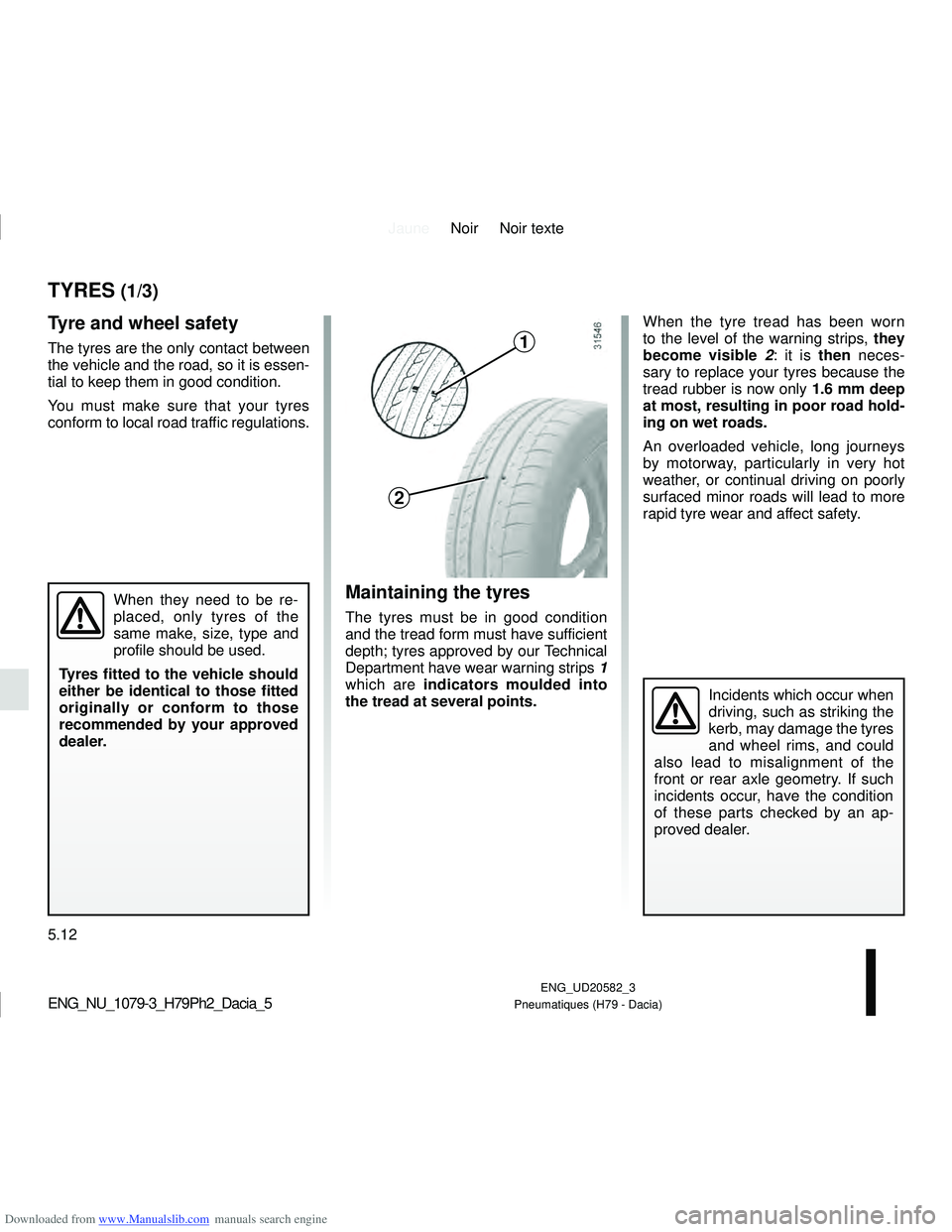
Department have wear warning strips 1
which are indicators moulded into
the tread at several points. When the tyre tread has been worn
to the level of the warning strips, they
become visible
2: it is then neces-
sary to replace your tyres because the
tread rubber is now only 1.6 mm deep
at most, resulting in poor road hold-
ing on wet roads.
An overloaded vehicle, long journeys
by motorway, particularly in very hot
weather, or continual driving on poorly
surfaced minor roads will lead to more
rapid tyre wear and affect safety.
Incidents which occur when
driving, such as striking the
kerb, may damage the tyres
and wheel rims, and could
also lead to misalignment of the
front or rear axle geometry. If such
incidents occur, have the condition
of these parts checked by an ap-
proved dealer.
1
2
Page 182 of 244
Downloaded from www.Manualslib.com manuals search engine JauneNoir Noir texte
5.14
ENG_UD20582_3
Pneumatiques (H79 - Dacia)ENG_NU_1079-3_H79Ph2_Dacia_5
Use in winter
Chains
2-wheel drive version (2WD)
Snow chains must be fitted to the
front wheels.
4-wheel drive version (4WD)
Snow chains may be fitted to only the
front wheels, or to all four wheels.
TYRES (3/3)
It is forbidden to fit snow
chains to only the rear
wheels.
Snow chains may only be
fitted to tyres of the same size as
those originally fitted to your vehicle.
Only certain chains can be fitted to
tyres.
Consult an approved dealer.
Snow or Winter tyres
We would recommend that these be
fitted to all four wheels to ensure that
your vehicle retains maximum adhe-
sion.
Warning: These tyres sometimes
have a specific direction of rotation
and a maximum speed index which
may be lower than the maximum
speed of your vehicle.
Studded tyres
This type of equipment may only be
used for a limited period and as laid
down by local legislation.
It is necessary to observe the speed
specified by current legislation.
These tyres must, at a minimum, be
fitted to the two front wheels.
In all cases, we would recommend
that you contact your approved
dealer who will be able to advise you
on the choice of equipment which is
most suitable for your vehicle.
Changing wheels around
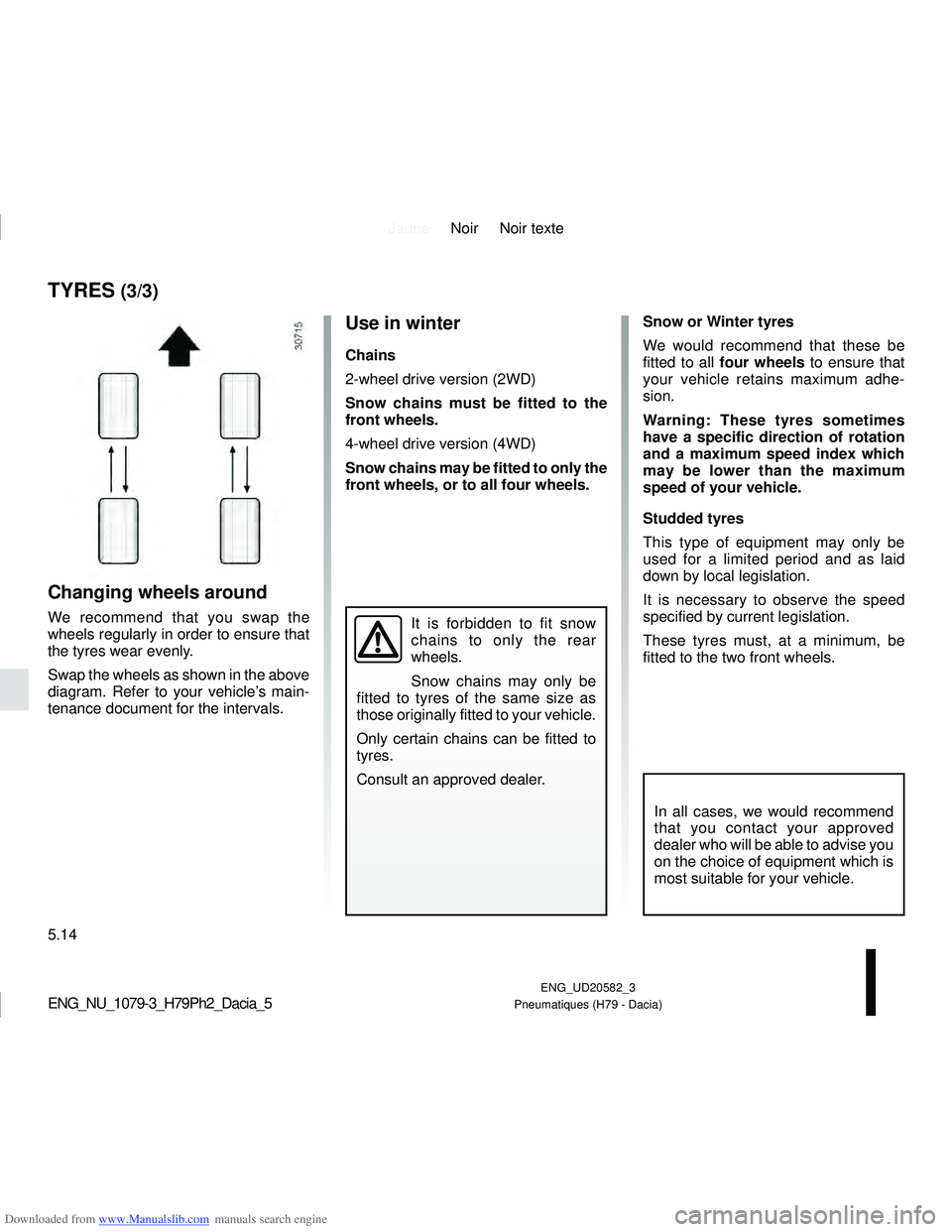
We recommend that you swap the
wheels regularly in order to ensure that
the tyres wear evenly.
Swap the wheels as shown in the above
diagram. Refer to your vehicle’s main-
tenance document for the intervals.
Page 183 of 244

Downloaded from www.Manualslib.com manuals search engine JauneNoir Noir texte
5.15
ENG_UD35430_2
Feux avant : remplacement des lampes (H79 Ph2 - Dacia)
ENG_NU_1079-3_H79Ph2_Dacia_5
The bulbs detailed below can be re-
placed. However, we recommend that
these be replaced by an approved
dealer if this proves difficult.
Dipped beam headlights
Remove cover A.
Unclip bulb 4 by pressing connector 3
downwards to release the bulb from
clips 2 and 1.
The bulbs are under pres-
sure and can break when
replaced.
Risk of injury.
FRONT LIGHTS: changing bulbs (1/4)
Do not touch the bulb glass. Hold it
by its base.
It is essential to use anti-UV bulbs so
as not to damage the plastic on the
headlights .
Remove bulb 4 from connector 3.
Bulb type: H7
Once the bulb has been replaced, be
sure to correctly reposition lug 5 in
notch 6, then refit cover A.
A
1
2
3
4
34
5
6
Page 203 of 244

Downloaded from www.Manualslib.com manuals search engine JauneNoir Noir texte
5.35
ENG_UD32190_1
Batterie : dépannage (H79 - Dacia)
ENG_NU_1079-3_H79Ph2_Dacia_5
BATTERY: troubleshooting (1/2)
To avoid all risk of sparks:
– Ensure that any consumers (cour- tesy lights, etc.) are switched off
before disconnecting or reconnect-
ing the battery;
– when charging, stop the charger before connecting or disconnecting
the battery;
– to avoid creating a short circuit be- tween the terminals, do not place
metal objects on the battery;
– always wait at least one minute after the engine has been switched off
before disconnecting a battery;
– make sure that you reconnect the battery terminals after refitting.
Handle the battery with care
as it contains sulphuric acid,
which must not come into
contact with eyes or skin. If
it does, wash the affected area with
plenty of cold water and consult a
doctor, if necessary.
Ensure that naked flames, red hot
objects and sparks do not come into
contact with the battery as there is a
risk of explosion.
The engine may be hot during oper-
ations in close proximity. In addition,
the engine cooling fan may start to
operate at any moment. Risk of se-
rious injury.
Certain batteries may have
specific recharging require-
ments; consult your au-
thorised dealer. Avoid any
risk of sparks, as this could cause
a sudden explosion, and always
charge the battery in a well-venti-
lated area. Risk of serious injury.
Connecting a battery charger
The battery charger must be com-
patible with a battery with nominal
voltage of 12 volts.
Do not disconnect the battery when the
engine is running. Follow the instruc-
tions given by the manufacturer of
the battery charger you are using.
When many accessories are fitted to
the vehicle, have them connected to
the + after ignition feed.
Page 205 of 244

Downloaded from www.Manualslib.com manuals search engine JauneNoir Noir texte
5.37
ENG_UD26988_1
Télécommande à radiofréquence : piles (X52 - Dacia)
ENG_NU_1079-3_H79Ph2_Dacia_5
Replacing the remote control
battery
Undo screw 1 to remove the remote
control cover. Replace battery
2 according to the di-
rection marked on the cover.
Note: It is not advisable to touch the
electronic circuit in the key cover when
replacing the battery.
Do not throw away your
used batteries; give them to
an organisation responsible
for collecting and recycling
batteries.
RADIO FREQUENCY REMOTE CONTROL: batteries
1
2
When refitting, ensure that the cover
is correctly clipped on and the screw
tightened.
The batteries are available from ap-
proved Dealers, and their service
life approximately two years.
Check that there is no dye on the
battery: risk of an incorrect electri-
cal contact.
Page 207 of 244

Downloaded from www.Manualslib.com manuals search engine JauneNoir Noir texte
5.39
ENG_UD33915_2
Remorquage : dépannage (H79 Ph2 - Dacia)
ENG_NU_1079-3_H79Ph2_Dacia_5
TOWING: breakdown (1/3)
Towing procedure
The steering wheel must be unlocked
and the ignition key must be in posi-
tion M (ignition on) to provide stop
lights and hazard warning lights on
the towed vehicle. Always switch on
the lights when driving at night.
Unhitch the trailer, etc., if one is being
towed.
You must observe the towing regu-
lations which apply in the country in
which you are driving: do not exceed
the towing weight for your vehicle.
Contact an approved Dealer.
Front and rear towing points
Only use the front 1 and rear 2
towing points.
When the engine is
stopped, steering and brak-
ing assistance are not op-
erational.
Do not leave the tools unse-
cured inside the vehicle as
they may come loose under
braking.
– Use a rigid towing bar (except for off-road recovery). If a rope or cable
is used (where the law allows this), the vehicle being towed must be a\
ble
to brake.
– A vehicle must not be towed if it is not fit to be driven.
– Avoid accelerating or braking suddenly when towing, as this may result in\
damage being caused to the vehicle.
– When towing a vehicle, it is advisable not to exceed 15 mph (25 km/h).
These towing points may only be used
for towing: never use them for lifting the
vehicle directly or indirectly.
12