2020 CADILLAC XT6 heating
[x] Cancel search: heatingPage 272 of 385

Cadillac XT6 Owner Manual (GMNA-Localizing-U.S./Canada-12984300) -
2020 - CRC - 3/19/19
VEHICLE CARE 271
water and DEX-COOL coolant. Be sure
the cooling system is cool before this
is done. SeeEngine Overheating 0272.
The coolant surge tank is located in
the engine compartment on the driver
side of the vehicle. See Engine
Compartment Overview 0263.
How to Add Coolant to the
Surge Tank
{Warning
Spilling coolant on hot engine parts
can burn you. Coolant contains
ethylene glycol and it will burn if
the engine parts are hot enough.
{Warning
Steam and scalding liquids from a
hot cooling system are under
pressure. Turning the pressure cap,
even a little, can cause them to
come out at high speed and you
could be burned. Never turn the cap
(Continued)
Warning (Continued)
when the cooling system, including
the pressure cap, is hot. Wait for
the cooling system and pressure
cap to cool.
Caution
Failure to follow the specific
coolant fill procedure could cause
the engine to overheat and could
cause system damage. If coolant is
not visible in the surge tank,
contact your dealer.
The coolant surge tank pressure cap
can be removed when the cooling
system, including the surge tank
pressure cap and upper radiator hose,
is no longer hot.
1. Turn the pressure cap slowly counterclockwise. If a hiss is
heard, wait for that to stop.
A hiss means there is still some
pressure left.
2. Keep turning the pressure cap slowly and remove it.
Page 273 of 385

Cadillac XT6 Owner Manual (GMNA-Localizing-U.S./Canada-12984300) -
2020 - CRC - 3/19/19
272 VEHICLE CARE
3. Fill the coolant surge tank withthe proper mixture to the mark
pointed to on the front of the
coolant surge tank.
4. With the coolant surge tank pressure cap off, start the engine
and let it run until you can feel
the upper radiator hose getting
hot. Watch out for the engine
cooling fans. By this time, the
coolant level inside the coolant
surge tank may be lower. If the
level is lower, add more of the
proper mixture to the coolant
surge tank until the level reaches
the mark pointed to on the front
of the coolant surge tank.
5. Replace the pressure cap tightly.
6. Verify coolant level after the engine is shut off and the
coolant is cold. If necessary,
repeat coolant fill procedure
Steps 1–6.Caution
If the pressure cap is not tightly
installed, coolant loss and engine
damage may occur. Be sure the cap
is properly and tightly secured.
Engine Overheating
The vehicle has several indicators to
warn of the engine overheating.
There is an engine coolant
temperature gauge on the instrument
cluster. See Engine Coolant Temperature
Gauge 0117. The vehicle may also
display a message on the Driver
Information Center (DIC).
If the decision is made not to lift the
hood when this warning appears, get
service help right away. See Roadside
Service 0353.
If the decision is made to lift the
hood, make sure the vehicle is parked
on a level surface. Then check to see if
the engine cooling fan is running.
If the engine is overheating, the fan should be running. If it is not, do not
continue to run the engine. Have the
vehicle serviced.
Caution
Do not run the engine if there is a
leak in the engine cooling system.
This can cause a loss of all coolant
and can damage the system and
vehicle. Have any leaks fixed
right away.
If Steam Is Coming from the
Engine Compartment
{Warning
Steam and scalding liquids from a
hot cooling system are under
pressure. Turning the pressure cap,
even a little, can cause them to
come out at high speed and you
could be burned. Never turn the cap
when the cooling system, including
the pressure cap, is hot. Wait for
the cooling system and pressure
cap to cool.
Page 285 of 385

Cadillac XT6 Owner Manual (GMNA-Localizing-U.S./Canada-12984300) -
2020 - CRC - 3/19/19
284 VEHICLE CARE
FusesUsage
F22 Electronic brake control module
F23 Parking/Trailer lamps
F24 Right trailer stoplamp/Turnlamp
F25 Steering column lock
F26 –
F27 Left trailer stoplamp/ Turnlamp
F28 –
F29 –
F30 Washer pump
F31 –
F32 Headlamp left
F33 –
F34 Horn
F35 –
F36 –
F37 Headlamp right
F38 – Fuses
Usage
F39 Transmission control module 1
F40 Left rear bus electrical center/DC DC ignition
F41 Instrument cluster
F42 Heating, ventilation, and air conditioning/
Central gateway
module/Run/Crank
F43 Head-up display
F44 Electronic brake control module
electric brake booster/
Run/Crank
F45 –
F46 –
F47 –
F48 Rear wiper 2
F49 Interior rearview mirror
F50 Fuel system control module/Run/Crank
F51 Heated steering wheel Fuses
Usage
F52 Folding seats switch
F53 –
F54 Coolant pump
F55 Air conditioning clutch
F56 –
F57 Engine control module/Ignition
F58 Transmission control module/Ignition
F59 Engine control module battery
F60 –
F61 O2 sensor 1/ Aeroshutter/Mass air
flow sensor
F62 Engine control module–odd
F63 O2 sensor 2
F64 Engine control module–even
Page 287 of 385
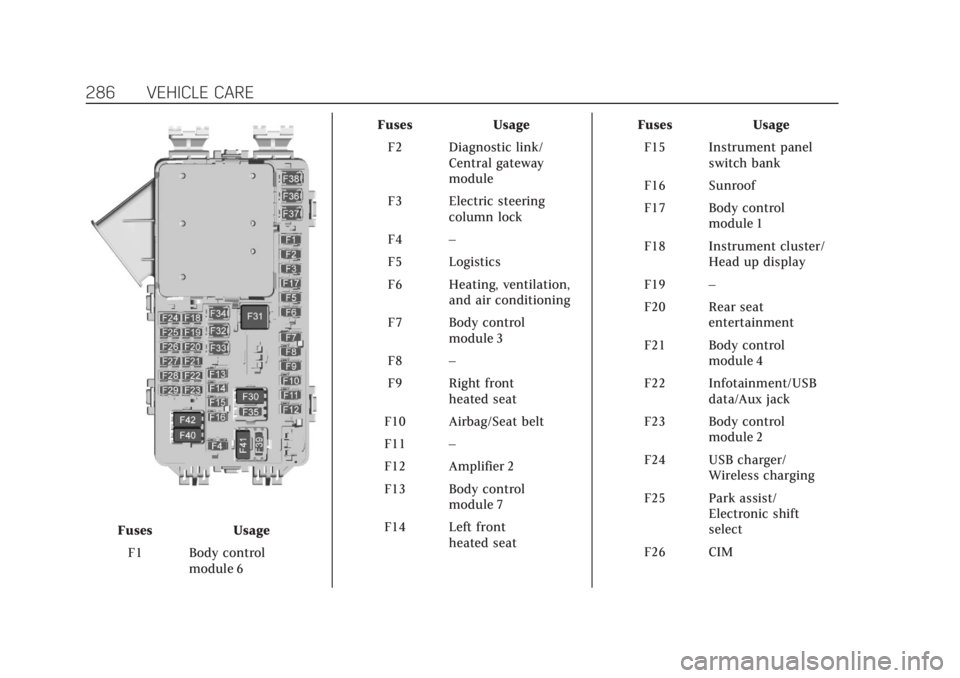
Cadillac XT6 Owner Manual (GMNA-Localizing-U.S./Canada-12984300) -
2020 - CRC - 3/19/19
286 VEHICLE CARE
FusesUsage
F1 Body control module 6 Fuses
Usage
F2 Diagnostic link/ Central gateway
module
F3 Electric steering column lock
F4 –
F5 Logistics
F6 Heating, ventilation, and air conditioning
F7 Body control module 3
F8 –
F9 Right front heated seat
F10 Airbag/Seat belt
F11 –
F12 Amplifier 2
F13 Body control module 7
F14 Left front heated seat Fuses
Usage
F15 Instrument panel switch bank
F16 Sunroof
F17 Body control module 1
F18 Instrument cluster/ Head up display
F19 –
F20 Rear seat entertainment
F21 Body control module 4
F22 Infotainment/USB data/Aux jack
F23 Body control module 2
F24 USB charger/ Wireless charging
F25 Park assist/ Electronic shift
select
F26 CIM
Page 288 of 385

Cadillac XT6 Owner Manual (GMNA-Localizing-U.S./Canada-12984300) -
2020 - CRC - 3/19/19
VEHICLE CARE 287
FusesUsage
F27 Video/Night vision module
F28 Heating, ventilation, and air conditioning
display
F29 Radio
F30 Steering wheel adjustment controls
F31 Electric brake boost
F32 DC AC inverter
F33 Driver power seat
F34 Passenger power seat
F35 Battery IEC 1 feed
F36 Electric power steering
F37 Rear seat entertainment/USB
charge/Wireless
charging module/
Auxiliary power
outlet/Lighter Fuses
Usage
F38 Body control module 8
F39 –
Circuit
Breakers Usage
F40 –
F41 –
F42 Auxiliary power outlet/LighterRear Compartment Fuse
Block
The rear compartment fuse block is in
the cargo area, on the driver side of
the vehicle behind the lower trim
panel. To access the fuses in the Rear
Electrical Center, remove the center
cargo bin then small side bin. See Rear
Storage 097. See your dealer if
additional assistance is needed.
The label for this fuse block is in the
spare tire area, on the foam under the
cargo floor.
Page 290 of 385

Cadillac XT6 Owner Manual (GMNA-Localizing-U.S./Canada-12984300) -
2020 - CRC - 3/19/19
VEHICLE CARE 289
FusesUsage
F38 Window module
F39 –
F40 Memory seat module
F41 Automatic occupancy sensor
F42 Trailer battery 2
F43 –
F44 Third row seats
F45 Liftgate motor
F46 Rear heated seats
F47 –
F48 Glass break sensor
F49 –
F50 –
F51 –
F52 Active dampening system module
F53 –
F54 External object calculating/Side blind
zone alert Fuses
Usage
F55 Theft deterrent
F56 Universal garage door opener/Rain sensor
F57 Folding seats 2
Circuit
Breakers Usage
CB1 –
CB2 –
CB3 Rear auxiliary power outlet
Relays Usage
K1 Folding seats 1
K2 –Wheels and Tires
Tires
Every new GM vehicle has
high-quality tires made by a
leading tire manufacturer. See the
warranty manual for information
regarding the tire warranty and
where to get service. For
additional information refer to the
tire manufacturer.
{Warning
.Poorly maintained and
improperly used tires are
dangerous.
.Overloading the tires can
cause overheating as a
result of too much flexing.
There could be a blowout
and a serious crash. See
Vehicle Load Limits 0176.
(Continued)
Page 298 of 385

Cadillac XT6 Owner Manual (GMNA-Localizing-U.S./Canada-12984300) -
2020 - CRC - 3/19/19
VEHICLE CARE 297
{Warning
Neither tire underinflation nor
overinflation is good.
Underinflated tires, or tires that
do not have enough air, can
result in:
.Tire overloading and
overheating which could
lead to a blowout.
.Premature or
irregular wear.
.Poor handling.
.Reduced fuel economy.
Overinflated tires, or tires that
have too much air, can result in:
.Unusual wear.
.Poor handling.
.Rough ride.
.Needless damage from
road hazards. The Tire and Loading Information
label on the vehicle indicates the
original equipment tires and the
correct cold tire inflation
pressures. The recommended
pressure is the minimum air
pressure needed to support the
vehicle's maximum load carrying
capacity. See
Vehicle Load Limits
0 176.
How the vehicle is loaded affects
vehicle handling and ride comfort.
Never load the vehicle with more
weight than it was designed to
carry.
When to Check
Check the pressure of the tires
once a month or more. Do not
forget the compact spare, if the
vehicle has one. The cold compact
spare tire pressure should be at
420 kPa (60 psi). See Compact
Spare Tire 0317. How to Check
Use a good quality pocket-type
gauge to check tire pressure.
Proper tire inflation cannot be
determined by looking at the tire.
Check the tire inflation pressure
when the tires are cold, meaning
the vehicle has not been driven for
at least three hours or no more
than 1.6 km (1 mi).
Remove the valve cap from the
tire valve stem. Press the tire
gauge firmly onto the valve to get
a pressure measurement. If the
cold tire inflation pressure
matches the recommended
pressure on the Tire and Loading
Information label, no further
adjustment is necessary. If the
inflation pressure is low, add air
until the recommended pressure is
reached. If the inflation pressure
is high, press on the metal stem in
the center of the tire valve to
release air.
Page 377 of 385

Cadillac XT6 Owner Manual (GMNA-Localizing-U.S./Canada-12984300) -
2020 - CRC - 3/19/19
376 INDEX
E
Electric Brake Boost . . . . . . . . . . . . . . . . 197
Electric Parking Brake . . . . . . . . . . . . . . 198
Electric Parking Brake Light . . . . . . . 122
Electrical Equipment, Add-On . . . . . 256
Electrical SystemEngine Compartment FuseBlock . . . . . . . . . . . . . . . . . . . . . . . . . . . . . 282
Fuses and Circuit Breakers . . . . . . . 281
Instrument Panel Fuse Block . . . . 285
Overload . . . . . . . . . . . . . . . . . . . . . . . . . . . 281
Rear Compartment Fuse Block . . . . . . . . . . . . . . . . . . . . . . . . . . . . . 287
Emergency
OnStar . . . . . . . . . . . . . . . . . . . . . . . . . . . . . 364
Engine Air Cleaner/Filter . . . . . . . . . . . . . . . . . 268
Check Light (MalfunctionIndicator) . . . . . . . . . . . . . . . . . . . . . . . . 120
Compartment Overview . . . . . . . . . . 263
Coolant Temperature Gauge . . . . . 117
Cooling System . . . . . . . . . . . . . . . . . . . 269
Drive Belt Routing . . . . . . . . . . . . . . . . 348
Exhaust . . . . . . . . . . . . . . . . . . . . . . . . . . . . 189
Heater . . . . . . . . . . . . . . . . . . . . . . . . . . . . . 184
Oil Life System . . . . . . . . . . . . . . . . . . . . 266
Oil Pressure Light . . . . . . . . . . . . . . . . . 126
Overheating . . . . . . . . . . . . . . . . . . . . . . . 272 Engine (cont'd)
Power Messages . . . . . . . . . . . . . . . . . . 135
Running While Parked . . . . . . . . . . . 190
Starting . . . . . . . . . . . . . . . . . . . . . . . . . . . . 181
Engine Air Filter Life System . . . . . . 267
Entry Lighting . . . . . . . . . . . . . . . . . . . . . . 151
Equipment, Towing . . . . . . . . . . . . . . . . . 252
Event Data Recorders . . . . . . . . . . . . . . 361
Exit Lighting . . . . . . . . . . . . . . . . . . . . . . . . 151
Extended Parking . . . . . . . . . . . . . . . . . . . 189
Extender, Seat Belt . . . . . . . . . . . . . . . . . . 62
Exterior Lamp Controls . . . . . . . . . . . . 144
Exterior Lamps Off Reminder . . . . . . 147
Exterior Lighting Battery Saver . . . . 151
F
Filter, Engine Air Cleaner . . . . . . . . . . . . . . . . 268
Flash-to-Pass . . . . . . . . . . . . . . . . . . . . . . . . 147
Flashers, Hazard Warning . . . . . . . . . . 148
Flat Tire . . . . . . . . . . . . . . . . . . . . . . . . . . . . . 310
Changing . . . . . . . . . . . . . . . . . . . . . . . . . . 311
Floor Mats . . . . . . . . . . . . . . . . . . . . . . . . . . . 331
Fluid Automatic Transmission . . . . . . . . . 267
Brakes . . . . . . . . . . . . . . . . . . . . . . . . . . . . . 275
Washer . . . . . . . . . . . . . . . . . . . . . . . . . . . . 273
Folding Mirrors . . . . . . . . . . . . . . . . . . . . . . 33 Forward Collision Alert (FCA)
System . . . . . . . . . . . . . . . . . . . . . . . . . . . . . 226
Frequency Statement Radio . . . . . . . . . . . . . . . . . . . . . . . . . . . . . . 359
Front Pedestrian Braking (FPB) System . . . . . . . . . . . . . . . . . . . . . . . . . . . . . 230
Front Seats
Heated and Ventilated . . . . . . . . . . . . . 48
Fuel Additives . . . . . . . . . . . . . . . . . . . . . . . . . . 242
Economy, Driving for Better . . . . . 165
Filling a Portable FuelContainer . . . . . . . . . . . . . . . . . . . . . . . . 244
Filling the Tank . . . . . . . . . . . . . . . . . . . 242
Foreign Countries . . . . . . . . . . . . . . . . . 242
Gauge . . . . . . . . . . . . . . . . . . . . . . . . . . . . . . 117
Low Fuel Warning Light . . . . . . . . . 127
Management, Active . . . . . . . . . . . . . . 188
Prohibited Fuels . . . . . . . . . . . . . . . . . . 241
Recommended . . . . . . . . . . . . . . . . . . . . 241
Top Tier . . . . . . . . . . . . . . . . . . . . . . . . . . . 241
Fuses Engine Compartment FuseBlock . . . . . . . . . . . . . . . . . . . . . . . . . . . . . 282
Fuses and Circuit Breakers . . . . . . . 281
Instrument Panel Fuse Block . . . . 285
Rear Compartment Fuse
Block . . . . . . . . . . . . . . . . . . . . . . . . . . . . . 287