2019 YAMAHA XT1200Z warning
[x] Cancel search: warningPage 99 of 118
Periodic maintenance an d a djustment
6-36
6
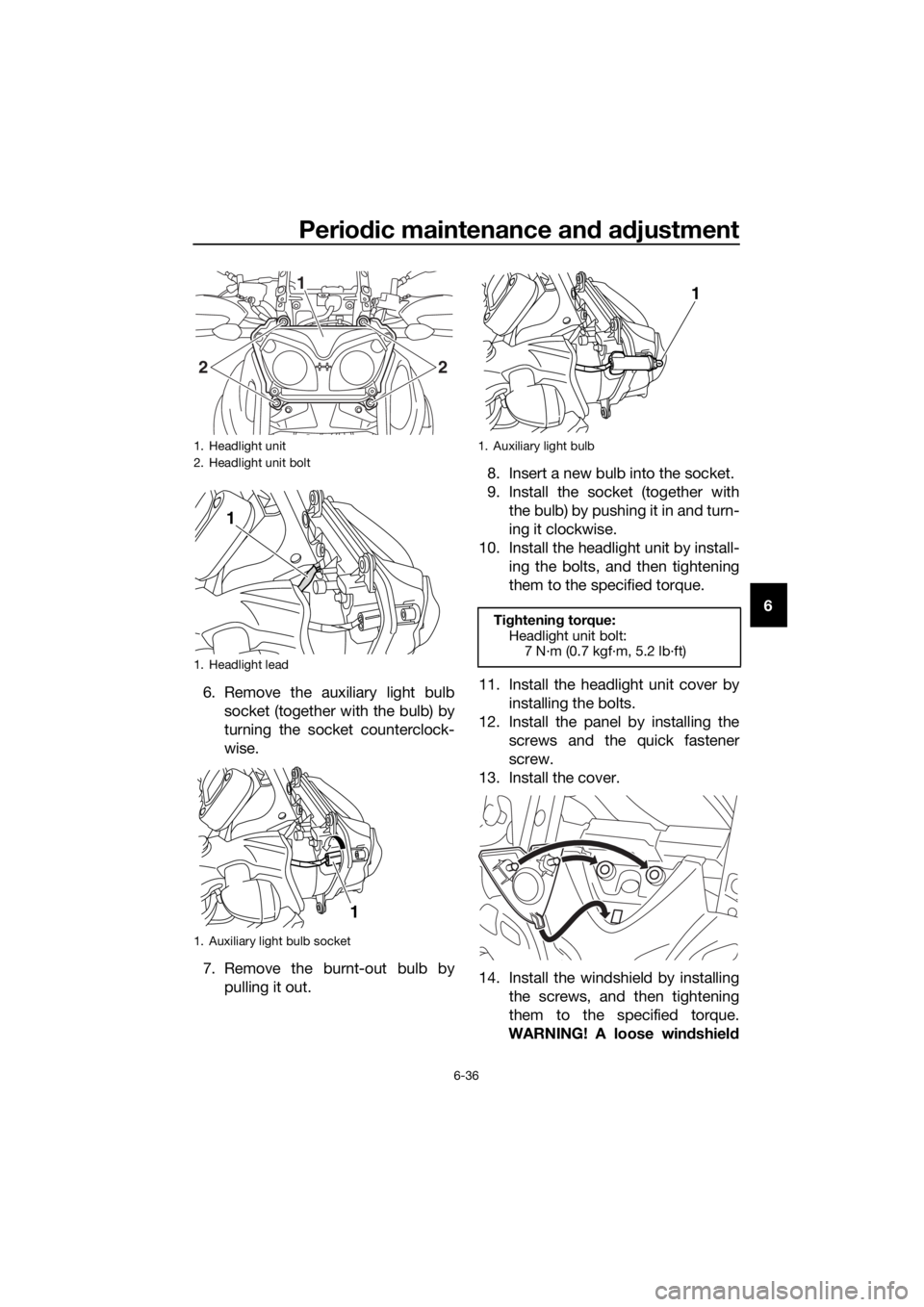
6. Remove the auxiliary light bulb socket (together with the bulb) by
turning the socket counterclock-
wise.
7. Remove the burnt-out bulb by pulling it out. 8. Insert a new bulb into the socket.
9. Install the socket (together with
the bulb) by pushing it in and turn-
ing it clockwise.
10. Install the headlight unit by install- ing the bolts, and then tightening
them to the specified torque.
11. Install the headlight unit cover by installing the bolts.
12. Install the panel by installing the screws and the quick fastener
screw.
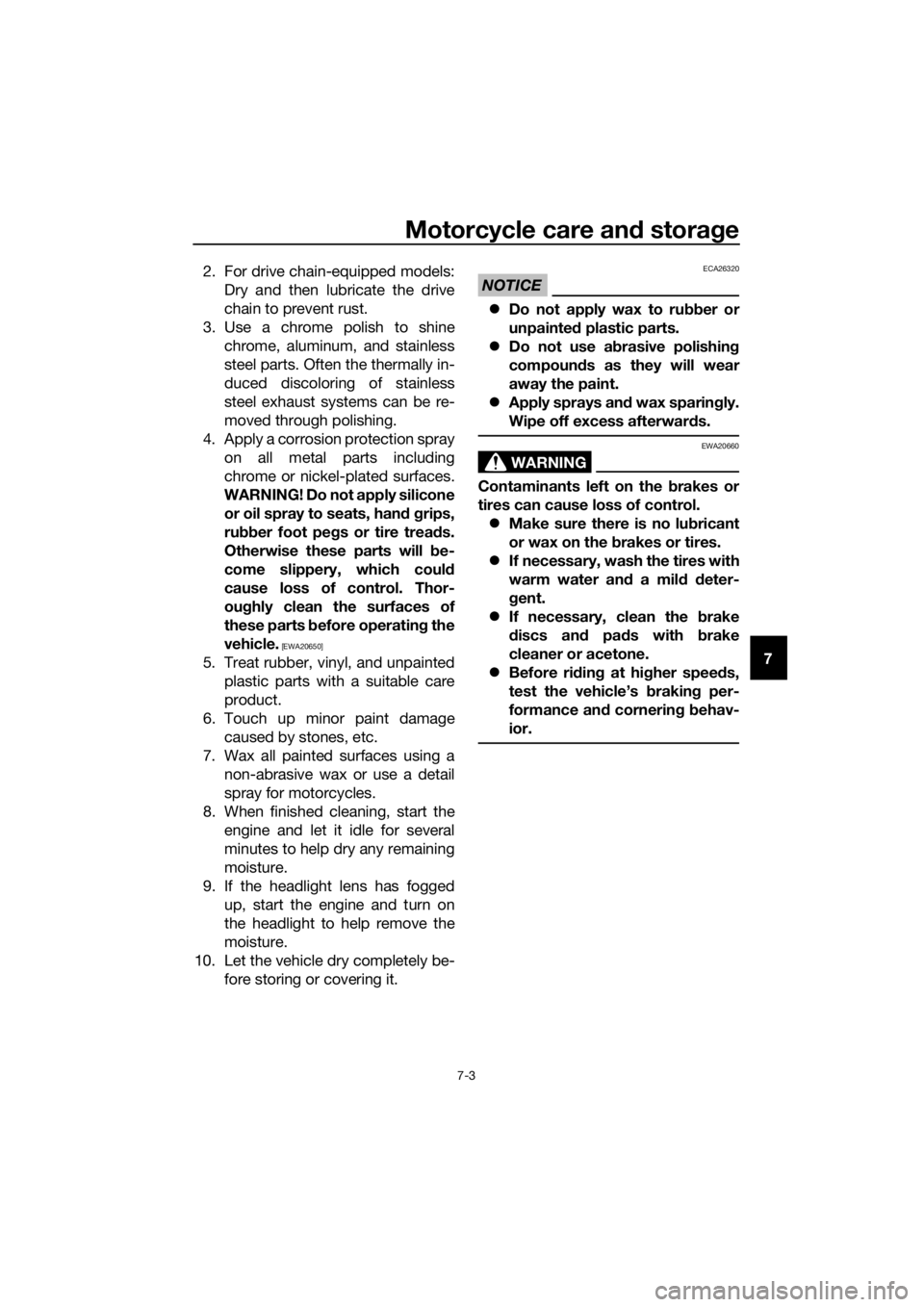
13. Install the cover.
14. Install the windshield by installing the screws, and then tightening
them to the specified torque.
WARNING! A loose win dshield
1. Headlight unit
2. Headlight unit bolt
1. Headlight lead
1. Auxiliary light bulb socket
1
2
2
1
1
1. Auxiliary light bulb
Tightenin g torque:
Headlight unit bolt: 7 N·m (0.7 kgf·m, 5.2 lb·ft)
1
UBP8E1E0.book Page 36 Friday, September 14, 2018 11:35 AM
Page 102 of 118

Periodic maintenance an d a djustment
6-39
6
EAU24351
Supportin g the motorcycle
Since this model is not equipped with a
centerstand, follow these precautions
when removing the front and rear
wheel or performing other mainte-
nance requiring the motorcycle to
stand upright. Check that the motorcy-
cle is in a stable and level position be-
fore starting any maintenance. A
strong wooden box can be placed un-
der the engine for added stability.
To service the front wheel
1. Stabilize the rear of the motorcy- cle by using a motorcycle stand
or, if an additional motorcycle
stand is not available, by placing a
jack under the frame in front of the
rear wheel.
2. Raise the front wheel off the ground by using a motorcycle
stand.
To service the rear wheel
Raise the rear wheel off the ground by
using a motorcycle stand or, if a motor-
cycle stand is not available, by placing
a jack either under each side of the
frame in front of the rear wheel or under
each side of the swingarm.
EAU25872
Trou bleshootin g
Although Yamaha motorcycles receive
a thorough inspection before shipment
from the factory, trouble may occur
during operation. Any problem in the
fuel, compression, or ignition systems,
for example, can cause poor starting
and loss of power.
The following troubleshooting charts
represent quick and easy procedures
for checking these vital systems your-
self. However, should your motorcycle
require any repair, take it to a Yamaha
dealer, whose skilled technicians have
the necessary tools, experience, and
know-how to service the motorcycle
properly.
Use only genuine Yamaha replace-
ment parts. Imitation parts may look
like Yamaha parts, but they are often
inferior, have a shorter service life and
can lead to expensive repair bills.
WARNING
EWA15142
When checkin g the fuel system, d o
not smoke, an d make sure there are
no open flames or sparks in the ar-
ea, inclu din g pilot li ghts from water
heaters or furnaces. Gasoline or
g asoline vapors can i gnite or ex-
plo de, causin g severe injury or prop-
erty damag e.
UBP8E1E0.book Page 39 Friday, September 14, 2018 11:35 AM
Page 104 of 118

Periodic maintenance an d a djustment
6-41
6 En
gine overheatin g
WARNING
EWAT1041
Do not remove the ra diator cap when the en gine an d ra diator are hot.
Scal din g hot flui d an d steam may b e blown out un der pressure, which
coul d cause serious injury. Be sure to wait until the eng ine has cooled.
Place a thick ra g, like a towel, over the ra diator cap, an d then slowly ro-
tate the cap counterclockwise to the detent to allow any resi dual pres-
sure to escape. When the hissin g soun d has stopped , press down on the
cap while turnin g it counterclockwise, an d then remove the cap.
TIP
If coolant is not available, tap water can be temporarily used instead, provided
that it is changed to the recommended coolant as soon as possible.
Wait until the engine
has cooled.
Check the coolant
level in the reservoir
and radiator.Add coolant.
(See TIP.)
The coolant level is
OK.
There is no leakage.
There is leakage.
The coolant level is
low.
Check the cooling
system for leakage.
Have a Yamaha
dealer check and
repair the cooling
system.
Start the engine. If the engine overheats again,
have a Yamaha dealer check and repair the cooling
system.
UBP8E1E0.book Page 41 Friday, September 14, 2018 11:35 AM
Page 107 of 118
Motorcycle care and stora ge
7-3
7
2. For drive chain-equipped models:
Dry and then lubricate the drive
chain to prevent rust.
3. Use a chrome polish to shine chrome, aluminum, and stainless
steel parts. Often the thermally in-
duced discoloring of stainless
steel exhaust systems can be re-
moved through polishing.
4. Apply a corrosion protection spray on all metal parts including
chrome or nickel-plated surfaces.
WARNING! Do not apply silicone
or oil spray to seats, han d g rips,
ru bber foot pe gs or tire tread s.
Otherwise these parts will b e-
come slippery, which coul d
cause loss of control. Thor-
ou ghly clean the surfaces of
these parts before operatin g the
vehicle. [EWA20650]
5. Treat rubber, vinyl, and unpainted plastic parts with a suitable care
product.
6. Touch up minor paint damage caused by stones, etc.
7. Wax all painted surfaces using a non-abrasive wax or use a detail
spray for motorcycles.
8. When finished cleaning, start the engine and let it idle for several
minutes to help dry any remaining
moisture.
9. If the headlight lens has fogged up, start the engine and turn on
the headlight to help remove the
moisture.
10. Let the vehicle dry completely be- fore storing or covering it.
NOTICE
ECA26320
Do not apply wax to ru bber or
unpainte d plastic parts.
Do not use a brasive polishin g
compoun ds as they will wear
away the paint.
Apply sprays an d wax sparin gly.
Wipe off excess afterwar ds.
WARNING
EWA20660
Contaminants left on the brakes or
tires can cause loss of control. Make sure there is no lu bricant
or wax on the brakes or tires.
If necessary, wash the tires with
warm water an d a mil d d eter-
g ent.
If necessary, clean the brake
d iscs an d pa ds with b rake
cleaner or acetone.
Before ri din g at hi gher spee ds,
test the vehicle’s brakin g per-
formance an d cornerin g b ehav-
ior.
UBP8E1E0.book Page 3 Friday, September 14, 2018 11:35 AM
Page 108 of 118

Motorcycle care and stora ge
7-4
7
EAU83472
Stora ge
Always store the vehicle in a cool, dry
place. If necessary, protect it against
dust with a porous cover. Be sure the
engine and the exhaust system are
cool before covering the vehicle. If the
vehicle often sits for weeks at a time
between uses, the use of a quality fuel
stabilizer is recommended after each
fill-up.
NOTICE
ECA21170
Storin g the vehicle in a poorly
ventilate d room or coverin g it
with a tarp, while it is still wet,
will allow water an d humi dity to
seep in an d cause rust.
To prevent corrosion, avoi d
d amp cellars, sta bles ( because
of the presence of ammonia)
an d areas where stron g chemi-
cals are stored .
Long term stora ge
Before storing the vehicle long term (60
days or more): 1. Make all necessary repairs and perform any outstanding mainte-
nance.
2. Follow all instructions in the Care section of this chapter.
3. Fill up the fuel tank, adding fuel stabilizer according to product in-
structions. Run the engine for 5
minutes to distribute treated fuel
through the fuel system.
4. For vehicles equipped with a fuel cock: Turn the fuel cock lever to
the off position. 5. For vehicles with a carburetor: To
prevent fuel deposits from build-
ing up, drain the fuel in the carbu-
retor float chamber into a clean
container. Retighten the drain bolt
and pour the fuel back into the fuel
tank.
6. Use a quality engine fogging oil according to product instructions
to protect internal engine compo-
nents from corrosion. If engine
fogging oil is not available, per-
form the following steps for each
cylinder:a. Remove the spark plug cap and spark plug.
b. Pour a teaspoonful of engine oil into the spark plug bore.
c. Install the spark plug cap onto the spark plug, and then place
the spark plug on the cylinder
head so that the electrodes are
grounded. (This will limit spark-
ing during the next step.)
d. Turn the engine over several times with the starter. (This will
coat the cylinder wall with oil.)
WARNING! To prevent d am-
a g e or injury from sparkin g,
make sure to groun d the
spark plu g electro des while
turnin g the en gine over.
[EWA10952]
e. Remove the spark plug cap
from the spark plug, and then
install the spark plug and the
spark plug cap.
7. Lubricate all control cables, piv- ots, levers and pedals, as well as
the sidestand and centerstand (if
equipped).
UBP8E1E0.book Page 4 Friday, September 14, 2018 11:35 AM
Page 115 of 118

10-1
10
Index
A
ABS ...................................................... 3-24
ABS warning light ................................... 3-4
Air filter element ................................... 6-17
Auxiliary DC jack .................................. 3-39
Auxiliary light bulb, replacing ............... 6-35
B
Battery .................................................. 6-30
Brake and clutch fluids, changing ........ 6-26
Brake and clutch levers, checking and
lubricating .......................................... 6-27
Brake and shift pedals, checking and
lubricating .......................................... 6-27
Brake fluid level, checking ................... 6-25
Brake lever ........................................... 3-23
Brake lever free play, checking ............ 6-23
Brake light switches ............................. 6-23
Brake pedal .......................................... 3-24
C
Canister ................................................ 6-10
Care ........................................................ 7-1
Carriers ................................................. 3-37
Catalytic converter ............................... 3-30
Clutch lever ................................. 3-22, 6-22
Coolant ................................................. 6-16
Cowlings, removing and installing ......... 6-7
Cruise control indicator lights ................ 3-4
Cruise control switches ........................ 3-21
Cruise control system ............................ 3-6
D
Data recording, vehicle .......................... 9-3
Diagnostic connector ............................. 9-2
Dimmer/Pass switch ............................ 3-20
D-mode (drive mode) ........................... 3-19
E
Engine break-in ...................................... 5-5
Engine idling speed, checking ............. 6-18
Engine oil .............................................. 6-10
Engine serial number.............................. 9-1
Engine trouble warning light................... 3-4
F
Final gear oil ......................................... 6-14
Front and rear brake pads, checking ... 6-24
Front fork, adjusting ............................. 3-34
Front fork, checking ............................. 6-29
Fuel....................................................... 3-28
Fuel consumption, tips for reducing ...... 5-4
Fuel tank cap........................................ 3-27
Fuel tank overflow hose ....................... 3-29
Fuses, replacing ................................... 6-32
H
Handlebar switches .............................. 3-20
Hazard switch ....................................... 3-20
Headlight bulb, replacing ...................... 6-33
High beam indicator light........................ 3-3
Horn switch........................................... 3-20
I
Identification numbers ............................ 9-1
Ignition circuit cut-off system ............... 3-40
Immobilizer system ................................. 3-1
Immobilizer system indicator light .......... 3-5
Indicator lights and warning lights .......... 3-3
L
License plate light bulb, replacing ........ 6-38
Luggage strap holders .......................... 3-38
M
Main switch/steering lock ....................... 3-2
Maintenance and lubrication, periodic ... 6-4
Maintenance, emission control system .................................................. 6-3
Matte color, caution ................................ 7-1
Menu switch ......................................... 3-21
Model label ............................................. 9-1
Multi-function meter unit ........................ 3-9
N
Neutral indicator light.............................. 3-3
O
Oil level warning light .............................. 3-4
P
Parking .................................................... 5-6
Part locations .......................................... 2-1
R
Rider seat.............................................. 3-30
Rider seat height, adjusting .................. 3-31
S
Safety information................................... 1-1
Select switch ........................................ 3-21
Shifting .................................................... 5-3
Shift pedal............................................. 3-22
Shock absorber assembly, adjusting ... 3-36
Sidestand .............................................. 3-40
Sidestand, checking and lubricating .... 6-28
Spark plugs, checking ............................ 6-9
Specifications ......................................... 8-1
Starting the engine.................................. 5-2
Steering, checking ................................ 6-29
Stop/Run/Start switch .......................... 3-20
Storage ................................................... 7-4
Supporting the motorcycle ................... 6-39
Swingarm pivots, lubricating ................ 6-28
UBP8E1E0.book Page 1 Friday, September 14, 2018 11:35 AM