2019 YAMAHA FX HO CRUISER cooling
[x] Cancel search: coolingPage 5 of 116

Table of contents
General and important labels ........... 1
Identification numbers .................... 1
Primary Identification (PRI-ID)
number............................................ 1
Craft Identification Number (CIN) ....... 1
Engine serial number.......................... 1
Manufactured date label .................... 2
Model information ........................... 2
Builder’s plate .................................... 2
Important labels .............................. 4
Warning labels.................................... 5
Other labels ........................................ 8
Safety information ............................. 9
Limitations on who may operate
the watercraft ............................... 9
Cruising limitations ........................ 10
Operation requirements ................ 11
Recommended equipment ........... 13
Hazard information........................ 14
Watercraft characteristics ............. 14
Wakeboarding and water-skiing ... 16
Safe boating rules ......................... 17
Enjoy your watercraft
responsibly ................................. 18
Description....................................... 19
Watercraft glossary ....................... 19
Location of main components ...... 20
Control function operation ............. 24
Watercraft control functions ......... 24
Yamaha Security System ................. 24
Engine stop switch .......................... 25
Engine shut-off switch .................... 25
Start switch ..................................... 25
Throttle lever .................................... 26
RiDE lever ........................................ 26
Steering system ............................... 26
Adjustable tilt steering system ......... 27
Cooling water pilot outlet ................. 28
Water separator................................ 28
Watercraft operation ...................... 29
Watercraft operation functions ..... 29
Shift system ..................................... 29
Electric trim system .......................... 31
Watercraft operation modes ......... 33
Reverse assist .................................. 33
T.D.E. (thrust directional
enhancer) ...................................... 33
No-wake mode ................................. 34
Drive control mode ........................... 35
Cruise assist ..................................... 37
Instrument operation ...................... 39
Multifunction information center ... 39
Operation buttons ............................ 40
Touch screen.................................... 40
Status area ....................................... 41
Home screen ................................... 41
Information screen .......................... 42
Drive control mode screen .............. 43
Setting menu screen ....................... 43
Engine lock screen .......................... 45
Warning function .............................. 45
Equipment operation ...................... 48
Equipment..................................... 48
Seats ................................................ 48
Handgrip........................................... 49
Reboarding grip................................ 49
Reboarding step ............................... 49
Bow eye............................................ 50
Stern eyes ........................................ 50
Cleat ................................................. 50
Pull-up cleats (FX Cruiser HO).......... 51
Storage compartments .................... 51
Fire extinguisher holder and cover ... 54
Optional part mounting bracket ....... 55
Operation and handling
requirements ................................... 56
Fuel requirements ......................... 56
Fuel................................................... 56
Engine oil requirements ................ 58
Engine oil .......................................... 58
UF3V70E0.book Page 1 Tuesday, August 28, 2018 10:16 AM
Page 6 of 116

Table of contents
Draining the bilge water ................ 59
Draining the bilge water on land ...... 59
Draining the bilge water on water .... 60
Transporting on a trailer ................ 61
First-time operation ........................ 62
Engine break-in ............................. 62
Pre-operation checks ..................... 63
Pre-operation checklist .................... 63
Pre-operation check points........... 65
Pre-launch checks ........................... 65
Post-launch checks ......................... 71
Operation ......................................... 73
Operating your watercraft ............. 73
Getting to know your watercraft ...... 73
Learning to operate your
watercraft ...................................... 73
Riding position ................................. 74
Launching the watercraft ................. 74
Starting the engine on water ............ 74
Stopping the engine ......................... 75
Leaving the watercraft...................... 75
Operating the watercraft .................. 75
Turning the watercraft ...................... 76
Stopping the watercraft ................... 77
Operating the watercraft in reverse
or neutral ...................................... 78
Boarding the watercraft ................... 79
Starting off........................................ 81
Capsized watercraft ......................... 82
Beaching and docking the
watercraft ...................................... 83
Operating in weeded areas .............. 83
After removing the watercraft from
the water ....................................... 84
Care and storage............................. 85
Post-operation care ...................... 85
Flushing the cooling water
passages....................................... 85
Cleaning the watercraft .................... 86
Battery care ...................................... 86
Long-term storage ........................ 89
Cleaning ........................................... 89
Lubrication ....................................... 89
Rustproofing ..................................... 89
Maintenance .................................... 90
Maintenance ................................. 90
Tool kit.............................................. 90
Removing and installing the engine
cover ............................................. 90
Periodic maintenance chart ............. 92
Engine oil and oil filter ...................... 94
Specifications .................................. 95
Specifications ............................... 95
Trouble recovery ............................. 96
Troubleshooting ............................ 96
Troubleshooting chart ...................... 96
Emergency procedures ................ 99
Cleaning the jet intake and
impeller ......................................... 99
Raising the reverse gate ................ 100
Jumping the battery ....................... 100
Replacing the fuses ........................ 101
Towing the watercraft..................... 103
Submerged watercraft ................... 103
Index............................................... 105
UF3V70E0.book Page 2 Tuesday, August 28, 2018 10:16 AM
Page 26 of 116

Description
20
EJU31012
Location of main components
Exterior
1
6
78
910
5
234
1Hood
2Beverage holder (page 53)
3Pull-up cleat (FX Cruiser HO) (page 51)
4Footwell
5Optional part mounting bracket
6Fuel filler cap (page 56)
7Front seat (page 48)
8Rear seat (page 48)
9Cooling water pilot outlet (page 28)
10Bow eye (page 50)
UF3V70E0.book Page 20 Tuesday, August 28, 2018 10:16 AM
Page 34 of 116
Control function operation
28
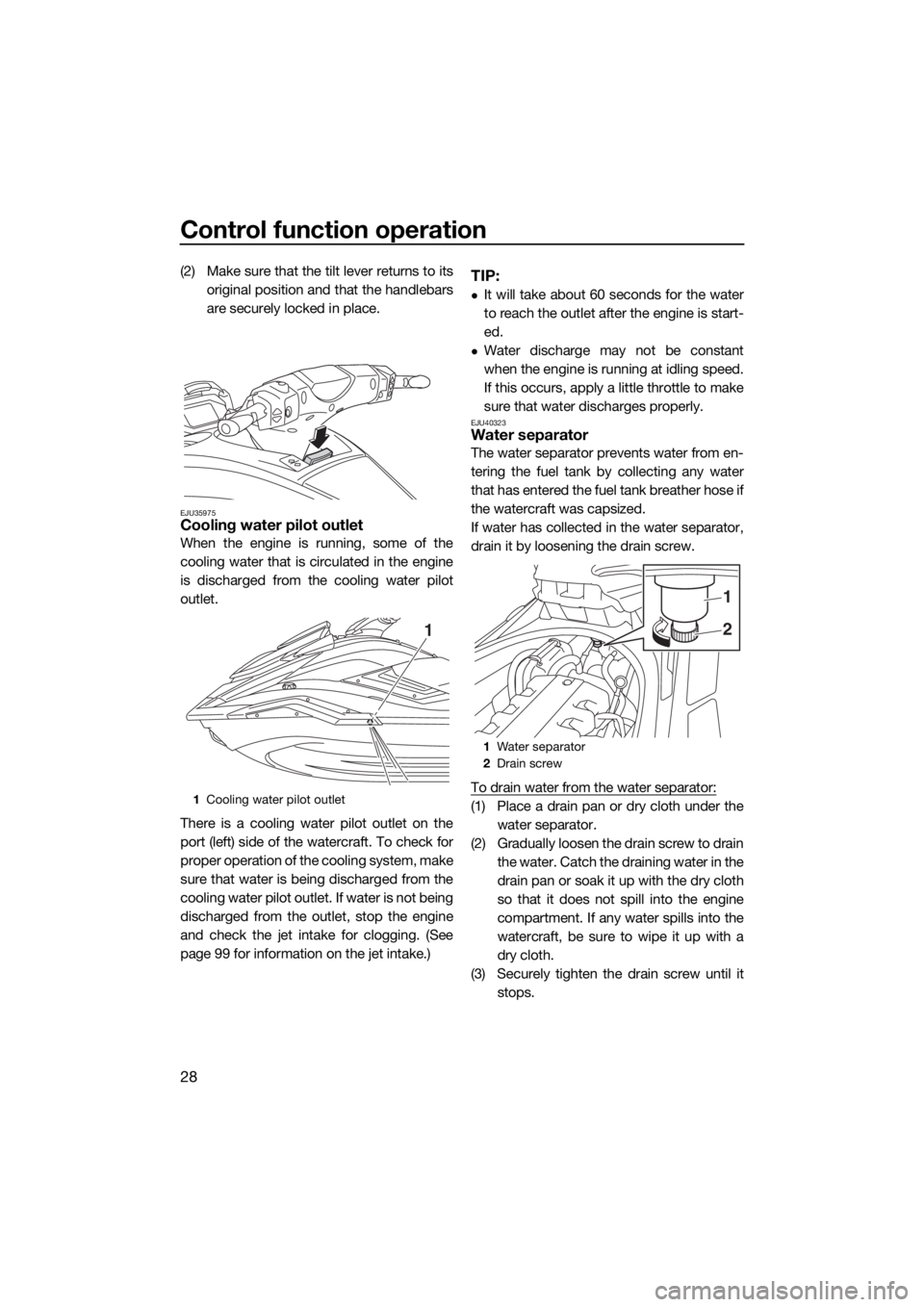
(2) Make sure that the tilt lever returns to its
original position and that the handlebars
are securely locked in place.
EJU35975Cooling water pilot outlet
When the engine is running, some of the
cooling water that is circulated in the engine
is discharged from the cooling water pilot
outlet.
There is a cooling water pilot outlet on the
port (left) side of the watercraft. To check for
proper operation of the cooling system, make
sure that water is being discharged from the
cooling water pilot outlet. If water is not being
discharged from the outlet, stop the engine
and check the jet intake for clogging. (See
page 99 for information on the jet intake.)
TIP:
It will take about 60 seconds for the water
to reach the outlet after the engine is start-
ed.
Water discharge may not be constant
when the engine is running at idling speed.
If this occurs, apply a little throttle to make
sure that water discharges properly.
EJU40323Water separator
The water separator prevents water from en-
tering the fuel tank by collecting any water
that has entered the fuel tank breather hose if
the watercraft was capsized.
If water has collected in the water separator,
drain it by loosening the drain screw.
To drain water from the water separator:
(1) Place a drain pan or dry cloth under the
water separator.
(2) Gradually loosen the drain screw to drain
the water. Catch the draining water in the
drain pan or soak it up with the dry cloth
so that it does not spill into the engine
compartment. If any water spills into the
watercraft, be sure to wipe it up with a
dry cloth.
(3) Securely tighten the drain screw until it
stops.1Cooling water pilot outlet
1
1Water separator
2Drain screw
2
1
UF3V70E0.book Page 28 Tuesday, August 28, 2018 10:16 AM
Page 53 of 116

Instrument operation
47
If the engine overheat warning is activated,
immediately reduce the engine speed, return
to shore, and then make sure that water is
being discharged from the port (left) cooling
water pilot outlet while the engine is running.
If there is no discharge of water, stop the en-
gine, and then check the jet intake for clog-
ging. (See page 99 for information on the jet
intake.) NOTICE: If you cannot locate and
correct the cause of the overheating, con-
sult a Yamaha dealer. Continuing to oper-
ate at higher speeds could result in severe
engine damage.
[ECJ00042]
TIP:
While the engine overheat warning is acti-
vated, the maximum engine speed is limit-
ed.
Tap “ ” to display a description of the
warning in the center display.
Oil pressure warning “ ”
If the oil pressure drops significantly, the
warning bar is shown instead of the tachom-
eter value display, “ ” and “ ” are
shown, and the buzzer sounds intermittently.
If the oil pressure warning is activated, imme-
diately reduce the engine speed, return to
shore, and then check the engine oil level.(See page 58 for information on checking the
engine oil level.) If the oil level is sufficient,
have a Yamaha dealer check the watercraft.
TIP:
While the oil pressure warning is activated,
the maximum engine speed is limited.
Tap “ ” to display a description of the
warning in the center display.
Other warnings (communication errors,
exceeding the maintenance intervals, and
so on) “ ”
If any other malfunction is detected or if the
engine has been operated for more than 50
hours since the last maintenance, the warn-
ing bar is shown instead of the tachometer
value display, “ ” is shown, and the buzz-
er sounds intermittently.
If a warning is activated, have the watercraft
serviced by a Yamaha dealer as soon as pos-
sible.
TIP:
Tap “ ” to display a description of the
warning in the center display.
UF3V70E0.book Page 47 Tuesday, August 28, 2018 10:16 AM
Page 70 of 116

Pre-operation checks
64
TIP:
To ensure safety and reliability, pre-operation checks should be made each time the water-
craft is used.
Jet thrust nozzle and re-
verse gate Check the jet thrust nozzle and reverse gate for
damage.70
Stern drain plugsCheck the stern drain plugs for damage and foreign
material and check that they are securely installed.71
HoodCheck that the hood is securely closed. 71
Front and rear seatsCheck that the seats are securely installed. 48
POST-LAUNCH CHECKS
Cooling water pilot outletCheck that water is discharged from the cooling
water pilot outlet while the engine is running.72
Multifunction information
centerCheck the multifunction information center for prop-
er operation.72
Shift system Check the shift system for proper operation. 72
Engine idling speedCheck the engine idling speed. 72 ITEM ROUTINE PAGE
UF3V70E0.book Page 64 Tuesday, August 28, 2018 10:16 AM
Page 78 of 116

Pre-operation checks
72
EJU40553Cooling water pilot outlet check
Make sure that water is discharged from the
cooling water pilot outlet while the engine is
running. (See page 28 for information on the
cooling water pilot outlet.)
EJU45260Multifunction information center check
Make sure that the multifunction information
center operates properly. (See page 39 for in-
formation on proper operation of the multi-
function information center.)
EJU43392Shift system check
Operate the throttle lever and RiDE lever, and
check that the watercraft moves or does not
move according to the displayed shift indica-
tor. (See page 29 for shift system operation
procedures.) WARNING! To avoid colli-
sions, operate at safe speeds and keep asafe distance away from people, objects,
and other watercraft.
[EWJ01860]
EJU40172
Engine idling speed check
Start the engine and warm it up. Use the ta-
chometer in the multifunction information
center to make sure that the engine idling
speed is not significantly above or below the
specified range.
1Shift indicator
2“F” (Forward position)
3“N” (Neutral position)
4“R” (Reverse position)
Engine idling speed:
1300 ±100 r/min
0
N13.6Vx100
RPM
100%
MPH
R NF4
3
2
1
UF3V70E0.book Page 72 Tuesday, August 28, 2018 10:16 AM
Page 90 of 116

Operation
84
EJU40242After removing the watercraft from
the water
NOTICE
ECJ01311
Do not run the engine over 4000 r/min on
land. Also, do not run the engine for more
than 15 seconds without supplying water,
otherwise the engine could overheat.
After operating and removing the watercraft
from the water, promptly discharge the re-
maining water from the cooling water pas-
sages.
To discharge water from the cooling water
passages:
(1) Make sure that the area around the wa-
tercraft is clear, and then start the en-
gine.
(2) Discharge the remaining water out of the
cooling water passages by alternately
squeezing and releasing the throttle lever
quickly for 10 to 15 seconds.
(3) Stop the engine.
UF3V70E0.book Page 84 Tuesday, August 28, 2018 10:16 AM