2019 VOLKSWAGEN TRANSPORTER stop
[x] Cancel search: stopPage 364 of 486
Warning lamp
ro First read and observe the Introductory Information and safety warnings & on page 362.
Lit up Possible cause
0 Fault in the alternator.
Several warning and indicator lamps will light up briefly as a functional check when the ignition is switched on. They will go out after a few seconds.
A WARNING
Failure to observe illuminated warning lamps and text messages can lead to your vehicle breaking down In traffic, and can cause acci-dent and serious injury.
Solution
Go to a qualified workshop. Have the electrical system checked. Switch off any electrical consumers that are not required. The vehicle battery will not be charged by the alternator while the vehicle is in motion.
A WARNING (Continued)
• Never ignore any illuminated warning lamps or text messages.
• Stop the vehicle as soon as possible and when safe to do so.
CD
Failure to observe illuminated indicator lamps and text messages can lead to your vehicle be-Ing damaged. <1
Checking the electrolyte level of the vehicle battery
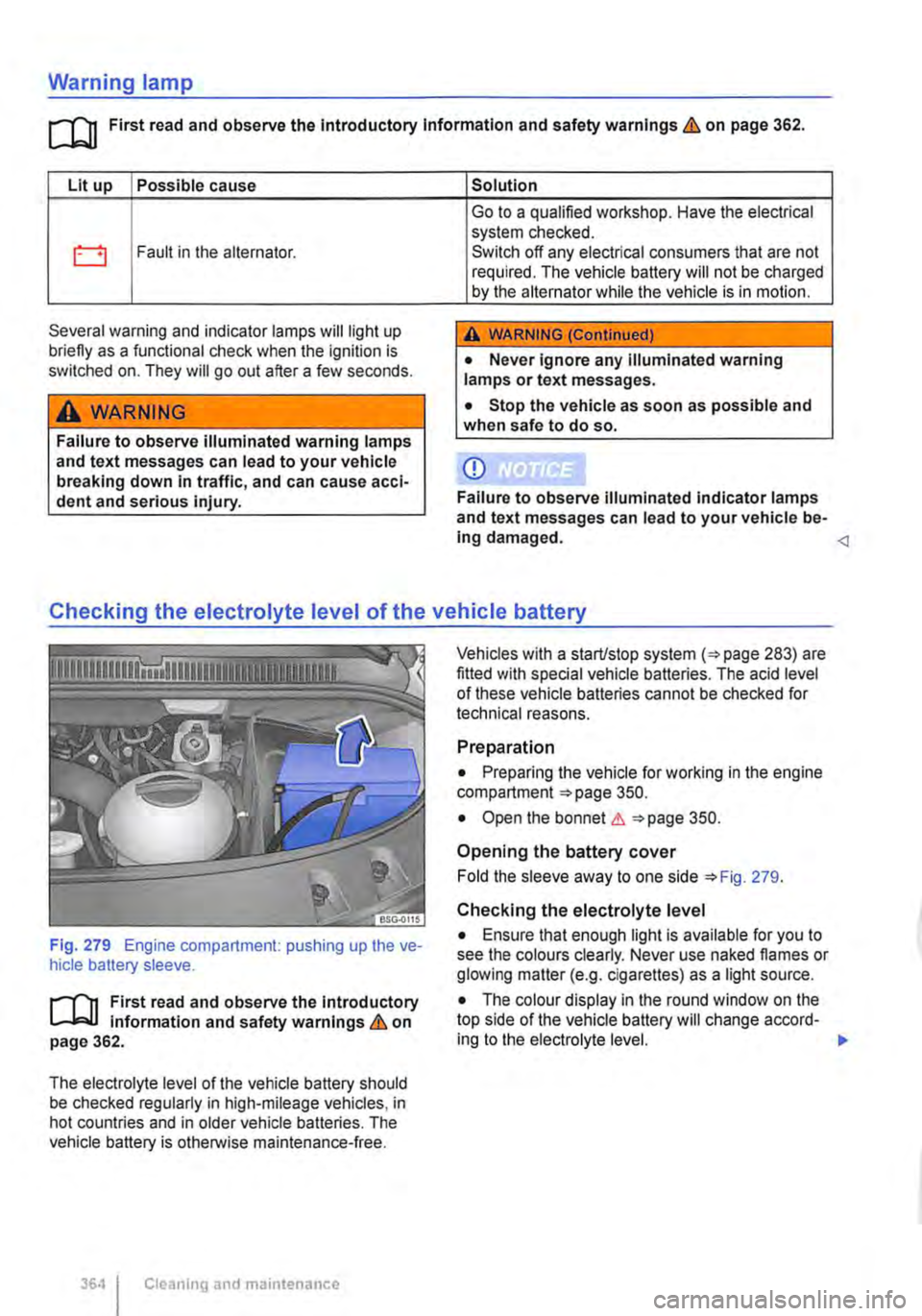
Fig. 279 Engine compartment: pushing up the ve-hicle battery sleeve.
r-111 First read and observe the Introductory l-Jo=,.lJ Information and safety warnings & on page 362.
The electrolyte level of the vehicle battery should be checked regularly in high-mileage vehicles, in hot countries and in older vehicle batteries. The vehicle battery is otherwise maintenance-free.
364 I Cleaning and maintenance
Vehicles with a starUstop system (=>page 283) are fitted with special vehicle batteries. The acid level of these vehicle batteries cannot be checked for technical reasons.
Preparation
• Preparing the vehicle for working in the engine compartment =>page 350.
• Open the bonnet &::. =>page 350.
Opening the battery cover
Fold the sleeve away to one side =>Fig. 279.
Checking the electrolyte level
• Ensure that enough light is available for you to see the colours clearly. Never use naked flames or glowing matter (e.g. cigarettes) as a light source.
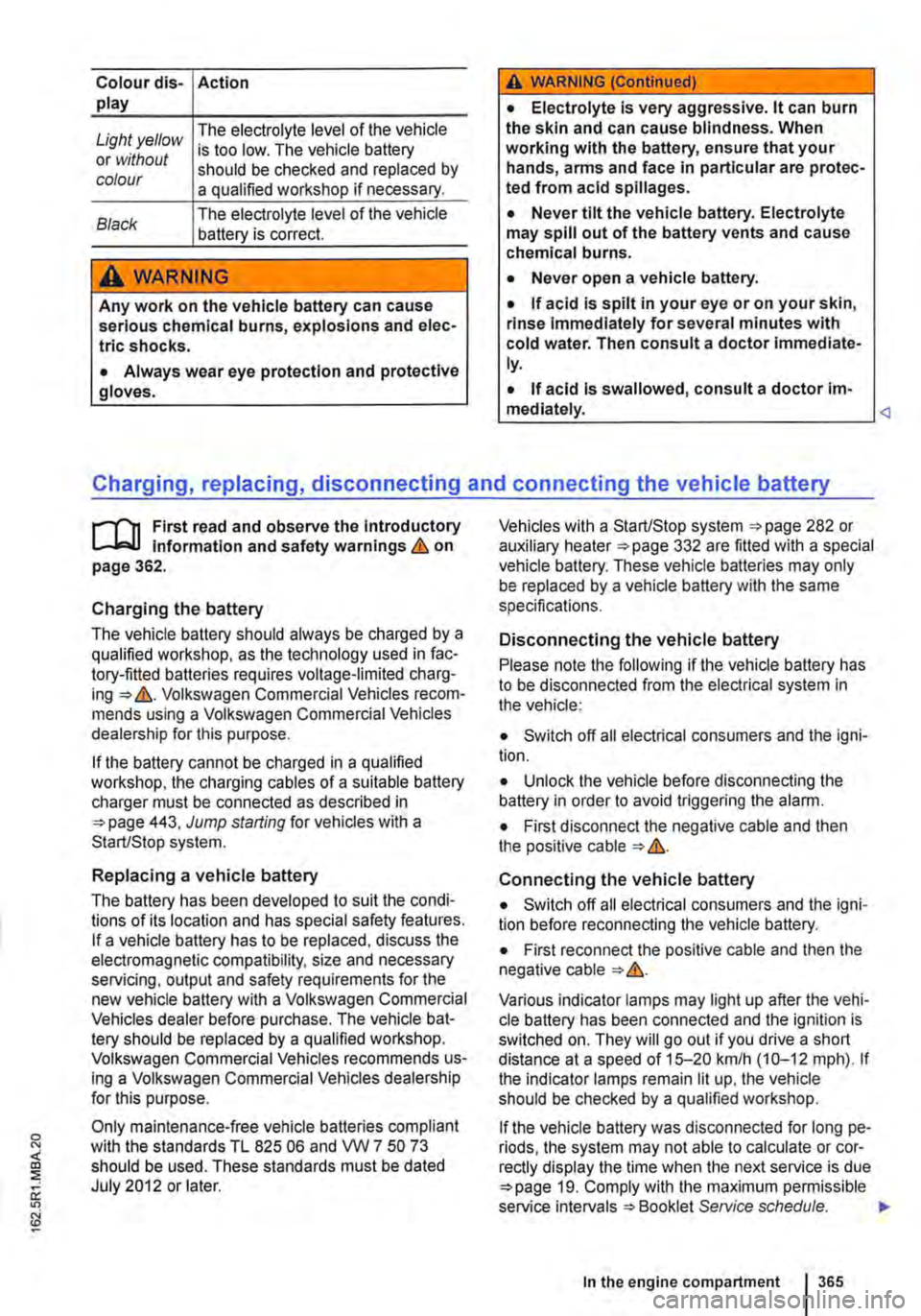
• The colour display in the round window on the top side of the vehicle battery will change accord-ing to the electrolyte level.
Page 365 of 486
Colour dis-Action play
Light yellow The electrolyte level of the vehicle
or without is too low. The vehicle battery
colour should be checked and replaced by a qualified workshop if necessary.
Black The electrolyte level of the vehicle battery is correct.
A WARNING
Any work on the vehicle battery can cause serious chemical burns, explosions and elec-trlc shocks.
• Always wear eye protection and protective gloves.
A WARNING (Continued)
• Electrolyte is very aggressive. lt can burn the skin and can cause blindness. When working with the battery, ensure that your hands, arms and face in particular are protec-ted from acid spillages.
• Never tilt the vehicle battery. Electrolyte may spill out of the battery vents and cause chemical burns.
• Never open a vehicle battery.
• if acid is spilt in your eye or on your skin, rinse immediately for several minutes with cold water. Then consult a doctor immediate-ly.
• If acid is swallowed, consult a doctor im-mediately.
r-"f'n First read and observe the introductory L-Jo:.l.l information and safety warnings & on page 362.
Charging the battery
The vehicle battery should always be charged by a qualified workshop, as the technology used in fac-tory-fitted batteries requires voltage-limited charg-ing => &. Volkswagen Commercial Vehicles recom-mends using a Volkswagen Commercial Vehicles dealership for this purpose.
If the battery cannot be charged in a qualified workshop, the charging cables of a suitable battery charger must be connected as described in =>page 443, Jump starting for vehicles with a Start/Stop system.
Replacing a vehicle battery
The battery has been developed to suit the condi-tions of its location and has special safety features. If a vehicle battery has to be replaced, discuss the electromagnetic compatibility, size and necessary servicing, output and safety requirements for the new vehicle battery with a Volkswagen Commercial Vehicles dealer before purchase. The vehicle bat-tery should be replaced by a qualified workshop. Volkswagen Commercial Vehicles recommends us-ing a Volkswagen Commercial Vehicles dealership for this purpose.
Only maintenance-free vehicle batteries compliant with the standards TL 825 06 and VVV 7 50 73 should be used. These standards must be dated July 2012 or later.
Vehicles with a Start/Stop system =>page 282 or auxiliary heater =>page 332 are fitted with a special vehicle battery. These vehicle batteries may only be replaced by a vehicle battery with the same specifications.
Disconnecting the vehicle battery
Please note the following if the vehicle battery has to be disconnected from the electrical system in the vehicle:
• Switch off all electrical consumers and the igni-tion.
• Unlock the vehicle before disconnecting the battery in order to avoid triggering the alarm.
• First disconnect the negative cable and then the positive cable => &.
Connecting the vehicle battery
• Switch off all electrical consumers and the igni-tion before reconnecting the vehicle battery.
• First reconnect the positive cable and then the negative cable=>&.
Various indicator lamps may light up after the vehi-cle battery has been connected and the ignition is switched on. They will go out if you drive a short distance at a speed of 15-20 kmlh (10-12 mph). If the indicator lamps remain lit up, the vehicle should be checked by a qualified workshop.
if the vehicle battery was disconnected for long pe-riods, the system may not able to calculate or cor-rectly display the time when the next service is due =>page 19. Comply with the maximum permissible service intervals =>Booklet Service schedule. ""
In the engine compartment 365
Page 366 of 486
Automatic switch-off for electrical consumers
The intelligent vehicle electrical system automati-cally implements a range of measures to prevent the battery from discharging under high loads:
• The idling speed is increased so that the alter-nator provides more electricity.
• The performance of large electrical consumers may be reduced or they may be switched off com-pletely.
• The supply of electricity to the 12-volt sockets and the cigarette lighter is interrupted temporarily while the engine is being started.
The vehicle electrical system cannot always pre-vent the vehicle battery from discharging. For ex-ample, if the ignition is left on for an extended peri-od of time with the engine off, or if the parking light is left on when the vehicle is parked for an exten-ded period.
What can cause the vehicle battery to discharge?
• Long periods at a standstill in which the engine is not running, especially if the ignition is switched on.
• The use of electrical consumers when the en-gine is switched off.
• When the supplementary heater is in operation =>page 332.
A WARNING
Incorrectly attaching the battery and using In-correct vehicle batteries can cause short cir-cuits, fire and serious Injuries.
366 I Cleaning and maintenance
A WARNING (Continued)
• Always use maintenance-free and leak-proof batteries that have the same properties, specifications and dimensions as the factory-fitted vehicle battery.
A WARNING
A highly explosive mixture of gases Is given off when the vehicle battery is being charged.
• Vehicle batteries should only be charged in well-ventilated spaces.
• Never charge a vehicle battery once it has been frozen. Discharged vehicle batteries can even freeze at temperatures of around o•c (+32.FJ.
• The vehicle battery has to be replaced if it has ever been frozen.
• Incorrectly connected cables can cause a short circuit. First connect the positive cable and then the negative cable.
CD
• Never make or break connections between vehicle batteries if the ignition is switched on or the engine is running. Never use a vehicle battery that does not correspond with the vehi-cle's specifications. The vehicle's electrical system or electronic components could be damaged, which could lead to electrical faults, for example In the start/stop system.
• Never connect equipment that provides electricity, such as solar panels or a battery charger, to the 12-volt socket or to the cigarette lighter to charge the vehicle battery. This can damage the vehicle electrical system.
Dispose of the vehicle baltery as required by legislation. Batteries may contain toxic sub-stances such as sulphuric acid and lead.
Electrolyte can pollute the environment. Clean up any service fluid leakages and dis-pose of them property.
Page 367 of 486
Wheels and tyres
Useful information about wheels and tyres
o:::n Introduction
This chapter contains information on the following subjects:
Handling wheels and tyres .............. .
Rims
368
369
New wheels and tyres . . . . . . . . . . . . . . . . . . . 370 Tyre pressure . . . . . . . . . . . . . . . . 371
Tread depth and wear indicators 372 Tyre damage 373
Spare wheel . . . . . . . . . . . . . . . . . . . . . . . . . . . . 374
Tyre lettering . . . . . . . . . . . . . . . . . . . . . . . . . . . 375
Winter tyres . . . . . . . . . . • . • • . . . . . . . . . . . . 378 Snow chains . . . . . . . . . . . . . . . . . 379
Volkswagen Commercial Vehicles recommends that work on tyres and wheels is carried out by a qualified workshop. They are familiar with the pro-cedure and have the necessary special tools and spare parts and the proper facilities for disposing of the old tyres. Volkswagen Commercial Vehicles recommends using a Volkswagen Commercial Ve-hicles dealership for this purpose.
Additional information and warnings:
• Transporting 125
• Towing a trailer 139
• Braking, stopping and parking 269
• Tyre monitoring system 318
• Cleaning and caring for the vehicle exterior 380
• Consumer information 404
• Vehicle tool kit 416
• Hubcaps 417
• Changing a wheel 420
• Breakdown set 425
A WARNING
New tyres or tyres which are old, worn down or damaged cannot provide full levels of vehi-cle control and braking power.
• Incorrect handling of wheels and tyres can reduce vehicle safety and cause accidents and serious injuries.
A WARNING (Continued)
• All four wheels must be fitted with radial tyres of the same type, size (rolling circum-ference) and the same tread.
• New tyres will have to be run In as they will initially have reduced grip and braking ef-fect. Drive particularly carefully for the first 600 km in order to prevent accidents and se-rious injury.
• Check tyre pressures regularly and always keep to the specified tyre pressure value. If the tyre pressure is too low, it Is possible that the tyre temperature will Increase to such an extent when driving that the tread peels off and the tyre bursts.
• Never drive with worn tyres or tyres that are damaged (cuts, cracks or blisters). Driv-Ing with tyres in this condition can result in blown tyres, accidents and serious Injuries. Worn or damaged tyres must be replaced as soon as possible.
• Never exceed the top speed and load per-mitted for the fitted tyres.
• The effectiveness of the driver assist sys-tems and brake support systems depends on the tyre grip.
• If you notice unusual vibration or if the ve-hicle pulls to one side when driving, stop the car immediately and check the wheels and tyres for damage.
• In order to reduce the risk of losing con-trol of the vehicle, and the risk of accident and serious injury, never loosen the bolts on rims with bolted on rim rings.
• Do not use wheels or tyres if you do not know their history. Used wheels and tyres could be damaged, even If the damage is not visible.
• Old tyres (even if never used) can sudden-ly Jose pressure or burst, especially at high speeds. This can cause accidents and seri-ous injuries. Avoid using tyres that are more than six years old. If you have no alternative, drive slowly and with extra care at all times.
m For technical reasons, it is not generally pos-L!.J sible to use the wheels from other vehicles. This can also apply to wheels of the same vehicle .,.
Wheels and tyres I 367
Page 381 of 486

Washing the vehicle
r-f'n First read and observe the introductory Information and safety warnings & on page 380.
The longer substances such as insects, bird drop-pings, resinous tree sap, road dirt, industrial de-posits, tar, soot or road salt and other corrosive materials remain on the vehicle, the more damage they do to the paintwork. High temperatures (for in-stance in strong sunlight) accelerate the corrosion process. The underside of the vehicle should also be cleaned thoroughly and regularly.
Car washes
Please observe the signs on the automatic car wash. Before using an automatic car wash take the usual precautions, such as closing all windows and folding in the exterior mirrors, in order to avoid damage to the vehicle. You must consult the car wash operator if there are special parts on your ve-hicle such as spoilers, roof luggage carrier systems or radio aerials ::.CD.
The paint is so hard-wearing that the car can nor-mally be washed without problems in an automatic car wash. However, the effect on the paint de-pends to a large extent on the design of the car wash. Volkswagen Commercial Vehicles recom-mends the use of car washes without brushes.
To remove any wax residue from the windows and to stop wipers rubbing, please note the following points ::.page 382, Cleaning windows and exterior mirrors.
Washing the car by hand
When washing by hand, first soften the dirt with plenty of water and rinse off as well as possible.
Then clean the vehicle with a soft sponge, a glove or a brush using only light pressure. Start with the roof and work from the top to the bottom. Use a shampoo for very stubborn dirt only.
The sponge or glove should be wrung out thor-oughly at regular intervals.
Clean the wheels, sill panels etc. last. Use a differ-ent sponge for this purpose.
A WARNING
Parts of the vehicle with sharp edges can cause Injury.
• Protect your hands and arms from cuts on sharp parts, for example when cleaning the underbody or the inside of the wheel hous-lngs.
A WARNING
After the car has been washed, the braking effect could set in later than normal and ex-tend the braking distance as the brake discs and brake pads will be wet, or iced up In win-ter.
• You can "dry and de-ice" the brakes by performing careful braking manoeuvres. Make sure that you do not endanger any oth-er road users or violate any legal regulations when doing so.
CD
• The water should be no warmer than +so•c (+140.FJ.
• Do not wash the vehicle in direct sunlight in order to avoid damage to the vehicle palntwork.
• Never clean with insect sponges, rough kitchen sponges or similar products as these can damage the surface.
• Never clean the headlights with a dry cloth or sponge. Always use a wet cloth or sponge. lt is best to use soapy water.
• Washing the vehicle In cold weather: if the vehicle is rinsed with a hose, do not direct the water at the lock cylinders or the gaps around the doors, boot, or bonnet. The locks and seals could freeze.
CD
Observe the following guidelines before driving the vehicle into an automatic car wash in order to avoid damage to the vehicle:
• Ensure that the gap between the guide rails In the car wash is sufficient for the vehicle track. If the track is too narrow your wheels and tyres will be damaged.
• Switch off the rain sensor before driving the vehicle Into an automatic car wash.
• Check that the car wash is tall and wide enough for your vehicle.
• Fold In the exterior mirrors. Electrically fold-Ing exterior mirrors must be moved electrically. Do not fold them in and out by hand.
• In order to prevent damage to the palntwork on the bonnet, fold the wipers back onto the windscreen after drying the wiper blades. Do not drop the wipers onto the glass.
• Lock the tailgate to prevent it from opening accidentally In the car wash.
Page 383 of 486
Removing wax
Car washes and care products could leave wax deposits on the glass surfaces. Wax residue can only be removed using a special cleaning product or cleaning cloths. Wax deposits on the wind-screen can cause the wiper blades to rub. Volks-wagen Commercial Vehicles recommends that a glass cleaning cloth G 052 522 A1 be used to re-move wax deposits from the windows and exterior mirrors each time the vehicle is washed.
A window cleaning agent specifically for removing wax will stop the blades rubbing if added to the windscreen wash water. Dilute the cleaner as in-structed. Grease-removing cleaners will not re-move wax deposits =-CD.
Special cleaners, glass cleaners and glass clean-ing cloths are available from Volkswagen Commer-cial Vehicles dealerships.
Removing snow
Use a small brush to remove snow from the win-dows and exterior mirrors.
Removing ice
The best method for removing ice is to use a de-icer spray. If you use an ice scraper, do not move it to and fro, but push it in one direction only. Mov-ing the ice scraper backwards can cause dirt to scratch the window.
Cleaning and changing wiper blades
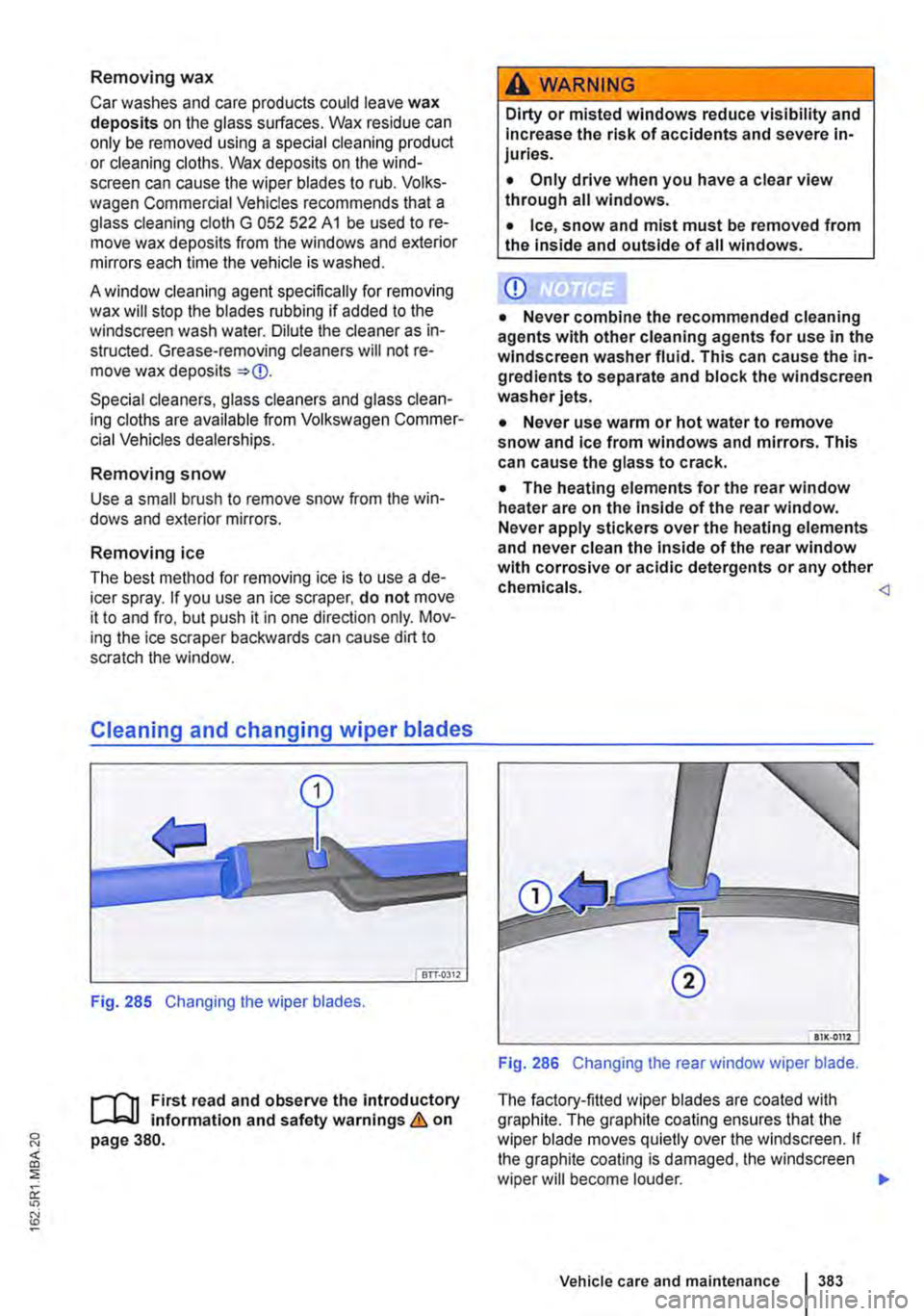
Fig. 285 Changing the wiper blades.
1"'111 First read and observe the introductory l..-J,:.U information and safety warnings & on page 380.
A WARNING
Dirty or misted windows reduce visibility and Increase the risk of accidents and severe in-juries.
• Only drive when you have a clear view through all windows.
• Ice, snow and mist must be removed from the inside and outside of all windows.
CD
• Never combine the recommended cleaning agents with other cleaning agents for use in the windscreen washer fluid. This can cause the in-gredients to separate and block the windscreen washer jets.
• Never use warm or hot water to remove snow and Ice from windows and mirrors. This can cause the glass to crack.
• The heating elements for the rear window heater are on the Inside of the rear window. Never apply stickers over the heating elements and never clean the inside of the rear window with corrosive or acidic detergents or any other chemicals.
The factory-fitted wiper blades are coated with graphite. The graphite coating ensures that the wiper blade moves quietly over the windscreen. If the graphite coating is damaged, the windscreen wiper will become louder. .,..
Vehicle care and maintenance 383
Page 394 of 486
Accessories, modifications, repairs and renewal of parts
o::n Introduction
This chapter contains information on the following subjects:
Running-in 394
Accessories and replacement parts 395 Service fluids and consumables . . . . . . . . . . . 395
Repairs and technical modifications . . . . . . . . 396
Repairs and faults in the airbag system . . . . . 397
Retrofitting two-way radios . . . . . . . . . . . . . . . . 398
Information stored in the control units . . . . . . . 398 Using a mobile telephone in the vehicle without a connection to the external aerial . . 399
Vehicle lifting points 401
Additional information and warnings:
• Seat belts '*page 79
• Airbag system '*page 87
• Towing a trailer 139
• Ashtray and cigarette lighter 161
• Electrical sockets 163
• Braking, stopping and parking '*page 269
• Pull-away assist systems 282
• ParkPilot 287
• Reversing camera (Rear Assist) '*page 291
• Cruise control system (CCS) 295
• Driver Alert System 315
• Tyre monitoring system 318
• Preparation for working in the engine compart-ment page 350
• Engine oil 353
• Engine coolant '*page 358
• Battery 362
Running-in
r--('n First read and observe the introductory L-J.:.lJ information and safety warnings & on page 394.
Please follow the regulations concerning running-in new parts.
394 I Cleaning and maintenance
• Cleaning and caring for the vehicle exterior 380
• Cleaning and caring for the interior 388
• Consumer information 404
• Radio, provision for mobile tele-phone, infotainment system, navigation system
A WARNING
Unsuitable spare parts and accessories, In-correctly carried out work, modifications and repairs can lead to damage to the vehicle and cause accidents and serious Injuries.
• Volkswagen Commercial Vehicles strongly recommends you use only approved Volks-wagen accessories and Volkswagen Genuine Parts®. These parts and accessories have been specially tested by Volkswagen Com-mercial Vehicles for suitability, reliability and safety.
• Repairs and modifications to your vehicle should only be carried out by a qualified workshop. Qualified workshops have the nec-essary tools, diagnostic equipment, repair In-formation and qualified personnel.
• Never fit parts to your vehicle that are In any way different from the factory-fitted parts.
• Never secure or mount objects such as drink holders or telephone holders on or next to the airbag covers or within the deployment zone of the airbag.
• Only use rim/tyre combinations which have been approved by Volkswagen Commer-cial Vehicles for your vehicle type.
Any new engine has to be run in during the first 1 ,500 kilometres. During its first few hours of run-ning, the internal friction in the engine is greater than later on when all the moving parts have bed-ded down.
The style of driving during the first 1 ,500 kilometres will also affect the engine quality. Even after this time-and especially with a cold engine-drive the .,.
Page 410 of 486
If and when
Practical tips
Frequently asked questions
If you suspect that a vehicle fault has arisen or your vehicle has been damaged, read and observe the following information before contacting a Volkswagen Commercial Vehicles dealership or
qualified workshop. You may also find useful infor-mation in the index under the headings "Things to note" or "Checklist".
To note Some possible causes Possible solution
Vehicle battery is discharged. -How to jump start =>page 443. -Recharge vehicle battery 362.
Engine does not start. The incorrect vehicle key is be-Use a valid vehicle key 36. ing used.
Fuel level is too low. Fill the tank 340.
Supplementary heating system Switch off the supplementary heating
Smoke is coming from the is running. system 332. wing. Supplementary heater is run-No solution 345. ning.
-Battery in the remote control -Replace the battery 36. Vehicle cannot be locked or key is flat. -Move closer to the vehicle. unlocked with the remote -Located too far away from the -Synchronise the vehicle key =>page 36. vehicle. control key. -Buttons were pressed outside -Lock or unlock the vehicle manually
the range. 413.
Cold engine. brake assist sys-Refer to the index under entries for Unusual noises. tems, supplementary heating "Noises". system.
Assist systems are active. Refer to the index under entries for "As-sist systems". Unusual handling. DSG® dual clutch gearbox is too Stop the vehicle immediately hot. 266.
Front seats cannot be ad-Vehicle battery is discharged. Recharge vehicle battery 362.
justed electrically. Fuse blown. Check fuse and replace as necessary 429.
The vehicle has no vehicle No direct solutions possible as it depends
jack, spare wheel or break-Equipment depends on type of on the equipment level. Contact a Volks-vehicle. wagen Commercial Vehicles dealership if down set. necessary 416.
-Windows or sliding roof are open. The interior monitoring sys--Item attached to the interior Remove any objects that could trigger a tem triggers a false alarm. mirror is moving. false alarm 44. -A mobile telephone is vibrating inside the vehicle.
Functions are not working Settings have been made in the Check and if necessary reset back to fac-as described in the owner's manual. Volkswagen information system. tory settings 24.
410 I If and when