Diesel
Vehicles with a diesel engine must be run on diesel in compliance with the European standard
EN 590 or the German standard DIN 590 ⇒.
Where diesel complying with the specified standard is not available, Volkswagen dealerships will
have information on what kind of diesel is suitable for the vehicle.
If and when
Vehicle toolkit
Introduction
This chapter contains information on the followingsubjects:
⇒ Stowage
⇒ Contents
⇒ Collapsible chock
Observe any country-specific legislation when securing your vehicle in the event of a breakdown.
Stowage
First read and observe the introductoryinformation and safety warnings⇒
Introduction
The vehicle tool kit may be located in various positions in the luggage compartment:
•In a bag on the left or right in the stowage areas of the luggage compartment ⇒ Luggage
compartment equipment.
•In a foam rubber holder under the luggage compartment floor ⇒ Luggage compartment
equipment.
In some models, the luggage compartment may contain a loose box with a vehicle tool kit. This
supplied vehicle tool kit is intended for a possible switch of winter tyres and does not need to be
carried in the vehicle at all times.
After using the vehicle jack, crank it back to its original position so that it can be stored
safely.
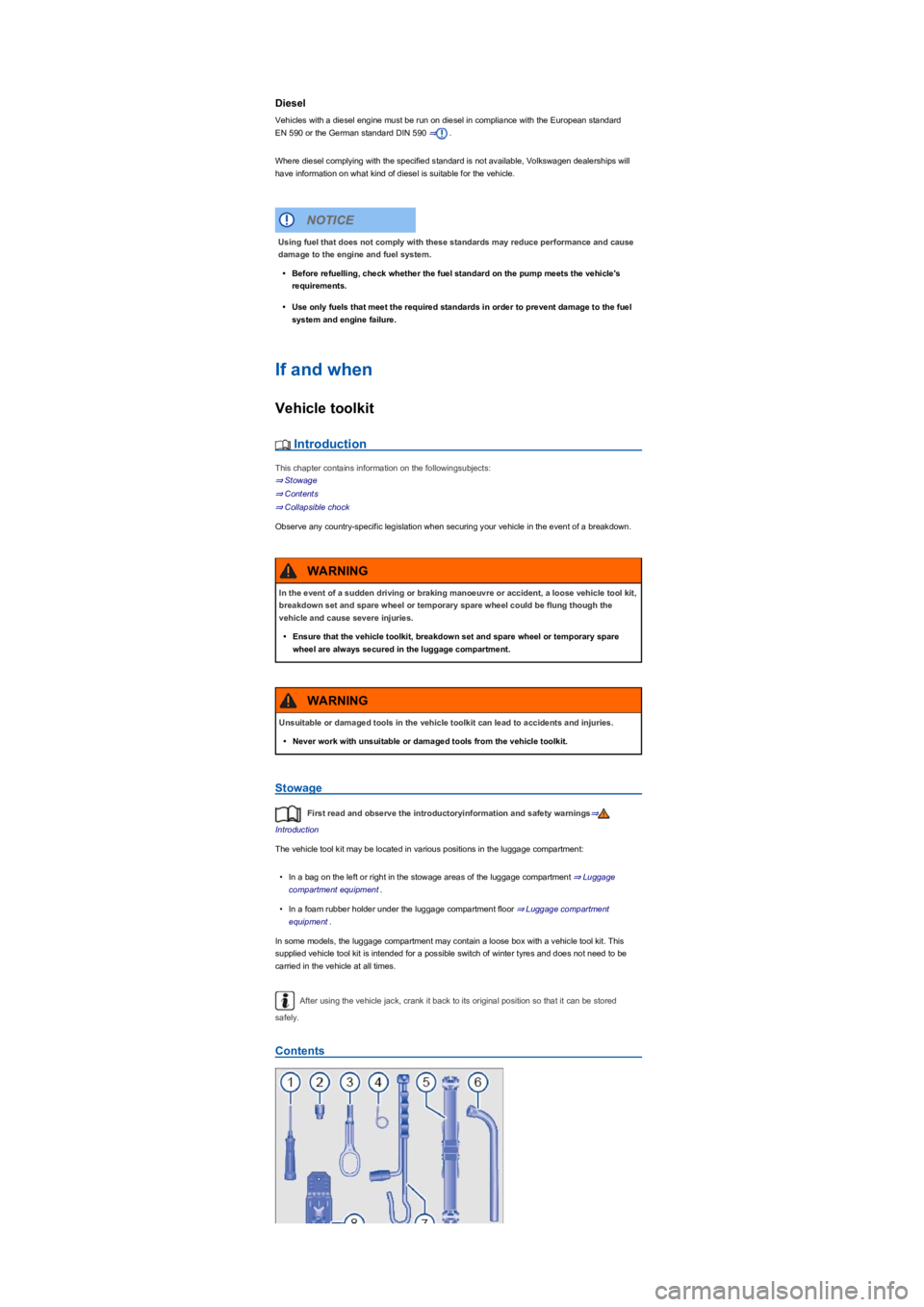
Contents
Using fuel that does not comply with these standards may reduce performance and cause
damage to the engine and fuel system.
•Before refuelling, check whether the fuel standard on the pump meets the vehicle's
requirements.
•Use only fuels that meet the required standards in order to prevent damage to the fuel
system and engine failure.
NOTICE
In the event of a sudden driving or braking manoeuvre or accident, a loose vehicle tool kit,
breakdown set and spare wheel or temporary spare wheel could be flung though the
vehicle and cause severe injuries.
•Ensure that the vehicle toolkit, breakdown set and spare wheel or temporary spare
wheel are always secured in the luggage compartment.
WARNING
Unsuitable or damaged tools in the vehicle toolkit can lead to accidents and injuries.
•Never work with unsuitable or damaged tools from the vehicle toolkit.
WARNING
Dispose of used or out-of-date sealant in accordance with legal requirements.
You can get a new tyre filler bottle from a Volkswagen dealership.
Observe the separate instructions from the manufacturer of the breakdown set.
Contents of the breakdown set
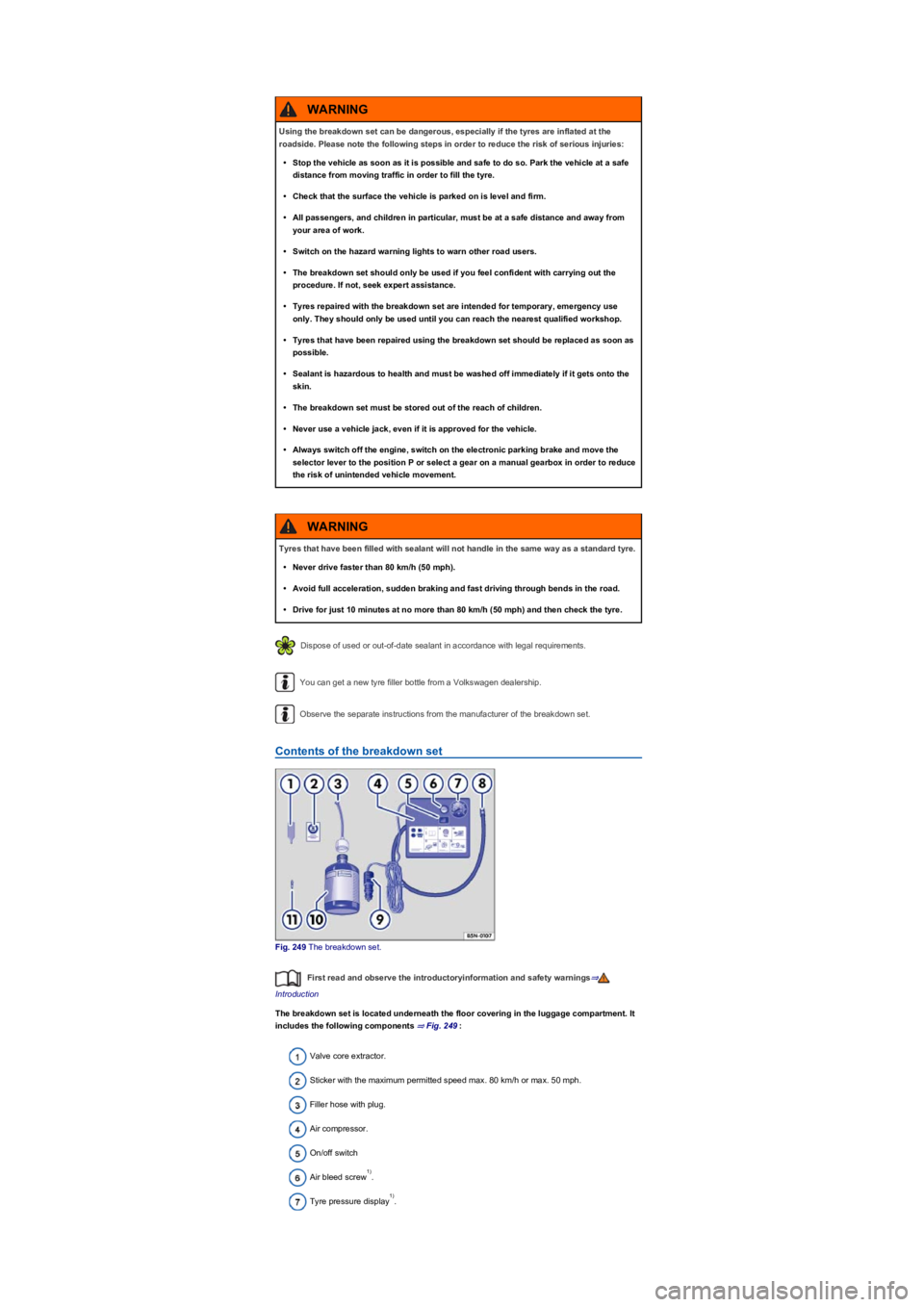
Fig. 249 The breakdown set.
First read and observe the introductoryinformation and safety warnings⇒
Introduction
The breakdown set is located underneath the floor covering in the luggage compartment. It
includes the following components ⇒ Fig. 249:
Valve core extractor.
Sticker with the maximum permitted speed max. 80 km/h or max. 50 mph.
Filler hose with plug.
Air compressor.
On/off switch
Air bleed screw.
Tyre pressure display.
Using the breakdown set can be dangerous, especially if the tyres are inflated at the
roadside. Please note the following steps in order to reduce the risk of serious injuries:
•Stop the vehicle as soon as it is possible and safe to do so. Park the vehicle at a safe
distance from moving traffic in order to fill the tyre.
•Check that the surface the vehicle is parked on is level and firm.
•All passengers, and children in particular, must be at a safe distance and away from
your area of work.
•Switch on the hazard warning lights to warn other road users.
•The breakdown set should only be used if you feel confident with carrying out the
procedure. If not, seek expert assistance.
•Tyres repaired with the breakdown set are intended for temporary, emergency use
only. They should only be used until you can reach the nearest qualified workshop.
•Tyres that have been repaired using the breakdown set should be replaced as soon as
possible.
•Sealant is hazardous to health and must be washed off immediately if it gets onto the
skin.
•The breakdown set must be stored out of the reach of children.
•Never use a vehicle jack, even if it is approved for the vehicle.
•Always switch off the engine, switch on the electronic parking brake and move the
selector lever to the position P or select a gear on a manual gearbox in order to reduce
the risk of unintended vehicle movement.
WARNING
Tyres that have been filled with sealant will not handle in the same way as a standard tyre.
•Never drive faster than 80 km/h (50 mphyf.
•Avoid full acceleration, sudden braking and fast driving through bends in the road.
•Drive for just 10 minutes at no more than 80 km/h (50 mphyf�DQG�WKHQ�FKHFN�WKH�W\UH.
WARNING
1yf
1yf