Page 127 of 189

Vehicle care125Caution
When transporting the vehicle on
a train or on a recovery vehicle, the
mud flaps might be damaged.
Vehicle storage
Storage for a long period of time
If the vehicle is to be stored for several months:
● Wash and wax the vehicle.
● Have the wax in the engine compartment and underbody
checked.
● Clean and preserve the rubber seals.
● Fill up fuel tank completely.
● Change the engine oil.
● Drain the washer fluid reservoir.
● Check the coolant antifreeze and
corrosion protection.
● Adjust tyre pressure to the value specified for full load.
● Park the vehicle in a dry, wellventilated place. Engage first or
reverse gear. Prevent the vehicle from rolling.
● Do not apply the parking brake.
● Open the bonnet, close all doors and lock the vehicle.
● Disconnect the clamp from the negative terminal of the vehicle
battery. Beware that all systems are not functional, e.g. anti-theft
alarm system.
Putting back into operation When the vehicle is to be put back into
operation:
● Connect the clamp to the negative terminal of the vehicle
battery. Activate the electronics
of the power windows.
● Check tyre pressure.
● Fill up the washer fluid reservoir.
● Check the engine oil level.
● Check the coolant level.
● Fit the number plate if necessary.End-of-life vehicle recovery
Information on end-of-life vehicle
recovery centres and the recycling of
end-of-life vehicles is available on our
website. Only entrust this work to an
authorised recycling centre.
Gas vehicles must be recycled by a
service centre authorised for gas
vehicles.
Page 128 of 189
126Vehicle careVehicle checks
Performing work9 Warning
Only perform engine compartment
checks when the ignition is off.
The cooling fan may start
operating even if the ignition is off.
9 Danger
The ignition system uses
extremely high voltage. Do not
touch.
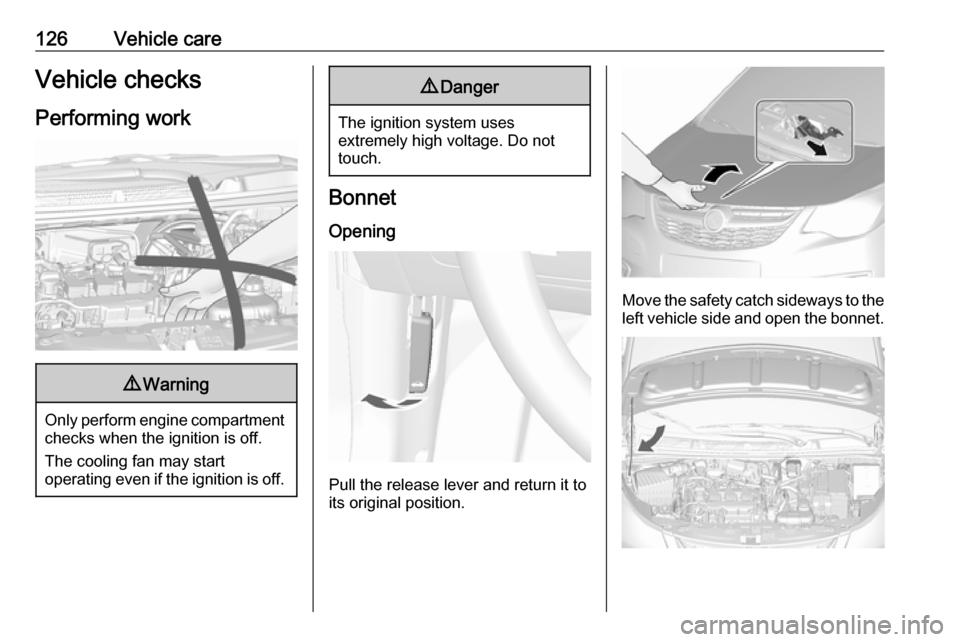
Bonnet
Opening
Pull the release lever and return it to
its original position.
Move the safety catch sideways to the left vehicle side and open the bonnet.
Page 129 of 189

Vehicle care1279Warning
When the engine is hot, touch the
bonnet support rod at the foam
padding only.
Lift the bonnet, remove the bonnet
support rod from the holder and
secure the bonnet support rod
properly.
If the bonnet is opened during an
Autostop, the engine will be restarted automatically for safety reasons.
Closing
Before closing the bonnet, make sure that all caps are closed properly, then
press the support into the holder.
Lower the bonnet and allow it to fall
into the latch from a low height
(20-25 cm). Check that the bonnet is
engaged.
Caution
Do not press the bonnet into the
latch, to avoid dents.
Engine oil
Check the engine oil level manually
on a regular basis to prevent damage
to the engine.
Ensure that the correct specification
of oil is used.
Recommended fluids and lubricants
3 163.
The maximum engine oil
consumption is 0.6 l per 600 miles.
Check with the vehicle on a level
surface. The engine must be at
operating temperature and switched
off for at least 5 minutes.Caution
It is the owner's responsibility to
maintain the proper level of an
appropriate quality oil in the
engine.
Pull out the dipstick, wipe it clean,
reinsert it fully, pull out and read the
engine oil level.
When the engine oil level has
dropped to the MIN mark, top up
engine oil.
Page 162 of 189

160Vehicle careIf using a car wash, comply with the
car wash manufacturer's instructions. The windscreen wiper and rear
window wiper must be switched off.
Remove antenna and external
accessories such as roof racks etc.
If you wash your vehicle by hand,
make sure that the insides of the
wheel housings are also thoroughly
rinsed out.
Clean edges and folds on opened
doors and the bonnet as well as the
areas they cover.
Clean bright metal mouldings with a
cleaning solution approved for
aluminium to avoid damages.Caution
Always use a cleaning agent with
a pH value of four to nine.
Do not use cleaning agents on hot surfaces.
Have the door hinges of all doors
greased by a workshop.
Do not clean the engine compartment with a steam-jet or high-pressure jet
cleaner.
Thoroughly rinse and leather-off the vehicle. Rinse leather frequently. Use
separate leathers for painted and
glass surfaces: remnants of wax on
the windows will impair vision.
Exterior lights
Headlight and other light covers are
made of plastic. Do not use any
abrasive or caustic agents, do not use
an ice scraper, and do not clean them
dry.
Polishing and waxing
Wax painted parts of the vehicle
regularly (at the latest when water no longer beads). Otherwise, the
paintwork will dry out.
Polishing is necessary only if the paint
has become dull or if solid deposits
have become attached to it.
Paintwork polish with silicone forms a
protective film, making waxing
unnecessary.
Unpainted plastic body parts must not be treated with wax or polishing
agents.Windows and windscreen wiper
blades
Switch off wipers before handling in
their areas.
Use a soft lint-free cloth or chamois
leather together with window cleaner
and insect remover.
When cleaning the rear window from
inside, always wipe in parallel to the
heating element to prevent damage.
For mechanical removal of ice, use a
sharp-edged ice scraper. Press the
scraper firmly against the glass so
that no dirt can get under it and
scratch the glass.
Clean smearing wiper blades with a
soft cloth and window cleaner.
SunroofNever clean with solvents or abrasive
agents, fuels, aggressive media (e.g.
paint cleaner, acetone-containing
solutions etc.), acidic or highly
alkaline media or abrasive pads. Do
not apply wax or polishing agents to
the sunroof.
Page 184 of 189

182IndexAAccessories and vehicle modifications .......................... 124
Adjustable air vents ...................100
Airbag and belt tensioners ...........68
Airbag deactivation ................43, 68
Airbag label................................... 38 Airbag system .............................. 38
Air conditioning regular operation ................................ 101
Air conditioning system ................ 95
Air intake .................................... 101
Air vents...................................... 100
Antilock brake system ................ 110
Antilock brake system (ABS) .......70
Anti-theft alarm system ................25
Appearance care ........................159
Ashtrays ....................................... 62
Autostop ..................................... 105
B Battery discharge protection ........93
Battery voltage ............................. 81
Belts.............................................. 36
Bonnet ....................................... 126
Bonnet open ................................. 72
Brake and clutch fluid .................163
Brake and clutch system .............69
Brake assist ............................... 111
Brake fluid .................................. 129Brakes ............................... 110, 129
Breakdown.................................. 158
Bulb replacement ....................... 132
C Catalytic converter .....................108
Central locking system ................20
Centre console storage ...............51
Centre high-mounted brake light 136
Changing tyre and wheel size ...148
Charging system .......................... 69
Child locks ................................... 22
Child restraint installation locations ................................... 47
Child restraints.............................. 44
Child restraint systems ................44
Cigarette lighter ........................... 62
City mode ................................... 113
Climate control ............................. 15
Climate control systems ...............94
Clock ............................................ 60
Code ............................................. 79
Control indicators.......................... 65
Control of the vehicle .................102
Controls ........................................ 58
Coolant and antifreeze ...............163
Cornering lights ............................ 89
Cruise control ...................... 72, 115
Cupholders .................................. 50
Curtain airbag system .................. 43