Page 527 of 700
5277-3. Do-it-yourself maintenance
7
Maintenance and care
YARIS_F_OM_Europe_OM52K19E
WARNING
■When replacing wheels
● Do not use wheels that are a different size from those recommended in the
Owner’s Manual, as this may result in a loss of handling control.
● Never use an inner tube in a leaking wheel which is designed for a tube-
less tire. Doing so may result in an accident, causing death or serious
injury.
■ When installing the wheel nuts
● Never use oil or grease on the wheel bolts or wheel nuts.
Oil and grease may cause the wheel nuts to be excessively tightened,
leading to bolt or disc wheel damage. In addition, the oil or grease can
cause the wheel nuts to loosen and the wheel may fall off, causing an acci-
dent and resulting in death or serious injury. Remove any oil or grease
from the wheel bolts or wheel nuts.
■ Use of defective wheels prohibited
Do not use cracked or deformed wheels.
Doing so could cause the tire to leak air during driving, possibly causing an
accident.
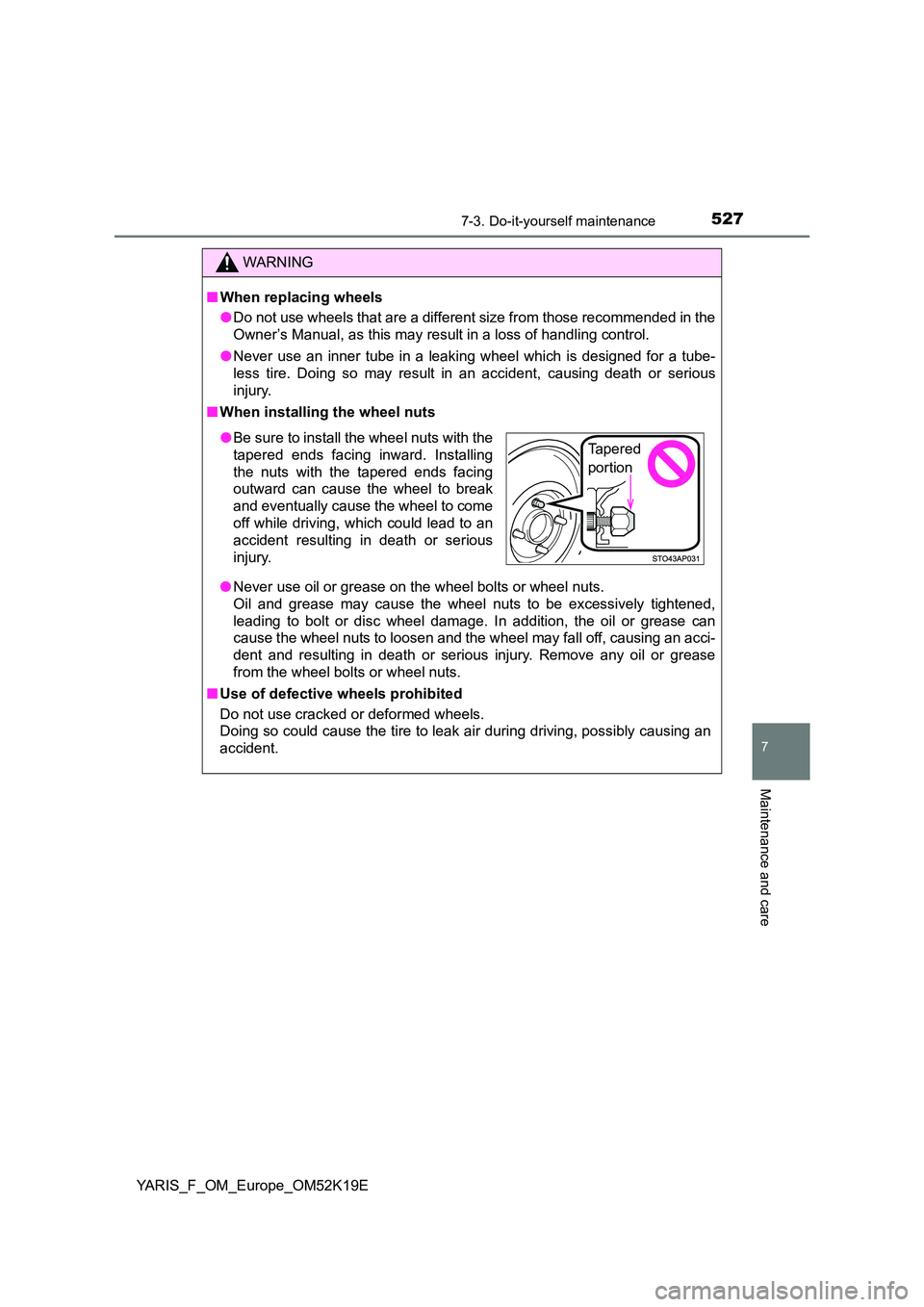
● Be sure to install the wheel nuts with the
tapered ends facing inward. Installing
the nuts with the tapered ends facing
outward can cause the wheel to break
and eventually cause the wheel to come
off while driving, which could lead to an
accident resulting in death or serious
injury.
Tapered
portion
Page 528 of 700
5287-3. Do-it-yourself maintenance
YARIS_F_OM_Europe_OM52K19E
NOTICE
■Replacing tire pressure warning valves and transmitters (vehicles with
a tire pressure warning system)
● Because tire repair or replacement may affect the tire pressure warning
valves and transmitters, make sure to have tires serviced by any autho-
rized Toyota retailer or Toyota authorized repairer, or any reliable repairer
or other qualified service shop. In addition, make sure to purchase your
tire pressure warning valves and transmitters at any authorized Toyota
retailer or Toyota authorized repairer, or any reliable repairer.
● Ensure that only genuine Toyota wheels are used on your vehicle.
Tire pressure warning valves and transmitters may not work properly with
non-genuine wheels.
Page 534 of 700
5347-3. Do-it-yourself maintenance
YARIS_F_OM_Europe_OM52K19E
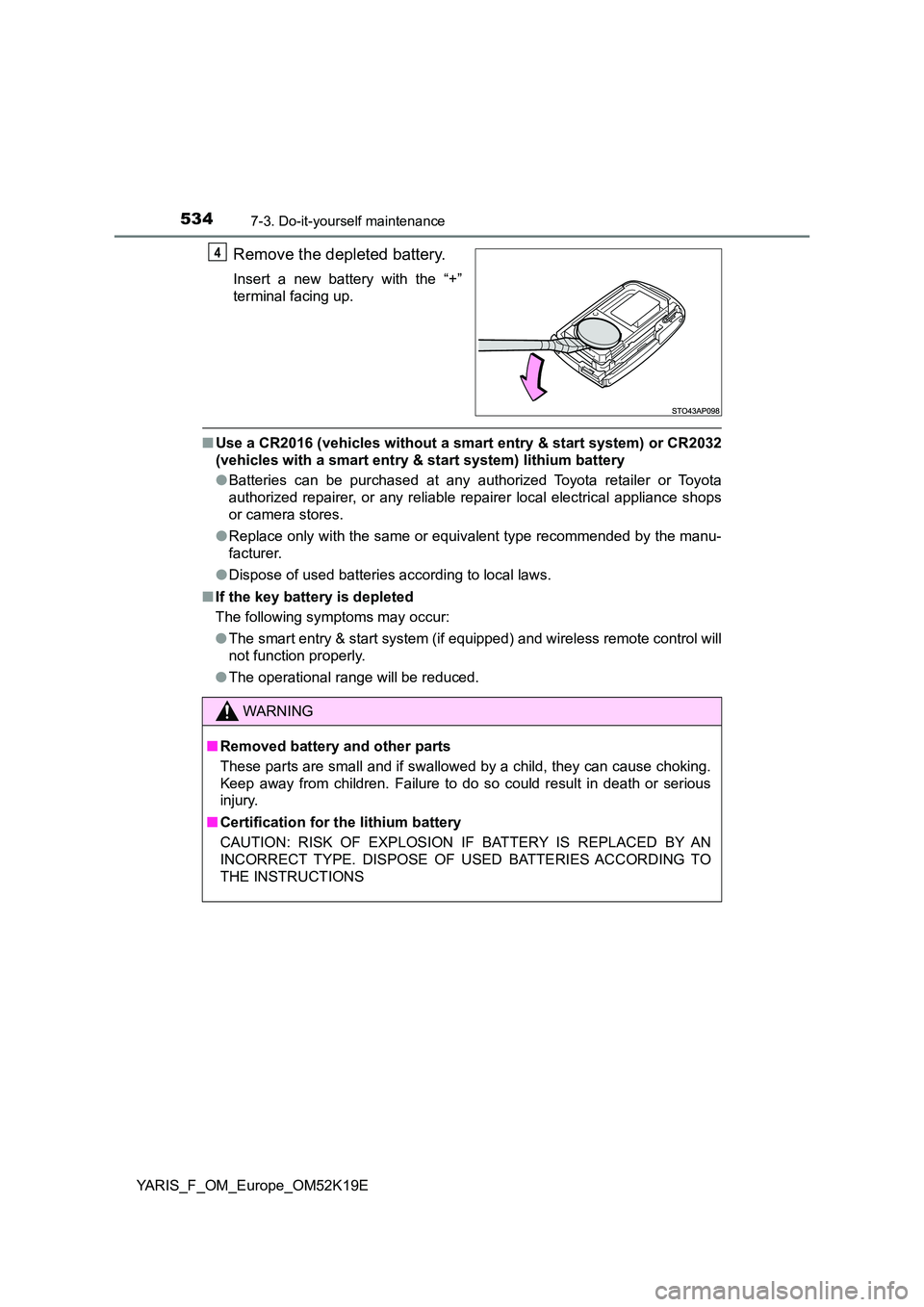
Remove the depleted battery.
Insert a new battery with the “+”
terminal facing up.
■ Use a CR2016 (vehicles without a smart entry & start system) or CR2032
(vehicles with a smart entry & start system) lithium battery
● Batteries can be purchased at any authorized Toyota retailer or Toyota
authorized repairer, or any reliable repairer local electrical appliance shops
or camera stores.
● Replace only with the same or equivalent type recommended by the manu-
facturer.
● Dispose of used batteries according to local laws.
■ If the key battery is depleted
The following symptoms may occur:
● The smart entry & start system (if equipped) and wireless remote control will
not function properly.
● The operational range will be reduced.
4
WARNING
■Removed battery and other parts
These parts are small and if swallowed by a child, they can cause choking.
Keep away from children. Failure to do so could result in death or serious
injury.
■ Certification for the lithium battery
CAUTION: RISK OF EXPLOSION IF BATTERY IS REPLACED BY AN
INCORRECT TYPE. DISPOSE OF USED BATTERIES ACCORDING TO
THE INSTRUCTIONS
Page 541 of 700
5417-3. Do-it-yourself maintenance
7
Maintenance and care
YARIS_F_OM_Europe_OM52K19E
■ When reinstalling the cover (type C fuse box)
Left-hand drive vehicles
Right-hand drive vehicles
Reinstall the cover, and then hook the
rubber strip’s groove onto the cover.
Reinstall the cover, and then hook the
rubber strip’s groove onto the cover.
WARNING
■ To prevent system breakdowns and vehicle fire
Observe the following precautions.
Failure to do so may cause damage to the vehicle, and possibly a fire or
injury.
● Never use a fuse of a higher amperage rating than that indicated, or use
any other object in place of a fuse.
● Always use a genuine Toyota fuse or equivalent.
Never replace a fuse with a wire, even as a temporary fix.
● Do not modify the fuses or fuse boxes.
NOTICE
■Before replacing fuses
Have the cause of electrical overload determined and repaired by any
authorized Toyota retailer or Toyota authorized repairer, or any reliable
repairer as soon as possible.
Page 561 of 700
5617-3. Do-it-yourself maintenance
7
Maintenance and care
YARIS_F_OM_Europe_OM52K19E
WARNING
■Replacing light bulbs
● Turn off the lights. Do not attempt to replace the bulb immediately after
turning off the lights.
The bulbs become very hot and may cause burns.
● Do not touch the glass portion of the light bulb with bare hands. When it is
unavoidable to hold the glass portion, use and hold with a clean dry cloth
to avoid getting moisture and oils on the bulb.
Also, if the bulb is scratched or dropped, it may blow out or crack.
● Fully install light bulbs and any parts used to secure them. Failure to do so
may result in heat damage, fire, or water entering the headlight unit. This
may damage the headlights or cause condensation to build up on the lens.
■ To prevent damage or fire
● Make sure bulbs are fully seated and locked.
● Check the wattage of the bulb before installing to prevent heat damage.
Page 563 of 700
563
8When trouble arises
YARIS_F_OM_Europe_OM52K19E
8-1. Essential information
Emergency flashers ........... 564
If your vehicle has to
be stopped in
an emergency .................. 565
8-2. Steps to take in
an emergency
If your vehicle needs to
be towed .......................... 567
If you think something is
wrong ............................... 574
Fuel pump shut off system
(gasoline engine only) ..... 575
If a warning light turns on
or a warning buzzer
sounds ............................. 576
If a warning message is
displayed (vehicles with
color display) ................... 587
If you have a flat tire
(vehicles with
an emergency tire
puncture repair kit)........... 592
If you have a flat tire
(vehicles with
a spare tire) ..................... 610
If the engine will not start ... 625
If the electronic key does
not operate properly
(vehicles with a smart
entry & start system)........ 627
If the vehicle battery is
discharged ....................... 630
If your vehicle overheats .... 636
If you run out of fuel and
the engine stalls
(diesel engine only) ......... 641
If the vehicle becomes
stuck ................................ 643
Page 566 of 700
5668-1. Essential information
YARIS_F_OM_Europe_OM52K19E
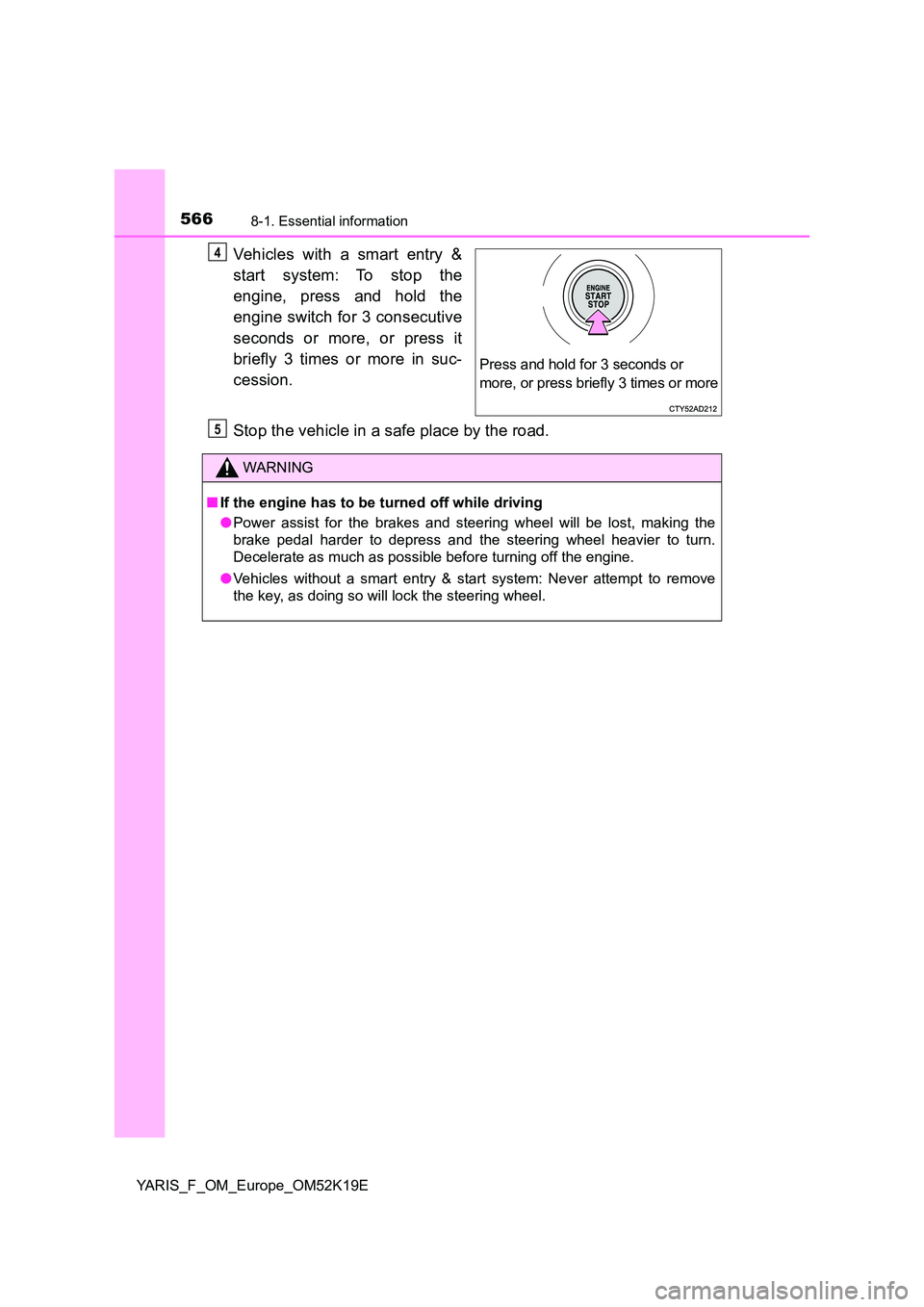
Vehicles with a smart entry &
start system: To stop the
engine, press and hold the
engine switch for 3 consecutive
seconds or more, or press it
briefly 3 times or more in suc-
cession.
Stop the vehicle in a safe place by the road.
Press and hold for 3 seconds or
more, or press briefly 3 times or more
4
WARNING
■ If the engine has to be turned off while driving
● Power assist for the brakes and steering wheel will be lost, making the
brake pedal harder to depress and the steering wheel heavier to turn.
Decelerate as much as possible before turning off the engine.
● Vehicles without a smart entry & start system: Never attempt to remove
the key, as doing so will lock the steering wheel.
5
Page 572 of 700
5728-2. Steps to take in an emergency
YARIS_F_OM_Europe_OM52K19E
WARNING
Observe the following precautions.
Failure to do so may result in death or serious injury.
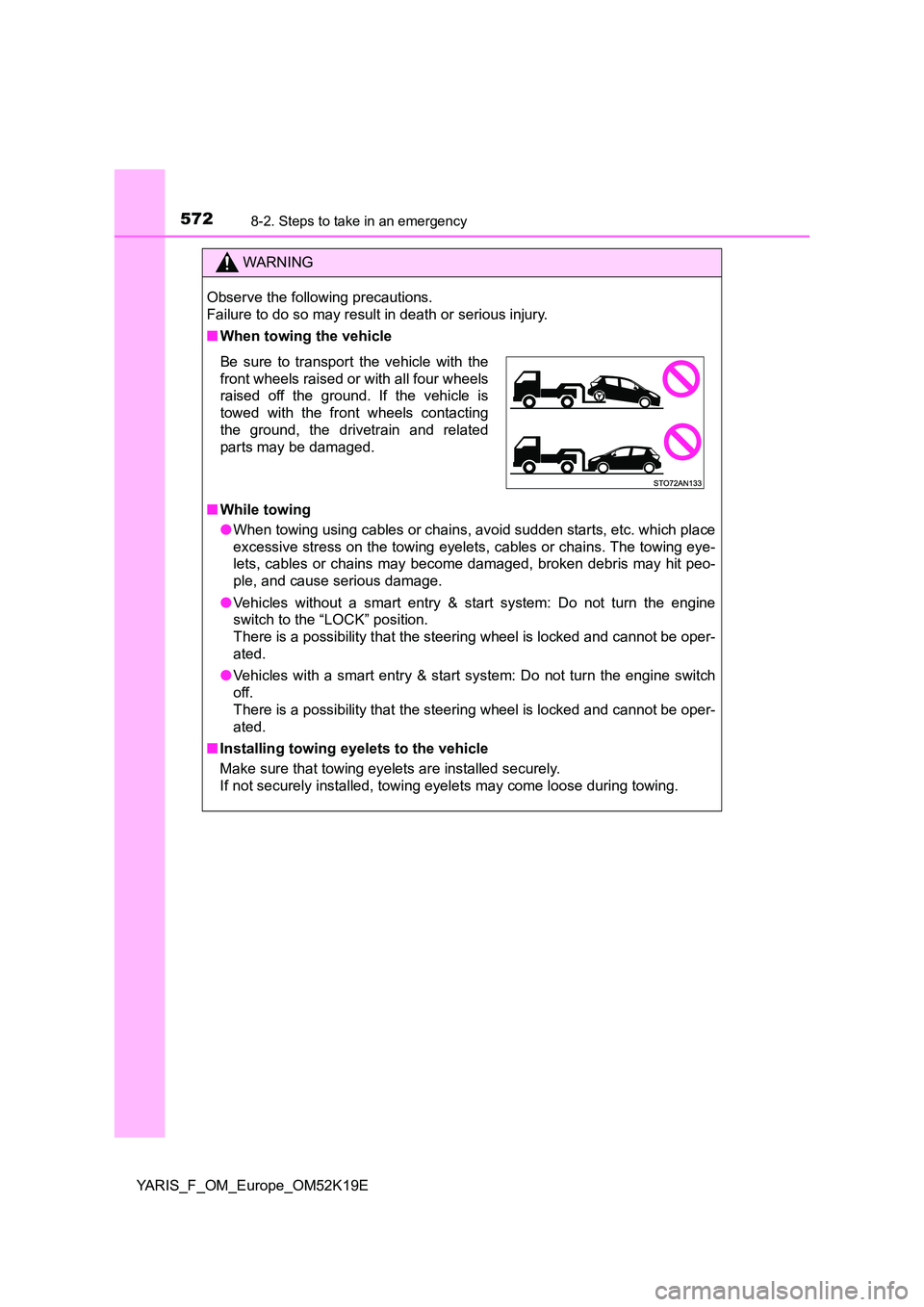
■ When towing the vehicle
■ While towing
● When towing using cables or chains, avoid sudden starts, etc. which place
excessive stress on the towing eyelets, cables or chains. The towing eye-
lets, cables or chains may become damaged, broken debris may hit peo-
ple, and cause serious damage.
● Vehicles without a smart entry & start system: Do not turn the engine
switch to the “LOCK” position.
There is a possibility that the steering wheel is locked and cannot be oper-
ated.
● Vehicles with a smart entry & start system: Do not turn the engine switch
off.
There is a possibility that the steering wheel is locked and cannot be oper-
ated.
■ Installing towing eyelets to the vehicle
Make sure that towing eyelets are installed securely.
If not securely installed, towing eyelets may come loose during towing.
Be sure to transport the vehicle with the
front wheels raised or with all four wheels
raised off the ground. If the vehicle is
towed with the front wheels contacting
the ground, the drivetrain and related
parts may be damaged.